Intercom vs Ada vs Talkdesk: Enterprise CX AI Comparison
Intercom vs Ada vs Talkdesk: Which Enterprise CX Platform Fits Your Team?
Enterprise customer experience teams face a crowded field in 2026. Three platforms come up repeatedly in shortlists: Intercom, Ada, and Talkdesk. Each takes a different route to the same goal — resolving more customer issues with less manual effort.
This comparison looks at what each platform does well, where it fits, and which criteria actually separate them. The goal is a shortlist you can defend, not a feature dump.
What each platform is built to do
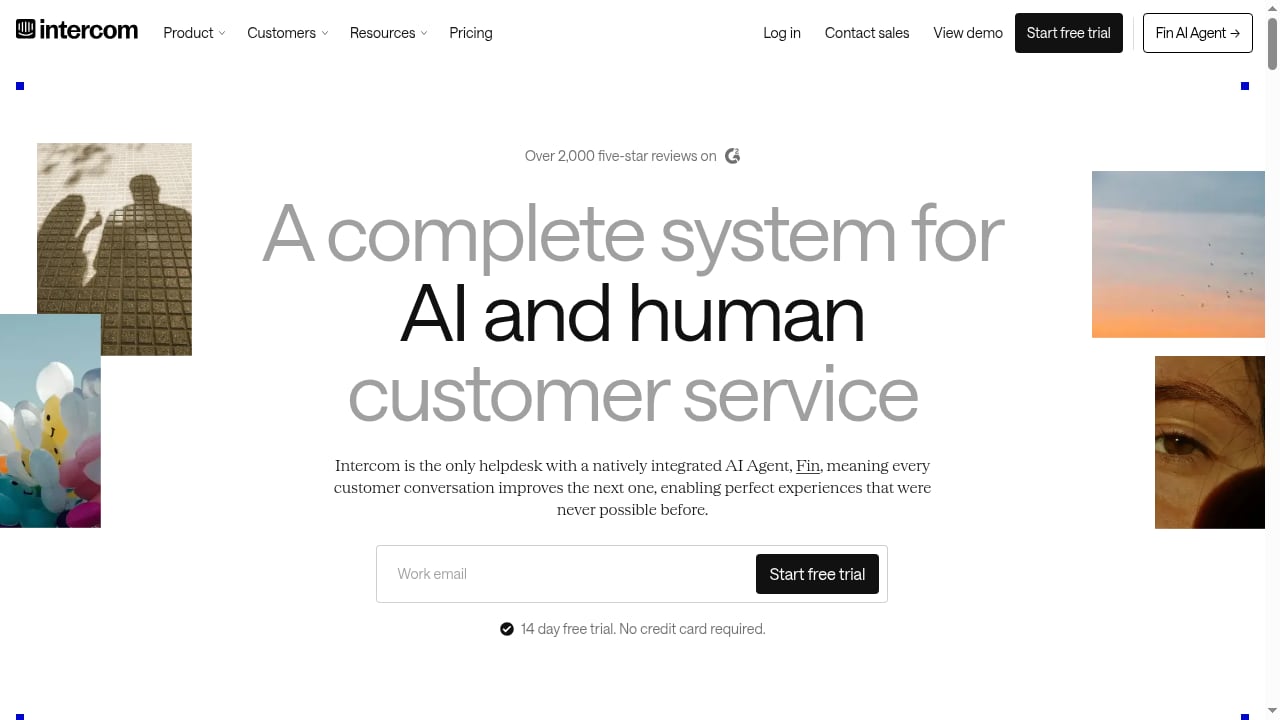
First viewport screenshot of Intercom | A complete system for human and AI customer service.
Intercom is an AI-first customer service platform that pairs a helpdesk with a natively integrated AI Agent called Fin. It is positioned as a complete system for human and AI customer service, with Fin handling conversations across chat, email, phone, WhatsApp, SMS, and social channels. Intercom reports that Fin resolves an average of 76% of customer queries end to end, and the platform is trusted by more than 30,000 brands.
Ada is an AI customer service platform focused on autonomous resolution. Its stated goal is to resolve over 80% of support inquiries without human intervention, and it targets enterprise CX teams that want to deflect high volumes of routine contacts. Ada's strength is in high-volume, structured query handling across messaging and voice channels.
Talkdesk is a contact center software platform built around Customer Experience Automation. It combines AI and real-time data to automate customer journeys, and it offers industry-specific "Experience Clouds" for sectors like healthcare, financial services, and retail. Talkdesk is a full CCaaS (Contact Center as a Service) platform, meaning it owns the telephony, IVR, routing, and workforce management layers.
Where Ada stands out
Ada's core pitch is autonomous resolution at scale. For enterprises with a large volume of repetitive inquiries — order status, account questions, policy lookups — Ada is designed to handle those without routing to a human. Its platform supports messaging, social, and voice channels, and it is often shortlisted by teams whose primary metric is containment rate.
Ada is a reasonable fit when:
- Your support volume is dominated by structured, repeatable questions.
- You want a standalone AI resolution layer that can sit alongside existing systems.
- Your team is comfortable configuring and tuning an AI agent without a tightly coupled helpdesk.
One consideration: Ada is primarily an AI resolution platform, not a full helpdesk. Teams that need ticketing, agent workflows, and AI in one system may need to pair it with another tool.
Where Talkdesk stands out
First viewport screenshot of AI Customer Experience Automation Solutions | Contact Center Software | Talkdesk.
Talkdesk's differentiator is its contact center depth. Because it is a full CCaaS platform, it handles telephony, IVR, routing, recording, and workforce management natively. For large contact centers with complex voice operations, that matters — you are not stitching together a phone system and an AI layer.
Talkdesk also packages its platform into industry-specific clouds. A healthcare organization gets prebuilt workflows for its sector; a retail team gets commerce-oriented automation. That industry packaging can shorten implementation time compared to building workflows from scratch.
Talkdesk is a strong fit when:
- You are replacing or upgrading a full contact center platform, not just adding AI.
- Voice is a primary channel and you need native telephony and routing.
- Your industry has specific compliance or workflow requirements that prebuilt clouds address.
Pricing for Talkdesk is typically quoted per user per month, with enterprise contracts and negotiated rates. Reported list prices for CCaaS platforms in this tier commonly range from roughly $85 to $225 per user per month, though actual quotes vary significantly.
Where Intercom has a supported advantage
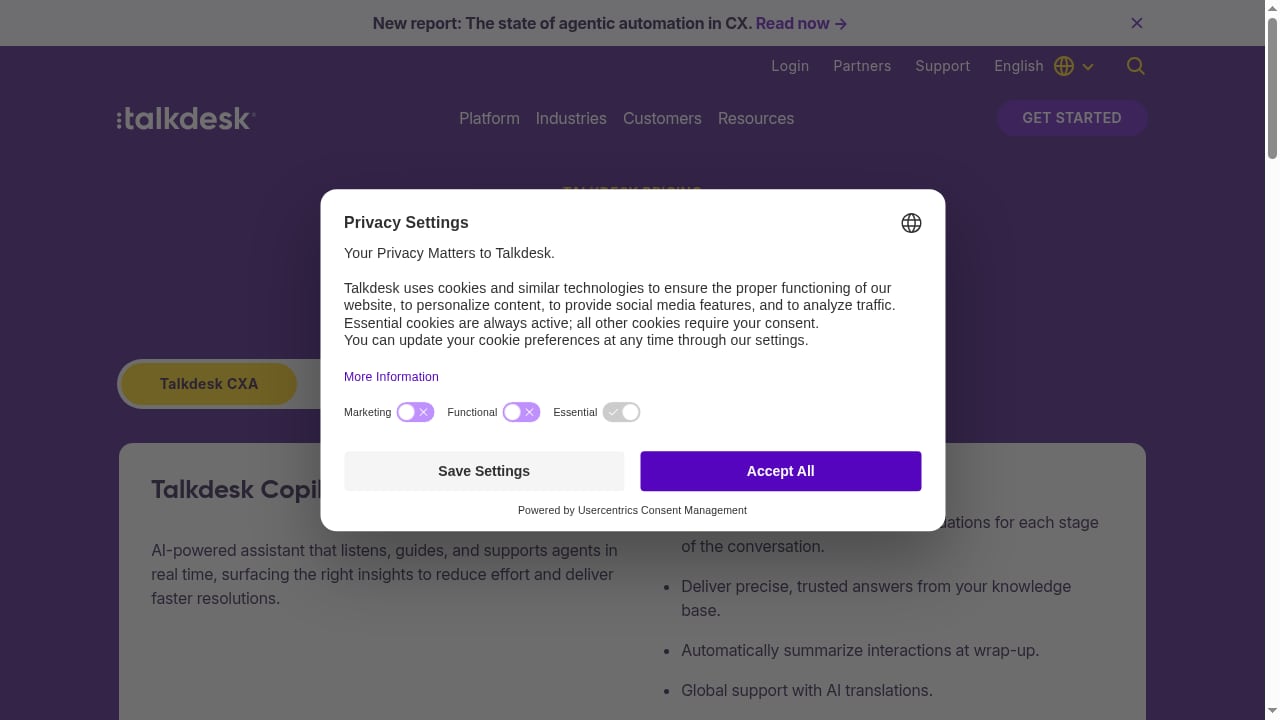
First viewport screenshot of Customer Experience Automation (CXA) Pricing | Talkdesk.
Intercom's distinction is architectural: it is the only helpdesk with a natively integrated AI Agent. That means Fin and the helpdesk share the same data, workflows, and reporting layer — there is no handoff friction between an AI tool and a separate ticketing system.
This matters in practice for a few reasons:
Unified AI and human workflows. When Fin cannot resolve an issue, the conversation moves to a human agent with full context already attached. There is no separate AI platform to reconcile with the helpdesk.
Outcome-based AI pricing. Fin is priced at $0.99 per resolved outcome, which aligns cost with results rather than seat count or session volume. For teams modeling AI ROI, that is a more predictable structure than per-session fees.
Multilingual coverage. Fin supports 45+ languages with automatic detection, which is relevant for enterprises serving global customers.
Measurable results. Intercom publishes customer outcomes such as AgriWebb reducing support costs by 80% and AI21 Labs automating 82% of support. These are specific, named proof points rather than general claims.
Intercom also offers a 14-day free trial with no credit card required, which lets teams test Fin against real queries before committing.
How to choose between them
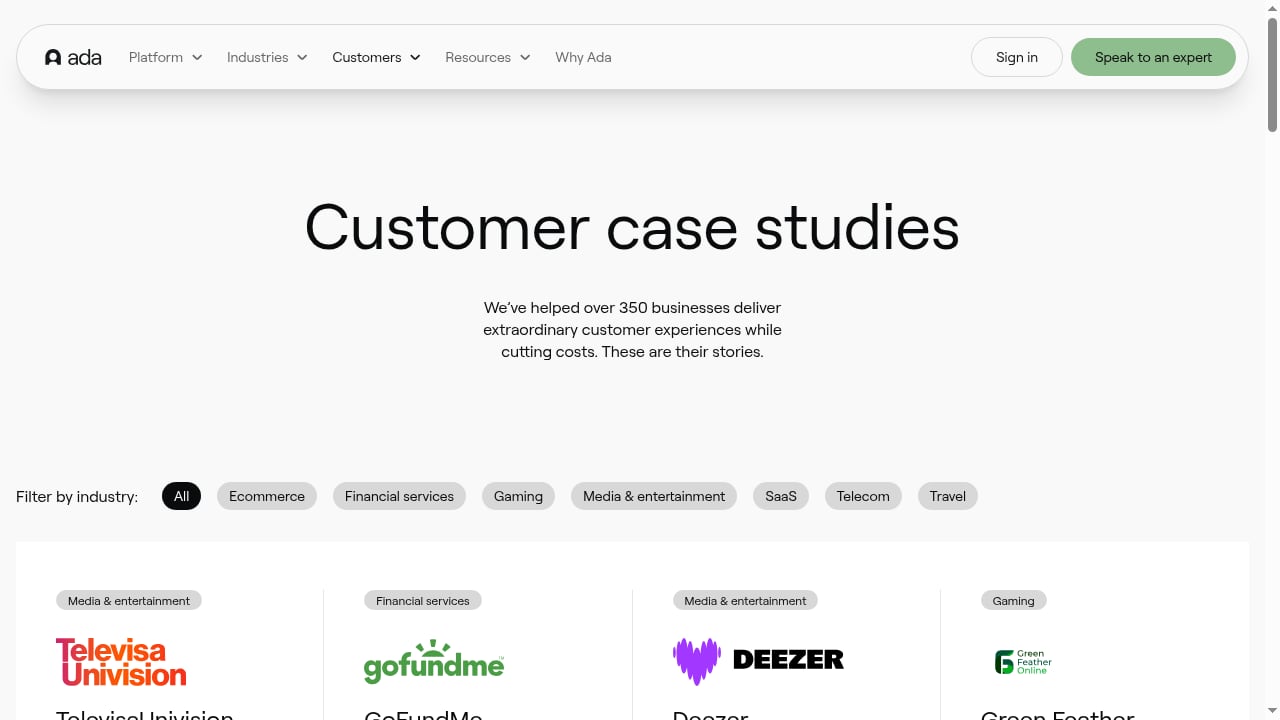
First viewport screenshot of AI Customer Service Case Studies & Results | Ada.
The right choice depends on what you are actually replacing or adding.
| If your priority is... | Consider... |
|---|---|
| A unified AI agent and helpdesk in one system | Intercom |
| Maximum autonomous resolution on structured queries | Ada |
| Full contact center replacement with native telephony | Talkdesk |
| Outcome-based AI pricing tied to resolutions | Intercom |
| Industry-specific prebuilt workflows | Talkdesk |
| A standalone AI layer alongside existing tools | Ada |
A practical approach: define your primary constraint first. If it is handoff friction between AI and human agents, a natively integrated platform addresses that directly. If it is raw containment volume, an autonomous resolution specialist may be the faster path. If it is replacing an aging contact center, a full CCaaS platform is the category you are shopping in.
For teams already evaluating Intercom against other platforms, comparisons like Intercom vs Gladly: AI Helpdesk or Agentic Commerce? and Intercom vs Genesys Cloud CX vs Front: 2026 Comparison show how the same criteria apply across different competitor types.
If you are new to Intercom and want to see how Fin is configured before comparing platforms, How to Use Intercom: Setup, Fin AI Agent & Best Practices walks through the setup process.
Practical evaluation steps
Before committing to any platform, run a structured evaluation:
- Quantify your resolution gap. What percentage of current tickets could be resolved without a human? That number sets your baseline.
- Test with real queries. Use actual customer conversations, not demo scripts. Ask each vendor to run a sample of your historical tickets.
- Model pricing at your volume. Per-resolution, per-session, and per-seat models produce very different costs at scale. Build a spreadsheet with your actual numbers.
- Check handoff quality. When the AI escalates, does the human agent get full context? Test this specifically.
- Verify channel coverage. Confirm the channels you actually use are supported natively, not via workarounds.
For broader context on how AI agents fit into support strategy, B2B Support in 2026: Strategy, AI Agents & Best Practices covers the operational side of deploying AI in a support organization.
Related reading
- Enjo Review 2026: AI Support Agent That Resolves End to End - Evidence-based Enjo review: end-to-end AI resolution, AI Actions, pricing signals, setup, limitations, and who should buy it in 2026.
Sources and further reading
- 10 Best Customer Experience Software Tools (2026) - Compare the 10 best customer experience software tools in 2026. Covers AI agents, helpdesks, VoC platforms, and analytics with pricing and use cases.
- AI Agents for customer service: 13 best platforms compared (2026) - Compare the 13 best AI agents for customer service. Explore features, pricing, benefits, and tips for choosing an AI customer service agent.
- Best AI Call Center Software in 2026: 10 Platforms Compared - Compare 10 AI call center software platforms for 2026: full CCaaS suites, AI layers, and specialist tools, with list pricing and a 30-day pilot plan.
Frequently asked questions
Is Intercom or Ada better for enterprise customer service?
It depends on your architecture. Intercom combines an AI agent and helpdesk in one system, which reduces handoff friction. Ada focuses on autonomous resolution and can work as a standalone AI layer. Teams that want one integrated system often lean toward Intercom; teams that want a dedicated resolution engine alongside existing tools may prefer Ada.
Can Talkdesk replace a full contact center?
Yes. Talkdesk is a full CCaaS platform with native telephony, IVR, routing, and workforce management. It is designed for organizations replacing or upgrading their contact center infrastructure, not just adding an AI layer.
How does Fin AI Agent pricing work?
Fin is priced at $0.99 per resolved outcome. You pay when Fin resolves a customer issue, not per seat or per session. This aligns cost with results and makes ROI modeling more straightforward.
What resolution rate should I expect from an AI agent?
Intercom reports Fin resolves an average of 76% of queries, with ecommerce brands reaching 70–84%. Ada states its platform resolves over 80% of support inquiries. Actual results depend on your query mix, knowledge base quality, and configuration.
Do these platforms support voice channels?
All three support voice in some form. Intercom offers Fin Voice, Talkdesk has native telephony as a CCaaS platform, and Ada supports voice among its channels. Voice depth varies, so test your specific call flows.
Which platform is best for multilingual support?
Intercom's Fin supports 45+ languages with automatic detection. If you serve customers across many regions, verify language coverage against your actual customer base during evaluation.
Conclusion
Intercom, Ada, and Talkdesk each solve a different version of the enterprise CX problem. Ada excels at autonomous resolution volume. Talkdesk excels at full contact center infrastructure with industry-specific packaging. Intercom's advantage is architectural integration — a natively connected AI agent and helpdesk that eliminates handoff friction and ties AI cost to resolved outcomes.
The right choice starts with your primary constraint. Identify whether you are fixing handoff friction, maximizing containment, or replacing contact center infrastructure. That answer narrows the shortlist faster than any feature comparison.
For teams ready to test the integrated approach, Intercom offers a 14-day free trial with no credit card required.