Intercom vs Chatwoot: Which Support Platform Wins in 2026?
Intercom vs Chatwoot: Which Support Platform Wins in 2026?
Choosing between Intercom and Chatwoot comes down to a fundamental trade-off: Intercom offers a polished, AI-first customer service platform with mature automation and a premium price tag, while Chatwoot delivers an open-source, privacy-focused alternative that can dramatically lower costs but demands more technical ownership. Both tools centralize customer conversations across live chat, email, and social channels. The right choice depends on your budget, team structure, and how much you value data control versus hands-off convenience.
This comparison breaks down pricing, AI capabilities, channel coverage, automation, data ownership, and ideal use cases so you can make an informed decision without the marketing spin.
Pricing: The Gap Is Bigger Than the Sticker Price
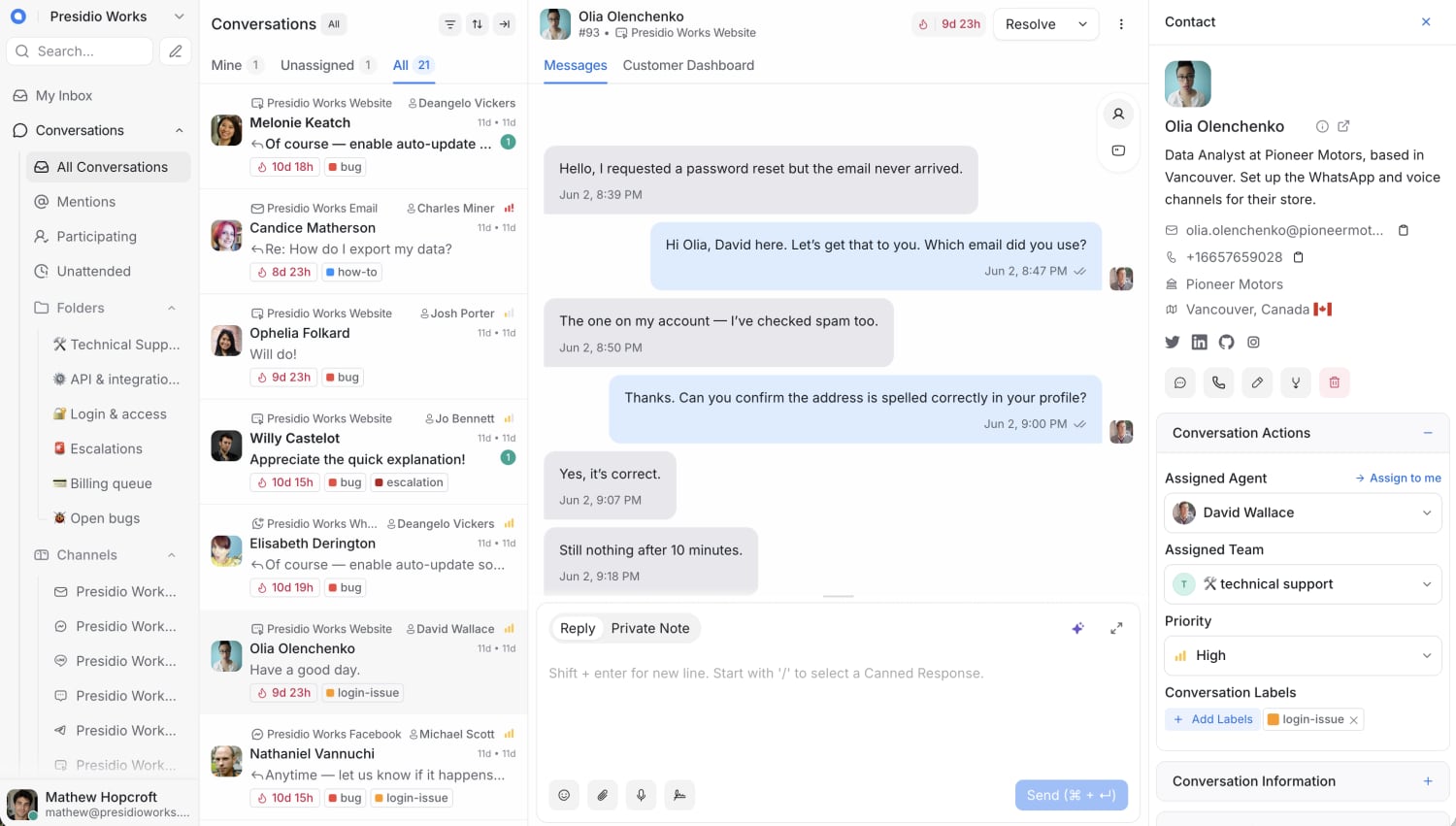
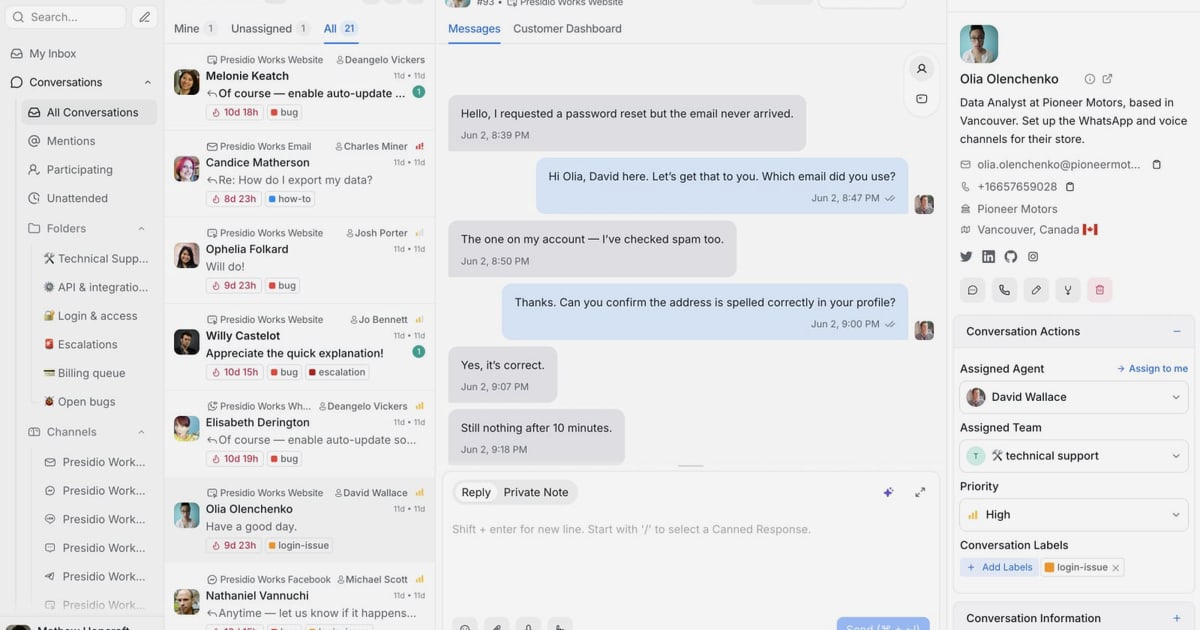
Chatwoot dashboard showing a customer conversation.
Intercom's advertised seat prices are only the starting point. The real cost of running Intercom often lands 60–80% higher once AI fees and add-ons stack up.
Intercom Pricing Structure
Intercom lists three core plans:
- Essential: $29–39 per seat per month
- Advanced: $85–99 per seat per month
- Expert: $132–139 per seat per month
Those numbers do not include several significant add-ons:
- Fin AI Agent: $0.99 per resolved conversation. A team resolving 2,000 tickets per month pays an extra $1,980 before any base seat cost.
- Fin AI Copilot: $35 per agent per month beyond a small free allowance.
- WhatsApp sessions: $0.07–$0.10 per conversation.
- SMS messages: $0.01–$0.09 per message.
A five-person team on the Advanced plan with moderate AI usage can realistically spend $800–$1,200 per month. For larger teams, the bill scales aggressively with both agent count and conversation volume.
Chatwoot Pricing Structure
Chatwoot's pricing model is fundamentally different:
- Self-hosted Community Edition: Free under the MIT license, with unlimited agents and conversations. You only pay for server infrastructure, typically $10–40 per month.
- Cloud Hacker: $0 for up to two agents and 500 conversations per month.
- Cloud Startups: $19 per agent per month, including all channels and 300 Captain AI credits.
- Cloud Business: $39 per agent per month, adding voice, teams, automation, and 500 Captain AI credits.
- Cloud Enterprise: $99 per agent per month, adding SSO/SAML, audit logs, and 800 Captain AI credits.
Channels like WhatsApp, Telegram, email, SMS, Instagram, and Facebook are included in the plan price. There are no per-session fees beyond what the underlying provider charges.
For a five-agent team, Chatwoot self-hosted costs roughly $10–40 per month total, compared to $495 or more for Intercom Advanced before AI fees. That is a 10–20x difference for the same team size.
AI Capabilities: Fin vs Captain
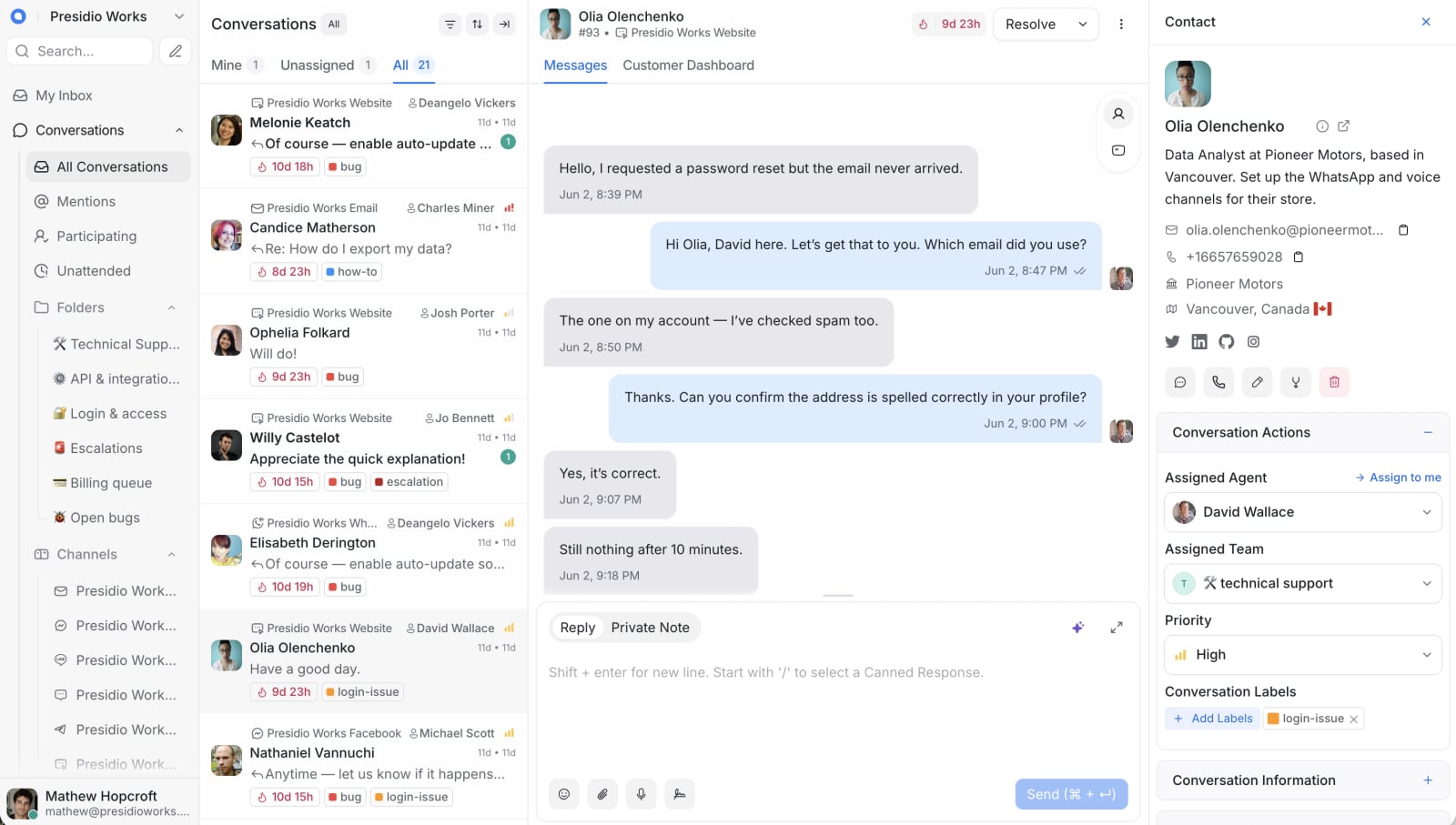
Chatwoot dashboard showing a customer conversation.
Intercom's AI is more mature and more deeply integrated. Chatwoot's AI is sufficient for many teams but less turnkey.
Intercom Fin AI Agent
Fin is Intercom's proprietary AI agent, built on GPT-4 and trained natively on your help center content. It can resolve a high percentage of tickets autonomously, and Intercom reports that Fin resolves up to 50% of customer questions instantly. The quality is genuinely strong, and the integration with Intercom's help desk is seamless.
The problem is the cost model. Because Fin charges $0.99 per resolved conversation, your best-performing AI becomes your most expensive line item. High-volume teams can see AI costs rival or exceed their base seat costs.
Chatwoot Captain
Chatwoot's built-in AI assistant, Captain, learns from your help center, chats, and FAQs to suggest answers and automate responses. Depending on your cloud plan, you receive 300–800 monthly AI credits. Self-hosted users can bring their own API key and connect any LLM provider, including OpenAI or open-source models.
Captain can suggest replies, draft canned responses, and summarize conversations. For most small and mid-sized teams, this is sufficient. What Chatwoot lacks is the same turnkey, deeply integrated AI resolution engine that Intercom ships out of the box.
Channel Coverage: Chatwoot Covers More of the Long Tail
Both platforms cover the core channels: live chat widget, email, WhatsApp, Facebook Messenger, Instagram DM, and SMS. Chatwoot adds several channels Intercom does not support:
- Telegram
- TikTok DM
- LINE
If your customers are active on Telegram or LINE, Chatwoot is the only option between the two. Intercom focuses on higher-value channels where enterprise buyers are active, and it charges usage fees for WhatsApp and SMS on top of the base plan.
Automation and Workflows: Intercom Goes Beyond Support
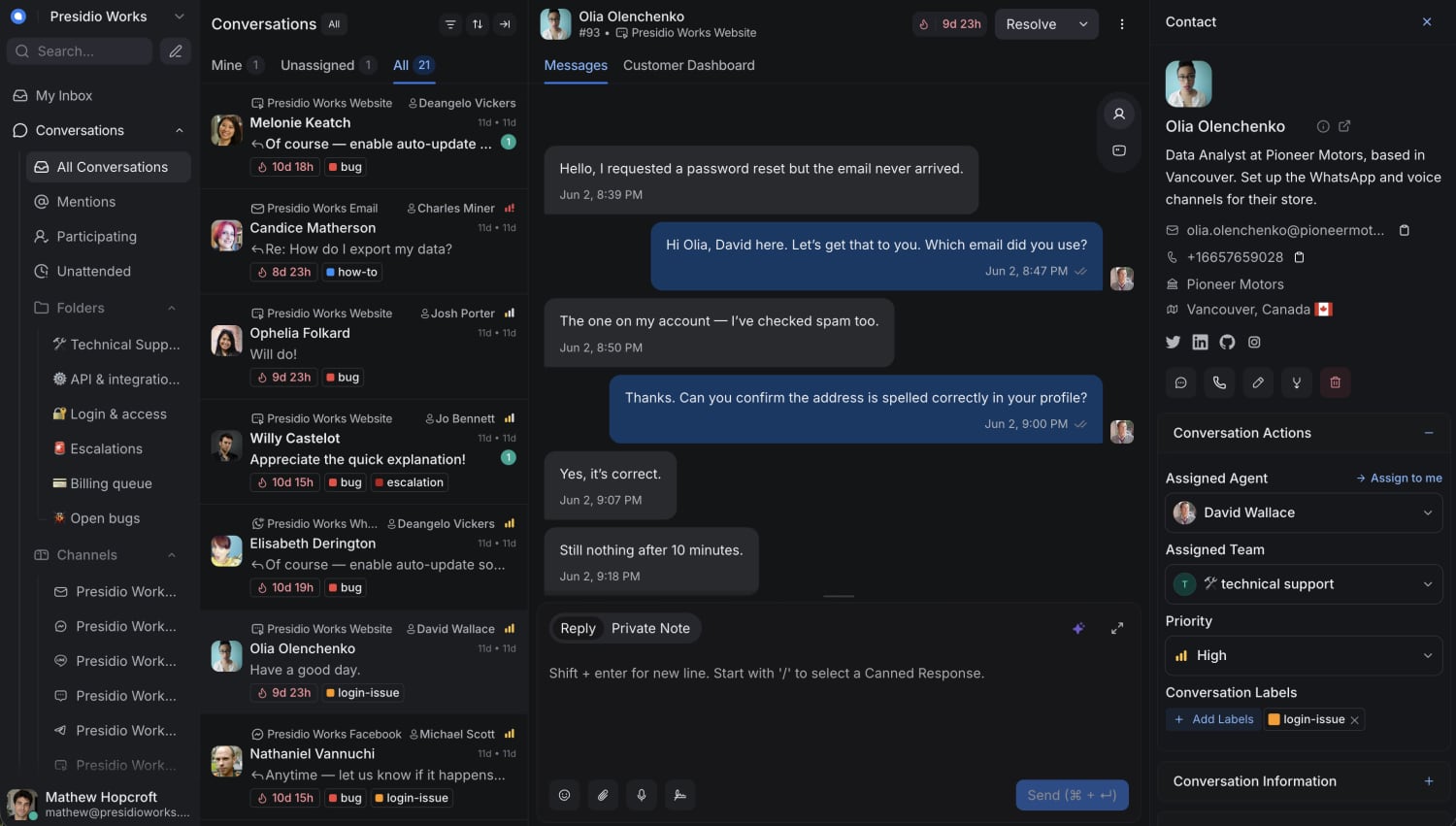
Chatwoot dashboard showing a customer conversation.
Intercom's workflow builder is more powerful. It supports drag-and-drop logic trees, conditional routing, multi-step automations, product tours, banners, and in-app messages. This makes Intercom a complete platform for proactive customer engagement, not just reactive support.
Chatwoot offers solid automation fundamentals: assignment rules, auto-replies, canned responses, conversation labels, and team routing. What it does not have is product tours, targeted campaigns, onboarding flows, or surveys. If you want those features, you would need a separate tool.
For teams whose job is to respond to inbound support requests, Chatwoot's automation is entirely sufficient. For SaaS companies that use the support tool as a marketing and onboarding channel, Intercom has more built in.
Data Ownership and Privacy: A Fundamental Difference
Chatwoot is open source under the MIT license. You can audit every line of code, run it on your own servers, and guarantee that customer conversation data never leaves your infrastructure. For GDPR-sensitive use cases, healthcare, legal, or any team handling sensitive data, this is a meaningful advantage.
Intercom is fully proprietary. All data lives on Intercom's US-based infrastructure, with HIPAA compliance available only on the Expert plan. There is no self-hosted option.
Chatwoot's cloud runs on AWS in the US. If you need EU data residency, self-hosting on EU infrastructure or using a managed provider with EU servers is the cleanest solution.
Setup and Maintenance: Managed vs Self-Managed
Intercom requires a few lines of JavaScript and configuration through a web dashboard. Setup is quick, and Intercom manages all infrastructure, uptime, and scaling automatically. This is the right choice for non-technical teams that want zero infrastructure responsibility.
Chatwoot self-hosting requires container orchestration knowledge—Docker, Kubernetes, and database tuning. Backups, security updates, SSL certificate renewals, and scaling become your responsibility. The trade-off is full control and dramatically lower costs.
Chatwoot's managed cloud option removes the DevOps burden while retaining most of the cost advantage. For teams that want the benefits of Chatwoot without managing servers, the cloud plans are a practical middle ground.
When to Choose Intercom
Intercom makes sense if:
- You are a well-funded SaaS company using support as a growth channel, with product tours, targeted messages, and onboarding flows.
- You need the most capable AI chatbot on the market and your volume is low enough that $0.99 per resolution is acceptable.
- Your team is non-technical and you want zero infrastructure responsibility.
- You need HIPAA compliance out of the box.
- You are already deep in the Intercom ecosystem with extensive workflow automations built out.
For a deeper look at how Intercom stacks up against other AI support platforms, see our Intercom vs Ada comparison and the Intercom vs Genesys Cloud CX vs Yuma AI analysis.
When to Choose Chatwoot
Chatwoot makes sense if:
- You want a predictable bill that does not spike with support volume or AI usage.
- Your customers are on channels Intercom does not support, such as Telegram, TikTok, or LINE.
- You need full data ownership or EU data residency for GDPR compliance.
- You are a developer or technical team comfortable with self-hosting.
- You want Intercom-level functionality for a team of five at the cost Intercom charges per seat.
For a broader comparison that includes OTRS alongside these two platforms, check out our Intercom vs OTRS vs Chatwoot comparison.
Migration Path from Intercom to Chatwoot
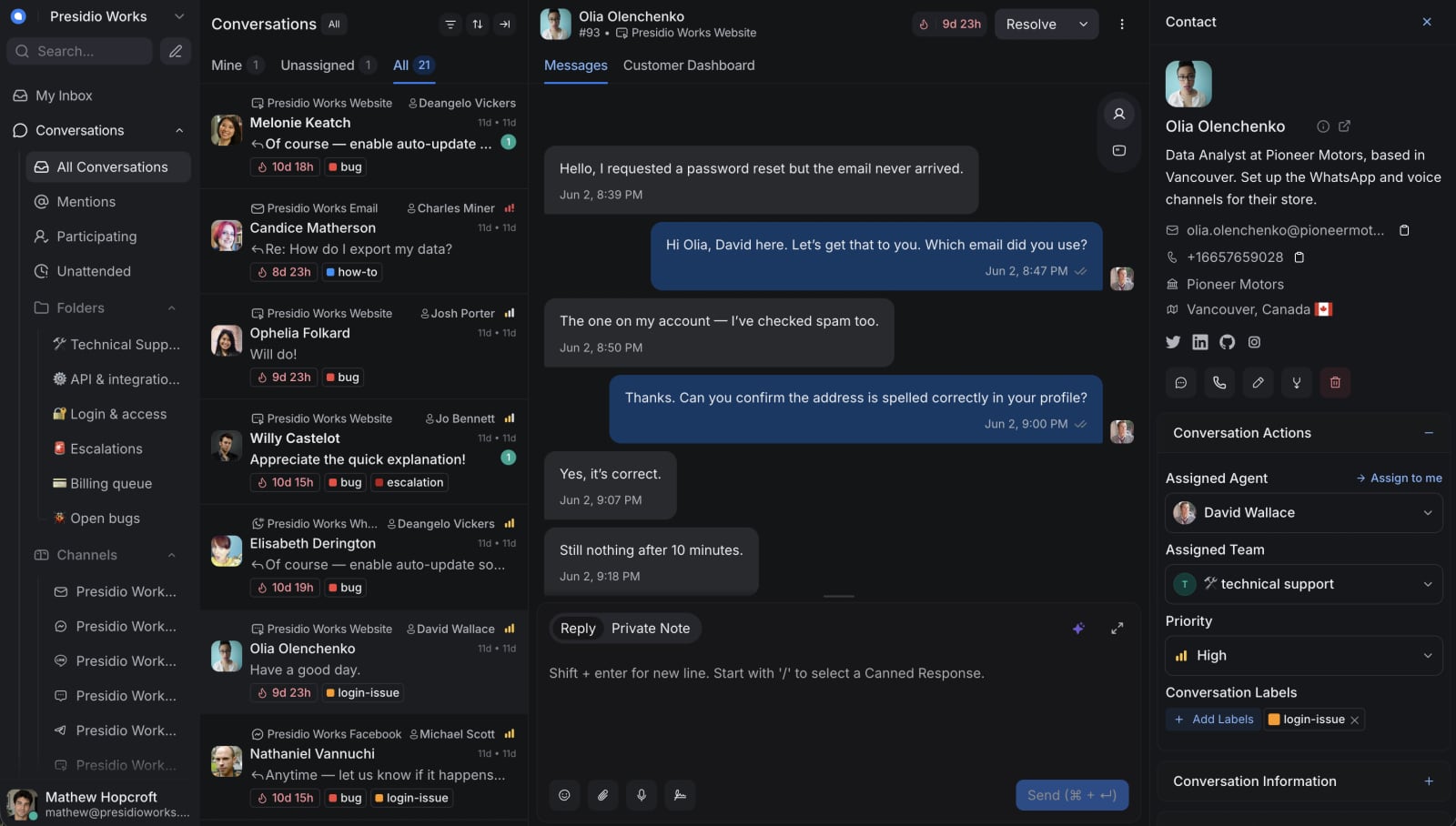
Chatwoot dashboard showing a customer conversation.
If you decide to switch, the migration process involves several steps:
- Export user data, conversation history, and contact attributes from Intercom using the REST API or automated export tools into JSON or CSV format.
- Provision and configure your self-hosted Chatwoot instance via Docker or Kubernetes, ensuring database connections and environment variables are operational.
- Use Chatwoot's administrative API or community migration scripts to map and import exported Intercom profiles and conversation threads.
- Replace the Intercom messenger widget snippet with the Chatwoot live chat SDK script.
- Verify live routing, agent availability, and channel integrations before terminating your Intercom subscription.
Migration is not a one-click process and requires basic scripting knowledge, but community scripts and documentation exist to guide the process.
Sources and further reading
- Chatwoot vs Intercom: The Honest Comparison (2026) - Intercom costs 60-80% more than advertised once AI fees and add-ons stack up. Chatwoot is open source, covers more channels, and starts at $0. Full feature and pricing comparison.
- Intercom vs Chatwoot - Is Chatwoot a good free alternative to Intercom? Detailed comparison of pricing ($39-$139+/month), features, self-hosting difficulty, and migration guide. Save money by switching to open source.
- Chatwoot vs Intercom 2026: Pricing + 5% Promo Code - Chatwoot vs Intercom: honest pricing and feature comparison. Plus the verified Chatwoot Cloud promo code — ACHIYAVS, 5% off, the real maximum.
FAQ
Can Chatwoot completely replace Intercom's live chat functionality?
Yes. Chatwoot provides a fully featured live chat widget, mobile apps, and a multi-channel shared inbox that handles real-time visitor messaging. It supports custom attributes, pre-chat forms, and file attachments out of the box.
Does Chatwoot include an AI chatbot comparable to Intercom's Fin?
Not in the same turnkey manner. Chatwoot's Captain AI can suggest replies and automate responses, and self-hosted users can connect any LLM provider via API. However, it does not offer the same drop-in proprietary AI agent trained natively on documentation as Intercom's Fin.
Is Chatwoot truly free when self-hosted?
Yes. The core application code is available under the MIT license, meaning you pay zero licensing fees. Your only costs are the underlying cloud server resources, domain names, and the labor required to maintain the deployment.
How difficult is it to migrate conversation history from Intercom to Chatwoot?
Migration requires extracting data via Intercom's API and transforming it into a format compatible with Chatwoot's database schema. Community scripts exist, but it is not a one-click automated process and requires basic scripting knowledge.
Does Chatwoot offer a managed cloud version?
Yes. Chatwoot Cloud offers hosted plans starting at $19 per agent per month, with a free tier for up to two agents. Managed hosting removes the DevOps burden while retaining most of the cost advantage over Intercom.
The Bottom Line
Intercom is a strong product with a mature AI agent, powerful marketing automation, and hands-off infrastructure. It is also expensive—unpredictably so—and built for a market segment with the budget to absorb that unpredictability.
Chatwoot is not a compromise for many teams. It handles every core channel, runs AI on top, and gives you the source code to inspect and extend. What you give up is Intercom's marketing automation layer and its most mature AI. What you get back is a predictable bill, full data ownership, and support for channels Intercom does not cover.
For privacy-conscious enterprises, technical teams, and cost-sensitive startups, Chatwoot is a compelling alternative. For well-funded SaaS companies that treat support as a growth channel and want the strongest out-of-the-box AI, Intercom remains the benchmark. The decision ultimately comes down to which trade-off your team can live with.
For more evidence-based platform reviews, see our ProProfs Help Desk review and ClickDesk review to understand how other alternatives compare.