Intercom vs Chatwoot vs ClearFeed: Which Helpdesk Wins?
Intercom vs Chatwoot vs ClearFeed: Choosing the Right Helpdesk for Your Team
Selecting a customer support platform today means navigating a landscape crowded with AI promises, open-source ideals, and channel-specific workflows. Intercom, Chatwoot, and ClearFeed represent three distinct philosophies: the AI-first powerhouse, the privacy-focused open-source challenger, and the Slack-native specialist. This comparison cuts through the marketing to help you match a tool to your actual support operations, team structure, and growth trajectory.
Intercom: The AI-First Customer Service Platform
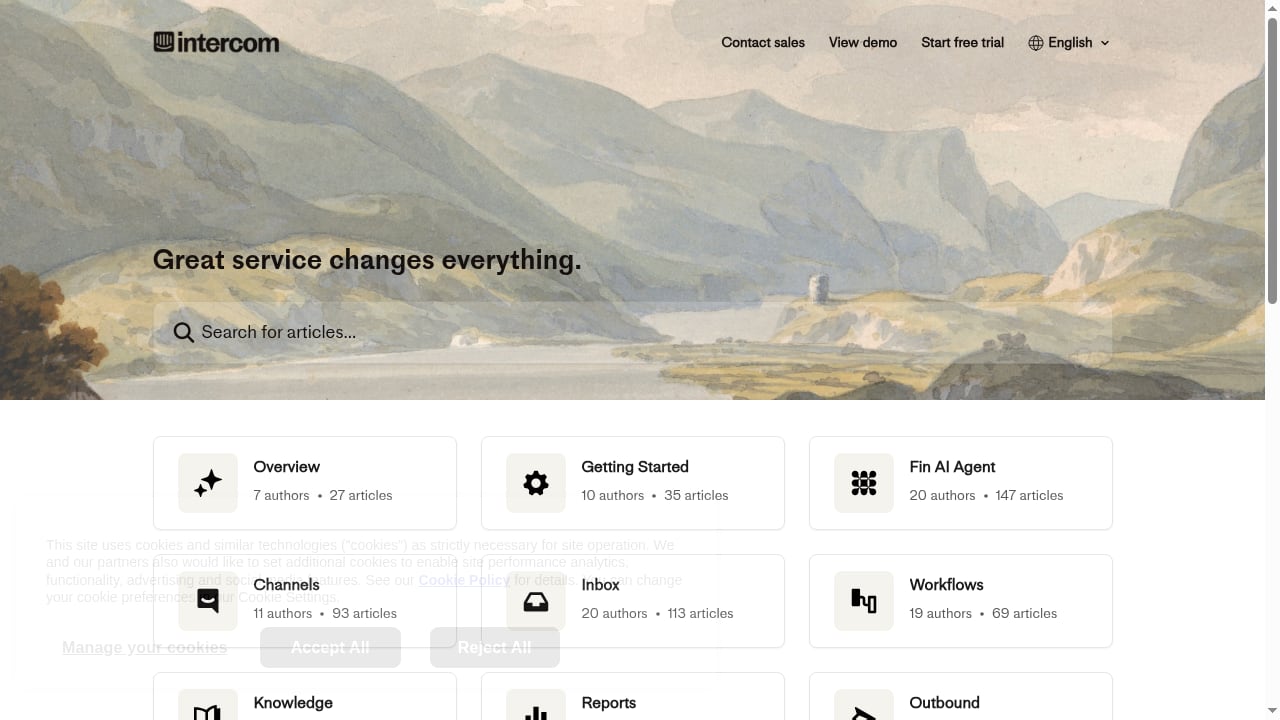
First viewport screenshot of Home | Intercom Help.
Intercom has redefined itself for the AI Agent era. At its core is Fin AI Agent, a natively integrated AI that resolves customer questions instantly by learning from your help center, support conversations, and internal knowledge. Unlike bolt-on chatbots, Fin is deeply embedded in the helpdesk, meaning it can take action—updating records, escalating issues, and providing verified answers without hallucinating.
Beyond the AI agent, Intercom offers a complete suite: a shared inbox for live chat, email, in-app messaging, and phone; Copilot, an AI assistant that drafts replies and summarizes threads for human agents; and AI Insights that automatically detect trending issues and sentiment shifts. For proactive outreach, outbound messaging tools let you trigger messages based on user behavior.
Intercom positions itself as the highest-performing platform for customer service, trusted by over 30,000 brands. Its outcome-based pricing scales from Essential to Expert plans, making it viable for small teams and enterprises alike. The platform’s strength lies in unifying automation and human support within a single, polished interface that reduces resolution times and increases deflection rates.
Chatwoot: The Open-Source Omnichannel Alternative
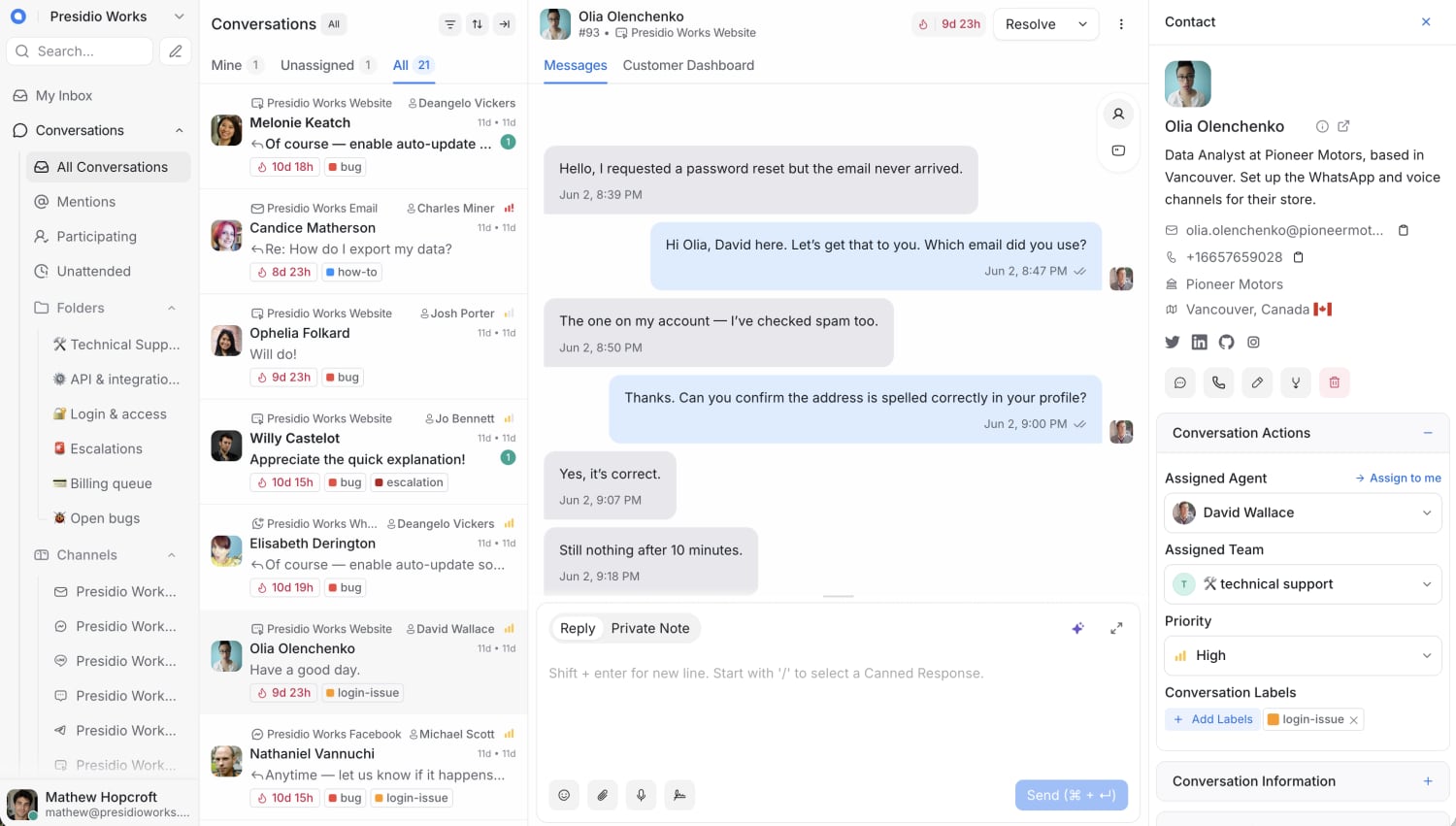
Chatwoot dashboard showing a customer conversation.
Chatwoot takes a fundamentally different approach: full data ownership through open-source architecture. Available as a cloud-hosted service or self-hosted on your own infrastructure, it gives businesses complete control over customer data—a critical requirement for organizations in regulated industries or those with strict privacy policies.
The platform consolidates live chat, email, WhatsApp, Instagram, Facebook, and voice calls into a single dashboard. Its built-in AI assistant, Captain, learns from your help center, past chats, and FAQs to suggest answers and automate responses, though it requires more configuration than Intercom’s Fin. Chatwoot supports over 15,000 businesses with features like custom branding, role-based access, SLA policies, and SSO/SAML integration.
Where Chatwoot shines is flexibility and cost control. The free self-hosted option eliminates per-agent pricing entirely—you pay only for server costs. For teams with technical expertise, this can mean supporting 200 agents for the price of infrastructure, compared to Intercom’s per-seat model. However, this comes with the responsibility of maintaining, updating, and scaling your own instance. The cloud-hosted plans offer a middle ground, providing managed infrastructure with predictable pricing.
ClearFeed: The Slack-Native Helpdesk for B2B Teams
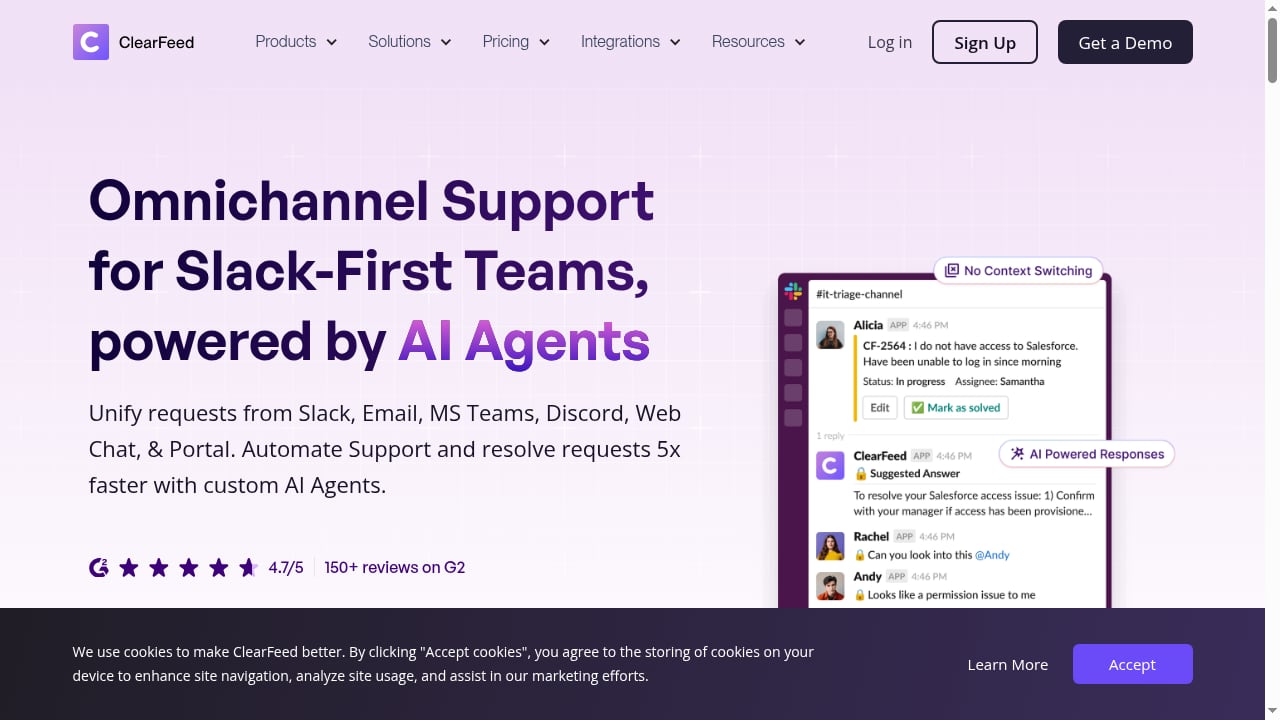
First viewport screenshot of The Next-Gen Helpdesk in Slack Powered by AI Agents.
ClearFeed solves a specific, widespread problem: B2B support that happens in shared Slack channels is chaotic and untrackable without the right tooling. Built for teams that use Slack as their primary communication hub, ClearFeed turns unstructured threads into a ticketing system with accountability, SLAs, and AI-powered automation.
The platform detects requests in conversations without requiring bot commands, triages them, and syncs bidirectionally with existing tools like Zendesk, Freshdesk, Jira, and Salesforce. Its AI agents can auto-resolve queries, suggest responses, and even update documentation through DocAssist—a feature that keeps knowledge bases current by learning from resolved conversations.
ClearFeed’s value proposition is eliminating context switching. Agents stay in Slack while managing support across email, web chat, Microsoft Teams, Discord, and Telegram—all consolidated into the Slack interface they already use. For internal IT, HR, and operations teams, it functions equally well as an internal helpdesk. The platform is particularly strong for companies supporting many customer Slack channels simultaneously, where broadcast announcements and SLA visibility prevent threads from slipping through the cracks.
Feature Comparison: Where Each Platform Excels
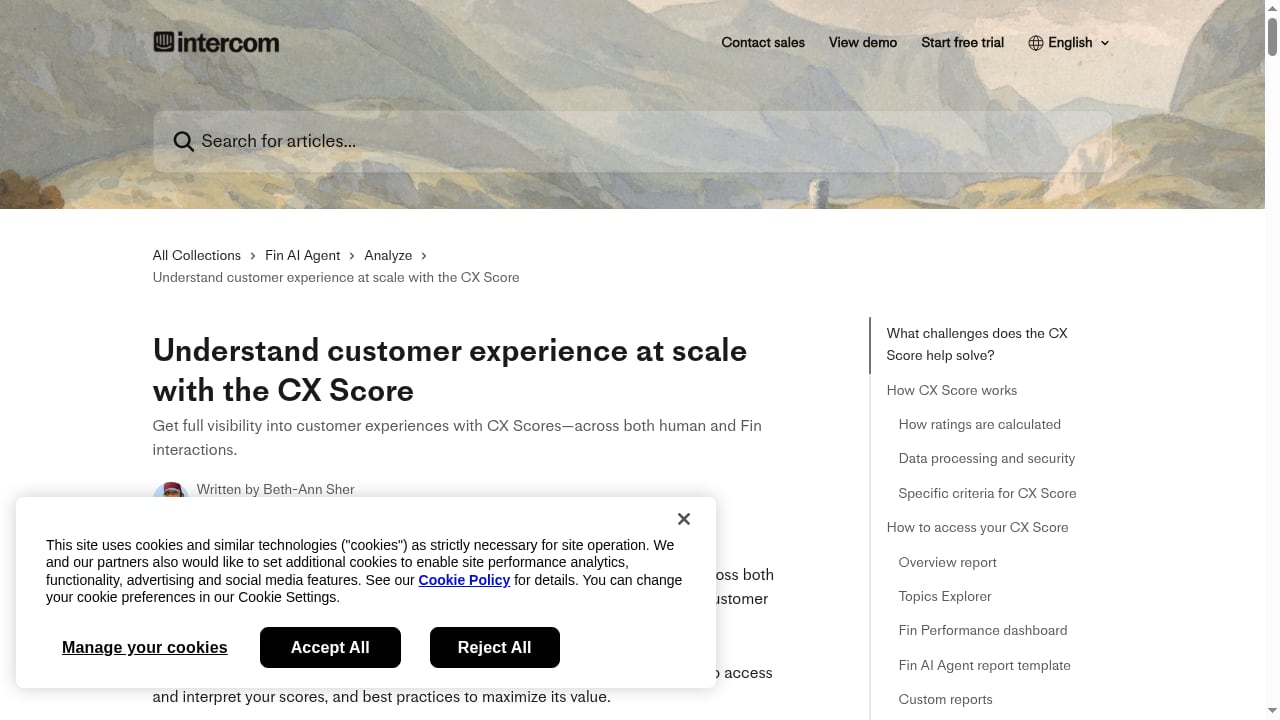
First viewport screenshot of Understand customer experience at scale with the CX Score | Intercom Help.
AI and Automation Capabilities
Intercom’s Fin AI Agent represents the most mature AI implementation, capable of resolving complex, multi-step issues without human intervention. It understands context, asks clarifying questions, and seamlessly hands off to human agents when needed. Chatwoot’s Captain provides AI-assisted responses but functions more as a copilot than a fully autonomous agent. ClearFeed’s AI focuses on request detection, auto-resolution of common queries, and documentation updates—optimized for the Slack environment rather than a standalone web chat experience.
Data Control and Deployment Flexibility
Chatwoot is the clear winner for organizations that require complete data sovereignty. Self-hosting on your own infrastructure means no third party ever touches your customer data. Intercom and ClearFeed are cloud-hosted solutions, which simplifies operations but means trusting their security and compliance measures. For healthcare, finance, or government use cases, Chatwoot’s architecture can be a deciding factor.
Channel Strategy and User Experience
Intercom excels at web and in-app messaging, providing a polished, consumer-grade experience that integrates deeply with product analytics. Chatwoot covers the broadest range of traditional channels—WhatsApp, Facebook, Instagram, and voice—making it ideal for businesses with diverse, global customer touchpoints. ClearFeed optimizes for a reality many B2B companies face: their most valuable customers communicate through Slack, and support quality in those channels directly impacts retention and expansion revenue.
Pricing and Total Cost of Ownership
Chatwoot’s free self-hosted option is unmatched for cost-conscious teams with DevOps resources. Even its cloud plans remain significantly less expensive than Intercom’s per-seat pricing at scale. Intercom’s outcome-based model ties cost to resolution volume rather than just agent count, which can be advantageous for teams with high automation rates. ClearFeed’s pricing is subscription-based with tiered plans, reflecting its specialized nature. When evaluating costs, factor in not just license fees but also setup time, ongoing maintenance, and the productivity gains from AI deflection.
When to Choose Intercom
Intercom is the right choice when your support strategy centers on AI-first resolution and you want a single platform that handles automation, human support, and proactive engagement. It fits teams that:
- Prioritize reducing support volume through intelligent deflection
- Need a polished, consumer-grade chat experience on web and mobile
- Want AI insights that automatically surface customer trends
- Value fast time-to-value over deep customization
- Can justify the investment through measurable efficiency gains
When to Choose Chatwoot
Chatwoot is ideal when data ownership and cost predictability outweigh the convenience of a fully managed platform. It suits teams that:
- Operate in regulated industries with strict data residency requirements
- Have the technical expertise to manage self-hosted infrastructure
- Need omnichannel support across WhatsApp, social media, and voice
- Want to avoid per-agent pricing as teams scale
- Prefer open-source software with community-driven development
When to Choose ClearFeed
ClearFeed is the best fit when Slack is where your customer relationships live and die. It’s designed for teams that:
- Provide B2B support through shared Slack channels with dozens or hundreds of clients
- Need SLA tracking and accountability in an inherently unstructured medium
- Want to keep agents in Slack without switching to a separate helpdesk
- Already use ticketing systems like Zendesk or Jira and need Slack integration
- Require internal helpdesk capabilities alongside external support
Making the Final Decision
Start by mapping your actual support workflows, not your aspirational ones. If 80% of customer conversations happen in Slack, ClearFeed’s specialization will deliver more value than a general-purpose platform. If your team lacks DevOps resources, Chatwoot’s self-hosted advantage becomes a liability. If your support volume is high but repetitive, Intercom’s Fin AI Agent can transform your economics.
Consider running parallel trials: test Intercom’s AI deflection rates against your current metrics, evaluate Chatwoot’s self-hosted performance with a pilot team, or measure ClearFeed’s impact on Slack response times. The right platform is the one that aligns with how your team actually works, not the one with the longest feature list.
Sources and further reading
- Chatwoot Competitors & Alternatives (2026) | Product Hunt - Explore Chatwoot alternatives like Crisp, Front, Zendesk, Featurebase, and ClearFeed for chat, email, Slack support, and roadmaps.
- Intercom vs Chatwoot - Is Chatwoot a good free alternative to Intercom? Detailed comparison of pricing ($39-$139+/month), features, self-hosting difficulty, and migration guide. Save money by switching to open source.
- Intercom | ClearFeed Help Center - This section will cover ClearFeed <> Intercom integration
Frequently Asked Questions
Can Chatwoot replace Intercom for a large enterprise?
Chatwoot can serve larger teams, but it requires significant technical investment in self-hosting infrastructure, monitoring, and scaling. Intercom’s managed infrastructure handles enterprise volumes without operational overhead. For enterprises with dedicated platform engineering teams, Chatwoot’s self-hosted model is viable; for those without, the total cost of ownership may exceed Intercom’s licensing fees.
Does ClearFeed work without an existing ticketing system?
Yes. ClearFeed provides its own native ticketing capabilities within Slack. However, its deep integrations with Zendesk, Freshdesk, and Jira mean it can also complement an existing helpdesk, acting as a Slack front-end while maintaining your established workflows.
How does Chatwoot’s AI compare to Intercom’s Fin?
Chatwoot’s Captain is an AI assistant that suggests responses and learns from your knowledge base, but it operates more as a copilot for human agents. Intercom’s Fin is a fully autonomous AI agent capable of resolving tickets end-to-end, including taking actions in external systems. Fin represents a more advanced AI implementation, while Captain is better suited for augmenting human agents.
Is ClearFeed suitable for non-Slack teams?
ClearFeed supports Microsoft Teams, Discord, and Telegram alongside Slack, but its core experience is optimized for Slack. Teams primarily using other platforms may find the experience less seamless. If Slack isn’t central to your communication, a more traditional omnichannel platform like Intercom or Chatwoot may be a better fit.
What hidden costs should I consider with self-hosting Chatwoot?
Beyond server costs, factor in engineering time for setup, security patching, backups, monitoring, and scaling. You’ll also need to manage integrations yourself and may miss out on cloud-only features. For teams without existing DevOps capacity, these costs can quickly outweigh the licensing savings.