Intercom vs CXone: AI-First Helpdesk or Contact Center?
Intercom vs CXone: AI-First Helpdesk or Contact Center Platform?
Intercom and NICE CXone both promise to improve customer experience with AI, but they were built for different jobs. Intercom is an AI-first customer service platform centered on its Fin AI Agent and a native helpdesk. CXone is an all-in-one, AI-powered customer experience platform that combines contact center as a service (CCaaS) with automation, analytics, and workforce tools for large operations.
This comparison breaks down how each platform handles AI resolution, channels, pricing, and scale so you can decide which one fits your team.
Quick comparison: Intercom vs CXone

CXone product interface.
| Dimension | Intercom | NICE CXone |
|---|---|---|
| Core positioning | AI-first customer service platform with native AI Agent (Fin) | All-in-one AI-powered CX platform combining CCaaS, AI, automation, and analytics |
| AI approach | Fin resolves conversations end to end; Copilot assists human agents | Agentic AI, AI-driven self-service, agent assist, journey orchestration |
| Strongest fit | Support teams that want AI resolution plus a modern helpdesk | Contact centers orchestrating journeys at enterprise scale |
| Pricing model | Outcome-based (per resolution) plus seats, with Essential, Advanced, and Expert plans | Usage-based, billed monthly in arrears, no prepay, tiered to lower costs as usage grows |
| Typical buyer | SMB to enterprise support and CX teams | Large contact centers in finance, healthcare, insurance, retail, telecom, government, education, and BPOs |
What Intercom is built for
Intercom is designed for the AI Agent era. Its defining feature is Fin, a natively integrated AI Agent that resolves customer conversations across chat, email, in-app messaging, and phone. Fin's average resolution rate across 12,000 customers is 76%, improving roughly 1% per month, and ecommerce brands regularly achieve 70–84% resolution.
Beyond Fin, Intercom includes:
- A shared inbox and helpdesk for human agent workflows, ticketing, and reporting in the same system as the AI Agent.
- Copilot, an AI assistant that helps human agents draft responses and find answers faster.
- AI Insights for analytics, including conversation evaluation without surveys.
- An integrated Help Center for self-service content.
- Outbound messaging for proactive support and engagement.
- Multi-channel support across live chat, email, in-app messaging, and phone.
Intercom reports that it is trusted by over 30,000 brands and serves businesses from small teams to large enterprises. It also offers a solution partner program for agencies and consultants, and a free trial.
One practical advantage: Fin can run with Intercom's helpdesk for the deepest integration, or connect to existing helpdesks such as Salesforce, HubSpot, and Freshworks, so teams can add AI resolution without migrating their entire support stack.
What CXone is built for
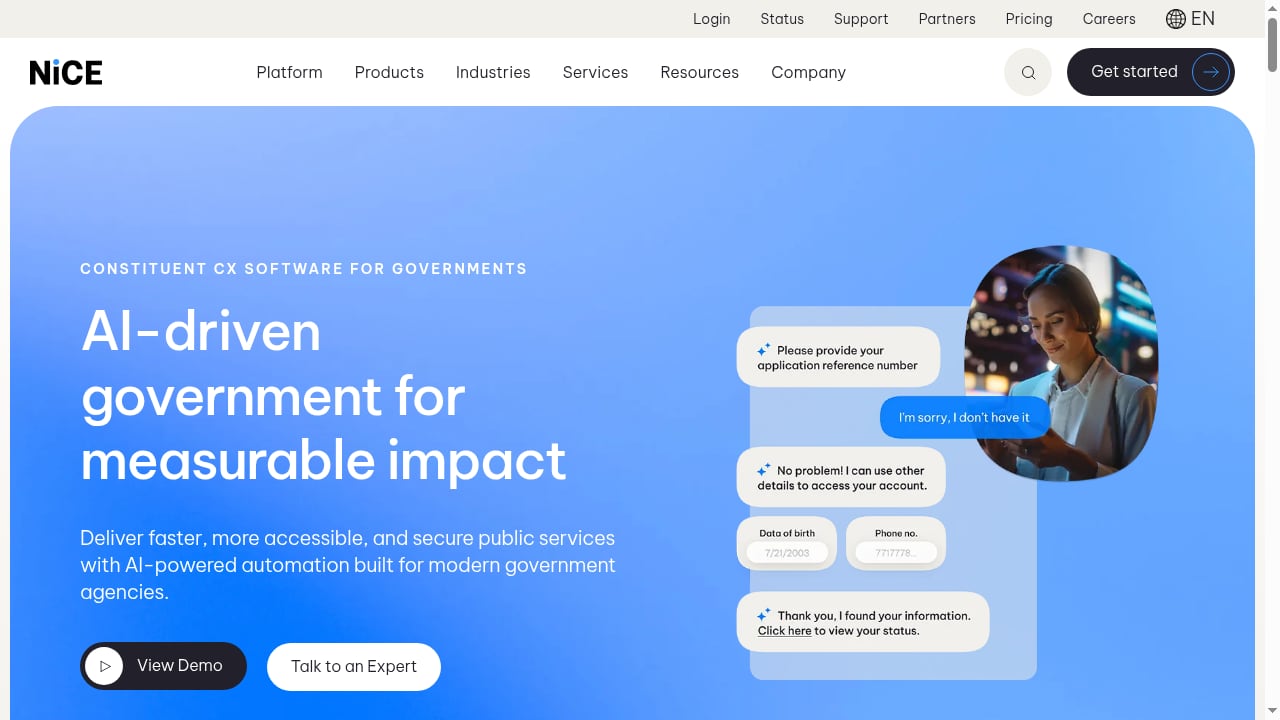
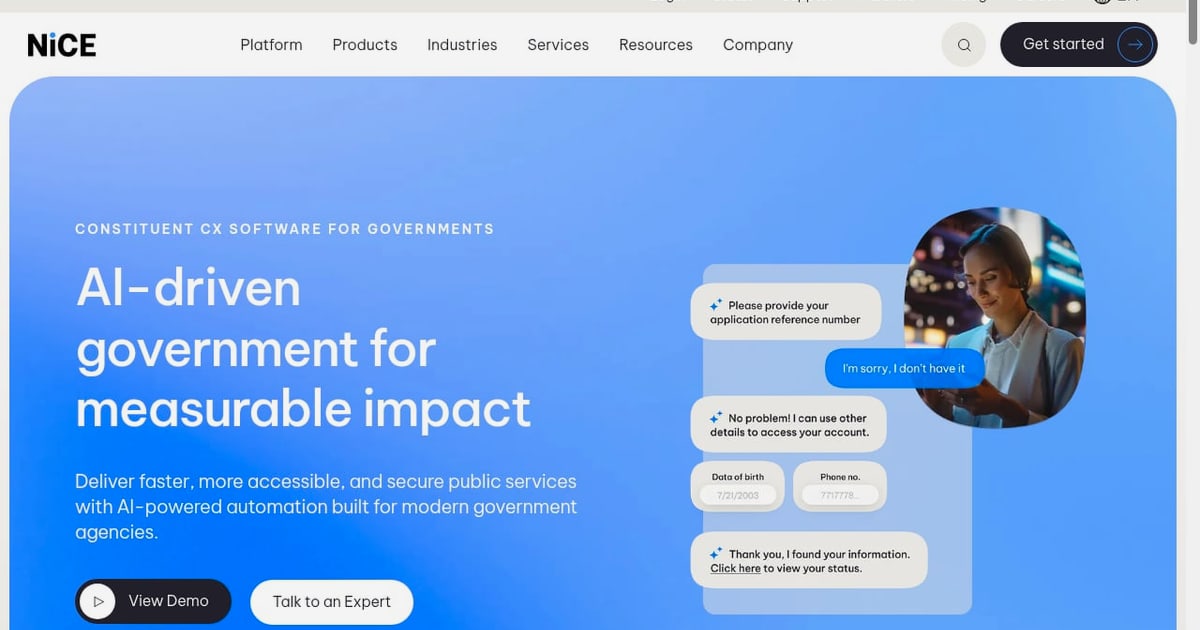
First viewport screenshot of Citizen Customer Experience Software for Government Organizations | NiCE CX Solutions.
NICE CXone is an all-in-one, AI-powered customer experience platform designed to orchestrate customer journeys at scale. It combines contact center as a service with advanced AI, automation, and analytics.
Its core capabilities include:
- Omnichannel routing across voice and digital channels.
- AI-driven self-service and agent assist.
- Workforce engagement management for scheduling, quality, and performance.
- Journey orchestration to coordinate interactions across touchpoints.
CXone positions itself as a way to move from AI experimentation to full-scale production by harmonizing agentic AI, real-time data, and human expertise. It serves industries including financial services, healthcare, insurance, retail, telecommunications, government, education, and business process outsourcers, with industry-specific packages such as student journey orchestration in higher education, patient experience in healthcare, and policyholder journey management in insurance.
CXone uses flexible, usage-based pricing with monthly billing in arrears, no prepay, and tiered models that lower costs as usage grows. Published starting prices for CXone have been cited at around $71 per agent per month, though enterprise configurations vary.
Where Intercom has the edge
AI resolution is the core product, not an add-on
Intercom's Fin is a native AI Agent with a documented average resolution rate of 76% across 12,000 customers. That outcome-based framing matters: Intercom prices Fin from $0.99 per outcome, which aligns cost with resolved conversations rather than seats alone. Teams can start with 50 outcomes per month minimum and no separate platform, setup, or integration fee when running Fin with an existing helpdesk.
Faster path to value for most support teams
Because Fin can connect to helpdesks like Salesforce, HubSpot, and Freshworks, or run natively with Intercom, teams can deploy AI resolution without a full contact-center migration. Intercom also reports that Fin is self-managed by CX teams with no engineering required, and includes simulations and testing for safe deployment.
A single system for AI and human support
Intercom combines AI resolution, human agent workflows, knowledge management, ticketing, and reporting in one platform. That reduces the integration burden that often appears when AI, helpdesk, and analytics are separate tools.
Governance and certifications
Fin carries ISO 42001, SOC 2 Type II, ISO 27001, and HIPAA certifications, and supports 45+ languages. CX Score evaluates 100% of conversations without surveys, which gives support leaders a continuous quality signal.
Where CXone has the edge

CXone product interface.
Deep contact center operations
CXone is built for contact centers that need omnichannel routing, workforce engagement management, and journey orchestration at enterprise scale. If your operation runs large voice queues with complex scheduling, quality management, and compliance requirements, CXone's CCaaS foundation is a natural fit.
Industry-specific packages
CXone offers tailored packages for higher education, healthcare, and insurance, among others. Organizations in regulated industries may find these pre-built configurations reduce implementation effort.
Usage-based pricing without prepay
CXone bills monthly in arrears with no prepay, and tiered models lower costs as usage grows. For very high-volume contact centers, that structure can be attractive compared with seat-heavy pricing.
Where CXone falls short for AI-first support
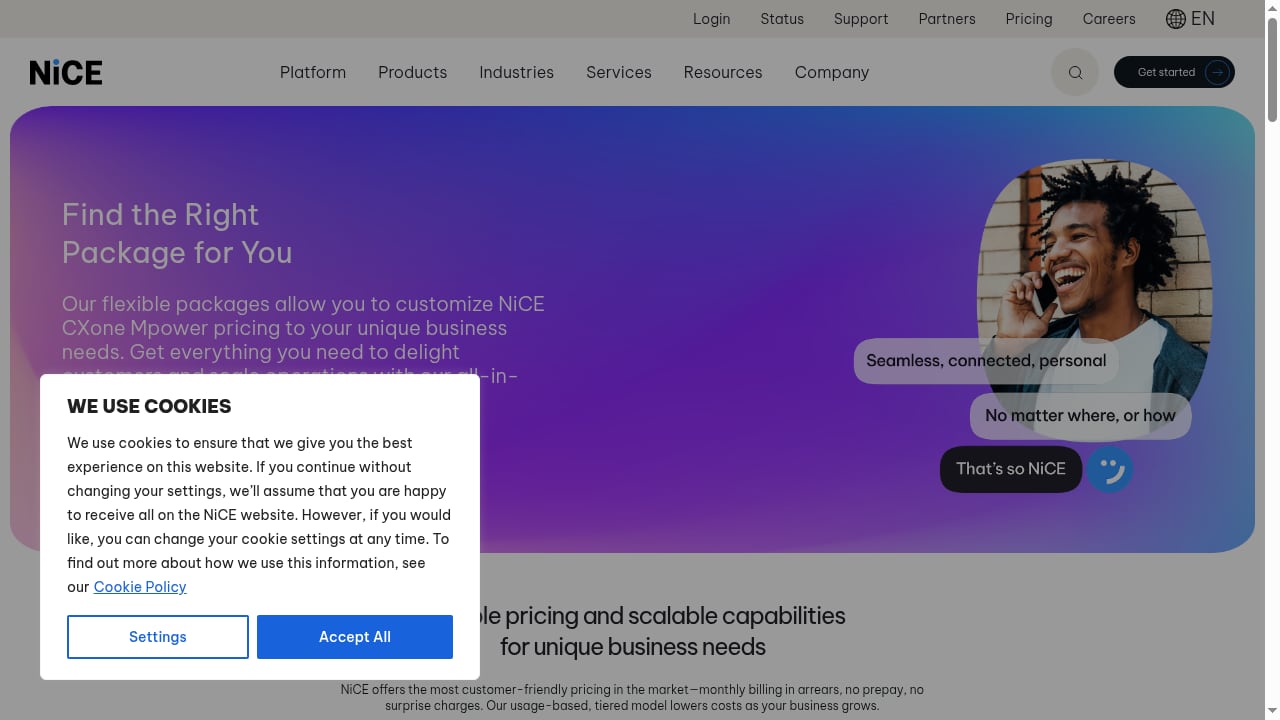
First viewport screenshot of CXone Packages and Pricing | NiCE.
CXone is a broad platform, and breadth can work against speed. For teams whose primary goal is fast, measurable AI resolution, CXone's contact-center-first architecture and enterprise implementation model may add complexity compared with Intercom's AI-first design.
Specific considerations:
- AI resolution is one capability among many. CXone's value proposition spans routing, workforce management, analytics, and journey orchestration. Teams that only need AI resolution plus a helpdesk may pay for capabilities they will not use.
- Enterprise orientation. CXone's industry packages and CCaaS foundation suit large operations. Smaller support teams may find the platform heavier than necessary.
- Pricing opacity at scale. While CXone publishes usage-based billing terms, actual costs depend on configuration and volume, which makes budgeting harder for teams that want predictable per-resolution economics.
- Analytics depth varies by need. Third-party reviews have described CXone as a good choice for basic analytics across all channels, which may not satisfy teams that want granular, AI-driven conversation insights out of the box.
Pricing comparison
| Platform | Model | Starting signal |
|---|---|---|
| Intercom | Outcome-based (per resolution) plus seats; Essential, Advanced, Expert plans | Fin from $0.99 per outcome; 50 outcomes/month minimum; Intercom Helpdesk from $19 per seat/month |
| CXone | Usage-based, monthly in arrears, no prepay, tiered | Cited from around $71 per agent/month; enterprise configurations vary |
Intercom's outcome-based pricing ties cost to resolved conversations, which can be more predictable for teams focused on AI resolution. CXone's usage-based model can scale down per-unit costs at high volume, but total cost depends on the full configuration.
Which should you choose?
Choose Intercom if:
- Your priority is AI resolution with a measurable resolution rate.
- You want a native AI Agent plus a modern helpdesk in one system.
- You need to deploy AI quickly, possibly on top of an existing helpdesk.
- You serve customers across chat, email, in-app messaging, and phone.
- You want outcome-based pricing tied to resolutions.
Choose CXone if:
- You run a large contact center with complex routing and workforce needs.
- You need journey orchestration across many touchpoints.
- You operate in an industry with specific compliance or workflow requirements that CXone's packages address.
- You prefer usage-based billing without prepay and expect high volumes.
For a broader look at how Intercom compares with other platforms, see our comparisons of Intercom vs DevRev and Intercom vs Deskpro. If you are evaluating support automation more generally, our buyer's guide to support automation covers the criteria that matter most.
Related reading
- Gladly Review 2026: AI Customer Service Platform Tested - Hands-on Gladly review: unified customer timeline, AI self-service, pricing signals, setup effort, limitations, and who should buy it in 2026.
- Zoom Meeting: How to Join, Host, and Get More Done - Learn how a Zoom meeting works: join links, hosting setup, AI features, recording, and tips for running smoother video calls in 2026.
- Intercom vs Featurebase vs ProProfs Help Desk (2026) - Compare Intercom, Featurebase, and ProProfs Help Desk on AI agents, pricing, channels, and use cases to pick the right support platform in 2026.
Sources and further reading
- Best Customer Experience Management Software in 2026Turn Survey Data into Actionable Insights with Dashboards and Sentiment Analysis - Compare the best customer experience software of 2026 by job, from collecting feedback to support to reputation management and analytics, with pricing and G2 ratings for each.
- 10 Best AI Agents for Customer Service in 2026 - Compare the best AI agents for customer service in 2026. Learn how they work, their key features, pricing, and how to choose the right platform for your team.
- 6 Best Contact Center Analytics Software of 2026 (Improve CX) - Contact center analytics software helps you get to the heart of your customer's voice. Here are the 6 best ones.
FAQ
Is Intercom or CXone better for AI customer service?
It depends on your goal. Intercom is built AI-first, with Fin resolving conversations end to end and a documented average resolution rate of 76% across 12,000 customers. CXone is a broader CX platform where AI is one capability within a contact-center suite. Teams prioritizing AI resolution often find Intercom's focused approach faster to deploy.
Can Intercom replace a contact center platform like CXone?
Intercom supports multi-channel service including phone, chat, email, and in-app messaging, plus AI resolution and human agent workflows. For many support teams, it can serve as the primary customer service platform. Very large contact centers with complex workforce management and routing needs may still require a dedicated CCaaS layer.
How does Intercom's pricing compare with CXone's?
Intercom prices Fin from $0.99 per outcome, with a 50 outcomes per month minimum, plus helpdesk seats from $19 per seat/month. CXone uses usage-based pricing billed monthly in arrears with no prepay, cited from around $71 per agent per month. Intercom's model ties cost to resolutions; CXone's scales with usage volume.
Does CXone offer AI agents like Fin?
CXone includes AI-driven self-service, agent assist, and agentic AI capabilities as part of its platform. The difference is architectural: Intercom's Fin is a native AI Agent at the center of the product, while CXone's AI is integrated into a broader contact-center suite.
Which platform is better for small support teams?
Intercom is generally a better fit for small and mid-sized teams because it combines AI resolution and a helpdesk in one platform with outcome-based pricing and a free trial. CXone's enterprise orientation and contact-center foundation are typically better suited to larger operations.
Conclusion
Intercom and CXone solve different problems. Intercom is an AI-first customer service platform where Fin resolves conversations and a native helpdesk supports human agents, with outcome-based pricing that ties cost to results. CXone is an all-in-one CX platform built for large contact centers that need omnichannel routing, workforce management, and journey orchestration.
If your priority is fast, measurable AI resolution across modern support channels, Intercom's focused design and documented performance make it the stronger starting point. If you run a complex contact center with enterprise-scale routing and compliance needs, CXone's breadth may justify its complexity. Evaluate both against your actual resolution goals, channel mix, and volume before deciding.