Intercom vs Dashly: AI Customer Service Compared (2026)
Intercom vs Dashly: AI Customer Service Compared (2026)
Choosing between Intercom and Dashly usually comes down to one question: are you buying a customer service platform, or an inbound revenue engine? Intercom is an AI-first customer service platform built around its Fin AI Agent and a full helpdesk. Dashly is an AI inbound revenue platform for B2B teams that want to engage, qualify, and convert website visitors into sales opportunities. They overlap in live chat and chatbots, but they are optimized for different jobs.
This comparison looks at what each platform actually does, where each one is strong, and where Dashly falls short as a substitute for Intercom. It is based on vendor documentation, published pricing, and review-based evidence from third-party comparisons.
Quick comparison: Intercom vs Dashly
Intercom vs Dashly: AI Customer Service Compared (2026) - Quick comparison: Intercom vs Dashly.
| Dimension | Intercom | Dashly |
|---|---|---|
| Primary positioning | AI-first customer service platform | AI inbound revenue platform for B2B |
| Core AI | Fin AI Agent, Copilot for agents, AI Insights | Four data-driven AI agents (Engagement, Qualifier, Support, Booking) |
| Best-fit teams | Support, success, and service teams of all sizes | B2B marketing, sales, and support teams chasing pipeline |
| Channels | Live chat, email, in-app messaging, phone, Help Center | Live chat, chatbots, triggered messages, pop-ups, email campaigns, messaging apps |
| Pricing model | Outcome-based (Essential, Advanced, Expert) plus per-resolution Fin charges | From about $500/month, no per-resolution AI charges |
| Integrations | 300+ native integrations | Roughly 30 native integrations |
| Free trial | Yes | 14-day free trial |
Neither platform is universally better. The right pick depends on whether your bottleneck is support resolution quality or inbound pipeline volume.
What Intercom does well
Intercom vs Dashly: AI Customer Service Compared (2026) - What Intercom does well.
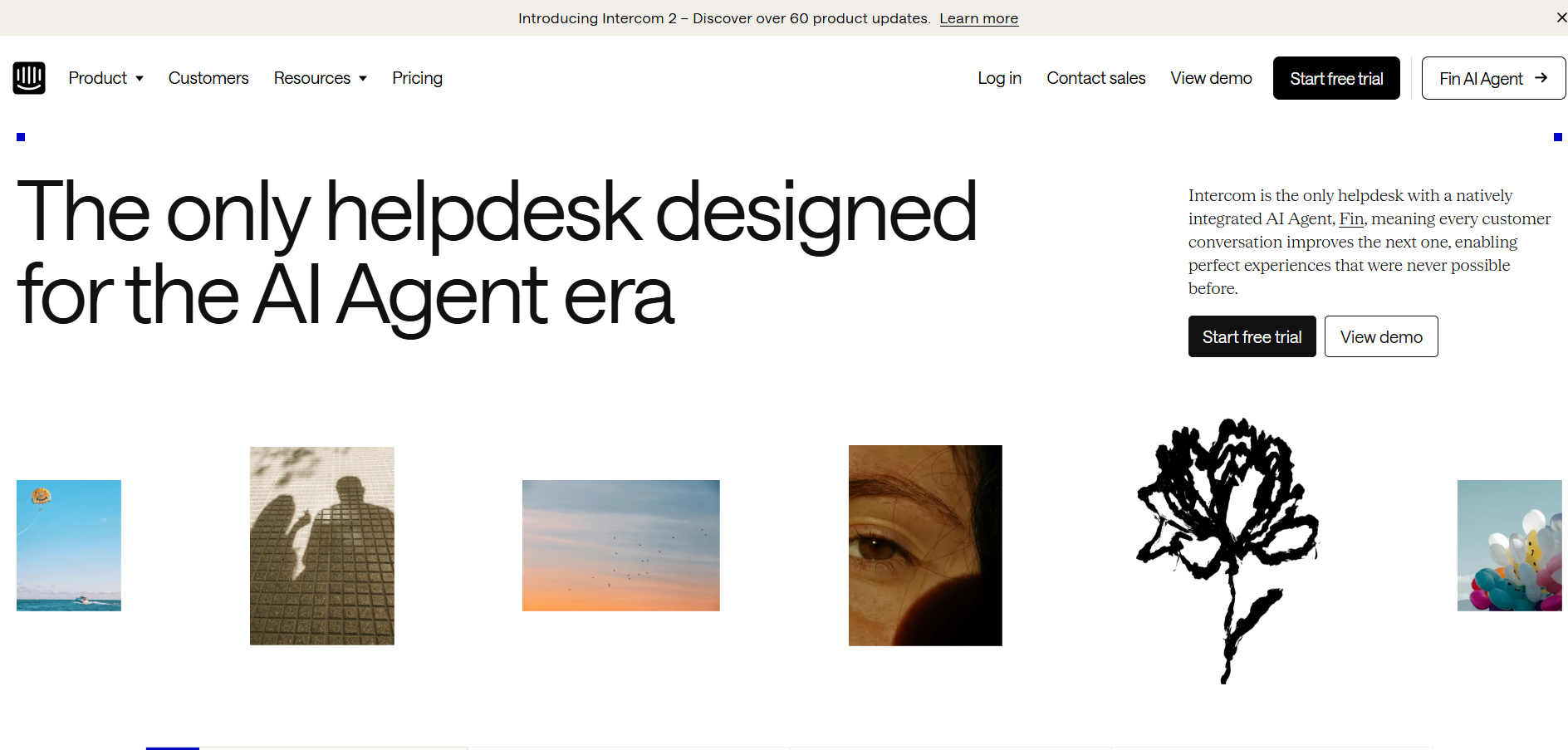
Intercom is designed for the AI Agent era. Its helpdesk includes a natively integrated AI Agent, Fin, that resolves customer questions instantly across channels. That native integration matters: Fin is not bolted onto a legacy ticketing system, so it shares context with the inbox, the Help Center, and agent workflows.
Key strengths supported by the product and third-party evidence:
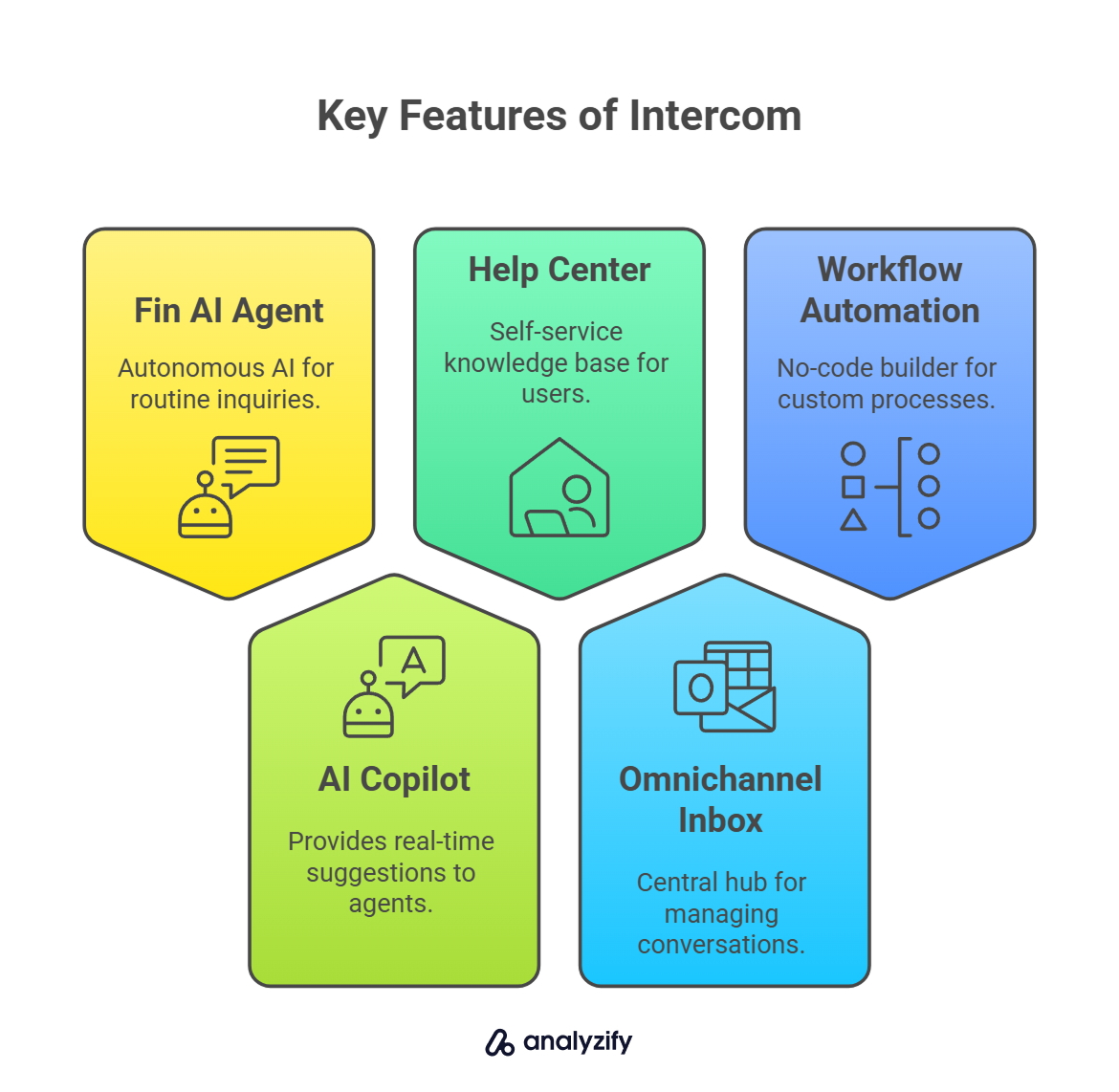
- Fin AI Agent for instant resolution. Fin handles common questions end to end, which reduces repetitive work for human agents. Chatbase's 2026 chatbot software comparison lists Intercom as best for support teams that want Fin AI alongside Intercom's help desk and messaging tools, starting at $29/seat/month plus $0.99 per Fin outcome.
- Copilot for agents. AI assistance inside the inbox helps human agents draft replies, summarize conversations, and find answers faster.
- AI Insights for analytics. Teams can see what customers ask, where AI resolves issues, and where humans are still needed.
- Multi-channel support. Live chat, email, in-app messaging, phone, and a Help Center run in one platform, which suits businesses from small teams to large enterprises.
- Scale and ecosystem. Intercom is trusted by over 30,000 brands and offers 300+ native integrations, according to the Dashly alternatives guide, which is far broader than Dashly's catalog.
- Outbound messaging and a partner program. Teams can run proactive messaging, and agencies or consultants can join a solution partner program.
If your priority is resolving customer questions quickly and consistently across channels, Intercom's depth is hard to match with a lighter inbound tool.
What Dashly does well
Dashly is not trying to be a full helpdesk. It is built as an AI inbound revenue platform for B2B companies. Its pitch is that four AI agents run on a native customer data platform (CDP) to engage, qualify, and book meetings 24/7 without hiring an SDR.
The four agents are Engagement, Qualifier, Support, and Booking. Together they:
- Capture and enrich lead profiles in real time using behavioral signals such as page visits, referral sources, and past interactions.
- Proactively message website visitors and answer questions.
- Qualify leads using firmographic and intent data.
- Book meetings automatically, with integrations such as Calendly.
Dashly also includes live chat, chatbots (Leadbot), triggered messages, pop-ups, email campaigns, a shared team inbox, and integrations with tools like HubSpot, WhatsApp, Telegram, and Instagram. Visual builders make chatbot and message sequences relatively easy to set up, and automated conversation assignment plus analytics help marketing and sales teams manage inbound flow.
For B2B teams whose main problem is converting anonymous website traffic into qualified meetings, Dashly's focus is genuinely useful. The Dashly alternatives guide cites Advertising Socials, a MarTech platform, reporting a 536% increase in booked meetings after replacing forms-only signup with Dashly's AI SDR.
Where Dashly falls short as an Intercom substitute

Intercom vs Dashly: AI Customer Service Compared (2026) - Where Dashly falls short as an Intercom substitute.
The weaknesses below are supported by the cited sources, not invented for this comparison.
1. Smaller integration ecosystem
The same Dashly alternatives guide notes that Dashly has about 30 native integrations versus 300+ for Intercom, based on G2 reviews. For teams with a complex stack, that gap means more manual work or middleware.
2. Less depth in ticketing and routing
Dashly's shared inbox and automated assignment are useful, but the source material explicitly states that Dashly lacks advanced ticketing routing rules at the depth of Zendesk Suite. Intercom's helpdesk is built around structured support workflows, so teams with SLA-driven or multi-team routing needs will find more native capability in Intercom.
3. Newer in the US market with fewer enterprise references
Dashly is described as newer in the US market, with fewer Fortune 500 reference logos than Intercom or Zendesk. That matters if procurement, security review, or brand recognition is part of your evaluation.
4. Narrower support scope
Dashly's Support agent is one of four agents focused on inbound revenue. Intercom's Fin, Copilot, and AI Insights are purpose-built for customer service at scale. If your roadmap includes advanced self-service, knowledge management, or service analytics, Intercom is the more complete platform.
5. Pricing entry point
Dashly starts at about $500/month, according to the Dashly alternatives guide. That is a higher entry point than Intercom's published starting price of $29/seat/month plus $0.99 per Fin outcome. Dashly's advantage is predictable pricing without per-resolution AI charges, but the upfront commitment is larger.
Pricing and cost predictability
Pricing is where the two platforms diverge most sharply.
- Intercom uses outcome-based pricing with Essential, Advanced, and Expert plans. Fin resolutions are billed per outcome at $0.99, per Chatbase's 2026 comparison. The Dashly alternatives guide notes that after Intercom's 2023 model update, some teams report opaque mixing of per-seat and per-resolution charges, making Fin cost forecasting harder at scale. It also notes that some Fin features, workflow customization, custom answers, and routing controls require Advanced or Expert plans.
- Dashly starts at about $500/month with no per-resolution AI charges, which makes annual cost easier to forecast at high conversation volume. The trade-off is the higher entry price and the smaller ecosystem.
If your conversation volume is high and unpredictable, Dashly's flat pricing may be easier to budget. If you want to start small and scale seats gradually, Intercom's entry point is lower.
Which platform should you choose?
Choose Intercom if:
- Customer service quality is your primary metric, not pipeline volume.
- You need a natively integrated AI agent (Fin) plus Copilot and AI Insights.
- You support customers across live chat, email, in-app messaging, phone, and a Help Center.
- You need 300+ integrations and enterprise-grade references.
- You want to start at a lower entry price and scale with outcome-based pricing.
Choose Dashly if:
- Your main goal is B2B inbound revenue: engaging, qualifying, and booking meetings.
- You want four AI agents on a native CDP working 24/7 without hiring an SDR.
- You prefer flat pricing without per-resolution AI charges.
- Your stack is relatively simple and your team values visual builders over deep configuration.
Consider both if:
Some B2B teams run Intercom for support and a separate inbound tool for sales qualification. That avoids forcing one platform to do a job it was not designed for. If you are comparing more options, see our Intercom vs Dashly vs Wonderchat comparison and our Intercom vs Wonderchat breakdown.
Practical examples
Scenario 1: SaaS support team with 10 agents. A SaaS company handles billing questions, bug reports, and onboarding help across chat and email. Intercom's Fin resolves common questions, Copilot helps agents draft replies, and AI Insights shows where documentation is missing. Dashly could handle chat and some qualification, but its ticketing depth and integration catalog would likely require workarounds.
Scenario 2: B2B agency generating demo requests. An agency wants to qualify website visitors and book demos automatically. Dashly's Qualifier and Booking agents, fed by the native CDP, can engage visitors, ask qualifying questions, and book meetings via Calendly. Intercom can do outbound messaging and chat, but it is not built around AI SDR workflows in the same way.
Scenario 3: Ecommerce brand scaling support. An ecommerce team needs order status answers, returns handling, and fast handoff to humans. Intercom's Help Center and Fin handle repetitive questions, while the shared inbox keeps agents organized. Dashly's live chat and chatbots can cover basic queries, but its strength is B2B lead qualification, not high-volume retail support.
For a deeper look at scaling service quality as you grow, see our guide on how to scale customer service without losing quality.
Related reading
- Automation Anywhere Review 2026: Agentic Automation Tested - Evidence-based Automation Anywhere review covering agentic process automation, ideal users, use cases, strengths, limitations, pricing signals, and setup in 2026.
Sources and further reading
- 12 Best Intercom Alternatives in 2026 (Pricing, Reviews & Use Cases) | Dashly Tools - Compare 12 verified Intercom alternatives across pricing, AI capabilities, and onboarding. Real G2 reviews, side-by-side feature matrix, free options included.
- 12 Best Intercom Alternatives & Competitors in 2026 - Comparison of the 12 best Intercom alternatives in 2026 with pricing, reviews, automation features, and workflow differences.
- Best Chatbot Software Platforms in 2026 - We tested 31 chatbot platforms and compared features, pricing, and AI quality. See which software fits your business, from free plans to enterprise solutions.
FAQ
Is Dashly a good Intercom alternative?
Dashly is a good alternative for B2B teams focused on inbound revenue, lead qualification, and meeting booking. It is less suited as a direct replacement for teams that need deep ticketing, broad integrations, and enterprise-grade customer service features.
Does Dashly have an AI agent like Fin?
Yes, Dashly has four AI agents: Engagement, Qualifier, Support, and Booking. They run on a native customer data platform. Intercom's Fin is a customer service AI agent integrated with the helpdesk, Copilot, and AI Insights.
Which is cheaper, Intercom or Dashly?
Intercom starts at $29/seat/month plus $0.99 per Fin outcome, per Chatbase's 2026 comparison. Dashly starts at about $500/month with no per-resolution AI charges, per the Dashly alternatives guide. Total cost depends on seat count and conversation volume.
Can Dashly replace Intercom for customer support?
For basic live chat and simple support queries, Dashly can cover the essentials. For advanced ticketing, routing rules, self-service at scale, and a large integration ecosystem, Intercom is the stronger fit.
Does Intercom have a free trial?
Yes, Intercom offers a free trial. Dashly offers a 14-day free trial.
Conclusion
Intercom and Dashly solve different problems. Intercom is an AI-first customer service platform built for the AI Agent era, with Fin, Copilot, AI Insights, multi-channel support, and 300+ integrations. Dashly is an AI inbound revenue platform for B2B teams that want to engage, qualify, and book leads 24/7 with four AI agents on a native CDP.
If your priority is customer service quality, scale, and ecosystem depth, Intercom is the better-supported choice. If your priority is inbound pipeline and predictable pricing, Dashly is worth evaluating, as long as you accept its smaller integration catalog, lighter ticketing depth, and newer US market presence.
For more comparisons, see our Intercom vs HappyFox analysis and our Intercom vs ProProfs Help Desk vs HelpCrunch comparison.