Intercom vs Genesys Cloud CX: AI Support Compared 2026
Intercom vs Genesys Cloud CX: AI Support Compared 2026
Intercom and Genesys Cloud CX both show up on shortlists for large support operations, but they were built to solve different problems. Intercom is an AI-first customer service platform with a natively integrated AI Agent, Fin, at its center. Genesys Cloud CX is an AI-powered omnichannel contact center platform with deep roots in voice, routing, and workforce management.
That difference shapes everything downstream: how fast you deploy, who owns the AI day to day, how costs scale, and what "resolution" actually means in your operation. This comparison breaks down the real trade-offs so you can pick the platform that matches your support model rather than the one with the longest feature list.
The core difference: resolution-first AI vs contact center orchestration
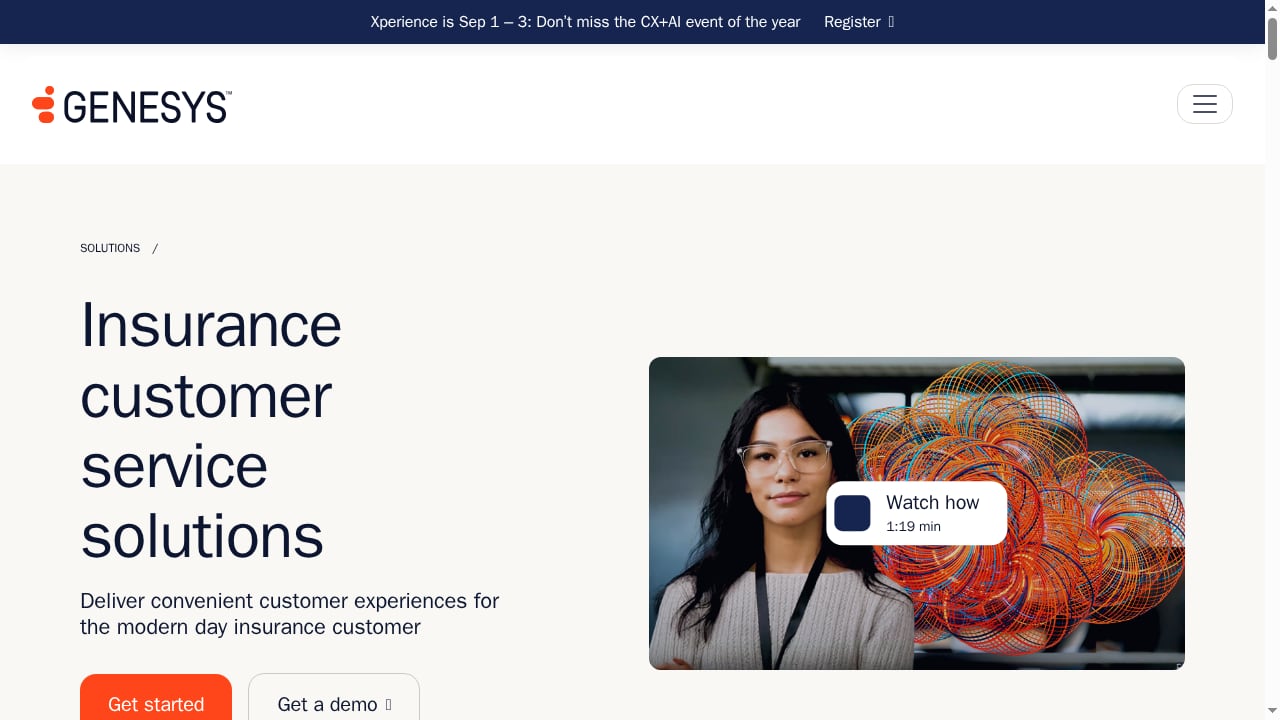
First viewport screenshot of Insurance customer service software | Genesys.
Genesys Cloud CX is a mature enterprise contact center platform. Its flagship strength is native voice, IVR, advanced routing, workforce forecasting, and quality management, with AI embedded to augment agents, supervisors, and CX leaders. Genesys Cloud AI bundles conversational AI, predictive AI, agent copilot, analytics, and workforce optimization into one platform.
Intercom approaches the same market from the opposite direction. Fin, Intercom's AI Agent, is designed to fully resolve customer issues rather than only assist agents or deflect basic questions. It can execute multi-step workflows such as refunds, account changes, subscription updates, and technical troubleshooting by combining natural language instructions, deterministic workflows, and live data access.
In practice:
- Genesys Cloud CX is optimized for call handling, routing efficiency, and workforce utilization at scale.
- Intercom is optimized for digital resolution speed and cost per resolution, with human handoff when a case needs a person.
Neither framing is a flaw. They are simply different operating models, and the wrong one for your team shows up as either wasted spend or wasted capability.
Time to value: days vs implementation cycles

Intercom vs Genesys Cloud CX: AI Support Compared 2026 - Time to value: days vs implementation cycles.
Deployment speed is one of the sharpest practical differences.
Fin can be deployed and start resolving issues in days, according to Fin's comparison with Genesys. Genesys implementations typically involve longer setup cycles, especially when voice, routing, and workforce configuration are in scope. At enterprise scale, professional services for Genesys run roughly $15,000–$60,000, and implementation budgets of $40,000–$120,000 are common for large contact centers, per first-year cost analysis from getomnichannel.com.
Why this matters: faster deployment reduces risk and accelerates ROI, particularly for teams testing AI-led automation before committing to a large, long-term contract. If your roadmap starts with digital channels and expands later, a shorter implementation cycle lets you learn from real conversations sooner.
Pricing models: per resolution vs per seat
Intercom vs Genesys Cloud CX: AI Support Compared 2026 - Pricing models: per resolution vs per seat.
This is where the two platforms diverge most visibly in budget meetings.
| Dimension | Intercom | Genesys Cloud CX |
|---|---|---|
| Pricing basis | Usage-based, tied to resolved conversations | Seat-based and tiered, often with minimum commitments |
| Published tiers | Essential $39, Advanced $99, Expert $139 per seat | CX1 $75 (voice), CX2 $115 (omnichannel), CX3 $155 (WFM) per user |
| AI access | AI Agent available across plans with usage-based pricing | AI packaged through tiered plans and AI Experience bundles |
| Voice | Supported through integrations and an evolving roadmap | Native, enterprise-grade telephony |
| Onboarding | Lower friction | Professional services often mandatory at scale |
Intercom's Fin AI is priced at $0.99 per resolution on a usage-based, uncapped model. Genesys voice minutes are billed separately, and AI access becomes more complex to forecast as usage scales through bundles.
The practical implication: when AI access is complex or seat-based, teams tend to automate less aggressively. Resolution-based pricing aligns spend with outcomes, while seat-based pricing scales cost regardless of effectiveness. Run your own math before signing — for a 50-agent team handling 5,000 monthly conversations, if Fin resolves 2,000 of them, that is roughly $1,980/month in AI fees on top of seats.
Where Genesys Cloud CX is genuinely strong
A fair comparison has to name what the substitute does well.
- Voice at scale. Genesys is stronger for large-scale, native voice operations. If voice is more than roughly 40% of your volume, a CCaaS platform built around telephony is the more natural fit.
- Workforce engagement. Forecasting, scheduling, and quality management are mature, first-class capabilities rather than add-ons.
- Complex routing. Multi-region, multi-skill routing logic for high-volume contact centers is a core competency.
- Regulated industries. Genesys serves financial services, healthcare, insurance, and government, including FedRAMP compliance for public sector needs.
- Ecosystem scale. Genesys reports over 10,000 companies across more than 100 countries.
If your organization already operates a large contact center with dedicated CX operations and IT teams, and longer implementation cycles are acceptable, Genesys remains a defensible choice.
Where Intercom's advantages show up
Intercom's strengths cluster around digital-first support where resolution rate and CSAT matter more than call metrics.
Autonomous resolution, not just deflection
Fin interprets intent using validated retrieval rather than keyword matching, combines multiple knowledge sources with live data, and executes actions through workflows and APIs under policy guardrails. It also includes built-in testing, audit logs, and usage controls, and hands off to human agents with a concise AI-generated summary.
That combination reduces repeat contacts and lowers cost per resolution. It is also a different ambition than deflection, which only measures how many contacts were avoided.
AI ownership stays with support teams
Because Fin is part of the support platform rather than an IT-led contact center build, AI ownership can live with support leadership. Teams can iterate on knowledge, workflows, and tone without waiting on a separate admin track. This matters for organizations that want to move quickly on automation without a long configuration queue.
Proactive engagement on the same surface
Intercom supports proactive messaging natively, including in-app messages, banners, and lifecycle-driven guidance. Genesys supports predictive and journey-based proactive engagement, primarily web- and voice-driven rather than product-native messaging. Keeping proactive, reactive, and human support on one operating surface reduces the context loss that creeps in when channels live in separate tools — a problem worth understanding in depth if you operate several channels, as covered in this playbook on maintaining context across channels.
Flexible deployment
Fin can also be deployed via API on top of Zendesk, Salesforce, or other helpdesks without migrating tools. That means you can test autonomous resolution on digital channels while an existing contact center continues to handle voice — a useful middle path for enterprises that are not ready to replace anything.
A staged view of AI adoption
G2's 2026 Agentic AI rankings placed six CX or conversation-first tools in the top 10, with Fin by Intercom at number two and Genesys Cloud CX at number eight, according to CX Today's coverage. Rankings like these reflect buyer sentiment and momentum, not absolute technical performance, but the pattern is informative.
A practical maturity curve looks like this:
- Assist. The AI drafts replies, summarizes context, and suggests next steps while a human owns the final response.
- Triage. The AI classifies, prioritizes, and routes, reducing misroutes but exposing gaps in taxonomy and reporting.
- Partial fulfillment. The AI completes bounded tasks such as updating account details or initiating a return, which raises the stakes on integration and permissions.
- End-to-end resolution. The AI carries a case from intent to outcome and knows when to escalate.
Genesys is well suited to organizations operating at stages one and two with heavy voice volume. Intercom is built for teams pushing toward stages three and four on digital channels. Most enterprises end up somewhere in between, which is why the decision is rarely binary.
Decision guide: which platform fits your team
Choose Genesys Cloud CX if:
- Voice is the dominant support channel and likely to stay that way.
- Workforce management and complex routing are primary needs.
- You already run a large contact center with dedicated CX ops and IT resources.
- Longer implementation cycles and professional services fees are acceptable.
- FedRAMP or similar compliance requirements shape your vendor list.
Choose Intercom if:
- Digital channels drive most of your support volume.
- Resolution rate and CSAT matter more than call metrics.
- You want fast deployment and predictable, usage-based costs.
- AI ownership should sit with support teams rather than IT.
- You want proactive, reactive, and human support on one surface.
Consider both if: voice volume is high but digital resolution is your growth priority. Fin can run via API on digital channels while Genesys continues to handle voice, letting you modernize incrementally instead of replacing your contact center.
If you are still weighing options across the category, this comparison of Intercom, Ultimate AI, and Freshdesk covers how AI resolution, pricing models, and channels differ among AI-first platforms, and this Intercom vs OTRS breakdown is useful if part of your team operates in an ITSM model.
Related reading
- Deskpro Review 2026: AI Help Desk Tested & Rated - Evidence-based Deskpro review for 2026: AI help desk features, pricing signals, setup, strengths, limitations, and who should buy it.
FAQ
Is Genesys Cloud CX an AI agent like Fin?
No. Genesys provides AI-powered assistance, analytics, and automation within a contact center platform, designed to augment agents and supervisors. Fin is an autonomous AI Agent built to resolve issues end to end across digital channels.
Can Intercom and Genesys Cloud CX work together?
Yes. Fin can be deployed via API to handle digital channels while Genesys continues to handle voice, allowing teams to modernize without replacing their contact center.
Which platform is better for voice?
Genesys is stronger for large-scale, native voice operations. Intercom supports voice through integrations and an evolving roadmap but is primarily optimized for digital resolution.
How do the pricing models differ?
Genesys uses seat-based, tiered pricing with minimum commitments and separately billed voice minutes. Intercom uses usage-based pricing tied to resolved conversations, with published seat tiers for the platform itself.
Which platform is easier to operate long term?
Teams prioritizing fewer vendors, faster iteration, and clearer ROI often prefer Intercom. Enterprises with established contact center operations and dedicated admin teams may prefer Genesys.
Conclusion
Intercom and Genesys Cloud CX are built for different problems. Genesys excels at large-scale voice and contact center orchestration. Intercom is designed to resolve customer issues end to end across digital channels with clear ownership and predictable costs.
The deciding question is not which platform has more features. It is which operating model matches how your team wants to resolve issues, who should own AI day to day, and how quickly you need automation to deliver measurable value. Answer those three questions honestly, and the choice becomes much clearer.