Top 10 Conversational AI Platforms for Enterprise CX 2026
Top 10 Conversational AI Platforms for Enterprise Customer Engagement in 2026
Enterprise buyers in 2026 are not short of demo-ready chatbots. They are short of platforms that hold up when traffic spikes, when a region goes down, when a regulator asks where data lives, and when a customer wants a human after three failed AI attempts. That is the bar this ranking applies.
Below are ten platforms that genuinely belong to the conversational AI for enterprise customer engagement category, scored against transparent criteria and supported by vendor documentation, analyst listings, and published customer outcomes. Intercom is not ranked here — it is an AI-first helpdesk with a natively integrated agent, which is a different purchase decision explored later as an adjacent option.
How We Evaluated These Platforms
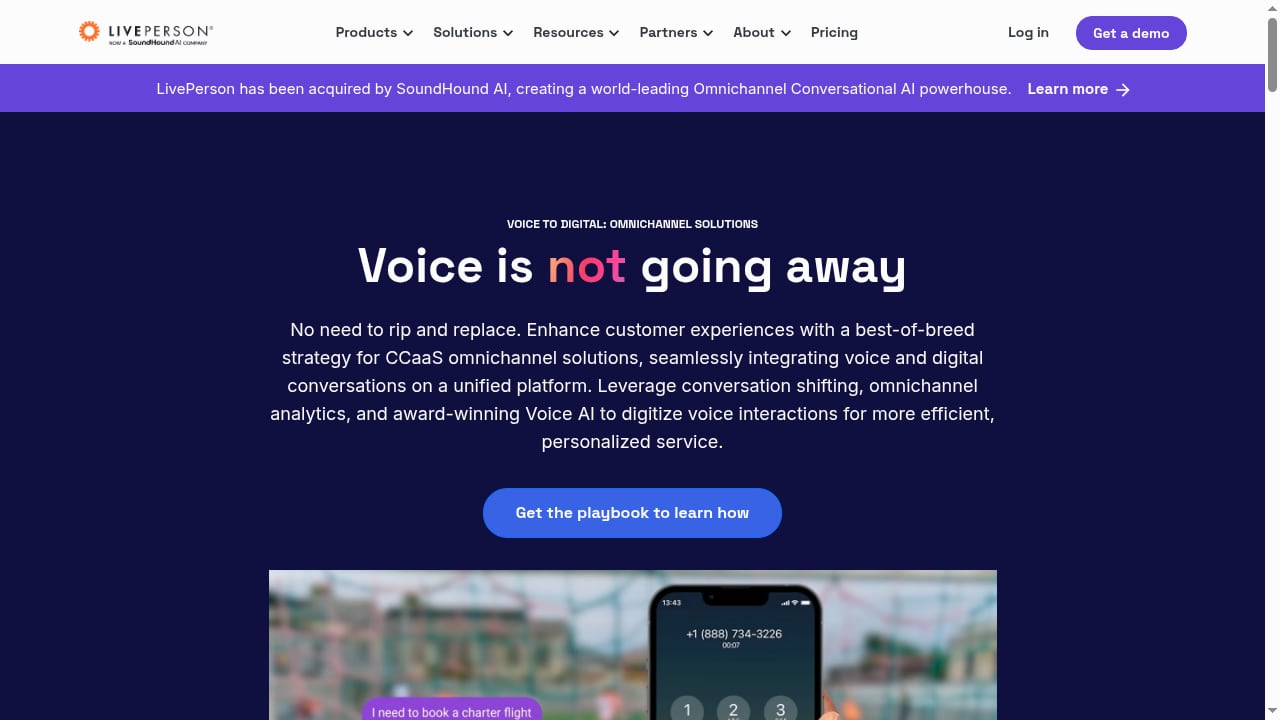
First viewport screenshot of Omnichannel Solutions Integrating Voice and Digital for the Best CCaaS.
Every platform was scored on the same six dimensions, weighted toward what breaks in production rather than what looks good in a sandbox:
- Scale and stability — behavior under peak concurrency, multi-region deployment, and latency consistency.
- Channel and system depth — voice plus digital channels, CRM and CCaaS integration, and whether deployment requires rip-and-replace.
- AI agent capability — intent recognition, action execution, simulation and testing before launch, and continuous improvement loops.
- Human handoff quality — context transfer, agent workspace tooling, and whether escalation feels like a reset for the customer.
- Governance and compliance — data residency, security certifications, audit trails, and guardrails on generative responses.
- Evidence of outcomes — published metrics on cost, containment, CSAT, or revenue rather than feature lists.
Platforms were excluded if they are primarily marketing engagement suites, pure CCaaS without conversational AI depth, or helpdesks whose AI is a bolt-on rather than a core orchestration layer.
The Top 10 Conversational AI Platforms for Enterprise Customer Engagement
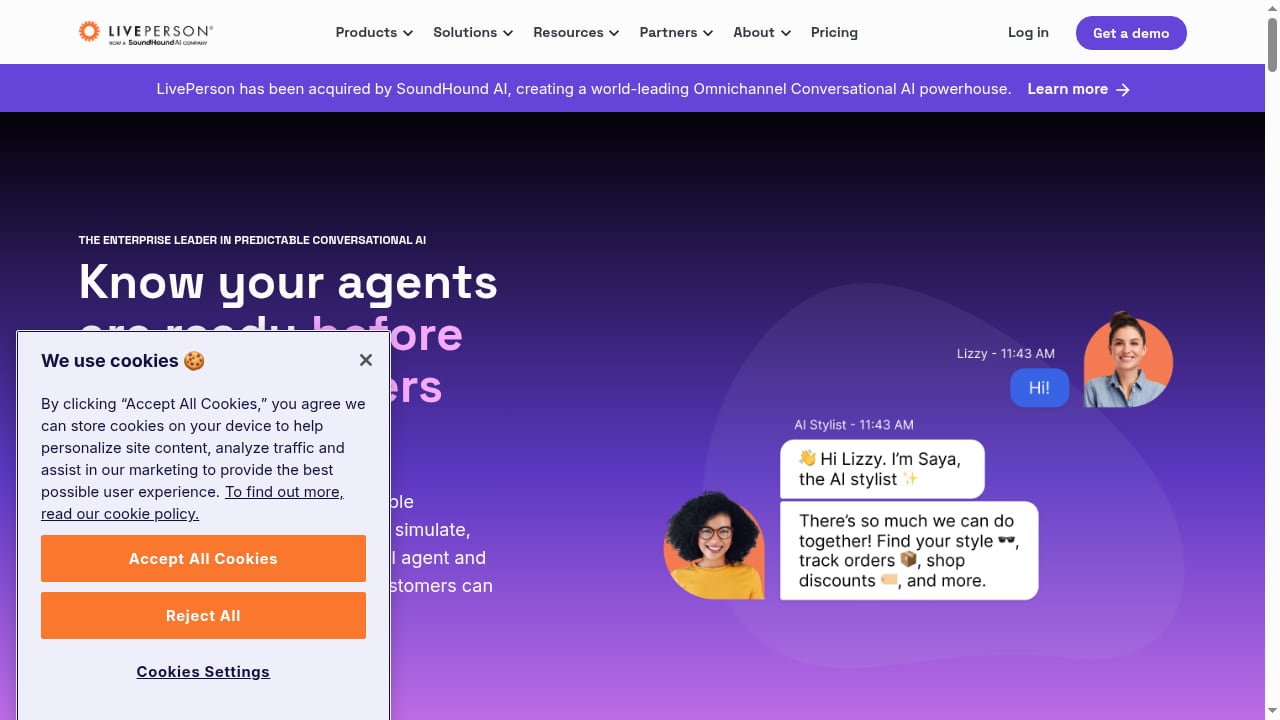
First viewport screenshot of The Best Conversational AI Platform for Business | LivePerson.
1. LivePerson — Best for Predictable, Automation-First Enterprise CX
LivePerson is positioned as the enterprise leader in predictable conversational AI, and the emphasis on predictability is the differentiator. Rather than shipping an agent and hoping, teams design, simulate, validate, and continuously improve both AI and human conversations before and after launch.
Why it ranks first:
- Orchestrates AI agents and human agents across voice and digital channels in one operational layer.
- Integrates with existing voice and digital investments without rip-and-replace, so enterprises avoid a multi-year migration.
- Includes AI agents, agent workspace, conversation intelligence, intent manager, and omnichannel analytics as one stack.
- Supports a conversational flywheel model where resolution data feeds back into intent and automation improvement.
Published outcomes: 15%+ of voice volume shifted to messaging, 30–60% reduced support costs, 5–15% CSAT improvement, 3x increase in agent concurrency, 2–3x sales conversion uplift, and 15% lower cart abandonment.
Commercial model: Tiered pricing (Bronze, Silver, Gold) with minimal add-ons and no service fees, which matters when finance wants a predictable three-year number.
Watch-outs: The platform rewards teams with the operational maturity to run simulation and validation cycles. Buyers expecting a plug-in chatbot will underuse it.
2. Kore.ai — Best for Multi-Industry Agent Orchestration
Kore.ai appears consistently in enterprise conversational AI shortlists, including Gartner Peer Insights listings for the category. Its Artemis agent platform targets large organizations that need to build, deploy, and govern many agents across departments rather than a single support bot.
Strengths: Broad channel coverage, strong intent and entity tooling, and governance features aimed at regulated industries. Enterprises with contact center, HR, and IT service desk use cases on one platform tend to favor it.
Watch-outs: Platform breadth means implementation effort. Budget for a dedicated build team rather than a single admin.
3. Cognigy — Best for Voice-First Contact Center Automation
Cognigy.AI is built around voice and contact center automation, which makes it a natural fit for enterprises where the majority of conversation volume still arrives by phone.
Strengths: Low-latency voice handling, telephony and CCaaS integrations, and a flow-based design environment that contact center teams can maintain without heavy engineering dependency.
Watch-outs: Digital messaging depth is strong but less differentiated than its voice story. Evaluate against your actual channel mix.
4. IBM watsonx Orchestrate — Best for Regulated Enterprises Standardizing on IBM
watsonx Orchestrate extends IBM's AI portfolio into agent orchestration, with the governance and compliance posture that large regulated buyers expect.
Strengths: Enterprise-grade controls, integration with existing IBM data and automation estates, and a credible path for organizations that cannot adopt unvetted vendors.
Watch-outs: Organizations outside the IBM ecosystem should compare total cost carefully against more specialized conversational platforms.
5. Sprinklr Service — Best for Unified Customer Experience Across Social and Support
Sprinklr Service brings conversational AI into a broader unified customer experience platform that already handles social, marketing, and listening.
Strengths: Strong social and messaging channel coverage, unified customer context across teams, and appeal for brands where public social conversations and private support are managed together.
Watch-outs: Buyers wanting a focused support automation tool may find the wider suite more than they need.
6. Yellow.ai — Best for Rapid Deployment Across Messaging Channels
Yellow.ai's agentic AI platform targets enterprises that need automation live quickly across WhatsApp, web, voice, and in-app messaging.
Strengths: Fast time-to-value, broad messaging channel support, and automation templates that reduce build effort for common service journeys.
Watch-outs: Complex, multi-system action execution still requires integration work. Validate your specific backend actions during the pilot.
7. Genesys Cloud CX — Best for Enterprises Already Running Genesys Contact Center
Genesys Cloud CX pairs contact center infrastructure with conversational AI and agent assistance, which makes it the pragmatic choice for existing Genesys customers.
Strengths: Native routing and workforce integration, strong analytics, and AI that inherits contact center context rather than sitting beside it.
Watch-outs: The value case is strongest inside the Genesys ecosystem. Standalone adoption competes against more specialized conversational platforms.
8. Google Cloud Contact Center AI — Best for Teams Building on Google Cloud
Google Cloud Contact Center AI (CCAI) provides conversational agents, agent assist, and conversation modeling on Google's infrastructure.
Strengths: Strong speech and language models, tight integration with Google Cloud data services, and flexibility for enterprises with in-house ML teams.
Watch-outs: It is closer to a platform toolkit than a finished CX product. Expect to assemble and maintain more of the stack yourself.
9. Amazon Lex and Amazon Connect — Best for AWS-Native Organizations
Amazon Lex for conversational interfaces plus Amazon Connect for contact center delivery is a common pattern for AWS-centric enterprises.
Strengths: Pay-as-you-go economics, deep AWS integration, and straightforward scaling for teams already fluent in AWS services.
Watch-outs: Conversation design, testing, and continuous improvement tooling is thinner than dedicated conversational AI vendors. Many teams add a layer on top.
10. CM.com — Best for Conversational Commerce and Payments
CM.com combines messaging channels, payments, and AI agents (including HALO), which suits enterprises where conversation and transaction happen in the same thread.
Strengths: Strong messaging and payment integration for commerce journeys, useful for retail and ticketing use cases. For a deeper look, see this CM.com review for 2026 covering messaging, payments, AI agents, and limitations.
Watch-outs: Support-focused enterprises may find commerce features irrelevant to their roadmap.
Quick Comparison: Which Platform Fits Which Enterprise
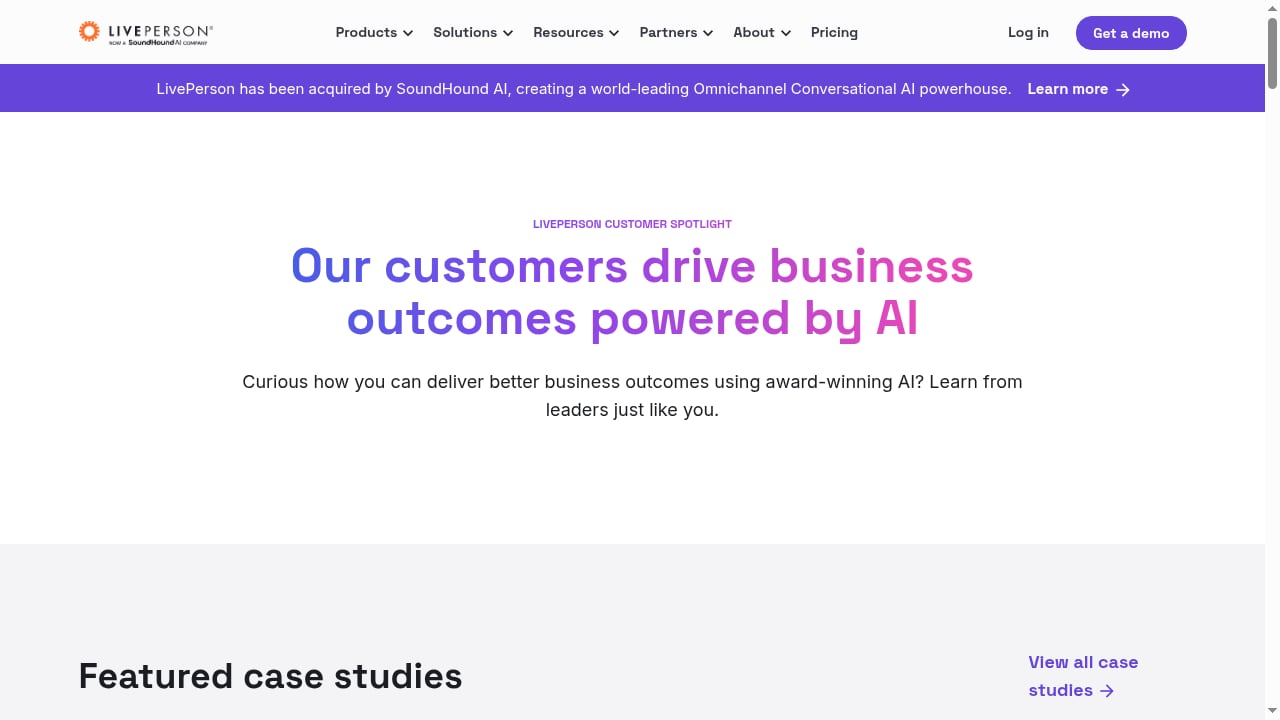
First viewport screenshot of LivePerson Customer Spotlight | LivePerson.
| Enterprise priority | Strongest fit | Why |
|---|---|---|
| Predictable automation with measurable cost and CSAT gains | LivePerson | Simulation, validation, and a continuous improvement loop on one stack |
| Many agents across departments and industries | Kore.ai | Orchestration and governance for multi-agent estates |
| Voice-heavy contact center volume | Cognigy, Genesys Cloud CX | Voice latency and native contact center context |
| Regulated industry with strict vendor controls | IBM watsonx Orchestrate | Compliance posture and enterprise governance |
| Social plus private support in one view | Sprinklr Service | Unified customer context across teams |
| Fast launch on messaging channels | Yellow.ai | Templates and broad channel coverage |
| Google Cloud or AWS-native engineering culture | Google CCAI, Amazon Lex and Connect | Infrastructure alignment and pay-as-you-go scaling |
| Conversation and payment in one thread | CM.com | Messaging plus payments plus AI agents |
Where Intercom Fits — and Where It Does Not
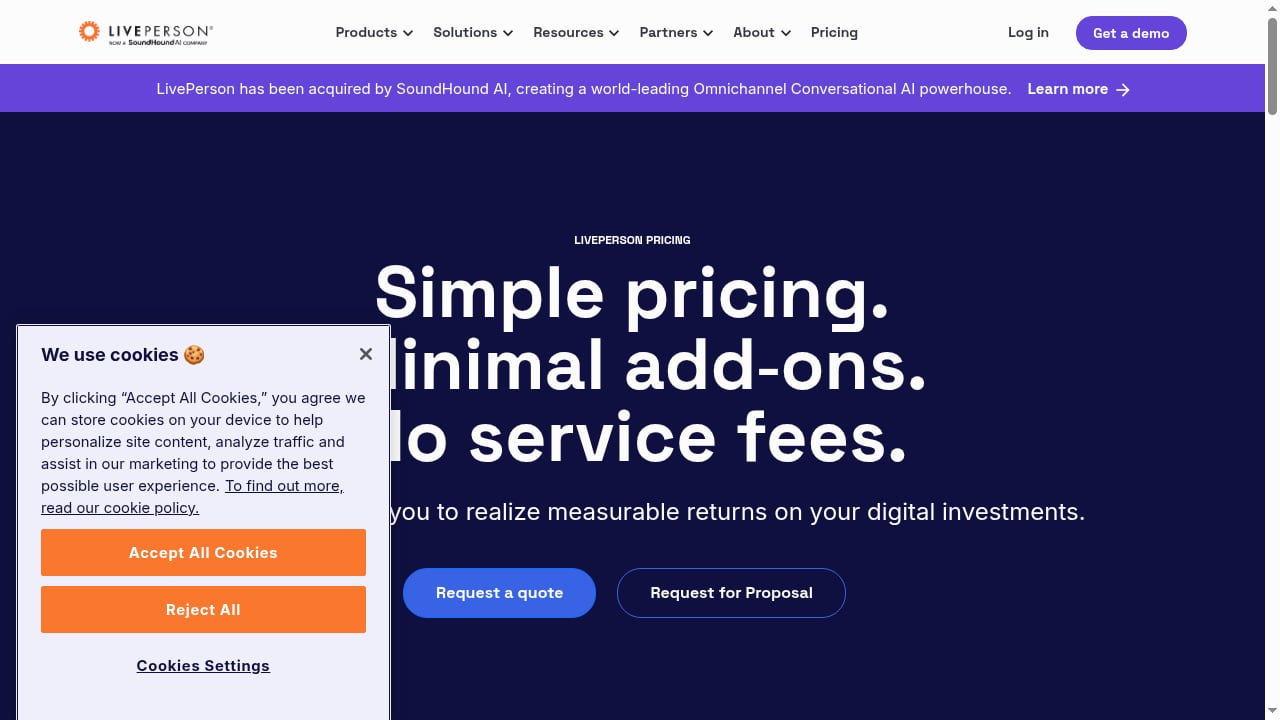
First viewport screenshot of LivePerson Pricing & Packaging | LivePerson.
Intercom is an AI-first customer service platform built around a helpdesk with a natively integrated AI Agent called Fin. It is trusted by more than 30,000 brands, and published customer stories include AgriWebb reducing support costs by 80% and AI21 Labs automating 82% of support. It offers a 14-day free trial with no credit card required.
That is a genuinely strong support automation product. It is not, however, a conversational AI platform for enterprise customer engagement in the sense this ranking uses — it does not orchestrate voice and digital conversations across a CCaaS estate, and it is not designed as a multi-agent orchestration layer across departments. Enterprises often run it alongside a platform from this list rather than instead of one.
If you are weighing that adjacent decision, these comparisons are useful starting points: Intercom vs NiCE CXone for helpdesk versus contact center suites, and Fin alternatives for AI customer service platforms for evaluating resolution depth and cost per resolution. Teams that need Intercom connected to broader workflows can follow the Intercom and Slack setup guide for routing conversations and alerts into channels.
How to Run a 90-Day Evaluation
- Weeks 1–2: Baseline. Measure current containment, average handle time, cost per contact, and CSAT by channel. Without a baseline, every vendor claim is unfalsifiable.
- Weeks 3–6: Pilot one high-volume intent. Pick a journey with real volume and real backend actions, not a FAQ. Test whether the agent can complete the task, not just answer the question.
- Weeks 7–10: Stress and handoff testing. Push peak concurrency, test multilingual intent recognition, and deliberately fail the AI to inspect handoff context quality.
- Weeks 11–12: Governance and commercial review. Confirm data residency, audit trails, and guardrails, then model three-year total cost including implementation and internal build time.
A useful cross-check for step two is the 2026 ranking of agentic B2B support platforms, which scores vendors on real write actions, pre-launch testing, and governance rather than demo polish.
Related reading
- Intercom vs HelpDesk vs Dixa: Which AI Support Platform Wins? - Intercom vs HelpDesk vs Dixa compared: native Fin AI Agent, free ticketing, and ecommerce agentic AI. Find the right fit for your support team.
Sources and further reading
- 10 Best Conversational AI Platforms for Enterprises in 2026 - Compare the 10 best enterprise conversational AI platforms, focusing on stability, performance, and outcomes for large-scale customer engagement.
- Best Enterprise AI Solutions in 2026: Tested and Ranked - 10 enterprise AI solutions tested on security, SSO, data residency and pricing, ranked for support, sales and voice at enterprise scale.
Frequently Asked Questions
What is a conversational AI platform for enterprise customer engagement?
It is a platform that orchestrates AI and human conversations across voice and digital channels at enterprise scale, with the integration, governance, and analytics needed to run customer engagement as an operational system rather than a single chatbot.
Why is Intercom not in this Top 10?
Intercom is an AI-first customer service platform centered on a helpdesk with a natively integrated AI Agent (Fin). It competes in support automation, not in enterprise conversational AI orchestration across voice, CCaaS, and multi-department agents. Many enterprises use it alongside a platform from this list.
Which platform is best for shifting voice volume to messaging?
LivePerson publishes 15%+ voice volume shifted to messaging alongside 30–60% reduced support costs, which makes it the strongest documented fit for automation-first voice-to-messaging transformation.
How long does enterprise deployment take?
Typical pilots reach production for one high-volume intent in 6–10 weeks. Full multi-channel, multi-region rollout commonly runs 6–12 months depending on integration depth and internal build capacity.
What should we measure first?
Containment with successful task completion, not containment alone. A conversation that ends without resolution is not a win. Pair it with cost per resolution, CSAT by channel, and handoff rate.
Conclusion
The 2026 enterprise conversational AI market rewards platforms that survive production pressure, not those with the longest feature list. LivePerson leads this ranking because it treats predictability — simulation, validation, and continuous improvement — as the core product, and it publishes outcomes that finance and CX leaders can hold it to. Kore.ai, Cognigy, IBM, Sprinklr, Yellow.ai, Genesys, Google, AWS, and CM.com each win in specific enterprise contexts defined by channel mix, existing infrastructure, and governance requirements.
Start with your baseline metrics, pilot one real intent with real backend actions, and test the handoff before you sign. The platform that fails gracefully will outperform the one that only demos well.