Fin Alternatives: How to Evaluate AI Customer Service Platforms
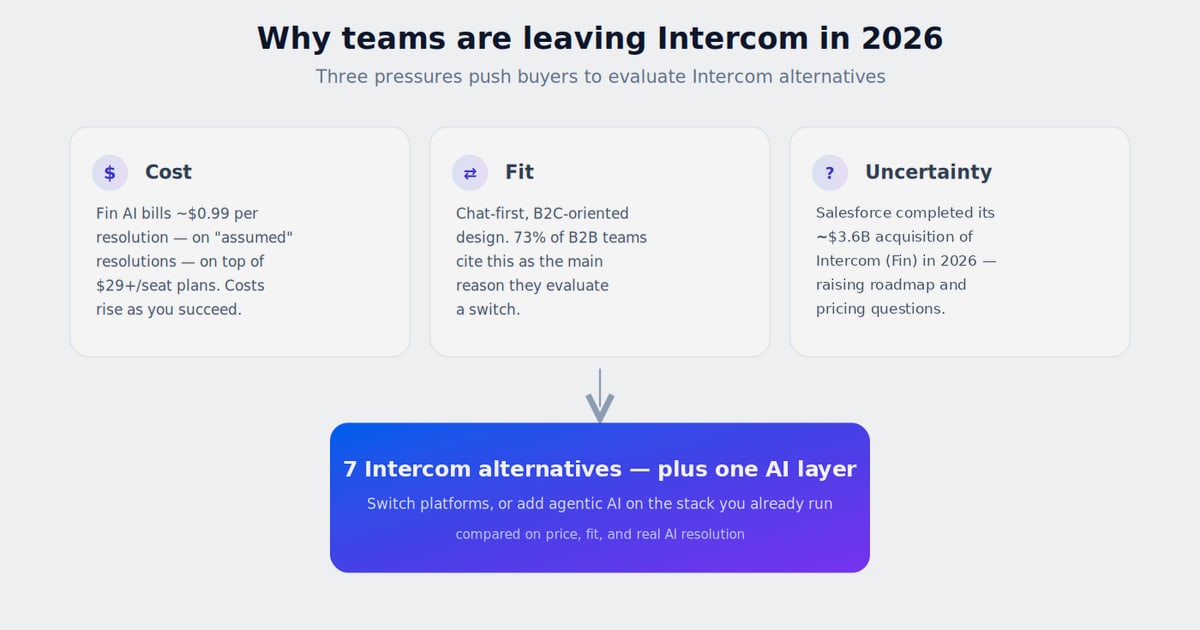
Fin Alternatives: How to Evaluate AI Customer Service Platforms
When teams search for Fin alternatives, they are usually deciding between fundamentally different approaches to AI in customer service. Some options are autonomous AI agents that resolve issues end to end. Others are automation layers that attach to an existing helpdesk. Still others are enterprise CRM platforms with embedded AI. These categories get grouped together in comparison articles, but they solve different problems and produce very different resolution outcomes.
This guide explains how to evaluate Fin alternatives based on what actually matters in production: resolution depth, action execution, human handoff quality, and cost predictability. It also covers where Intercom and its natively integrated Fin AI Agent fit into this landscape, and when a different approach makes more sense.
What makes Fin different from most alternatives
First viewport screenshot of Sign Up | Intercom.
Fin is designed for autonomous resolution, not just automated replies or deflection. In practice, that means it is built to interpret customer intent from natural language, reason over context and policy, take action across systems when needed, and confirm outcomes or escalate safely.
Many tools described as AI customer support stop at answer generation, routing, or agent assistance. That difference shows up directly in resolution rate, repeat contact, and cost per resolution. When you evaluate alternatives, the first question is whether you want AI to resolve issues or assist agents. The answer narrows the field quickly.
How to evaluate Fin alternatives correctly
Feature checklists are less useful than operating-model questions. Before comparing vendors, answer these questions honestly:
- Should AI resolve issues or assist agents?
- Who owns AI performance day to day?
- Can changes be made without engineers or vendor dependency?
- What happens when issues become complex or high-risk?
- How predictable is cost as volume scales?
These questions surface the structural differences between platforms that look similar on a feature grid.
The main categories of Fin alternatives
First viewport screenshot of Sign Up | Intercom.
Autonomous AI agents
These platforms are built to handle complete customer conversations, reason over context, and take action in external systems. They typically integrate with an existing helpdesk or operate as a standalone layer. Examples include Sierra, Decagon, and Forethought. They tend to require more engineering resources and longer implementation cycles, but they can resolve complex, multi-step issues.
AI automation layers
These tools attach to an existing helpdesk and focus on deflection, triage, and standardized workflows. Ada is a common example. They are faster to deploy and often cheaper at low volume, but they plateau on complex issues because they lack deep action execution.
CRM-embedded AI
Salesforce Agentforce embeds AI directly into the CRM data model and service workflows. This is a strong fit for enterprises already standardized on Salesforce, but it comes with configuration overhead and ties AI performance to the broader CRM roadmap.
AI-first helpdesks with native agents
Intercom combines a helpdesk with a natively integrated AI Agent called Fin. This means the AI and the helpdesk share the same data, workflows, and reporting layer. There is no integration gap between the AI and the system of record. For teams that want a complete system for human and AI customer service, this native architecture reduces the operational overhead of stitching together separate tools.
If you are comparing this category against standalone platforms, see the Intercom vs Zendesk vs ClickDesk comparison for a detailed breakdown of native versus integrated AI agents.
Comparison: Fin alternatives by resolution depth and control
| Platform | Category | Resolution depth | Action execution | Control model |
|---|---|---|---|---|
| Fin (Intercom) | AI-first helpdesk with native agent | High, including complex workflows | Native and policy-aware | No-code, self-serve |
| Salesforce Agentforce | CRM-embedded AI | Medium to high | Native to Salesforce workflows | Admin and SI-led |
| Forethought | AI agent point solution | Medium | Integration-dependent | Deterministic, integration-heavy |
| Sierra AI | AI agent platform | Medium to high | API-based | Engineering-led |
| Decagon | AI agent platform | Medium to high | API-based | Vendor and technical teams |
| Ada | Automation platform | Low to medium | Limited | No-code plus vendor support |
This table is a starting point, not a verdict. The right choice depends on your volume, complexity, team structure, and tolerance for integration work.
What to check before you commit
First viewport screenshot of Sign Up | Intercom.
Resolution rate versus containment rate
Containment measures how many conversations the AI keeps away from a human. Resolution measures whether the customer's issue was actually solved. A high containment rate with low resolution leads to repeat contacts and frustrated customers. Ask vendors for resolution data, not just deflection numbers.
Action execution across systems
Can the AI look up an order, process a refund, update an account, or change a subscription? If it can only answer questions, it will escalate anything that requires a write action. This is where many alternatives fall short in production.
Human handoff quality
When the AI escalates, what does the human agent receive? A full conversation summary, customer context, and attempted actions make handoff seamless. A bare transcript does not. Handoff quality is one of the most underrated evaluation criteria.
Cost predictability
Per-resolution pricing can climb as the AI improves and handles more volume. Seat-based pricing is more predictable but may not scale efficiently. Model your expected volume at 6, 12, and 24 months before committing. For a detailed breakdown of how AI resolution costs work, see Intercom pricing explained.
Maintenance and iteration
Who owns AI performance after launch? Can you update knowledge sources, add procedures, and test changes without engineering tickets? Platforms that require vendor or engineering involvement for every change create bottlenecks as your support needs evolve.
Where Intercom and Fin fit
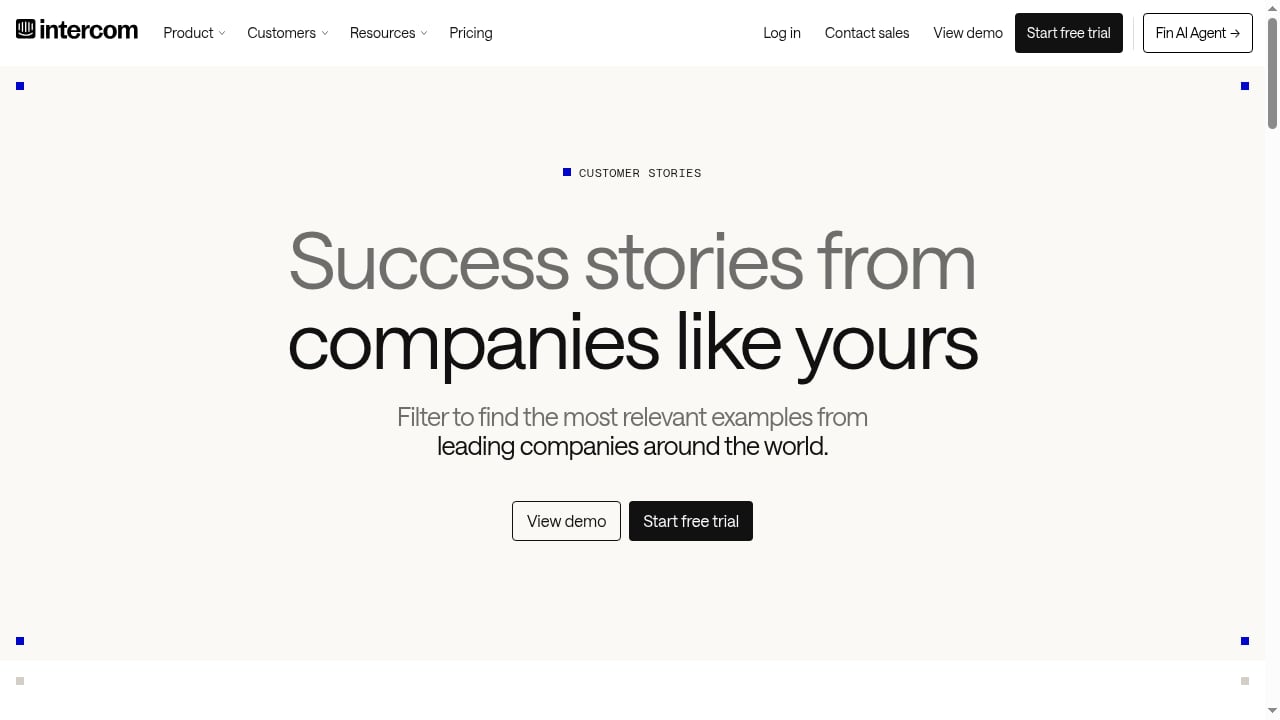
First viewport screenshot of Intercom Customers | See who trusts Intercom.
Intercom is an AI-first customer service platform that combines a helpdesk with a natively integrated AI Agent called Fin. It is designed to help businesses deliver efficient, personalized customer support at scale by automating conversations, unifying communications across channels, and providing AI-driven insights.
The platform serves support teams, customer experience leaders, and businesses of various sizes, from startups to large enterprises. Core use cases include automating customer support, reducing support costs, unifying digital and in-store experiences, and enabling multilingual support.
Key features include the Fin AI Agent, helpdesk, AI insights, bots and automation, and a pricing calculator for estimating costs based on team size and expected outcomes. Intercom positions itself as the only helpdesk with a natively integrated AI Agent and a complete system for human and AI customer service.
Notable proof points include being trusted by more than 30,000 leading brands, customer stories such as AgriWebb reducing support costs by 80% and AI21 Labs automating 82% of support, and a 14-day free trial with no credit card required.
If you want to see how Intercom and Fin work together in practice, the setup guide for Intercom with Fin walks through knowledge sources, procedures, simulations, and handoff configuration.
When a different approach makes sense
Intercom and Fin are not the right fit for every team. Consider alternatives when:
- You need deep voice-first automation at enterprise scale and your primary channel is phone.
- You are standardized on a CRM like Salesforce and want AI embedded directly into that data model.
- You have strong engineering resources and want to build custom agent behavior from scratch.
- Your support volume is low and you only need basic deflection.
For a broader view of the market, including agentic B2B support platforms scored on real write actions and governance, see the 2026 ranking of agentic B2B support platforms.
Related reading
- How to Use Intercom with Conversational AI and APIs for SMS, Email, Voice - Connect Intercom's Fin AI Agent with Twilio APIs for SMS, email, and voice. Step-by-step setup, data connectors, workflows, examples, and FAQs.
- Intercom vs OTRS: AI Helpdesk or ITSM Suite Compared - Intercom vs OTRS compared for customer service, ITSM, ISMS, and SOAR needs. See where Intercom's native Fin AI Agent wins and where OTRS fits better.
Sources and further reading
- 5 Best Fin AI Alternatives in 2026 - Explore Fin alternatives and competitors and see how AI agents differ in autonomous resolution, workflow execution, control, and long-term cost.
- The top 5 Fin AI alternatives in 2026 - Discover the 5 best Fin AI alternatives for CX, ranked by channel coverage, enterprise readiness, handoff quality, 3rd-party recognition, more.
- Intercom Fin AI Agent alternatives comparison – what are you using in 2026? : r/AI_Customer_Support - We're reviewing AI customer support platforms and Intercom Fin is obviously one of the products on the shortlist. It looks solid if you're already invested in the Intercom ecosystem, but I'm curious how it compares with dedicated AI agent platforms in real production environments.
FAQ
What is a true alternative to Fin?
A true alternative is an AI agent that can interpret intent, reason over context and policy, take action across systems, and confirm outcomes without real-time human involvement. Tools that only generate answers or deflect conversations are not direct alternatives.
Are Salesforce Agentforce and Forethought direct competitors to Fin?
They are evaluated in many of the same deals, but they differ in approach. Agentforce embeds AI into a CRM-first service model, while Forethought operates as an AI agent layer alongside an existing helpdesk. Fin is natively integrated into the Intercom helpdesk.
Do Fin alternatives replace a helpdesk?
Some do, some do not. Salesforce Agentforce is part of a full CRM service platform. Forethought, Sierra, and Decagon typically require an existing helpdesk. Intercom provides both the helpdesk and the native AI agent in one platform.
Why do resolution rates vary so widely between tools?
Resolution rates vary based on architecture and operating model. Systems that only generate answers or deflect conversations plateau quickly. Systems that combine reasoning, validation, and action execution resolve a broader range of issues.
How should I compare pricing across Fin alternatives?
Model your expected volume at multiple time horizons and ask vendors for resolution-based pricing details. Per-resolution pricing can be efficient at low volume but climb as automation improves. Seat-based pricing is more predictable but may not scale as efficiently. Always test with a trial before committing.
Conclusion
Evaluating Fin alternatives is not about finding the longest feature list. It is about matching the platform's operating model to your support strategy. If you want AI to resolve issues end to end within a unified helpdesk, Intercom and its natively integrated Fin AI Agent are built for that. If you need deep CRM integration, voice-first automation, or custom agent development, other platforms may fit better.
Start by answering the operating-model questions in this guide. Then test your top two or three candidates with real conversation data. The platform that resolves the most issues without escalating, at a predictable cost, is the right choice for your team.