Gladly Review 2026: AI Customer Service Platform Tested
Gladly Review 2026: AI Customer Service Platform Tested
Gladly is a customer service platform that organizes interactions around people, not tickets. Instead of opening a new case for every email, chat, or call, it keeps one continuous timeline per customer. That design choice shapes everything about the product — its strengths, its costs, and the kind of team that gets the most from it.
This review covers what Gladly does well, where it struggles, how pricing signals compare, and how to decide whether it belongs in your 2026 support stack.
What Gladly actually is
Gladly Review 2026: AI Customer Service Platform Tested - What Gladly actually is.
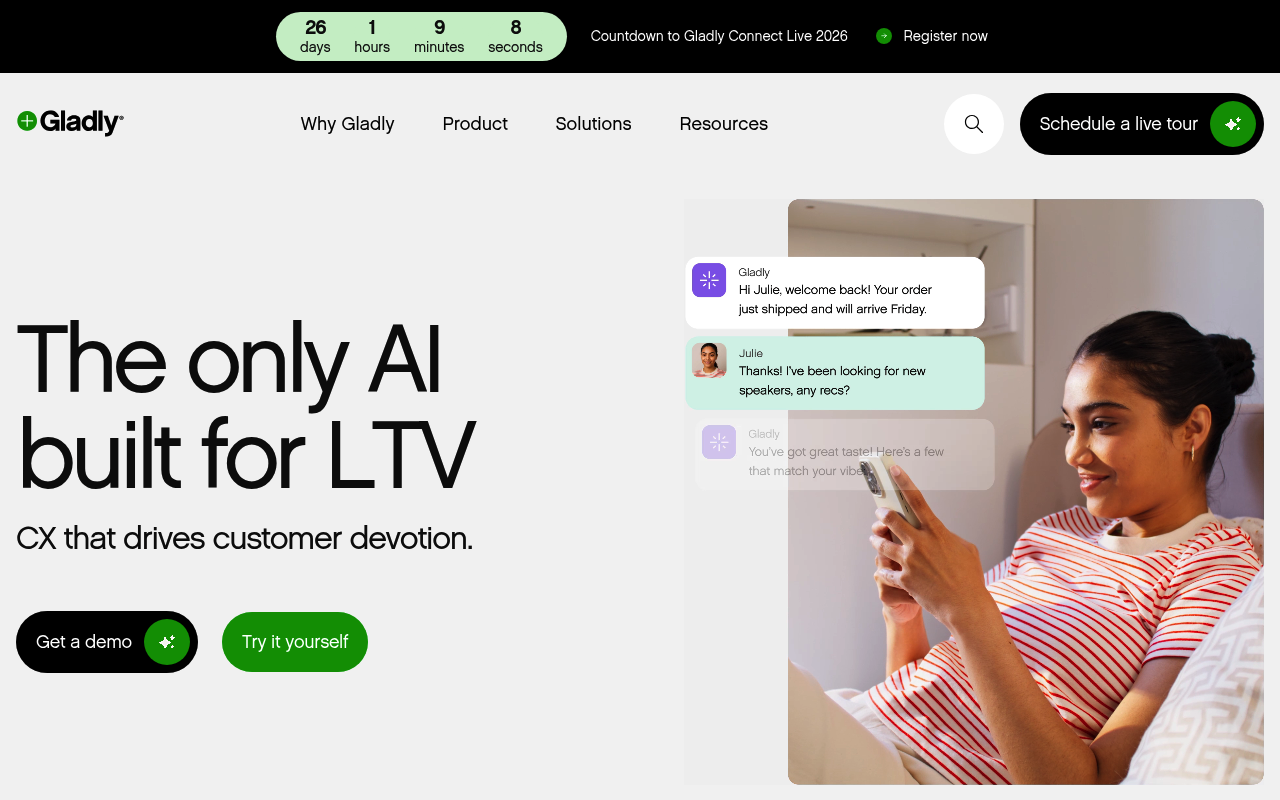
Gladly is an AI-powered customer experience platform for B2C brands. It unifies voice, email, chat, SMS, and social messaging into a single lifelong conversation thread per customer. Agents see purchase history, past conversations, and current context in one place rather than hunting across tabs.
The platform's AI layer automates routine inquiries, routes complex issues, and gives agents real-time guidance. Gladly positions itself as the CX AI that balances cost savings with customer devotion — turning support from a cost center into a loyalty and revenue driver.
Founded in 2014 and headquartered in San Francisco, Gladly serves retail, ecommerce, wellness, travel, and subscription businesses. Named customers include Crate & Barrel, Rothy's, Breeze Airways, Condé Nast, MaryRuth's, Ollie, ProClip USA, The Black Tux, and WeNatal.
Who Gladly is built for
Gladly Review 2026: AI Customer Service Platform Tested - Who Gladly is built for.
Gladly is not a general-purpose help desk. It fits a specific profile:
- B2C brands with high interaction volume. Retail, ecommerce, travel, and subscription businesses where the same customer returns repeatedly.
- Teams that value relationship continuity. If your agents regularly say "let me pull up your account," Gladly removes that step.
- Support organizations measured on LTV, not just ticket closure. Gladly's analytics tie conversations to revenue and retention signals.
- Companies willing to invest in change management. The customer-centric model is a workflow shift, not a plug-in.
If you run a B2B SaaS help desk with long technical tickets and few repeat contacts, a ticket-first tool will likely serve you better and cost less.
Core capabilities worth evaluating
Gladly Review 2026: AI Customer Service Platform Tested - Core capabilities worth evaluating.
Unified agent desktop
Every channel lands in one timeline. Agents see the full history — previous chats, emails, calls, and orders — without switching tools. Gartner Peer Insights reviewers consistently highlight this single timeline as the feature that makes support feel personal and efficient.
AI-powered self-service
Gladly's AI handles routine questions end to end. The vendor reports that 76% of conversations are fully resolved by AI, and customers see a 3x increase in 30-day resolution rates. Treat those as vendor-reported figures, but the direction is consistent with what buyers expect from modern CX AI.
Proactive messaging
Gladly supports outbound messaging for order updates, delays, and follow-ups. This matters for subscription and travel brands where a proactive message prevents an inbound contact.
Analytics and revenue attribution
Reporting connects conversation outcomes to CSAT, resolution time, and revenue per conversation. Gladly cites a 2.2x boost in revenue per conversation and a 65% increase in CSAT across its customer base.
Pricing signals

Gladly Review 2026: AI Customer Service Platform Tested - Pricing signals.
Gladly does not publish list pricing. Based on buyer conversations and vendor materials, expect:
- Quote-based pricing tied to agent seats and channel volume.
- Enterprise positioning — Gladly competes in the same bracket as Intercom and Zendesk Enterprise, not with $20-per-seat help desks.
- Implementation and onboarding fees for larger deployments.
- AI usage potentially metered separately from seat licenses.
For a structured way to compare these models, see our support automation buyer's guide.
Setup and implementation
Gladly is cloud-based with no on-premise option. Typical rollout involves:
- Channel connection — email, chat, voice, SMS, and social accounts.
- Data integration — order management, CRM, and subscription systems to populate the customer timeline.
- AI configuration — knowledge base ingestion, intent tuning, and escalation rules.
- Agent training — the biggest lift, because agents must unlearn ticket-first habits.
Expect weeks, not days, for a full deployment. Smaller teams can go live faster with a narrower channel set.
Strengths
- Customer-centric data model. The single timeline is genuinely different from ticket-based tools.
- Channel breadth. Voice, chat, email, SMS, and social in one place.
- AI that resolves, not just suggests. Vendor data shows strong full-resolution rates.
- Revenue-oriented analytics. Useful for teams that must justify support spend.
- Strong B2C references. The customer list is credible in retail and subscription verticals.
Limitations
- Opaque pricing. No public tiers make budgeting harder.
- Enterprise weight. Smaller teams may find it overbuilt and overpriced.
- Workflow migration cost. Moving from Zendesk or similar requires real change management.
- B2C bias. B2B and technical support use cases are less well served.
- AI accuracy depends on your knowledge base. Garbage in, garbage out.
Gladly vs the alternatives
| Platform | Best for | Pricing model | Key difference |
|---|---|---|---|
| Gladly | B2C brands focused on LTV | Quote-based | Customer timeline, not tickets |
| Intercom | Mid-market to enterprise | Seat + usage tiers | Strong AI agent, broader platform |
| Zendesk | General help desk | Seat-based tiers | Ticket-first, huge ecosystem |
| Deskpro | Cost-conscious teams | Seat-based | On-premise option available |
If you are weighing Gladly against Intercom, our Intercom vs Deskpro comparison shows how seat-based and usage-based models play out in practice. For a broader view of AI-first platforms, the Botpress review covers a different segment of the market.
Decision criteria: should you buy Gladly?
Ask these questions before requesting a quote:
- Do your customers contact you repeatedly? If yes, the unified timeline pays off. If every contact is a one-off, it does not.
- Is support measured on retention or revenue? Gladly's analytics are built for that conversation.
- Can you absorb a multi-week implementation? If you need to go live next week, look elsewhere.
- Do you have a clean knowledge base? AI resolution quality depends on it.
- Is your budget enterprise-level? If not, compare seat-based alternatives first.
Related reading
- Zoom Meeting: How to Join, Host, and Get More Done - Learn how a Zoom meeting works: join links, hosting setup, AI features, recording, and tips for running smoother video calls in 2026.
- Intercom vs Featurebase vs ProProfs Help Desk (2026) - Compare Intercom, Featurebase, and ProProfs Help Desk on AI agents, pricing, channels, and use cases to pick the right support platform in 2026.
- Intercom vs DevRev: Which AI Support Platform Wins in 2026? - Compare Intercom and DevRev on AI agents, ticketing, pricing, and use cases. See which customer service platform fits your team in 2026.
Sources and further reading
- Gladly Reviews & Ratings 2026 | Gartner Peer Insights - Explore 13 in-depth Gladly reviews and insights from real users verified by Gartner, and choose your business software with confidence.
- Gladly Reviews 2026: Details, Pricing, & Features - G2 - What I really adore about Gladly is its customer-centric approach and it truly puts the person at the center of every interaction. Instead of focusing on ...
- Gladly Reviews, Pros and Cons - 2026 Software Advice - I love Gladly, it is really easy to use and keeps you updated with every customer. You can access the transcript or history of chats at any time that you need ...
FAQ
Is Gladly a help desk or a CRM?
Neither, strictly. It is a customer service platform with a unified conversation timeline. It integrates with CRMs rather than replacing them.
How much does Gladly cost?
Gladly does not publish pricing. Expect quote-based enterprise pricing tied to seats, channels, and AI usage. Request a demo for a real number.
What do users like most about Gladly?
Reviewers on Gartner Peer Insights and G2 consistently praise the single customer timeline, the clean interface, and the ease of adding AI automations.
What are the main complaints?
Pricing opacity, implementation effort, and the learning curve for teams used to ticket-based tools.
Does Gladly work for small teams?
It can, but the platform is priced and designed for mid-market to enterprise B2C brands. Small teams often get better value from lighter tools.
How does Gladly handle AI hallucinations?
Gladly routes uncertain or complex issues to human agents. Accuracy still depends heavily on the quality of your knowledge base and escalation rules.
Conclusion
Gladly is a strong fit for B2C brands that treat support as a loyalty and revenue function. The unified customer timeline is a real architectural difference, not a marketing claim, and the AI layer delivers measurable resolution gains for teams with clean data.
The trade-offs are real: opaque pricing, enterprise-level implementation effort, and a poor fit for B2B or one-off support models. If your customers come back, your budget supports enterprise tools, and you are ready to change how agents work, Gladly deserves a serious evaluation. If not, a ticket-first platform will likely serve you better at a lower cost.
For a full picture of the market before you decide, start with our support automation buyer's guide and compare Gladly against the alternatives that match your scale.