Intercom vs ClearFeed: AI Support Platform Comparison 2026
Intercom vs ClearFeed: AI Support Platform Comparison 2026
Choosing between Intercom and ClearFeed often comes down to where your customers already are. Intercom is an AI-first customer service platform built around its Fin AI Agent, while ClearFeed is an AI-native helpdesk that treats Slack as the primary workspace. This comparison breaks down how each platform handles AI resolution, channel coverage, pricing, and team workflows so you can match the tool to your support model.
What Each Platform Is Built For
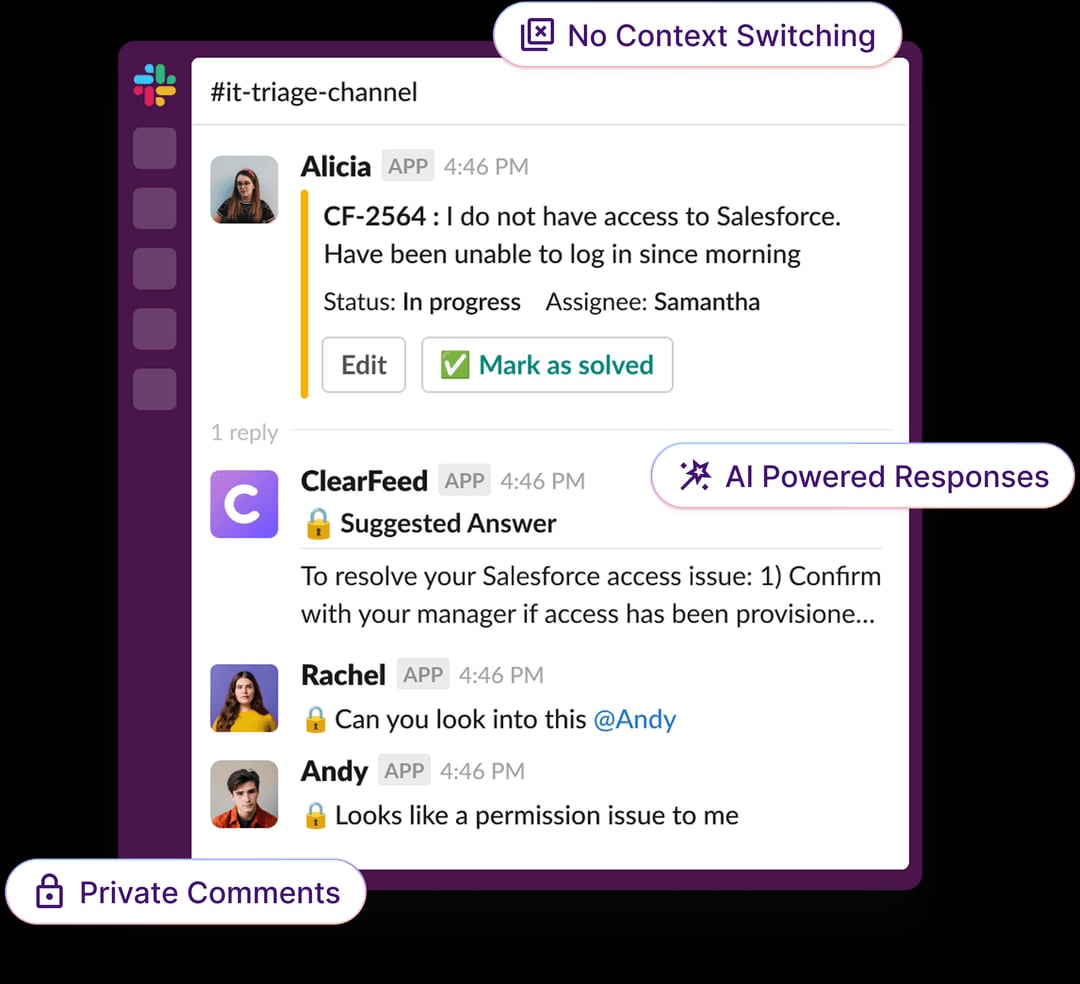
ClearFeed - The Next-Gen Helpdesk in Slack Powered by AI Agents.
Intercom: AI-first customer service for every channel
Intercom is designed for the AI Agent era. Its helpdesk includes Fin, a natively integrated AI Agent that resolves customer questions instantly, and Copilot, an AI assistant that helps human agents work faster. The platform supports live chat, email, in-app messaging, and phone, with a shared inbox and an integrated Help Center for self-service. AI Insights provides analytics on conversation trends, and outbound messaging lets teams proactively reach customers. Intercom serves businesses of all sizes, from small teams to large enterprises, and is trusted by over 30,000 brands. Pricing is outcome-based across Essential, Advanced, and Expert plans, with a free trial available.
ClearFeed: AI-native helpdesk for Slack-centric teams
ClearFeed is built for teams that use Slack as their main communication hub. It consolidates requests from Slack, email, web chat, Microsoft Teams, Discord, and Telegram into a unified Slack interface. Its AI agents auto-resolve queries, suggest responses, and update documentation through DocAssist. ClearFeed integrates deeply with Zendesk, Freshdesk, Jira, Salesforce, and HubSpot, and positions itself as a next-gen alternative to traditional helpdesks for Slack-first organizations. It supports external customer support, internal IT/HR/operations help desks, sales ops, and premium Slack support. Pricing is subscription-based with tiers for helpdesk, integrations, and AI agents.
AI Resolution: Fin vs ClearFeed's GPT-Powered Agents
Intercom's Fin AI Agent is built into the platform from the ground up. It resolves customer questions across channels without requiring a separate AI layer, and it learns from your help content and past conversations. Copilot assists human agents with suggested replies and summarization, while AI Insights surfaces patterns in customer contacts.
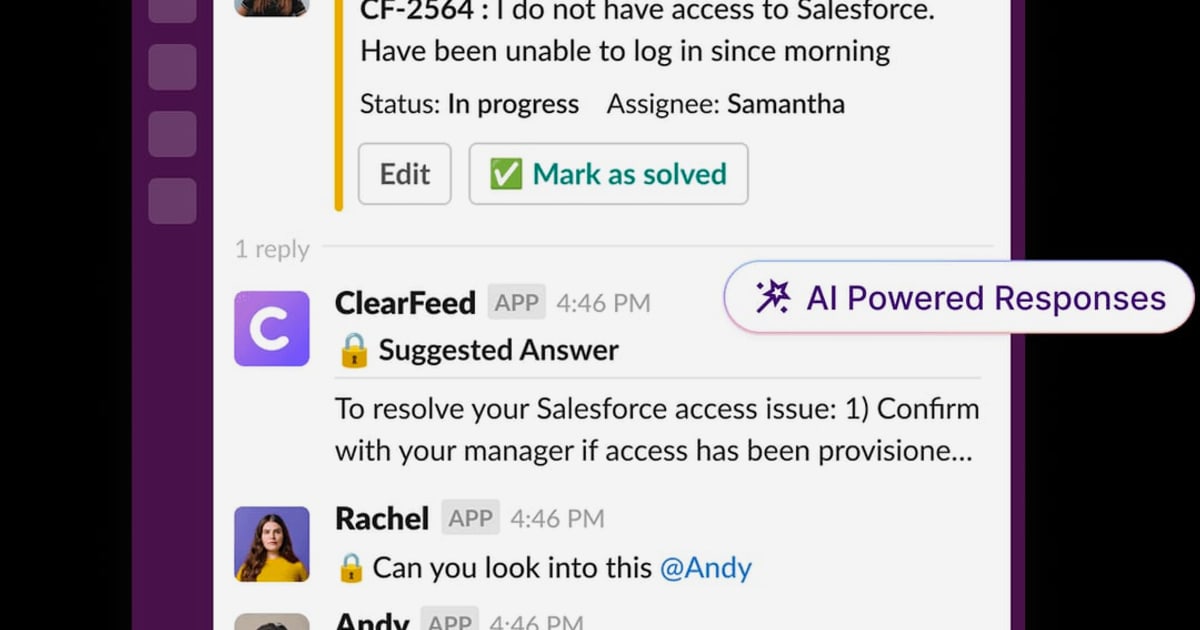
ClearFeed's AI capabilities focus on Slack workflows. Its virtual agent generates responses from indexed documentation and knowledge bases, and DocAssist helps keep documentation current. According to ClearFeed's own integration page, the GPT Agent suggests answers and KB links for new questions and can operate in deflection or agent-assistant mode. The AI is designed to reduce context switching for teams already working in Slack.
The key difference: Intercom's AI is the core of the platform, while ClearFeed's AI is optimized for Slack-based triage and response. If your customers expect instant answers across web, email, and in-app channels, Intercom's native AI Agent is a stronger fit. If your support happens primarily in Slack and you want AI to assist there, ClearFeed's approach may be sufficient.
Channel Coverage and Customer Experience
Intercom vs ClearFeed: AI Support Platform Comparison 2026 - Channel Coverage and Customer Experience.
Intercom supports live chat, email, in-app messaging, and phone, plus a Help Center for self-service. This multi-channel coverage means customers can reach you wherever they are, and Fin can resolve questions on any of those channels. For a deeper look at how multi-channel support strategies compare, see our guide to multi-channel customer support.
ClearFeed's strength is consolidating channels into Slack. It pulls requests from Slack, email, web chat, Microsoft Teams, Discord, and Telegram into a unified Slack interface. This reduces tool switching for internal teams, but it also means the customer experience is mediated through Slack. For external customers who are not in your Slack workspace, the experience may feel less direct than a branded help center or in-app messenger.
Slack Integration: Different Depths
ClearFeed's Slack integration is its foundation. It syncs Slack threads with Intercom tickets or conversations in real time, allows one-click ticket creation from Slack, and supports two-way sync of comments and status updates. According to ClearFeed's integration page, this can reduce Intercom license costs by letting more team members collaborate on tickets from Slack without full Intercom seats. It also supports ticket triage, CSAT surveys in Slack, and custom fields.
Intercom's Slack integration is more of a bridge. It routes conversations and notifications into Slack, but the core ticket management happens in Intercom. For teams that want Slack to be the primary interface, ClearFeed offers deeper native functionality. For teams that want Slack as a supplementary notification channel, Intercom's integration is adequate.
Pricing and Licensing Models
Intercom uses outcome-based pricing with Essential, Advanced, and Expert plans. The model ties cost to resolution outcomes, which can align spending with value but may require forecasting. A free trial is available.
ClearFeed uses a subscription model with tiers for helpdesk, integrations, and AI agents. According to a comparison from Plain, ClearFeed starts at $24 per agent per month, with usage-based pricing from $40 per month for 10 channels. ClearFeed's own page notes that its pricing is based on the number of tickets created in Slack, which can reduce Intercom license costs for teams that want to collaborate without buying full seats.
The trade-off: ClearFeed may lower per-seat costs for Slack-heavy teams, but it adds a layer between your customers and your helpdesk. Intercom's outcome-based pricing may cost more upfront but includes the full AI-first platform without a Slack dependency.
When to Choose Intercom
Intercom is the better fit when:
- Your customers expect support across live chat, email, in-app messaging, and phone.
- You want a natively integrated AI Agent (Fin) that resolves questions without a separate tool.
- You need a shared inbox, Help Center, and outbound messaging in one platform.
- You serve a mix of small teams and enterprise customers and need scalable pricing.
- You want AI Insights and Copilot to improve agent productivity and analytics.
Intercom's platform is designed for the AI Agent era, and its 30,000+ brand customers suggest broad adoption across industries. For teams comparing Intercom to other AI support platforms, see our Intercom vs Front comparison and Intercom vs Ultimate AI analysis.
When to Choose ClearFeed
ClearFeed is the better fit when:
- Your team lives in Slack and wants to manage support there.
- You need to consolidate Slack, email, web chat, Microsoft Teams, Discord, and Telegram into one Slack interface.
- You want to reduce Intercom license costs by letting engineers and PMs collaborate from Slack.
- You need deep integrations with Zendesk, Freshdesk, Jira, Salesforce, or HubSpot.
- You run both internal IT/HR help desks and external customer support.
ClearFeed's focus on Slack-native workflows can reduce context switching and speed up collaboration for technical teams. However, it may add complexity if you do not already use legacy ticketing systems, and its customer-facing experience is less direct than a dedicated help center.
Practical Example: A SaaS Company's Decision
Imagine a B2B SaaS company with 50 support agents. Customers reach out via in-app chat, email, and Slack Connect channels. The support team uses Slack internally, and engineers often need to weigh in on technical tickets.
With Intercom, the company could deploy Fin to resolve common questions in-app and via email, use Copilot to help agents draft replies, and manage all conversations in a shared inbox. Engineers could be looped in via Slack notifications, but ticket management stays in Intercom.
With ClearFeed, the company could route all Slack Connect messages into a shared queue, let engineers respond directly from Slack, and sync tickets to Jira for engineering follow-up. The trade-off is that in-app and email support would still need a separate helpdesk or would be funneled through Slack, which may not suit all customers.
The decision hinges on whether Slack is the center of your support universe or just one channel among many.
Related reading
- WotNot Review 2026: No-Code AI Agent Platform Tested - Evidence-based WotNot review for 2026: visual AI agent builder, LLM flexibility, WhatsApp and web chat, pricing from $29/month, setup, and limitations.
Sources and further reading
- Intercom Slack Integration | ClearFeed - Sync status/comments between Slack threads & Intercom in real-time. Convert threads & attachments to tickets in 1-click. Enable Engineers and Support to collaborate on tickets.
- Best AIs for customer support? Tested a bunch. Some thoughts… - Mar 4, 2026 ... we currently use intercom and I think all the cons you point out are valid. ... would be genuinely curious where ClearFeed lands for you if ...
- 10 Best Slack Apps for Customer Support in 2026 (Compared) - Compare the 10 best Slack apps for customer support in 2026. Plain, Thena, Zendesk, Intercom, and more — features, pricing, and use cases compared.
FAQ
Is ClearFeed a replacement for Intercom?
ClearFeed can replace Intercom for teams that want Slack as their primary support interface. It offers ticketing, AI agents, and multi-channel consolidation. However, it does not provide the same breadth of customer-facing channels (live chat, in-app messaging, phone) or a natively integrated AI Agent like Fin. For teams that need a full AI-first customer service platform, Intercom is the more complete solution.
Can ClearFeed reduce Intercom costs?
Yes. According to ClearFeed's integration page, managing support requests in Slack can reduce the need for multiple Intercom agent licenses. ClearFeed's pricing is based on tickets created in Slack, so team members can collaborate without full Intercom seats. This can lower costs for teams that already use Intercom but want more people involved in support.
Does Intercom have a Slack integration?
Yes, Intercom offers a Slack integration that routes conversations and notifications into Slack. However, it is more of a bridge than a native Slack helpdesk. ClearFeed's integration is deeper, with two-way sync, ticket creation from Slack, and CSAT surveys in Slack.
Which platform is better for internal help desks?
ClearFeed is specifically designed for internal IT/HR/operations help desks that operate in Slack. Intercom is primarily built for external customer service, though it can be used for internal support with some configuration. For Slack-native internal help desks, ClearFeed is the more natural fit.
What about AI resolution rates?
Intercom's Fin AI Agent is designed to resolve customer questions instantly across channels. ClearFeed's AI agents auto-resolve queries and suggest responses in Slack. Both use AI, but Intercom's AI is natively integrated into the platform, while ClearFeed's AI is optimized for Slack workflows. For teams that need AI resolution across multiple customer-facing channels, Intercom is the stronger choice.
Conclusion
Intercom and ClearFeed serve different support philosophies. Intercom is an AI-first customer service platform that puts Fin AI Agent at the center, supports multiple customer channels, and scales from small teams to enterprises. ClearFeed is an AI-native helpdesk that turns Slack into a support hub, with deep integrations and cost-saving potential for Slack-centric teams.
If your customers expect support across live chat, email, in-app messaging, and phone, and you want a natively integrated AI Agent, Intercom is the better fit. If your team lives in Slack and you want to manage support there without switching tools, ClearFeed offers a focused alternative. Evaluate your channel mix, AI resolution needs, and team workflows before deciding.
For more comparisons, see our Intercom vs HappyFox vs Genesys Cloud CX breakdown.