Intercom vs Gladly: AI Helpdesk or Agentic Commerce?

Intercom vs Gladly: AI Helpdesk or Agentic Commerce Platform?
Intercom and Gladly both promise AI-powered customer service, but they were built for different jobs. Intercom is a helpdesk with a natively integrated AI agent, Fin, designed for support teams across industries and company sizes. Gladly is an agentic commerce platform aimed at premium consumer brands, where service is expected to drive revenue as well as resolve problems.
This comparison looks at how each platform is architected, what the AI can actually do, how pricing works, and which type of team should pick which tool. Where public evidence is thin, we say so.
The core architectural difference
Gladly's defining design choice is that it organizes work around people, not tickets. Every call, email, text, chat, and social message from one shopper lands on a single lifelong conversation timeline. There are no tickets to merge and no duplicate threads, and agents see the customer's full history the moment they open a conversation. Gladly calls this "Lifelong Customer Memory."
Intercom takes a different route. It is a helpdesk first, with conversations, inboxes, and reporting built around support workflows, and Fin sits natively inside that system rather than being bolted on. That means the AI agent and the human workspace share the same data, knowledge, and handoff logic.
Neither model is universally better. The question is whether your business is relationship-shaped or workflow-shaped.
What Gladly does well
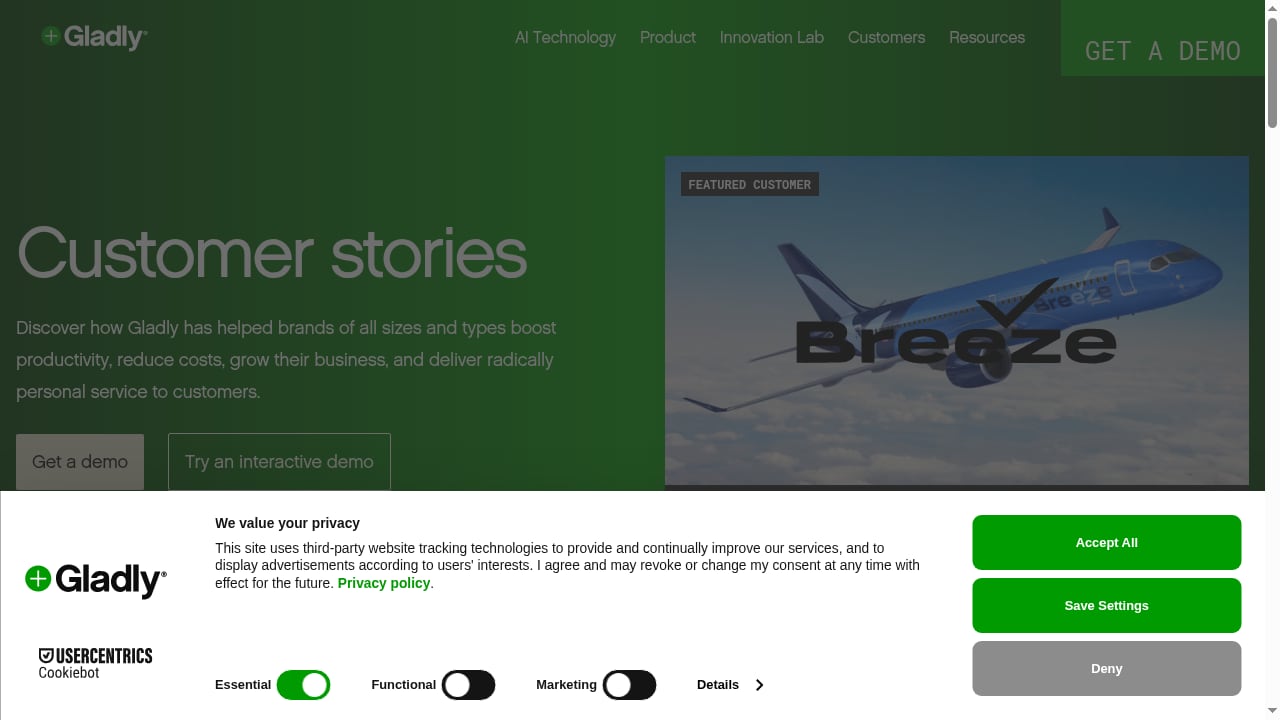
First viewport screenshot of Customers | Gladly.
Gladly's strengths are real and specific:
- One timeline per customer. For retail, apparel, beauty, and travel brands, where a shopper may call, chat, and DM over months, the persistent conversation model removes the "let me pull up your account" problem entirely.
- Native voice. Voice is a first-class channel, not an add-on. That matters for brands whose customers still pick up the phone.
- People Match routing. Gladly's patented routing engine assigns customers to the best-suited agent based on history, status, sentiment, and skill, rather than the next available person.
- Service-to-revenue features. Chat Payments lets agents collect payment inside a conversation, and the Commerce Agent is positioned to handle both pre-purchase product questions and post-purchase returns in one agent.
Gladly's customer logos, including Crate & Barrel, Nordstrom, Ulta Beauty, TUMI, UGG, and Breeze Airways, reflect its focus on high-lifetime-value consumer brands.
Where Gladly's model creates friction
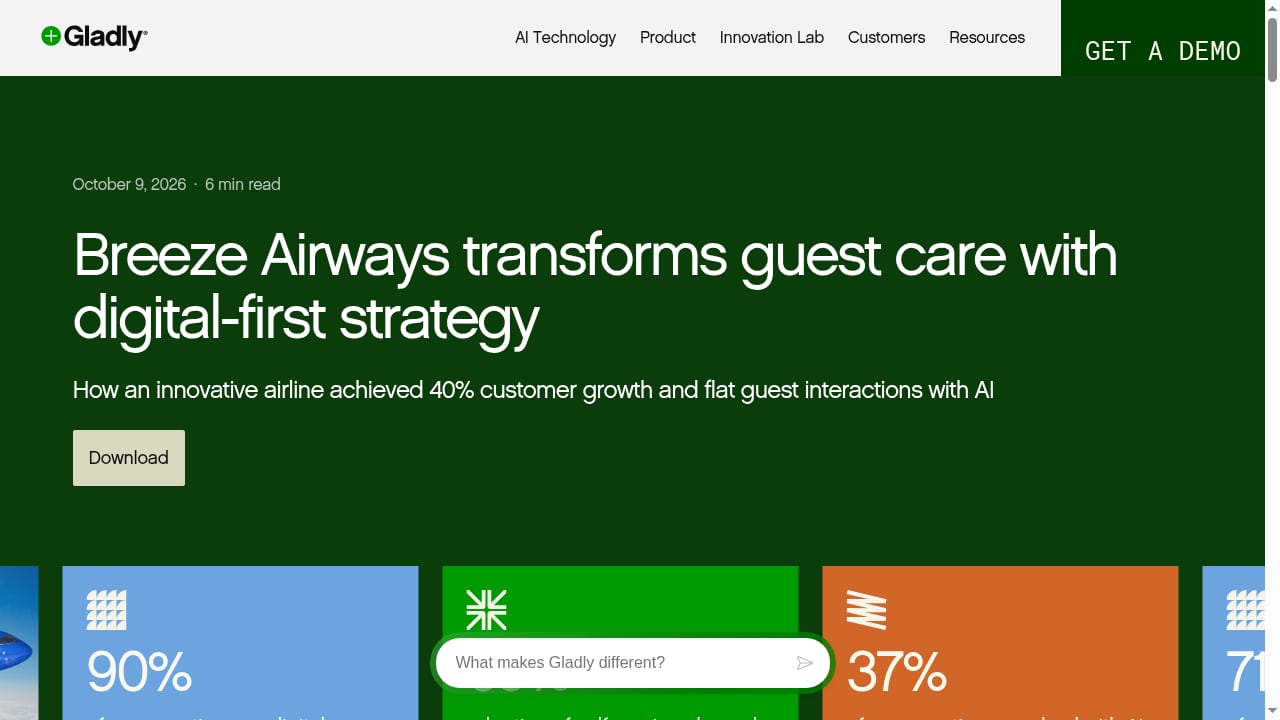
First viewport screenshot of Breeze Airways pioneers digital-first service | Gladly.
Gladly's design is opinionated, and that cuts both ways.
It is a weaker fit outside B2C retail and travel. Gladly is not built around tickets, SLAs, assets, or approval workflows the way a classic B2B or IT service desk is. If your support operation runs on escalations and service-level commitments, the customer-centric model is more platform than you need.
Pricing is opaque and premium. Gladly does not publish prices. Third-party estimates put seats around $180 per user per month with roughly a 10-seat minimum, which puts it out of reach for small teams and price-sensitive buyers. Anyone quoting exact figures is relying on customer reports and analyst estimates, not published rates.
Headline AI numbers deserve scrutiny. Gladly's homepage currently leads with commerce outcomes such as +19% conversion and 41% of carts saved rather than resolution rate. Those figures are best-case marketing; actual results depend on your content quality, catalog, return policies, and how repetitive your contact mix is.
Agentic commerce is still emerging. Gladly's Agentic Commerce extends its agent to AI platforms such as ChatGPT, Perplexity, and Gemini. That is a genuinely new surface, and it is not yet a mature, buyable category with a long track record.
What Intercom does well
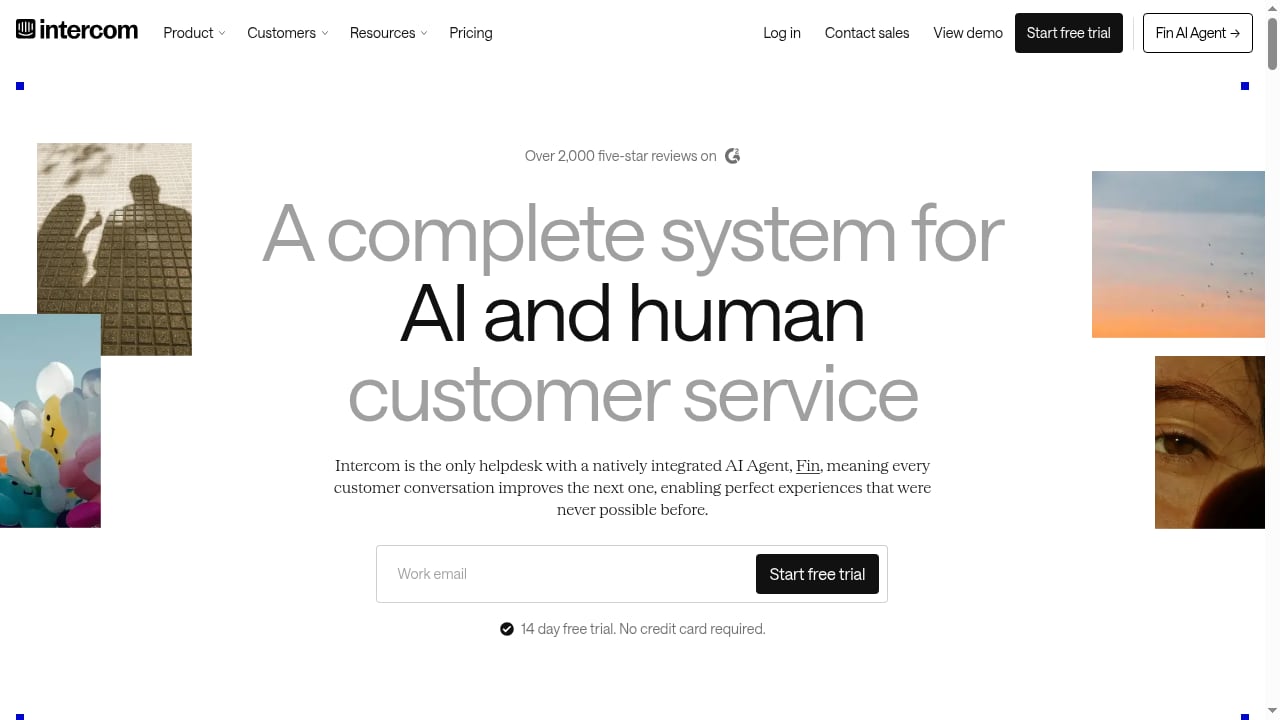
First viewport screenshot of Intercom | A complete system for human and AI customer service.
Intercom's positioning is "the only helpdesk with a natively integrated AI Agent," and that integration is the point.
- Fin AI Agent. Fin handles customer conversations inside the same system your human agents use, so context, knowledge, and handoffs stay consistent.
- Helpdesk plus AI in one stack. Support teams get inboxes, automation, bots, and AI insights without stitching together separate vendors.
- Proof at scale. Intercom reports more than 30,000 brands using the platform. Customer stories include AgriWebb reducing support costs by 80% and AI21 Labs automating 82% of support.
- Transparent entry point. A 14-day free trial with no credit card required, plus a pricing calculator for estimating costs by team size and expected outcomes, makes evaluation easier than a demo-only sales process.
- Broad fit. Intercom serves startups through large enterprises, and its use cases span support automation, cost reduction, multilingual support, and unifying digital and in-store experiences.
If you are evaluating the platform hands-on, our step-by-step guide to using Intercom covers Messenger setup, channel connections, knowledge base building, and Fin launch.
Where Intercom's model creates friction
Intercom is not a commerce platform. It does not offer in-chat payments or a shopping agent designed to convert browsers into buyers the way Gladly's Commerce Agent does. For a premium retail brand where service conversations are expected to close sales, that is a meaningful gap.
Its ticket-and-conversation data model also means that a customer who contacts you across five channels over two years may appear as multiple conversations rather than one continuous relationship timeline. Teams that prioritize lifelong customer memory will notice the difference.
Head-to-head comparison
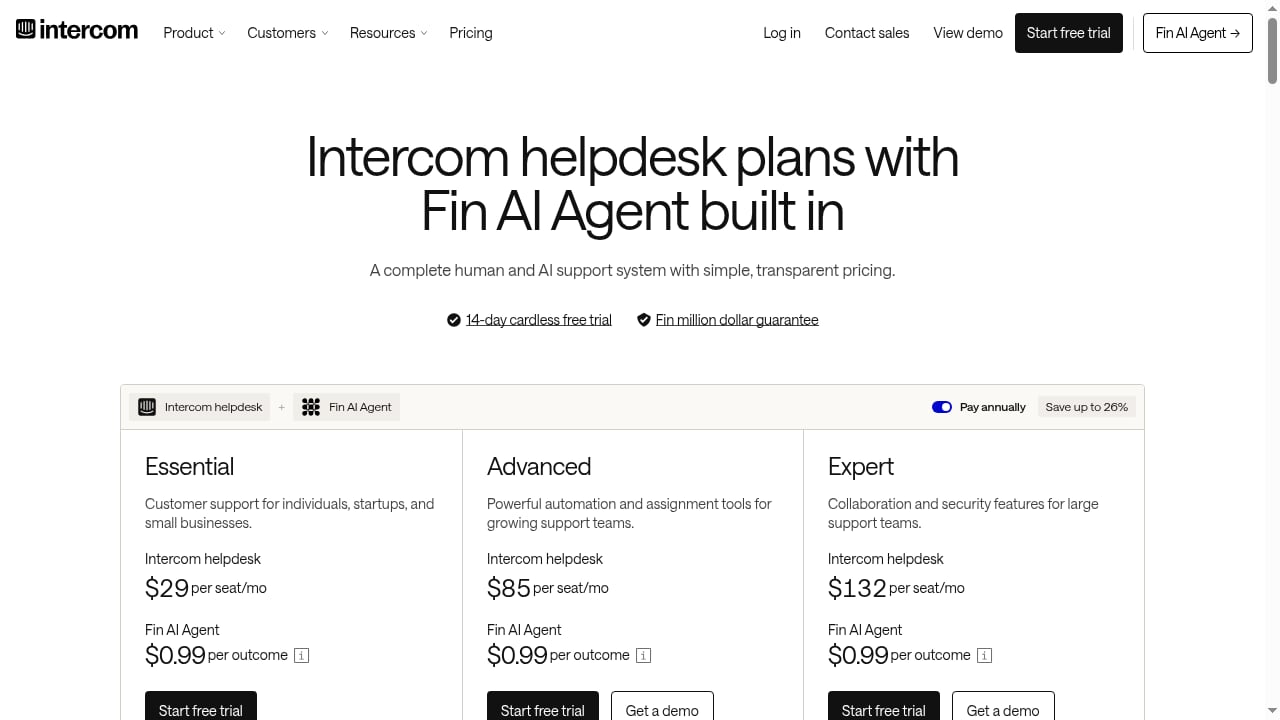
First viewport screenshot of Intercom Pricing | Plans for every team size.
| Dimension | Intercom | Gladly |
|---|---|---|
| Core model | Helpdesk with natively integrated AI agent | One lifelong conversation per customer, no tickets |
| AI agent | Fin AI Agent | Gladly AI / Gladly Commerce Agent (formerly Sidekick) |
| Channels | Digital channels plus in-store experience use cases | Voice, email, SMS, chat, social, all native |
| Commerce features | Not a commerce platform | Chat Payments, Commerce Agent, pre-purchase engagement |
| Pricing transparency | Free trial, pricing calculator, published entry pricing | No published pricing; third-party estimate ~$180/user/month, ~10-seat minimum |
| Best fit | Support teams across B2B and B2C, startups to enterprise | B2C retail, apparel, beauty, and travel brands with high LTV |
| Main limitation | No native commerce or payment layer | Premium cost, narrow B2C focus, emerging agentic commerce surface |
How to decide
Choose Gladly if you run a B2C retail, ecommerce, or hospitality brand where repeat purchases drive the business, you want voice handled natively, and you want service and commerce blended rather than living in separate stacks. You should also be comfortable with a demo-led sales process and a premium price point.
Choose Intercom if you want a helpdesk and AI agent in one system, you support a mix of B2B and B2C customers, you value published pricing and a self-serve trial, or you need AI-driven insights across a broad support operation.
Consider neither as a direct substitute if your team is an internal IT or B2B service desk with strict SLAs and approval workflows. Gladly is not built for that, and Intercom's commerce-adjacent use cases will not map either. Our B2B support strategy guide covers what those teams should prioritize instead.
If you are comparing a wider field, our Intercom vs Genesys Cloud CX vs Front comparison puts both platforms in context against other enterprise options.
Related reading
- Enjo Review 2026: AI Support Agent That Resolves End to End - Evidence-based Enjo review: end-to-end AI resolution, AI Actions, pricing signals, setup, limitations, and who should buy it in 2026.
- How to Use Intercom: Setup, Fin AI Agent & Best Practices - Learn how to use Intercom step by step: install the Messenger, connect channels, build your knowledge base, launch Fin AI Agent, and measure results.
- B2B Support in 2026: Strategy, AI Agents & Best Practices - Learn what B2B support is, how it differs from B2C, and how AI agents, SLAs, and multi-channel helpdesks improve retention and revenue.
Sources and further reading
- 12 Best AI Ecommerce Platforms in 2026, Compared by Use Case - Compare 12 best AI ecommerce platforms by use case — support, search, merchandising & analytics. See features, pricing, and real ROI results.
- What Is Gladly? Features, Pricing and Who It's For (2026) - Gladly is a customer service platform built on one lifelong conversation per customer. No public pricing; estimates put seats near $180/user/month.
- The best conversational commerce platforms compared (2026) - Explore what conversational commerce means in the LLM era and compare 4 platforms to equip your store.
FAQ
Is Gladly a direct competitor to Intercom?
Partially. Both offer AI-powered customer service, but Gladly is purpose-built for consumer brands that want service to drive commerce, while Intercom is a general-purpose helpdesk with a natively integrated AI agent. They overlap in conversational support and diverge sharply on commerce features and target market.
Does Intercom have an AI agent like Gladly's Commerce Agent?
Yes, Intercom has Fin, a natively integrated AI agent that resolves customer conversations inside the helpdesk. Fin is built for support resolution rather than pre-purchase selling or in-chat payments, which is where Gladly's Commerce Agent is positioned.
How much does Gladly cost compared to Intercom?
Gladly does not publish pricing; third-party estimates put seats around $180 per user per month with a roughly 10-seat minimum. Intercom publishes entry pricing, offers a pricing calculator, and provides a 14-day free trial with no credit card required, making cost evaluation more transparent up front.
Which platform is better for ecommerce support?
Gladly is the stronger fit if your ecommerce brand depends on high customer lifetime value, native voice, and blending service with selling. Intercom is the stronger fit if you want a broadly capable AI helpdesk with transparent pricing and a fast self-serve start.
Can Gladly handle B2B support?
Gladly is a weaker fit for B2B, IT, or internal-support teams because it is not built around tickets, SLAs, assets, and approval workflows. Intercom is more adaptable across B2B and B2C support operations.
Conclusion
Intercom and Gladly are not interchangeable. Gladly is an agentic commerce platform for premium consumer brands that want one lifelong conversation per customer and service that contributes to revenue. Intercom is an AI-first helpdesk with a natively integrated AI agent, built to automate and scale support across industries and company sizes, with published pricing and a free trial that make it easy to evaluate.
If your business is retail or travel and your customers' lifetime value justifies a premium, relationship-first platform, Gladly's model is worth a demo. If you want a complete system for human and AI customer service with transparent costs and broad applicability, Intercom is the more practical starting point.