Intercom vs HappyFox vs Botpress: 2026 AI Support Compared
Intercom vs HappyFox vs Botpress: Which AI Support Platform Fits in 2026?
Three platforms keep surfacing in the same shortlist, but they are not really the same kind of product. Intercom is an AI-first customer service platform where the AI Agent, Fin, is built into the helpdesk. HappyFox is a broad AI support suite spanning help desk, IT service management, and CRM. Botpress is an enterprise AI agent platform for teams that want to build and control their own agents. This comparison looks at where each one is genuinely strong, where the trade-offs sit, and how to decide without relying on vendor resolution claims alone.
The three platforms at a glance

HappyFox product interface.
| Platform | Core identity | Pricing shape | Best fit |
|---|---|---|---|
| Intercom | AI-first customer service platform with Fin AI Agent natively integrated into the helpdesk | Outcome-based plans (Essential, Advanced, Expert) plus per-resolution AI pricing | Teams that want AI resolution and a full helpdesk in one system |
| HappyFox | AI-powered customer service and IT support suite | Per-agent plans, with AI capabilities priced separately in some cases | Small and mid-size teams that want structured ticketing plus AI add-ons |
| Botpress | Enterprise AI agent platform for customer support | Free tier plus pay-per-usage; no per-seat cost | Technical teams building custom agents that sit on top of an existing helpdesk |
A useful way to read this table: Intercom sells a complete service platform, HappyFox sells a support suite with AI layered across it, and Botpress sells the AI layer itself. That difference drives almost every other decision.
Where Intercom has a clear advantage
Intercom's main structural advantage is that Fin is not bolted onto the helpdesk. The AI Agent, the shared inbox, the Help Center, and the messaging channels are part of one system, which shortens the path from signup to a working AI deployment. Teams already using Intercom can turn Fin on against the workflows and content they already have, rather than migrating data or rebuilding routing rules.
That native integration also matters for context. When a conversation moves from live chat to email or in-app messaging, the agent and the AI share the same history. For a deeper look at why that matters operationally, see how to maintain context across channels.
Other supported strengths:
- Fin AI Agent handles customer conversations directly, with Copilot assisting human agents inside the same inbox.
- AI Insights turns conversation data into reporting without a separate analytics tool.
- Multi-channel coverage spans live chat, email, in-app messaging, phone, and self-service through the Help Center.
- Outbound messaging lets teams reach customers proactively from the same platform.
- Scale and track record: Intercom reports more than 30,000 brands using the platform, from small teams to large enterprises, and offers a solution partner program for agencies and consultants.
If your priority is the fastest route to a functioning AI agent inside a full helpdesk, Intercom is the strongest of the three on that specific criterion.
Where HappyFox is genuinely strong

HappyFox product interface.
HappyFox competes on breadth and structure rather than AI-first design. Its suite covers Help Desk, AI Contact Center for voice, Autopilot for repetitive tasks, Chatbot for self-service, HappyFox AI across channels, and IT Service Management with Service Desk, Assist AI, and Workflows. It also extends into adjacent territory with HappyFox CRM and an upcoming Answer Engine Optimization product.
That breadth is real, and it shows up in a few practical ways:
- Structured ticketing workflows. Teams that live inside queues, categories, and process controls will find HappyFox familiar and well organized.
- IT service management. Organizations that need both customer support and internal IT support in one vendor have fewer moving parts to manage.
- Industry fit. HappyFox serves education, ecommerce, healthcare, and real estate, among others, and caters to small businesses, mid-market, and enterprise buyers.
- Cost profile. Per-agent pricing with AI priced separately can be easier to forecast for teams with stable headcount and modest automation needs.
One caveat worth checking directly with the vendor: because AI capabilities are priced separately from standard plans in some configurations, the total cost of ownership can be higher than the base per-agent rate suggests. Ask for a quote that includes the AI features you actually intend to use.
Where Botpress is genuinely strong
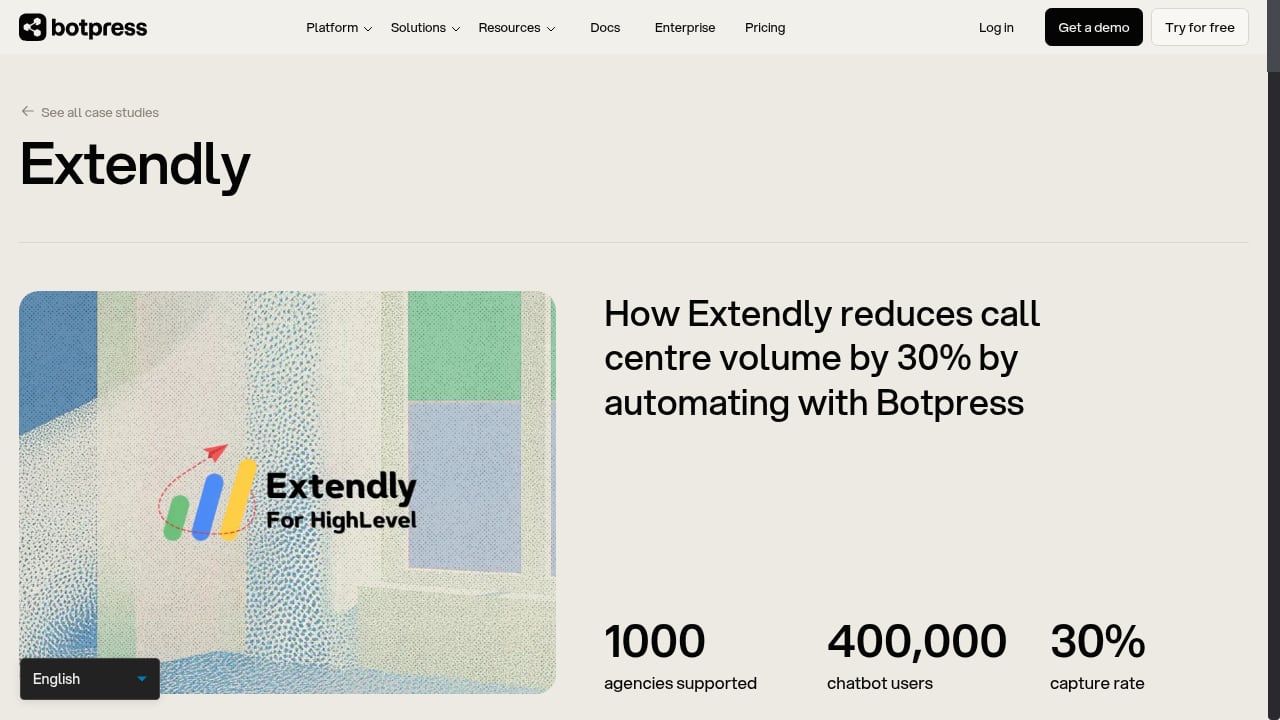
First viewport screenshot of How Extendly reduces call centre volume by 30% by automating with Botpress.
Botpress takes the opposite approach to Intercom. Instead of bundling AI into a helpdesk, it provides the infrastructure to build agents that handle support tickets, including complex ones. The platform includes Botpress Studio for visual agent building, a natural language builder, Botpress Engine as AI infrastructure, and core components like Knowledge Bases, Tables, and Escalate. Botpress Desk positions itself as an AI helpdesk built for complex support.
Its strongest arguments:
- No per-seat cost. Pricing is pay-per-usage, which suits teams that want to scale AI without scaling license fees.
- A generous free tier with no upfront commitment, useful for prototyping before a purchase decision.
- Deep customization. Technical teams can build multi-step agents that take actions, not just answer questions.
- Interoperability. Botpress integrates with Intercom, Zendesk, HubSpot, and Salesforce, and deploys across webchat, WhatsApp, and Slack.
- Support use cases include escalation and handoff, ticket enrichment, AI actions, ticket deflection, and ticket management.
- Proof points: Super Dispatch tripled AI resolution to 66% and cut cost per resolution to 67 cents; Extendly reduced call center volume by 30%; Fromages d'ici resolved 99% of customer queries; hostifAI handled 75% of conversations without humans.
Botpress also offers a managed plan where its team helps build and deploy agents, and cites customers including Thomson Reuters and the Quebec Government. The trade-off is configuration effort: this is a platform you build on, not one you switch on.
Pricing models compared
Pricing is where these three diverge most, and where vendor marketing is least helpful.
Intercom uses outcome-based plans (Essential, Advanced, Expert) with AI priced around resolutions, plus a free trial. You pay for results rather than seats on the AI side, which aligns cost with value but makes spike months harder to predict.
HappyFox uses per-agent pricing, with AI capabilities priced separately in some configurations. That is predictable for stable teams, but the AI line item needs to be modeled explicitly rather than assumed to be included.
Botpress uses a free tier plus pay-per-usage, with no per-seat cost. For technical teams, this can be the cheapest path at scale, but it assumes you have the engineering capacity to build and maintain agents.
Whichever platform you evaluate, model your worst month, not your average one. A product outage or a viral complaint can multiply resolution-based and usage-based bills in ways per-seat pricing does not.
What "resolution rate" actually hides
Every vendor in this category publishes an accuracy or resolution figure, and none of them define it the same way. Some count a ticket as resolved when the customer stops replying, which includes people who simply gave up. Others measure against a post-resolution CSAT survey, a much harder bar. A 99% resolution claim and a 66% resolution claim may not be measuring the same event at all.
The practical fix is to ask each vendor for their resolution definition in writing, then test it against your own ticket sample during a trial. If you are comparing more platforms, our Intercom vs Ultimate AI vs Freshdesk breakdown walks through the same question across a different shortlist.
How to choose between the three
First viewport screenshot of Botpress Customer Stories | Transforming Businesses with AI.
Choose Intercom if you want an AI Agent and a full helpdesk in one system, you value fast deployment over deep customization, and you want AI resolution, agent assistance, analytics, and outbound messaging under one roof. It is also the natural choice if you are already an Intercom customer.
Choose HappyFox if you need structured ticketing, IT service management, and a broad suite from a single vendor, and your team size and ticket volume are stable enough that per-agent pricing is easy to forecast. Verify the AI pricing line before you commit.
Choose Botpress if you have technical resources to build custom agents, you want to avoid per-seat costs, and you are comfortable running Botpress alongside an existing helpdesk such as Intercom, Zendesk, HubSpot, or Salesforce.
A pattern worth noting: Botpress and Intercom are not strictly mutually exclusive. Some teams run Botpress agents on top of an Intercom helpdesk, which means the real question is whether you want to build your AI layer or buy it integrated.
Related reading
- Intercom vs Genesys Cloud CX: AI Support Compared 2026 - Intercom vs Genesys Cloud CX compared for 2026: AI resolution vs contact center orchestration, pricing models, time to value, and which fits your team.
Sources and further reading
- Best AI Customer Support Tools in 2026: Full Comparison & Buyer’s Guide - FutureLume - AI Tools AI agents now close out a growing share of support tickets without a human ever touching them. But the platforms competing for your subscription differ wildly in pricing model, real-world accuracy, and what happens the moment a customer gets angry. Here's the comparison that skips the sales deck. What's in this guide The
- Best help desk software with AI automation in 2026 - Compare the top help desk platforms with AI automation, including Deskpro, Zendesk, Freshdesk, and Intercom.
- 13 Best AI Help Desk Software Tools for 2026 - AI cut response times by 22% in an HBS study. Compare the 13 best AI help desk software tools for smarter support in 2026.
FAQ
Is Intercom or HappyFox better for small support teams?
It depends on what you need first. Intercom bundles AI resolution and the helpdesk together, which reduces setup work. HappyFox offers structured ticketing at a per-agent price that can be easier to budget for small, stable teams. Compare total cost including AI features, not just the base plan.
Can Botpress replace Intercom entirely?
Botpress can handle support tickets and complex agent workflows, and it integrates with Intercom. Whether it replaces a helpdesk depends on how much ticketing, reporting, and channel management you need outside the AI layer. Many teams run it alongside an existing helpdesk rather than instead of one.
Which platform has the most predictable pricing?
HappyFox's per-agent model is the most predictable for stable headcount, though AI features may be priced separately. Intercom and Botpress both tie cost to outcomes or usage, which aligns spending with volume but requires worst-case modeling.
Do these platforms support voice support?
HappyFox includes AI Contact Center for voice. Intercom supports phone as one of its channels. Botpress deploys across webchat, WhatsApp, and Slack, with voice handled through integrations or custom builds. Confirm current voice capabilities directly with each vendor, since this area changes quickly.
How should I run a fair trial across all three?
Define your own resolution criteria before you start, run the same ticket sample through each platform, and measure escalation behavior, not just deflection. If you want a structured approach to evaluating AI help desks, our Deskpro review shows how one platform's AI features hold up under that kind of scrutiny.
Conclusion
Intercom, HappyFox, and Botpress are not three versions of the same product. Intercom is the strongest option when you want an AI Agent natively integrated into a full customer service platform and fast time to value. HappyFox is a credible choice for teams that need a broad support and IT service suite with structured workflows. Botpress is the right fit for technical teams that want to build custom AI agents without per-seat costs.
The decision usually comes down to one question: do you want to buy an integrated AI support platform, buy a support suite with AI layered on, or build your own AI layer on top of an existing helpdesk? Answer that first, and the shortlist narrows itself.