Intercom vs Jitbit Helpdesk vs Tidio: 2026 Comparison
Intercom vs Jitbit Helpdesk vs Tidio: Which Support Platform Fits in 2026?
Three tools, three different starting points. Intercom is built around an AI agent that resolves conversations end to end. Jitbit Helpdesk is a ticketing system with AI layered into the agent workflow. Tidio is a chat-first platform that automates conversations and nudges shoppers toward a purchase.
That difference in origin shapes everything else: how you set each one up, what it costs, and which support team gets the most out of it. This comparison walks through the criteria that actually change a buying decision, and it names the cases where each tool is the stronger choice.
Quick comparison at a glance
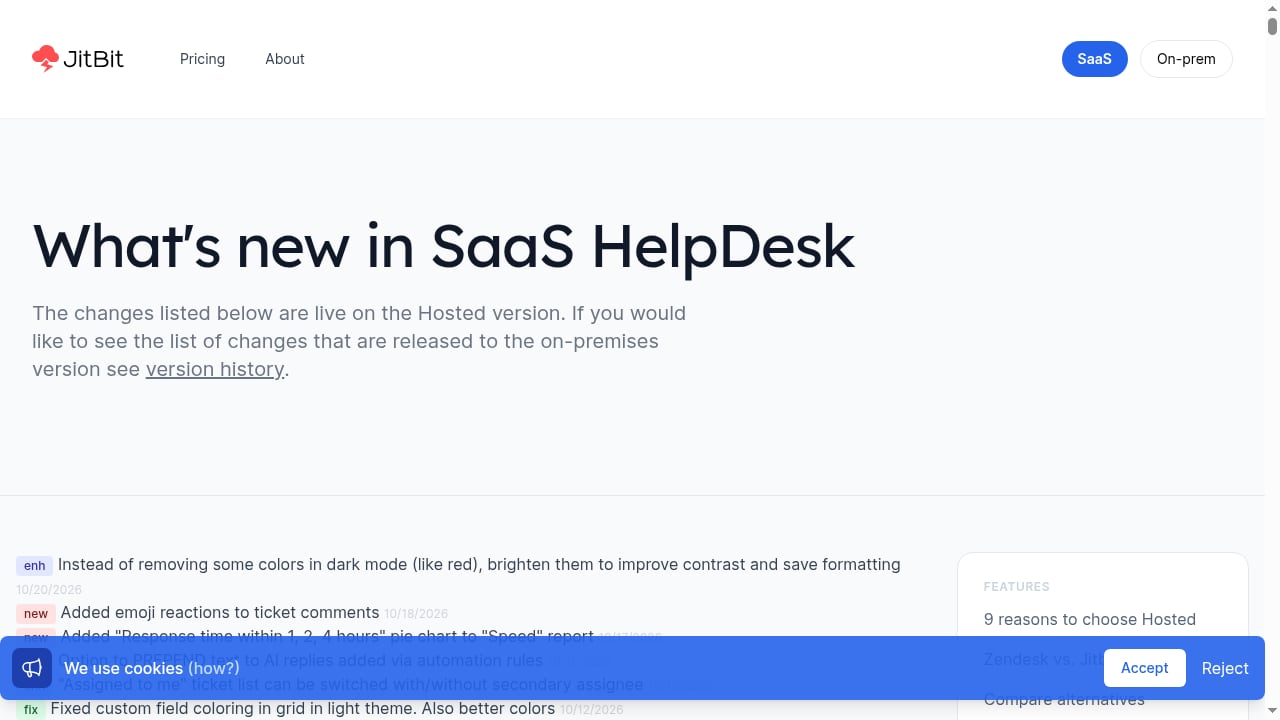
First viewport screenshot of SaaS Helpdesk change log.
| Criterion | Intercom | Jitbit Helpdesk | Tidio |
|---|---|---|---|
| Core design | AI-first customer service platform with a natively integrated AI Agent, Fin | Email-first help desk and ticketing system | AI customer service and help desk built around live chat |
| AI approach | Fin AI Agent handles customer conversations; AI Insights surfaces trends | AI assistant drafts replies, summarizes threads, triages tickets, and can post first-line replies | Lyro AI Agent answers questions and hands complex cases to humans |
| Deployment | SaaS | SaaS or self-hosted on Windows servers | SaaS |
| Pricing model | Essential, Advanced, and Expert plans; outcome-based pricing | Flat per-agent plans | Free plan, AI conversation-based billing, premium plans |
| Free trial | 14 days, no credit card required | 21 days, no credit card required | Free plan available |
| Strongest fit | Teams that want AI resolution as the primary support layer | Teams that want a full ticketing system with AI included and predictable bills | Ecommerce and SMB teams that want chat-led automation and sales support |
Where Intercom stands out
Intercom's defining claim is architectural: it describes itself as the only helpdesk with a natively integrated AI Agent, Fin. In practice, that means the AI agent and the helpdesk are one product rather than two systems connected by an integration. Every customer conversation becomes training material for the next one, so resolution quality compounds as volume grows.
The platform is organized around three pillars: the Fin AI Agent for service, the helpdesk for human agents, and AI Insights for spotting patterns in what customers ask. Intercom reports more than 30,000 brands using the platform, with published customer stories from companies such as Kalshi, Anthropic, and Nuuly.
Pricing runs on Essential, Advanced, and Expert plans with outcome-based pricing, and Fin AI Agent is included. A 14-day free trial covers both the helpdesk and Fin, with no credit card required. For a deeper look at how the agent performs in practice, see this Intercom review of the AI helpdesk and Fin Agent.
Choose Intercom when: AI resolution is the centerpiece of your support strategy, you handle high volumes of customer-facing conversations, and you want the agent and the helpdesk to share one system of record.
Where Jitbit Helpdesk stands out
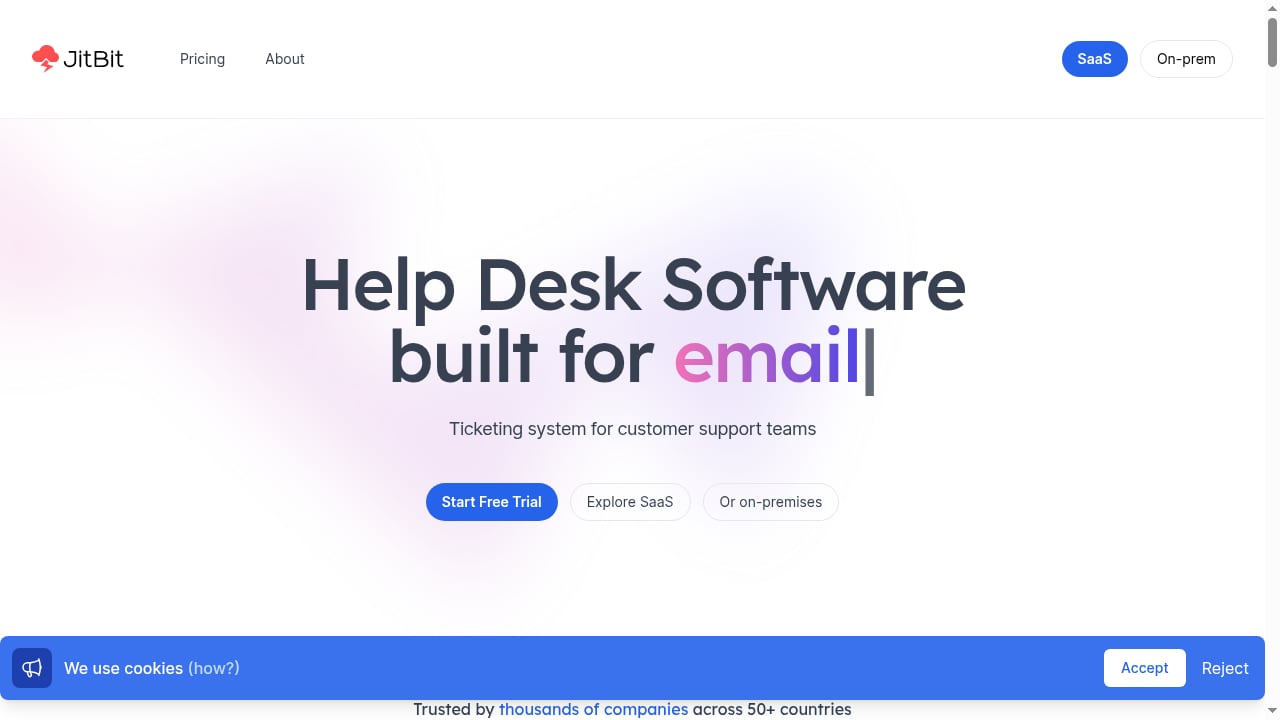
First viewport screenshot of Help Desk Software by Jitbit.
Jitbit starts from email and does it well. You forward a support mailbox to the helpdesk and start working tickets within minutes. It supports IMAP, MS Exchange, POP3, SMTP, and O365, and adds built-in anti-spam, deduplication, and flood protection so a shared inbox does not turn into a mess.
Two strengths deserve attention. First, deployment flexibility: Jitbit offers both hosted SaaS and a self-hosted edition for Windows servers, which matters to organizations with data-residency rules or legacy infrastructure. Second, pricing predictability: flat per-agent plans mean you can forecast next quarter's bill without a spreadsheet model, and AI credits are included from the Startup plan upward.
The AI features are built into the ticketing workflow rather than sold as a separate product. An assistant panel drafts replies grounded in your knowledge base, external documentation, canned responses, and similar closed tickets. It can summarize long threads, clean up drafts, and turn solved tickets into new knowledge base articles. Automation rules can run AI triage on incoming tickets and post first-line replies either to the customer or as internal notes for review.
Jitbit also serves regulated and public-sector buyers: healthcare organizations can sign a BAA for HIPAA compliance, and government teams can use purchase-order billing and on-premise deployment. The company publishes a business continuity plan with AWS redundancy, eight-hour recovery targets, and automated backups, and offers a 21-day free trial without a credit card.
Choose Jitbit when: your team lives in email, you need a self-hosted option, you want flat per-agent pricing with AI included, or you work in a regulated industry that requires a BAA or on-premise deployment.
Where Tidio stands out
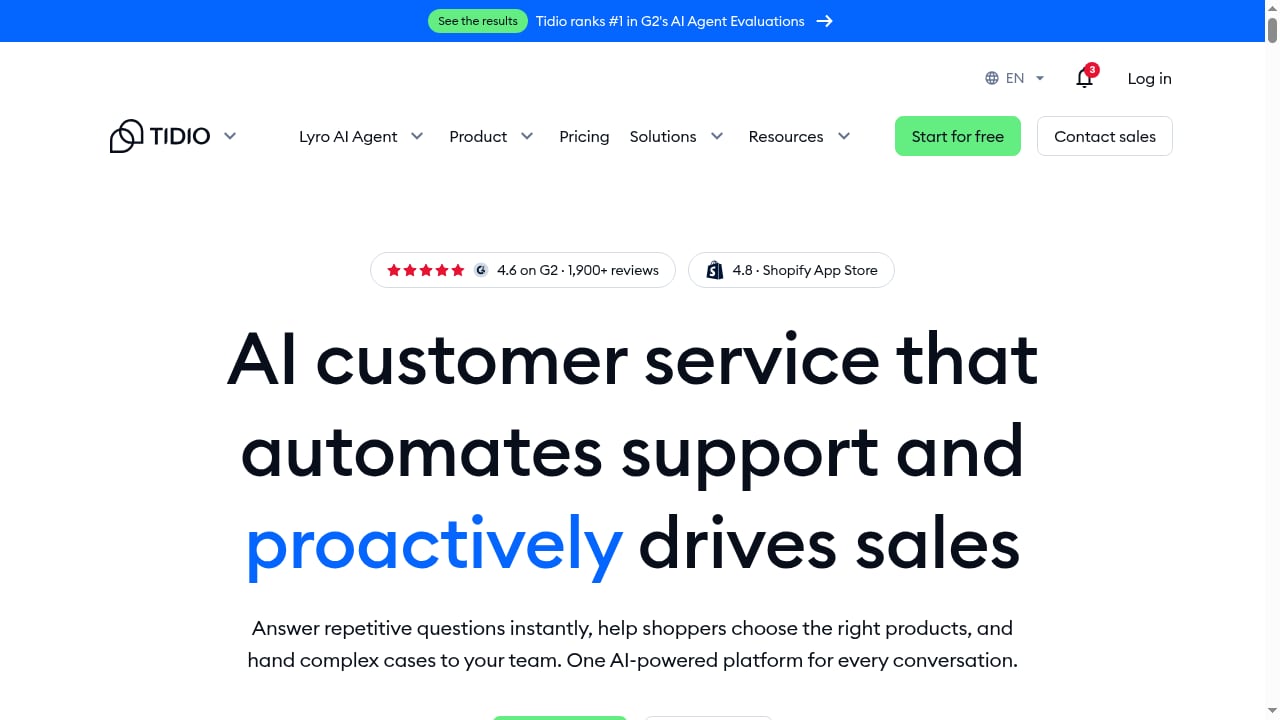
First viewport screenshot of AI Customer Service That Turns Chats Into Revenue | Tidio.
Tidio is the most sales-oriented of the three. Its Lyro AI Agent answers repetitive questions instantly, helps shoppers pick the right product, and hands complex cases to human agents. That combination of support and conversion is why Tidio reports more than 300,000 businesses using the platform, including ADT Security, Praktiker, and Gecko Hospitality.
The platform pairs Lyro with Flows, a decision-tree automation builder, and a unified help desk for live conversations and tickets. Tidio cites AI resolution rates of up to 90% of customer questions handled independently, along with faster response times and the ability to scale support without adding headcount.
Pricing is friendly to small teams: a free plan, AI conversation-based billing, and premium tiers, plus enterprise sales support. Tidio holds SOC 2 Type II, CCPA, and GDPR compliance and rates 4.6/5 on G2 and 4.7/5 on Capterra. For a closer evaluation, read this Tidio review on AI customer service that turns chats into revenue.
Choose Tidio when: you run an ecommerce or SMB support operation, chat is your main channel, and you want automation that also drives sales and lead capture.
How to compare them on the criteria that matter
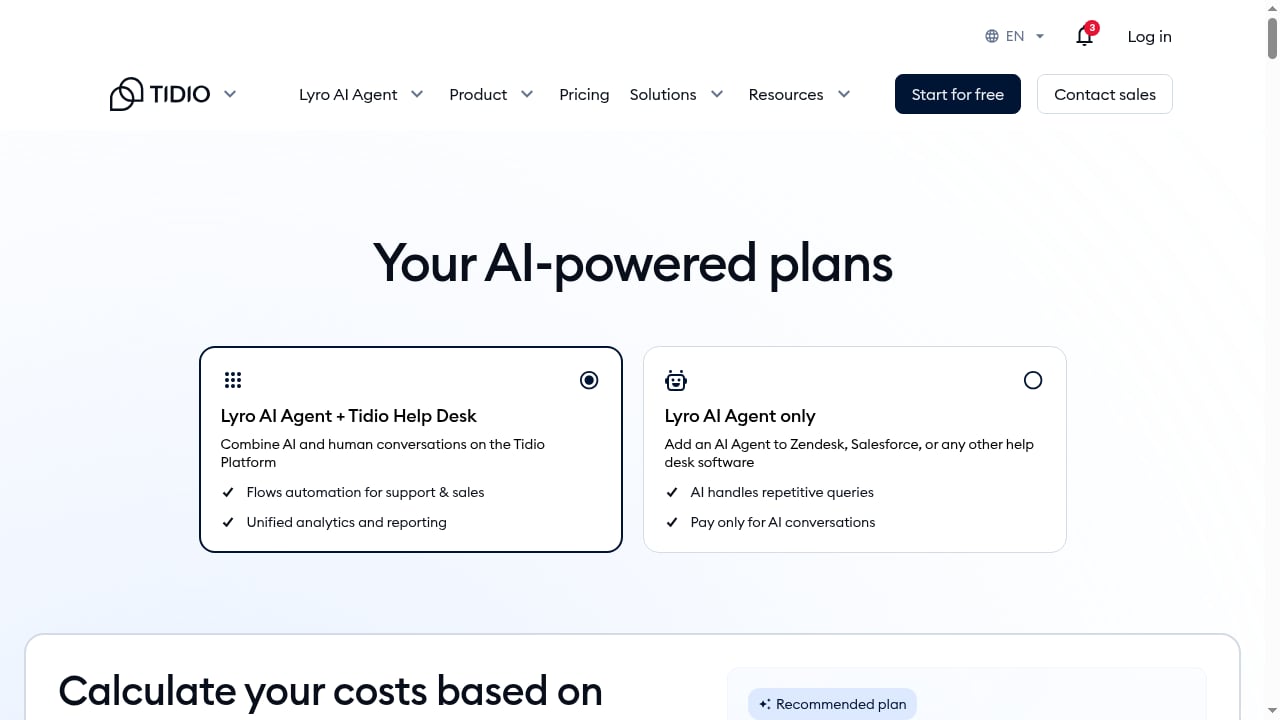
First viewport screenshot of Tidio Pricing—Find the Best Plan for Your Business Needs.
AI depth and how the agent is built
Intercom's advantage here is structural. Fin is not bolted onto the helpdesk; it is the same product, which is why Intercom can claim that each conversation improves the next. Jitbit takes a different route: its AI assists human agents inside the ticket and can also answer customers directly, with model choice that includes GPT and Gemini plus bring-your-own-key options for Claude, Azure OpenAI, or AWS Bedrock. Tidio's Lyro is optimized for fast, high-volume conversational resolution with a strong ecommerce bent.
If your metric is deflection rate on complex, multi-turn customer conversations, Intercom is the strongest of the three. If your metric is agent productivity inside a ticket queue, Jitbit's assistant panel is a serious contender. If your metric is chat conversion, Tidio is built for that.
Ticketing and inbox depth
Jitbit is a ticketing system first, and it shows: automation rules, reports, an API, Active Directory and Google Drive integrations, and a knowledge base are all part of the core product. Intercom pairs its helpdesk with Fin and AI Insights, giving support leaders a view of what customers ask and where the agent succeeds. Tidio's help desk unifies live conversations and tickets but leans toward chat-style workflows.
Email-heavy teams that need routing rules, SLAs, and reporting on agent workload will find Jitbit's ticketing foundation familiar. Teams that want AI resolution and human support in one place will prefer Intercom.
Deployment and compliance
This is where Jitbit has a clear edge for some buyers. A self-hosted Windows edition is rare in this category, and the ability to sign a BAA for HIPAA compliance opens healthcare use cases that SaaS-only vendors cannot serve as easily. Tidio counters with SOC 2 Type II, CCPA, and GDPR compliance, which covers most SaaS and ecommerce buyers. Intercom serves teams of all sizes, from small teams to large enterprises, and publishes customer stories across regulated and high-growth industries.
If on-premise deployment is a hard requirement, Jitbit is the only one of the three that offers it.
Pricing predictability
Jitbit's flat per-agent plans are the easiest to forecast: you know the agent count and the bill. Tidio's free plan and conversation-based AI billing lower the entry barrier for small teams. Intercom uses outcome-based pricing across Essential, Advanced, and Expert plans, with Fin included, which aligns cost with results but requires you to model your expected resolution volume.
A practical approach: estimate your monthly conversation volume, your expected AI resolution rate, and your agent headcount, then price all three against those numbers. The top 10 help desk and ticketing software guide scores platforms on exactly these dimensions if you want a broader shortlist.
Time to value
Jitbit's email-forwarding setup is the fastest of the three to get running. Tidio's free plan and chat widget make it quick to test on a storefront. Intercom's 14-day trial includes both the helpdesk and Fin, so you can measure real resolution rates before committing.
A simple decision framework
- You want AI to resolve customer conversations at scale, with the helpdesk and agent in one system: Intercom.
- You need a full ticketing system, flat per-agent pricing, or a self-hosted deployment: Jitbit Helpdesk.
- You run an ecommerce or SMB business where chat should support and sell: Tidio.
If you are also weighing other AI-first platforms, this Intercom vs Chatbase comparison covers how a dedicated AI support platform differs from a chatbot builder.
Related reading
- CoSupport AI Review 2026: Pricing, Accuracy & Real Fit - Evidence-based CoSupport AI review: how its autonomous agent and drafting assistant perform, pricing models, setup, limitations, and who should buy in 2026.
- Ensure Compliance in AI Customer Service: A Practical Guide - Learn how to ensure compliance in AI-first customer service with practical steps for AI agents, helpdesks, data privacy, and audit-ready support operations.
Sources and further reading
- Best AI helpdesk solutions in 2026 - Six AI helpdesk options compared for 2026 - from a free Copilot Studio agent grounded on SharePoint to Jitbit, Fin, Tidio, Freshdesk and ServiceNow. Pros, cons and real pricing for each.
- SaaS help desk software: 9 best tools compared for 2026 - SaaS help desk software: 9 tools compared on price, AI, ticketing, and integrations, with G2 ratings checked October 2026.
- 35 Best Customer Support Tools To Build a Scalable Support Stack - Improve your CSAT scores with the best customer support tools. Explore scalable software that automates ticket processing and delights your customers.
Frequently asked questions
Is Intercom more expensive than Jitbit Helpdesk and Tidio?
It depends on volume and model. Jitbit uses flat per-agent pricing, which is easy to forecast. Tidio offers a free plan and conversation-based AI billing, which keeps entry costs low. Intercom uses outcome-based pricing with Fin included, so cost scales with resolutions rather than seats. Teams with high AI resolution rates often find the outcome model competitive; teams with low volumes may prefer flat pricing.
Can Jitbit Helpdesk replace Intercom for customer support?
For email-first ticketing, yes. Jitbit handles email channels, automation, knowledge base, live chat, and AI-assisted replies, and it offers self-hosted deployment. Intercom's advantage is its natively integrated Fin AI Agent, which is designed for high-volume, multi-turn customer conversations rather than ticket assistance alone.
Does Tidio work for B2B SaaS support?
Tidio is used across SaaS as well as ecommerce, services, travel, education, and finance. Its strengths are chat-led automation, fast answers to repetitive questions, and sales conversion. B2B teams with complex, multi-step support processes should test Lyro against their hardest questions before committing.
Which platform offers a free trial?
Intercom offers a 14-day free trial with no credit card required, including the helpdesk and Fin AI Agent. Jitbit offers a 21-day free trial without a credit card. Tidio offers a free plan in addition to paid tiers.
Which tool is best for HIPAA-compliant support?
Jitbit states that it signs a BAA for HIPAA compliance on its Enterprise plan and offers a self-hosted edition, which makes it a strong candidate for healthcare support teams. Buyers in regulated industries should confirm compliance terms directly with any vendor before signing.
Conclusion
These three platforms are not interchangeable, and that is the point. Intercom is the choice when AI resolution is the strategy and you want Fin and the helpdesk in one system. Jitbit Helpdesk is the choice when you need a dependable ticketing foundation, flat pricing, or self-hosted deployment. Tidio is the choice when chat should both support customers and sell to them.
Start with your hardest constraint: deployment rules, budget predictability, or AI resolution targets. That constraint will usually point to one platform before the feature comparison is even finished.