Intercom vs Kore.ai: AI Support Platform Comparison 2026
Intercom vs Kore.ai: AI Support Platform Comparison 2026
Choosing between Intercom and Kore.ai is really a question about what kind of AI program you are building. Intercom pairs a full helpdesk with Fin, an AI Agent that resolves customer conversations across channels. Kore.ai positions itself as an enterprise agentic AI platform for building custom conversational assistants and automating workflows across customer service and employee productivity.
This comparison looks at where each platform fits, what the evidence shows, and how to decide without relying on vendor demos alone.
The core difference in one paragraph
Intercom is a customer service system with AI built in. The helpdesk, inbox, knowledge base, reporting, and Fin AI Agent share one data layer, so a conversation handled by AI can move to a human with full context. Kore.ai is closer to an AI development and orchestration platform: teams design, train, test, and deploy intelligent virtual assistants, often across voice, digital channels, and internal enterprise systems. One is a packaged support product; the other is a flexible builder with more configuration surface.
How Intercom approaches AI customer service
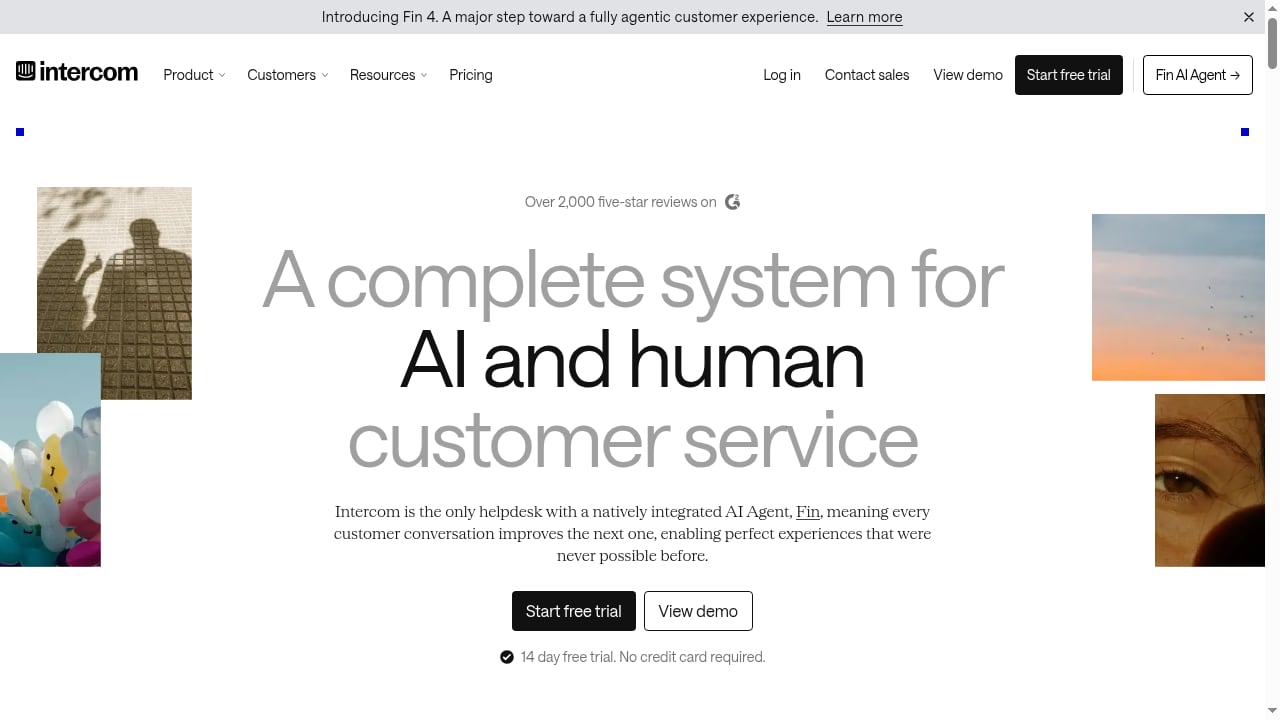
First viewport screenshot of www.intercom.com.
Intercom combines a fully featured AI-powered helpdesk with Fin, a natively integrated AI Agent. The platform is designed to help support teams onboard faster, work more efficiently, and deliver better customer experiences by unifying human agents and AI in one experience.
What the product includes
- An omnichannel inbox and AI-powered ticketing
- Copilot, an AI assistant for human agents
- Workflow automation, multiple team inboxes, and round-robin assignment
- Public and private multilingual help centers
- Pre-built reports
- Fin AI Agent for service, sales, and e-commerce conversations
Fin handles customer conversations across channels and is priced per outcome at $0.99 per resolution. Helpdesk plans are priced per seat per month: Essential at $19/seat/month annually, Advanced at $85/seat/month, and Expert at $132/seat/month. Intercom reports more than 30,000 customers, over 2,000 five-star reviews, and a 14-day free trial with no credit card required.
Where Intercom is strongest
The supported advantages cluster around speed to value and operational simplicity:
- One system for humans and AI. Because Fin lives inside the helpdesk, handoffs, reporting, and knowledge management do not require stitching together separate tools.
- Outcome-based AI pricing. Paying per resolution makes AI cost easier to forecast than seat-based or consumption-based models, and failed attempts or explicit requests for a human are not charged as outcomes.
- Fast onboarding for support teams. The packaged helpdesk means teams can launch without building assistants from scratch.
- Proven resolution results. Kalshi, for example, reports 80k+ monthly Fin resolutions and an 80% automation rate.
For a concrete view of what this looks like in practice, see how Fathom cut response times by 60% and reached 97% CSAT after rebuilding support on Intercom.
How Kore.ai approaches enterprise agentic AI
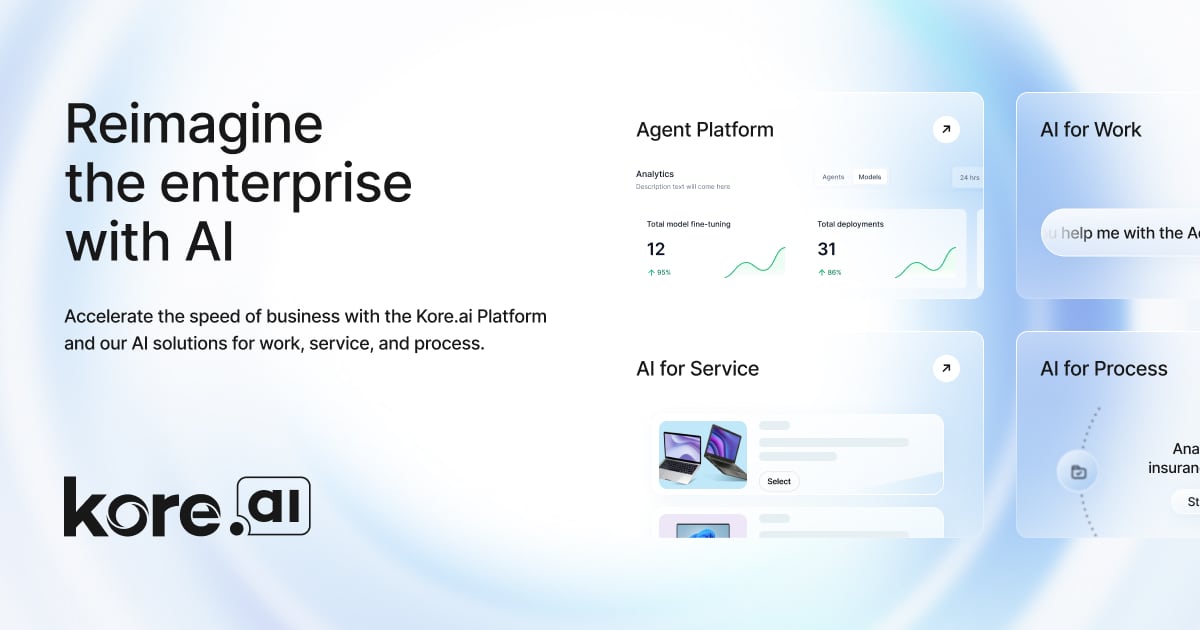
Enterprise Agentic AI Platform | Kore.ai product interface.
Kore.ai is described as a leader in enterprise AI that helps businesses accelerate outcomes across customer service and employee productivity with agentic AI. Its platform is built around designing, testing, training, deploying, analyzing, and managing intelligent virtual assistants.
What the platform emphasizes
- Multi-engine natural language understanding for intent detection
- Customization of assistants to brand voice, tone, and user preferences
- Omnichannel deployment across web, mobile, voice, social media, messaging apps, and smart devices
- Integration with CRM, ERP, HRMS, BI, and RPA systems through connectors and APIs
- Human-in-the-loop routing to live agents
- Chatbot analytics and conversational analytics dashboards
- Pre-built templates for domains such as IT, HR, and banking
- Flexible deployment across cloud, hybrid, and on-premises environments
Where Kore.ai is strongest
Kore.ai's advantages are real and specific: deep enterprise administration, role-based access controls, broad integration options, voice and digital channel coverage, and deployment flexibility that packaged SaaS helpdesks rarely match. Organizations with unusual workflows, strict data residency requirements, or heavy internal automation needs may find that flexibility valuable.
Where the substitute falls short for support teams
The evidence points to several practical limitations buyers should weigh.
Steep learning curve and administrator dependency
An independent platform roundup notes that Kore.ai's administrative interface carries a steep learning curve, making iterative changes dependent on specialized platform administrators. For a support team that wants to update answers, adjust workflows, and ship changes weekly, that dependency can slow improvement cycles.
Builder-first, not helpdesk-first
Kore.ai is oriented toward teams building custom conversational flows. That means more design and configuration work before the first customer conversation is resolved. Intercom's packaged helpdesk and native Fin agent reduce that upfront effort.
Pricing opacity
Kore.ai pricing is quote-only in published comparisons, while Intercom publishes both helpdesk seat pricing and a per-resolution AI rate. Quote-based enterprise contracts can reach six figures annually, which makes budget modeling harder before a sales cycle.
Less transparent AI outcome economics
Intercom's $0.99 per resolution model gives buyers a directly comparable AI usage rate. Kore.ai's usage-based model is not publicly listed, so the cost per resolved conversation must be negotiated and modeled internally.
Mixed evidence on ease of use
Kore.ai's own comparison cites G2 reviewers who found Kore.ai easier to use and set up than Intercom, and who reported issues with Intercom's bot functionality and support quality. That is a vendor-published perspective and should be balanced against independent reviews. The same source also notes reviewers found Intercom more complex and expensive, which underscores that perceived ease of use depends heavily on the buyer's technical resources.
Side-by-side comparison
| Dimension | Intercom | Kore.ai |
|---|---|---|
| Primary orientation | AI-powered helpdesk with native Fin AI Agent | Enterprise agentic AI platform and assistant builder |
| Time to first resolution | Fast; packaged helpdesk and AI agent | Longer; requires design, training, and configuration |
| AI pricing | $0.99 per resolution, published | Quote-only, usage-based |
| Helpdesk pricing | $19–$132 per seat/month, published | Not publicly listed |
| Channel coverage | Chat, email, messaging, and digital channels via helpdesk | Web, mobile, voice, social, messaging, smart devices |
| Customization depth | Workflow automation and configuration within the product | Deep NLU, templates, and enterprise system integration |
| Deployment flexibility | SaaS | Cloud, hybrid, and on-premises |
| Administration | Support-team friendly | Steep learning curve; specialist administrators often needed |
| Best fit | Support teams wanting fast AI resolution and one system | Enterprises building custom assistants across complex systems |
Pricing example: what each model means in practice
Suppose your team handles 10,000 support conversations per month and Fin resolves 60% of them. At $0.99 per resolution, that is roughly $5,940 per month in AI outcome costs, plus helpdesk seats for human agents. If you run a 10-person team on the Advanced plan at $85 per seat per month, seats add about $850 per month.
With Kore.ai, the same scenario requires a custom quote. You would need to model platform fees, usage, implementation services, and administrator time. That does not make Kore.ai more expensive in every case, but it does make the comparison harder to run before engaging sales.
When Kore.ai may be the better choice
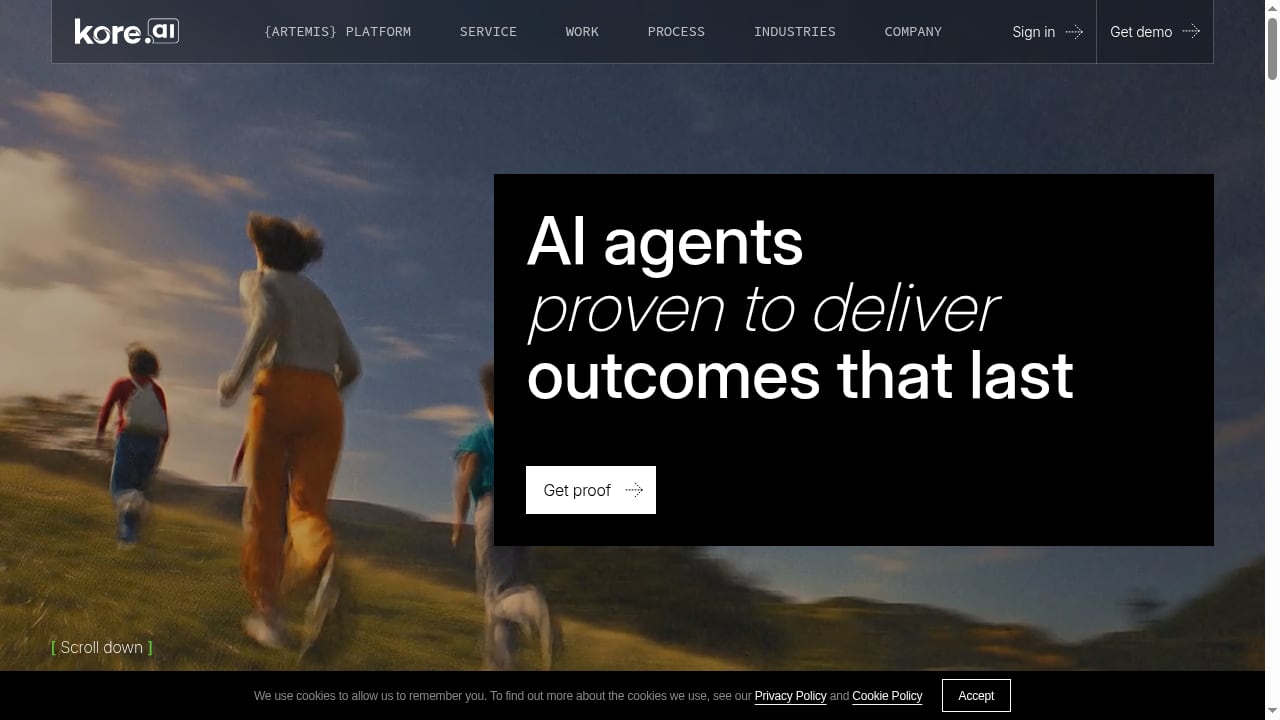
First viewport screenshot of kore.ai.
Kore.ai deserves serious consideration when:
- You need voice and digital assistants built on custom NLU rather than a packaged support agent
- You must integrate deeply with ERP, HRMS, or RPA systems across internal and external use cases
- You require on-premises or hybrid deployment for data residency or security reasons
- You have dedicated platform administrators who can own iterative assistant development
- Your program spans employee productivity and customer service under one enterprise AI strategy
For a deeper look at fit, strengths, limits, and setup effort, read this evidence-based Kore.ai review for 2026.
When Intercom is the better choice
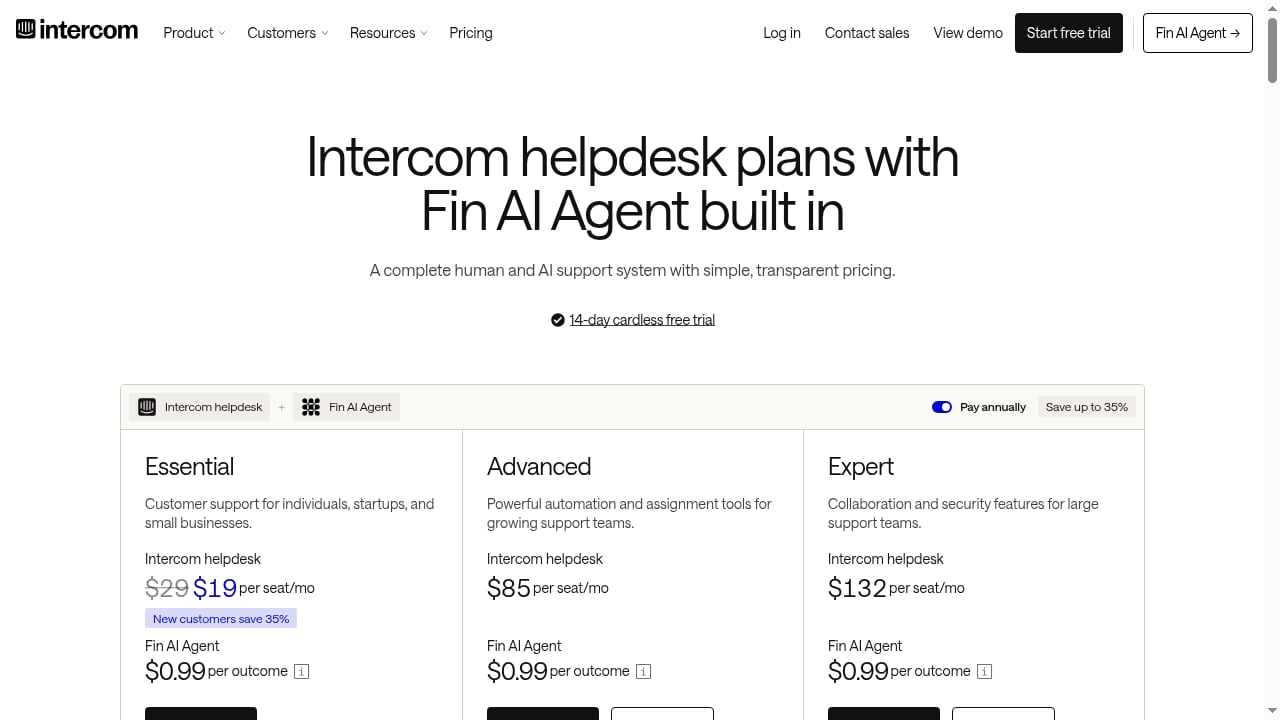
First viewport screenshot of www.intercom.com.
Intercom tends to win when:
- Customer service is the primary use case and you want AI resolving conversations quickly
- You prefer published, predictable pricing over negotiated enterprise contracts
- Your support team needs to manage knowledge, workflows, and reporting without engineering support
- You want human and AI agents working in one inbox with shared context
- You value a large customer base and a free trial to validate results before committing
If you are still mapping the market, this ranking of the top 10 AI customer service agent platforms for 2026 compares resolution quality, channels, integrations, and pricing across vendors.
Decision checklist
Use these questions to narrow the choice:
- Who will own the AI after launch? Support leads favor Intercom; platform administrators favor Kore.ai.
- How predictable must AI costs be? Published per-resolution pricing simplifies forecasting.
- Do you need voice and internal workflows in the same platform? Kore.ai's scope is broader.
- How fast must you launch? Packaged helpdesk plus native AI shortens time to value.
- What deployment constraints apply? On-premises and hybrid requirements point toward Kore.ai.
- How will you measure success? Define resolution rate, CSAT, and cost per outcome before comparing quotes.
Related reading
- How to Use Intercom with Slack: AI Support Meets Team Chat - Connect Intercom with Slack to route alerts, collaborate on tickets, and let AI handle support. Setup steps, workflows, and practical examples.
Sources and further reading
- Kore.ai vs Intercom: AI platform comparison - This post will compare two leading conversational AI platforms, Kore.ai and Intercom, focusing on their strengths and weaknesses.
- 10 Best Conversational AI Platforms for Enterprises - Learn how to evaluate conversational AI platforms on workflow execution, resolution quality, and enterprise readiness.
- 10 Best Agentic AI Customer Service Platforms, Compared - Compare the best AI-powered customer service platforms by pricing, action depth, and guardrails, with a ranked shortlist for enterprise buyers.
FAQ
Is Intercom or Kore.ai better for customer service?
For teams that want an AI-powered helpdesk with a native AI agent and published per-resolution pricing, Intercom is the more direct fit. Kore.ai is better suited to enterprises building custom assistants across voice, digital, and internal systems with dedicated administrative resources.
How does Intercom's Fin AI Agent pricing work?
Fin is priced at $0.99 per resolution. Failed attempts and conversations that explicitly request a human are not charged as outcomes. Helpdesk seats are billed separately, starting at $19 per seat per month annually.
Does Kore.ai publish its pricing?
Published comparisons list Kore.ai as quote-only with usage-based pricing. Buyers should request a full model that includes platform fees, usage, implementation, and ongoing administration.
Can Kore.ai handle voice channels?
Yes. Kore.ai supports omnichannel deployment including voice, web, mobile, social media, messaging apps, and smart devices, with multi-engine NLU for intent detection.
Which platform is easier to set up?
Intercom's packaged helpdesk is designed for faster onboarding by support teams. Independent commentary notes that Kore.ai's administrative interface has a steep learning curve and often requires specialized administrators for iterative changes.
Can I try Intercom before buying?
Yes. Intercom offers a 14-day free trial with no credit card required.
Conclusion
Intercom and Kore.ai solve different problems. Intercom is a complete customer service system where Fin AI Agent, the helpdesk, and human agents operate together, backed by published pricing and fast onboarding. Kore.ai is a flexible enterprise agentic AI platform with deep customization, broad integration options, and deployment flexibility, but also a steeper learning curve, administrator dependency, and quote-only pricing.
If your goal is to resolve customer conversations quickly with predictable AI costs and a support team that can operate the platform itself, Intercom is the stronger fit. If you are building a custom enterprise AI program across voice, internal systems, and complex workflows, Kore.ai may justify the added configuration effort. Evaluate both against your own resolution data, not a scripted demo.