Intercom vs Pylon vs Chatwoot: Which AI Support Platform Wins?
Intercom vs Pylon vs Chatwoot: Which AI Support Platform Wins?
Choosing a customer service platform in 2026 means weighing AI capability, channel coverage, pricing model, and data control. Intercom, Pylon, and Chatwoot each take a different path: Intercom leads with an AI-first helpdesk built around its Fin AI Agent, Pylon specializes in agentic B2B support with deep account context, and Chatwoot offers an open-source, self-hostable alternative with a built-in AI assistant. This comparison breaks down where each platform genuinely excels so you can match the tool to your team's reality.
Quick Comparison: Intercom vs Pylon vs Chatwoot

Pylon product interface.
| Criterion | Intercom | Pylon | Chatwoot |
|---|---|---|---|
| Best for | AI-first customer service across B2C and B2B | B2B support and customer success teams | Teams wanting open-source, self-hosted, or budget-friendly support |
| AI approach | Fin AI Agent resolves conversations natively; Copilot assists agents | Multiple AI agents (Assist, Background, Slack, Support) collaborating with humans | Captain AI assistant drafts replies, suggests answers, automates responses |
| Channel coverage | Live chat, email, in-app messaging, phone, Help Center | Slack, Microsoft Teams, Discord, Telegram, WhatsApp, phone, SMS, chat widget, email | Live chat, email, WhatsApp, Instagram, Facebook, voice calls |
| Pricing model | Outcome-based (Essential, Advanced, Expert) with free trial | Per-seat with seat minimums; AI features may cost extra | Free tier for 2 agents; paid plans from ~$19/agent/month; self-host option |
| Data control | Cloud-hosted | Cloud-hosted | Cloud or self-hosted for full data sovereignty |
| Standout proof | 30,000+ brands; natively integrated AI Agent | 1,500+ B2B companies; Ada chose Pylon for enterprise support | 15,000+ businesses; 21,000+ GitHub stars |
Intercom: AI-First Customer Service at Scale
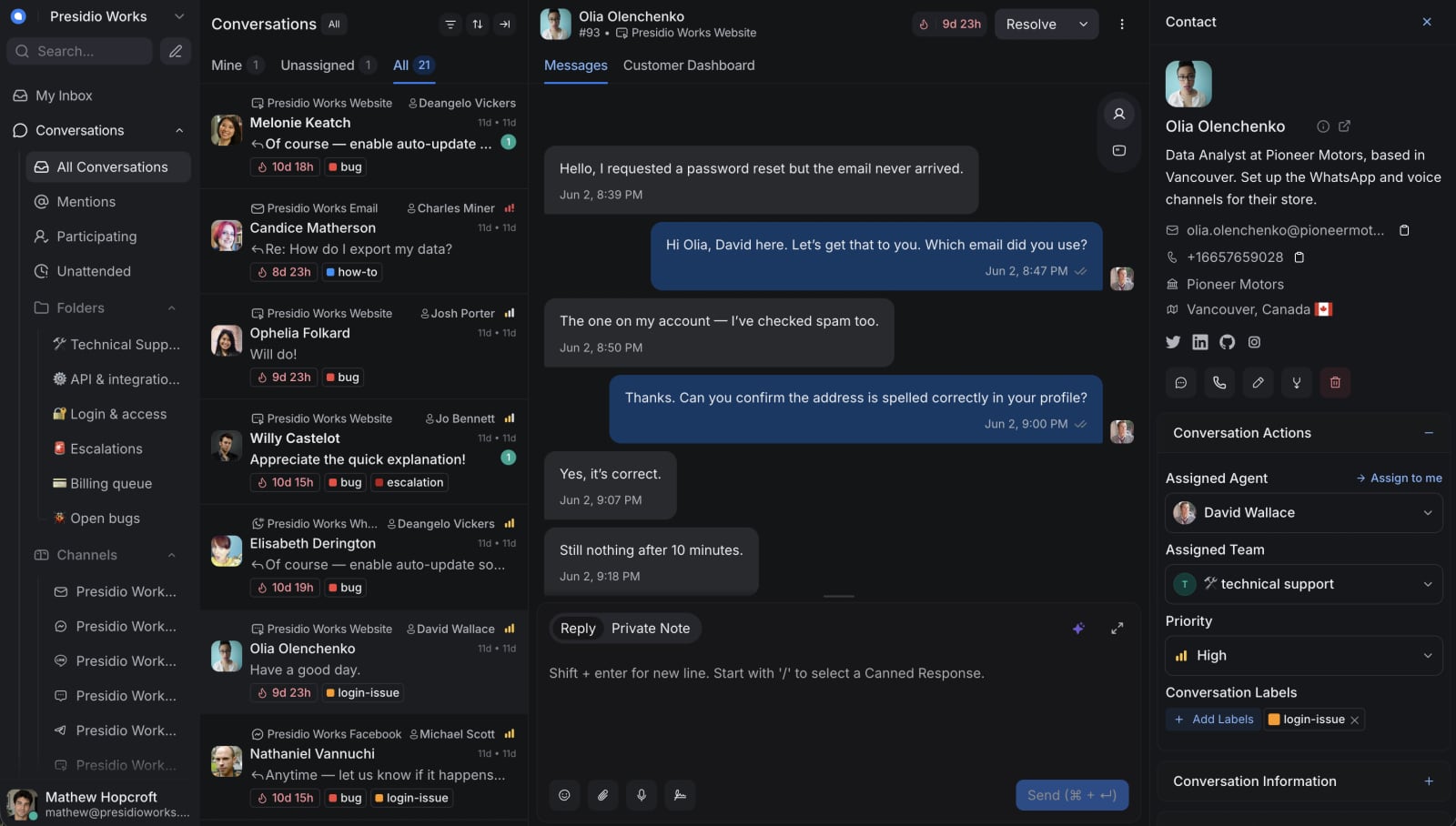
Chatwoot dashboard showing a customer conversation.
Intercom is built for the AI Agent era. Its core differentiator is Fin, a natively integrated AI Agent that resolves customer questions instantly across live chat, email, in-app messaging, and phone. Unlike bolt-on chatbots, Fin is part of the helpdesk itself, drawing on your Help Center and past conversations to deliver accurate answers without human intervention.
For support teams, Intercom adds Copilot, an AI assistant that helps agents draft responses, summarize conversations, and surface relevant knowledge. AI Insights turns conversation data into analytics that reveal trends and coaching opportunities. Outbound messaging lets you proactively reach customers, and the integrated Help Center supports self-service.
Intercom serves businesses of all sizes—from small teams to large enterprises—and is trusted by over 30,000 brands. Pricing is outcome-based across Essential, Advanced, and Expert plans, with a free trial available. If your priority is a single platform where AI handles the first line of support and humans handle the exceptions, Intercom is a strong fit. For a closer look at how it stacks up against other tools, see our Intercom vs HelpCrunch comparison.
Pylon: Purpose-Built for B2B Support Teams

Pylon product interface.
Pylon is an agentic B2B support platform designed for companies whose customers are other businesses. It shines when support happens in Slack, Microsoft Teams, or shared channels where account context matters. Pylon's AI agents—Assist, Background, Slack, and Support Agent—work alongside human teams to resolve tickets, automate workflows, and surface account intelligence.
Key strengths include a self-writing knowledge base that learns from resolved tickets, workforce management for scheduling and capacity planning, and built-in NPS/CSAT surveys. Pylon's omnichannel ticketing covers Slack, Microsoft Teams, Discord, Telegram, WhatsApp, phone, SMS, chat widget, and email. It positions itself as the only support platform built for B2B, emphasizing full account context and end-to-end resolution. Trusted by 1,500+ B2B companies, Pylon has customer stories like Ada choosing it for enterprise support.
Pricing starts at $59/seat/month with seat minimums, and AI features may cost extra per seat. That makes Pylon a significant investment, but for B2B teams that live in Slack and need account-level visibility, it can replace multiple tools. If you're evaluating B2B-focused options, our Intercom vs Olark vs Dixa comparison covers another set of trade-offs.
Chatwoot: Open-Source Flexibility and Data Control
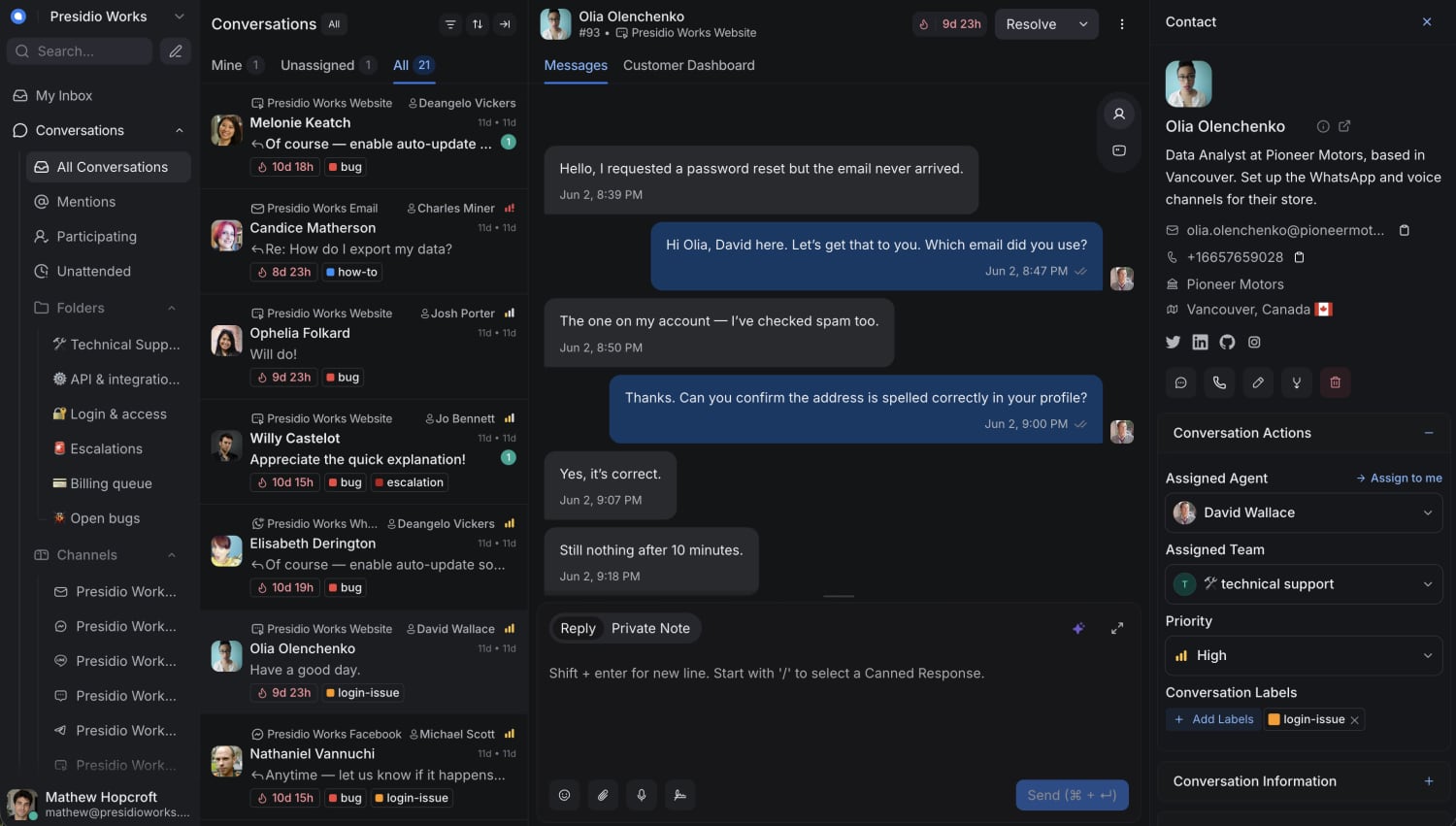
Chatwoot dashboard showing a customer conversation.
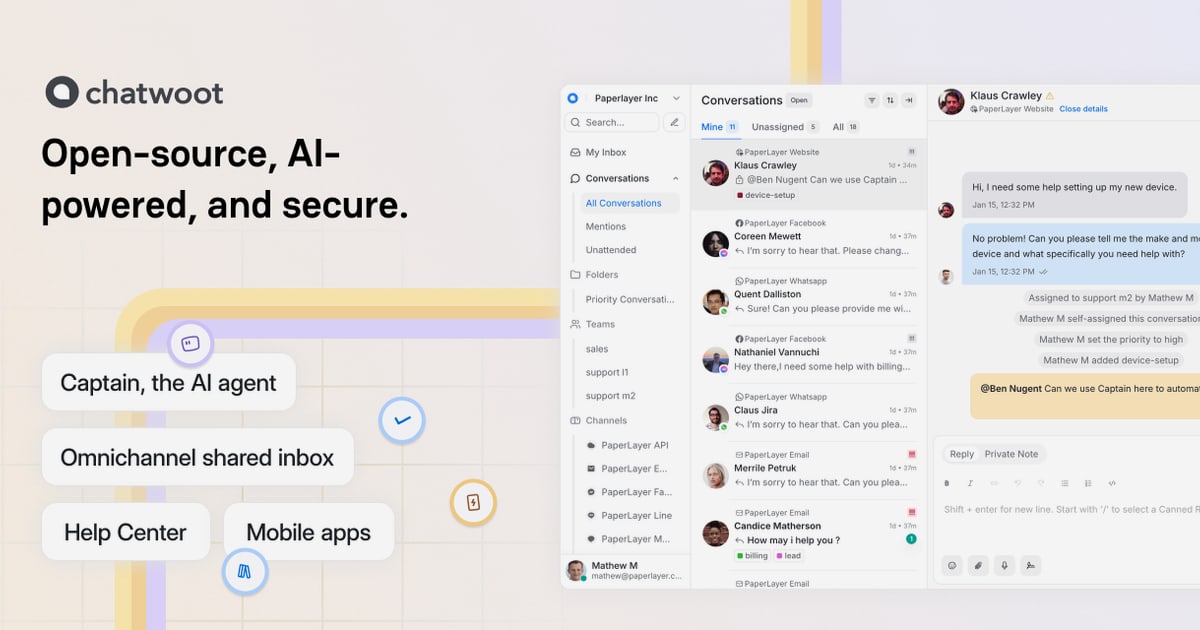
Chatwoot is an AI-powered, open-source customer support platform that gives teams full control over their data and deployment. It offers an omnichannel support desk covering live chat, email, WhatsApp, Instagram, Facebook, and voice calls from a single dashboard. Its built-in AI assistant, Captain, automates responses, suggests answers, and learns from help centers, chats, and FAQs to help agents resolve queries faster.
Chatwoot's standout feature is self-hosting: you can deploy it on your own infrastructure for complete data sovereignty. It also offers a cloud-hosted service. The platform is trusted by over 15,000 businesses and includes a free tier for up to two agents, with paid plans starting around $19/agent/month. Key features include AI-powered automation, voice calls, custom branding, role-based access, SLA policies, and SSO/SAML integration.
Chatwoot positions itself as a modern, privacy-focused alternative to Intercom, Zendesk, and Freshdesk. It's a strong choice for teams that need broad consumer messaging channels, want to avoid per-seat AI add-ons, or require on-premise deployment. For a deeper dive into scaling support without sacrificing quality, see our guide on how to scale customer service.
Where Each Platform Wins: Decision Guide
Choose Intercom if:
- You want an AI Agent (Fin) that natively resolves customer questions across chat, email, in-app, and phone.
- You need a unified platform for both B2C and B2B customer service.
- You value outcome-based pricing and a free trial to test AI resolution rates.
- You want AI-powered analytics (AI Insights) and agent assistance (Copilot) built in.
Choose Pylon if:
- Your customers are B2B and primarily reach out via Slack, Microsoft Teams, or shared channels.
- You need deep account intelligence and customer success workflows alongside support.
- You want AI agents that collaborate with human teams on complex tickets.
- You can accommodate per-seat pricing with seat minimums and potential AI add-ons.
Choose Chatwoot if:
- You need an open-source platform you can self-host for full data control.
- You serve consumers on WhatsApp, Instagram, Facebook, or Telegram and want those channels in one inbox.
- You want a free tier for up to two agents and transparent per-agent pricing.
- You prefer to avoid per-seat AI add-on fees and want Captain included in paid plans.
Related reading
- Yuma AI Review 2026: Ecommerce Support Automation Tested - Evidence-based Yuma AI review: how its ecommerce AI agents resolve WISMO, returns, and refunds, plus real pricing, setup, limits, and who should buy.
- 24/7 Customer Service Automation: How It Works in 2026 - Learn how 24/7 customer service automation works, what to automate, how to keep a human handoff, and which metrics prove it pays off.
Sources and further reading
- Chatwoot vs Pylon: Open-Source Support Alternative (2026) - Compare Chatwoot and Pylon side by side. Open-source, self-hostable, with 12+ channels and AI copilot. Free plan available.
- What Are the Best Customer Support Tools for Businesses in 2025? Top 10 Platforms Compared | Pylon - This comprehensive guide analyzes the top 10 customer support tools for 2025, providing specific pricing, G2 ratings, feature comparisons, and implementation timelines to help businesses choose the right platform for their needs.
- Is there an actual alternative to Intercom that we can switch to right ... - Jun 8, 2025 ... - Omnichannel inbox so users can continue the conversation between live chat and email with a smooth flow. - AI powered auto-translate for any ...
Frequently Asked Questions
Does Intercom have a free plan?
Intercom does not offer a free plan, but it provides a free trial so you can test Fin AI Agent and the helpdesk before committing. Pricing is outcome-based across Essential, Advanced, and Expert plans.
Can Pylon handle B2C support?
Pylon is purpose-built for B2B support. While it covers many channels, its design centers on business messaging platforms like Slack and Microsoft Teams, making it less suited for high-volume B2C consumer messaging.
Is Chatwoot really free?
Chatwoot offers a free tier for up to two agents on live chat. Paid plans add all channels and start around $19/agent/month. You can also self-host the open-source version at no license cost, though you'll manage infrastructure yourself.
Which platform has the best AI for resolving tickets?
Intercom's Fin is natively integrated and designed to resolve conversations end-to-end. Pylon offers multiple AI agents for B2B workflows, and Chatwoot's Captain focuses on drafting and suggesting responses. The best choice depends on whether you need autonomous resolution (Intercom), B2B collaboration (Pylon), or open-source flexibility (Chatwoot).
Can I migrate from one platform to another?
Yes, migration is possible, but effort varies. Chatwoot provides migration assistance, and Intercom and Pylon offer onboarding support. Data portability is highest with Chatwoot due to its open-source nature.
Conclusion
Intercom, Pylon, and Chatwoot are not interchangeable—they serve different priorities. Intercom is the strongest choice for teams that want an AI-first helpdesk with a natively integrated AI Agent that resolves customer questions across channels. Pylon is the specialist for B2B support teams that need account context and collaboration in Slack and Teams. Chatwoot is the open-source, self-hostable option for teams that value data control, broad consumer messaging channels, and transparent pricing.
Start by mapping your customer channels, your AI resolution goals, and your data requirements. If AI-first resolution across B2C and B2B is the goal, Intercom's Fin AI Agent and outcome-based pricing merit a close look. If your world is B2B Slack support, Pylon's account intelligence is compelling. If you need to own your infrastructure, Chatwoot's open-source model is hard to beat.