Intercom vs Pylon vs Gorgias: Which Support Platform Wins?
Intercom vs Pylon vs Gorgias: Which Support Platform Wins?
Choosing between Intercom, Pylon, and Gorgias is less about finding the "best" tool and more about matching the right platform to your business model. Intercom positions itself as an AI-first customer service platform for teams of all sizes. Pylon is built specifically for B2B companies that live in Slack and need deep account context. Gorgias is purpose-built for ecommerce brands that want support to drive revenue.
Each platform takes a fundamentally different approach to pricing, channels, and automation. This guide breaks down where each one wins, where it falls short, and how to decide based on your actual support volume and customer base.
Quick Comparison at a Glance

Pylon product interface.
| Criteria | Intercom | Pylon | Gorgias |
|---|---|---|---|
| Primary focus | AI-first customer service for all business types | Agentic B2B support with account context | Conversational AI for ecommerce |
| Pricing model | Per-seat plus per-AI-resolution | Per-seat with 3-seat minimum | Per-ticket volume |
| Key AI capability | Fin AI Agent, Copilot, AI Insights | Assist, Background, Slack, Support Agent | AI Agent on every plan |
| Channel coverage | Live chat, email, in-app, phone | Slack, Teams, Discord, Telegram, WhatsApp, phone, SMS, chat, email | Email, chat, voice, SMS, social |
| Best for | Teams scaling AI-first support across channels | B2B SaaS and customer success teams | Shopify and ecommerce brands |
Intercom: The AI-First Generalist
Intercom has repositioned itself around the AI Agent era. Its core bet is that Fin, the natively integrated AI agent, can resolve a meaningful share of customer conversations without human intervention. The platform pairs Fin with a shared inbox, Copilot for agent assistance, AI Insights for analytics, and outbound messaging.
The platform serves over 30,000 brands and offers Essential, Advanced, and Expert plans with outcome-based pricing. Intercom's broad channel support — live chat, email, in-app messaging, and phone — makes it a flexible choice for teams that need to meet customers wherever they are.
Where Intercom Has a Supported Advantage
Intercom's strongest position is as a general-purpose AI-first platform. Unlike Pylon's B2B focus or Gorgias's ecommerce specialization, Intercom can serve a wide range of business types without requiring a specific vertical fit. Its Fin AI Agent is designed to resolve issues instantly, and the platform's AI Insights give support leaders visibility into automation performance.
For teams that want a helpdesk with AI baked in from day one — rather than bolted on — Intercom's native integration between Fin, the inbox, and the Help Center is a genuine differentiator. The platform also supports a solution partner program, which can help larger organizations find implementation support.
Intercom's pricing follows a per-seat model with additional per-AI-resolution charges. According to independent pricing analysis, Intercom Fin resolutions cost around $0.99 each, which sits in the middle of the per-AI-resolution range across the market.
Pylon: Purpose-Built for B2B Support
Pylon product interface.
Pylon takes a different bet. Instead of trying to serve every business type, it focuses entirely on B2B companies where support and customer success teams need full account context to resolve issues. The platform is trusted by over 1,500 B2B companies, including enterprise customers like Ada.
Pylon's core pitch is that B2B support is fundamentally different from B2C support. B2B tickets involve account history, contract details, multiple stakeholders, and long resolution cycles. Pylon builds account intelligence directly into the ticketing workflow so agents and AI agents can see the full customer picture without switching tools.
Key Pylon Strengths
Pylon offers a suite of AI agents — Assist, Background, Slack, and Support Agent — that work alongside human teams rather than replacing them. The platform's self-writing knowledge base reduces the manual effort of maintaining documentation. Workforce management, analytics, and NPS/CSAT surveys round out the operational toolset.
Channel coverage is a major Pylon advantage for B2B teams. The platform supports omnichannel ticketing across Slack, Microsoft Teams, Discord, Telegram, WhatsApp, phone, SMS, chat widget, and email. For B2B companies whose customers communicate primarily through Slack or Teams, this is a significant practical benefit.
Independent reviews consistently rank Pylon highly for B2B SaaS teams. One 2026 customer service software ranking placed Pylon at 4.7/5 and named it the best pick for B2B SaaS, noting its strength for teams that operate support in Slack. Pricing starts at $59 per seat per month on annual billing with a three-seat minimum.
Gorgias: The Ecommerce Specialist
Gorgias is built for one job: helping ecommerce brands turn support into revenue. The platform combines an AI agent, unified helpdesk, live chat, and voice/SMS into a single inbox. Over 17,000 brands use Gorgias, from small shops to enterprise retailers.
The platform's deep integrations with Shopify, BigCommerce, and Magento — plus over 100 apps covering payments, subscriptions, returns, and marketing — mean agents can see order history, process refunds, and modify subscriptions without leaving the helpdesk. This context is what allows Gorgias's AI agent to resolve common ecommerce inquiries instantly.
What Makes Gorgias Different
Gorgias's pricing model is unusual and worth understanding. Instead of charging per agent, Gorgias bills based on ticket volume. Plans start at $10 per month for 50 tickets and scale up to $750 per month for 5,000 tickets. The AI agent is available on every plan, with AI resolutions billed separately at roughly $0.90 to $1.00 per resolution.
This per-ticket model has a clear advantage for ecommerce teams: you can add unlimited agents without increasing your base cost. Seasonal hiring spikes don't trigger price increases. For a brand that doubles support staff during the holiday season, this is a meaningful economic benefit.
Gorgias also focuses on revenue-driving features that generalist platforms don't prioritize: proactive engagement, product education, personalized recommendations, and revenue analytics. The platform is designed to help support teams increase conversions, not just resolve tickets.
Pricing Models Compared
The three platforms represent three different pricing philosophies:
Intercom uses a per-seat model with per-AI-resolution add-ons. Essential plans start at $29 per seat per month. Fin resolutions cost around $0.99 each. This model works well for teams that want predictable seat costs but can become harder to forecast as AI resolution volume grows.
Pylon uses a per-seat model starting at $59 per seat per month on annual billing, with a three-seat minimum. This is a straightforward model for B2B teams that know their headcount and want predictable costs.
Gorgias uses a per-ticket model starting at $10 per month for 50 tickets. AI resolutions are billed separately. This model favors teams with high agent counts relative to ticket volume — common in ecommerce where seasonal staffing fluctuates.
For a deeper look at how pricing models affect total cost of ownership, see our Top 10 AI Agentic Automation Platforms in 2026 comparison.
Channel Coverage: Where Each Platform Excels
Channel strategy is often the deciding factor between these three platforms.
Intercom excels at owned channels: live chat on your website, in-app messaging, email, and phone. Its in-app messaging capabilities are particularly strong for SaaS products that want to engage users contextually within the product experience.
Pylon wins on B2B communication channels. Native Slack and Microsoft Teams ticketing means B2B customers can get support without leaving their primary work environment. Discord and Telegram support extends this to developer-focused and community-driven companies.
Gorgias focuses on ecommerce channels: email, live chat, voice, SMS, and social media integrations. The platform's strength is pulling all customer touchpoints — order emails, chat conversations, social DMs — into one inbox with full purchase context.
Decision Guide: Which Platform Should You Choose?
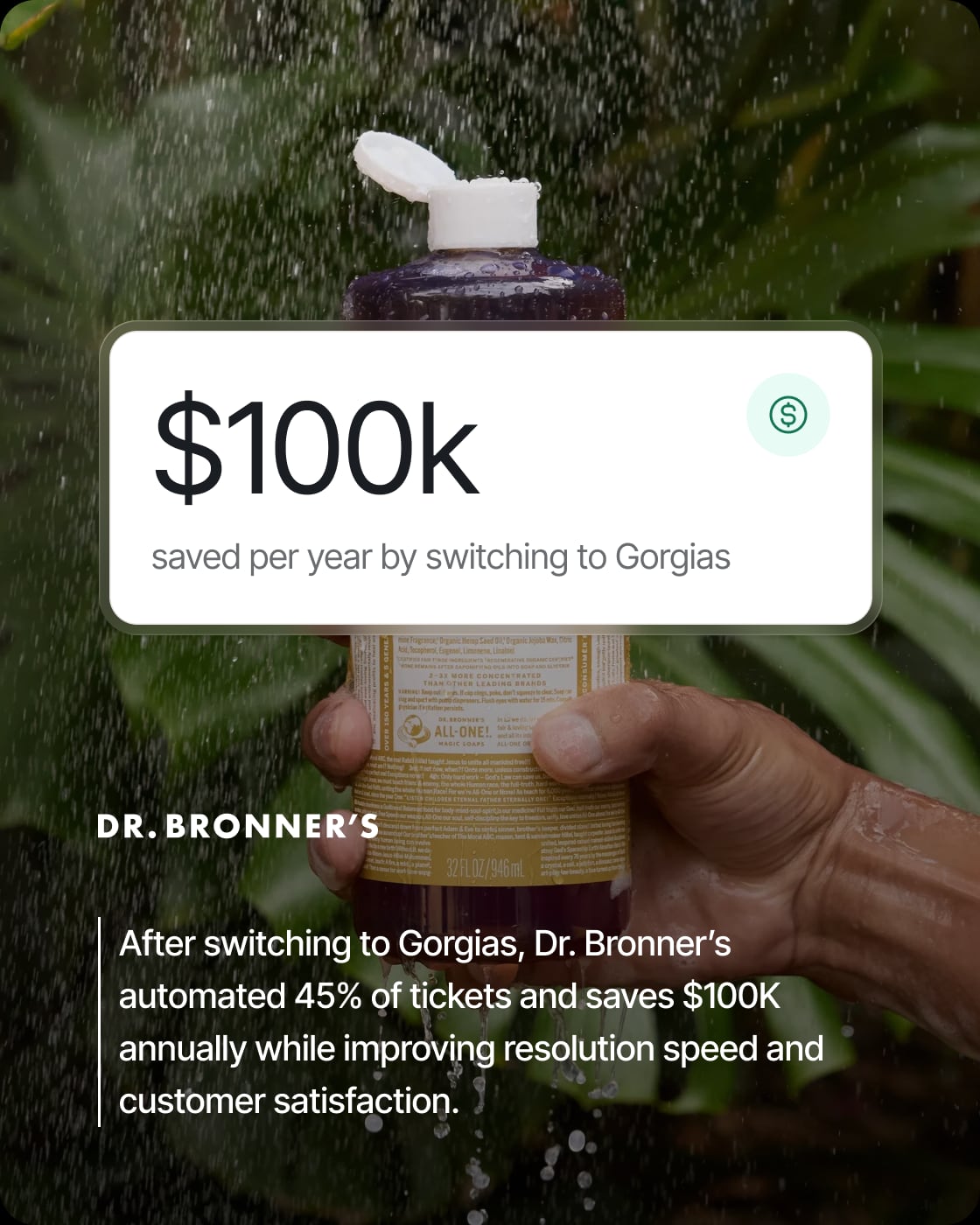
Dr. Bronner's, a Gorgias customer brand.
Choose Intercom if:
- You want an AI-first platform that works across business types and industries
- You need strong in-app messaging and product-led engagement
- You value a mature ecosystem with a partner program and extensive integrations
- Your support volume spans B2C and B2B customers
Choose Pylon if:
- You are a B2B company whose customers primarily communicate via Slack or Teams
- Your support team needs full account context to resolve issues
- You want AI agents that collaborate with human teams on complex B2B tickets
- You need workforce management and customer success workflows built in
Choose Gorgias if:
- You run an ecommerce brand on Shopify, BigCommerce, or Magento
- Your support team's primary job is resolving order, shipping, and return inquiries
- You want support to actively drive revenue through recommendations
- You prefer per-ticket pricing that scales with volume rather than headcount
Practical Example: Three Support Teams, Three Platforms
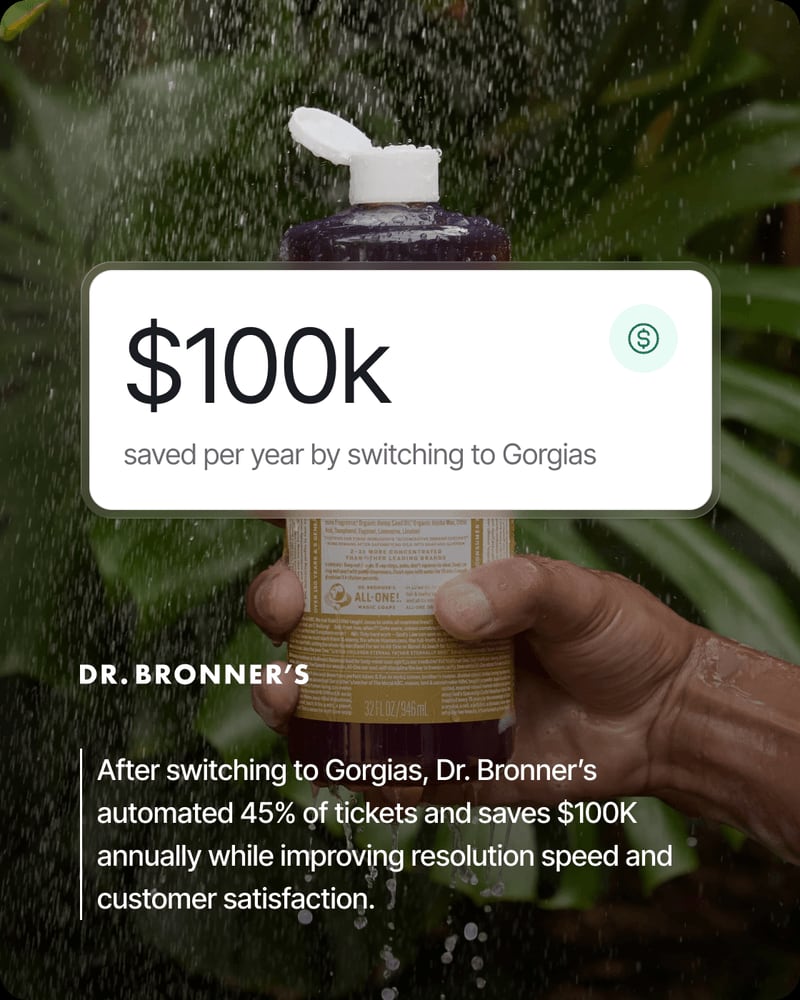
Dr. Bronner's, a Gorgias customer brand.
Consider three companies with different support needs:
A B2B SaaS company with 400 customers uses Slack as its primary support channel. Their support team of 8 handles complex integration questions that require account history and contract details. Pylon's Slack-native ticketing and account intelligence fit this workflow directly. Intercom's in-app messaging would be useful, but the team's customers don't want to leave Slack to get help.
A Shopify apparel brand receives 2,000 tickets per month, mostly about order status, returns, and sizing. Their support team fluctuates from 5 agents in summer to 15 during the holiday season. Gorgias's per-ticket pricing means the seasonal hiring spike doesn't increase base costs, and the Shopify integration lets agents process returns without switching tools.
A fast-growing SaaS company with both B2C and B2B customers needs a flexible platform that can handle live chat, email, and in-app messaging. Their support team of 20 wants AI to resolve routine questions while agents handle complex issues. Intercom's Fin AI Agent and broad channel support match this mixed customer base.
What About AI Agents?
All three platforms now offer AI agents, but their approaches differ.
Intercom's Fin is designed to resolve customer conversations end-to-end, with Copilot assisting human agents on complex issues. The platform's AI Insights provide analytics on automation performance. Intercom has made AI the centerpiece of its product strategy.
Pylon's AI agents — Assist, Background, Slack, and Support Agent — are designed to work alongside human teams on B2B customer work. The emphasis is on collaboration and account context rather than full deflection. This reflects the reality that B2B tickets often require judgment and stakeholder coordination.
Gorgias's AI Agent is available on every plan and is trained specifically on ecommerce scenarios: order status, returns, shipping, and product questions. The platform's AI is designed to resolve common inquiries instantly while escalating complex issues to human agents with full context.
For teams evaluating AI support platforms more broadly, our Freshdesk Review 2026 examines how another major player approaches AI agents and omnichannel support.
Related reading
- Intercom vs ProProfs Help Desk: Which Platform Wins? - Compare Intercom vs ProProfs Help Desk on AI agents, pricing, channels, scalability, and ease of use. See which support platform fits your team in 2026.
- Ultimate AI Login: Access Every AI Workspace Securely - Learn how to sign in to Ultimate AI platforms, fix common login errors, secure your account, and choose the right AI workspace for support and automation.
Sources and further reading
- Best AIs for customer support? Tested a bunch. Some thoughts… - Mar 4, 2026 ... Pylon seems more geared toward B2B startup SaaS teams? Slack ... not as a Zendesk clone or an Intercom copy, but as a different bet ...
- 10 Best Customer Service Software for 2026 (Ranked by Real Cost, Not Sticker Price) - The 10 best customer service software picks for 2026 — Help Scout, Crisp, Pylon, Freshdesk, Zoho Desk, Gorgias, Intercom, Helply, HubSpot Service Hub, and Tidio. Ranked by founders-first criteria: real all-in pricing including AI fees, per-seat vs. per-resolution economics, and how fast you will outgrow each one.
- Get to know the best Intercom alternatives for 2026 - Explore the best Intercom alternatives for strong customer support, clear workflows, and an AI-powered service that delivers a better customer experience.
Frequently Asked Questions
Is Intercom better than Pylon for B2B companies?
Not necessarily. Intercom offers broader channel support and a more mature AI platform, but Pylon is purpose-built for B2B workflows. If your B2B customers communicate primarily through Slack or Teams, and your support team needs deep account context, Pylon's specialized approach may serve you better than Intercom's generalist platform.
How does Gorgias pricing compare to Intercom?
Gorgias uses per-ticket pricing starting at $10 per month for 50 tickets, while Intercom uses per-seat pricing starting at $29 per seat per month plus per-AI-resolution charges. For ecommerce teams with fluctuating agent counts, Gorgias's per-ticket model can be more economical. For teams with stable headcount and lower ticket volume, Intercom's model may be more predictable.
Can Intercom handle ecommerce support?
Intercom can handle ecommerce support, but it lacks the deep Shopify, BigCommerce, and Magento integrations that Gorgias offers. Gorgias's ability to show order history, process refunds, and modify subscriptions directly in the helpdesk is a significant advantage for ecommerce teams. Intercom would require custom integrations to achieve similar functionality.
Does Pylon work for non-B2B companies?
Pylon is designed specifically for B2B companies and may not be the best fit for B2C support. Its account intelligence, Slack-native ticketing, and customer success workflows are built for B2B scenarios. B2C companies would likely find more value in Intercom's generalist approach or Gorgias's ecommerce focus.
Which platform has the best AI agent?
Each platform's AI agent is optimized for different scenarios. Intercom's Fin is a strong general-purpose AI agent with broad applicability. Pylon's AI agents excel at B2B workflows with account context. Gorgias's AI Agent is highly effective for ecommerce inquiries. The "best" AI agent depends on what types of conversations you need to automate.
Conclusion
Intercom, Pylon, and Gorgias are all strong platforms, but they serve different masters. Intercom is the AI-first generalist for teams that want a flexible platform across channels and customer types. Pylon is the B2B specialist for companies whose support lives in Slack and requires deep account context. Gorgias is the ecommerce specialist for brands that want support to drive revenue.
The right choice depends on your business model, your customers' preferred communication channels, and how you want AI to fit into your support workflow. If you're still comparing options, our Intercom vs Pylon comparison goes deeper into the B2B angle, and our Intercom vs LiveAgent vs Gladly comparison covers additional alternatives.
Start with your customers' communication preferences and your support team's workflow. The platform that fits those two factors best is the one that will serve you well in 2026 and beyond.