Intercom vs Replicant: AI Customer Service Showdown 2026
Intercom vs Replicant: AI Customer Service Showdown 2026
When evaluating AI agents for customer service, two names often surface: Intercom with its Fin AI Agent and Replicant, a dedicated AI contact center automation platform. Both promise to resolve customer inquiries efficiently, but they take fundamentally different approaches. This comparison breaks down their strengths, weaknesses, and ideal use cases to help you decide which platform aligns with your support strategy.
Understanding the Contenders
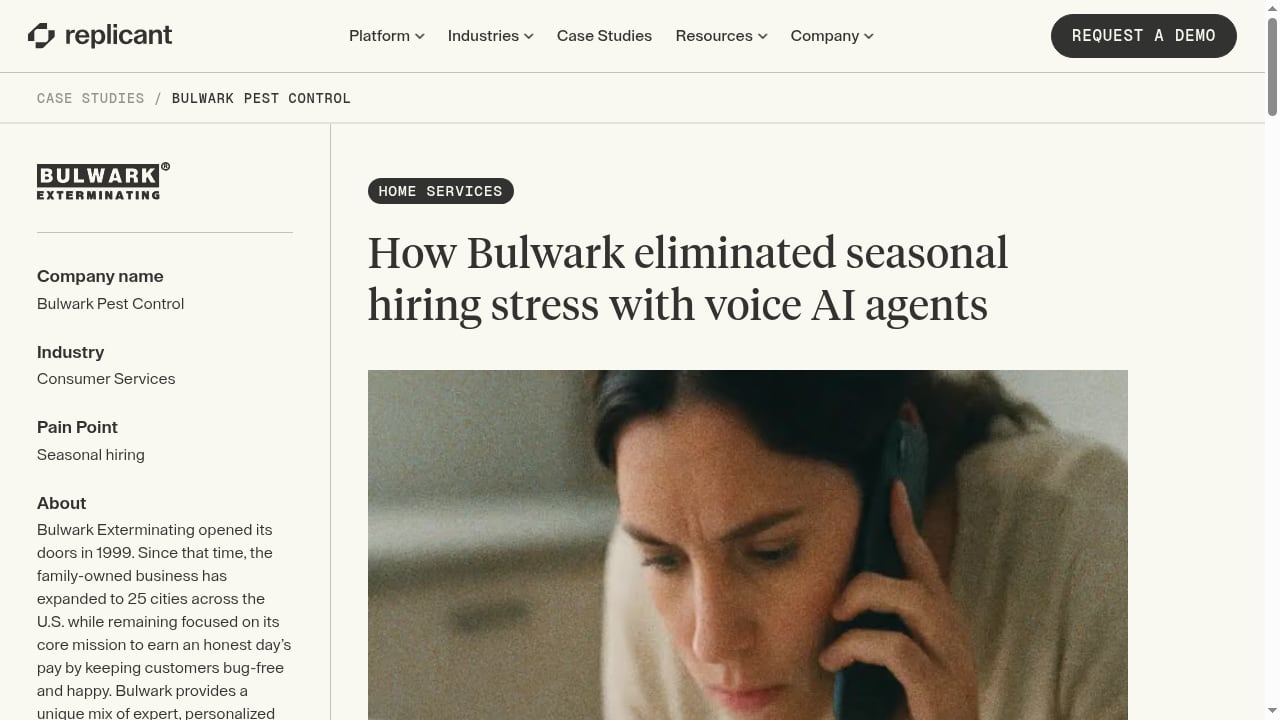
First viewport screenshot of How Bulwark eliminated seasonal hiring stress with AI | Replicant.
Intercom is an AI-first customer service platform that combines a full helpdesk with Fin, a natively integrated AI Agent. It handles conversations across chat, email, and other channels, and includes Copilot for human agents. With over 30,000 brands using it, Intercom is a mature, all-in-one solution.
Replicant positions itself as an enterprise AI contact center automation platform. Its AI agents are designed to resolve customer calls on the first attempt, freeing live agents to handle more complex issues. The focus is on voice automation and first-contact resolution.
Core Capabilities Compared

First viewport screenshot of www.replicant.com.
Channel Coverage
Intercom supports an omnichannel inbox covering chat, email, social, and messaging apps. Its Fin AI Agent can engage customers on these channels, providing a consistent experience. Replicant, by contrast, emphasizes voice interactions, though it may support other channels as well. For businesses where phone support is a primary channel, Replicant's voice-first design could be advantageous. However, Intercom's broader channel support makes it more versatile for digital-first customer service.
AI Resolution and Handoff
Both platforms aim to automate resolutions. Intercom's Fin AI Agent is built to handle customer conversations automatically and improves over time. It integrates with the helpdesk, so when a handoff to a human is needed, the context carries over seamlessly. Replicant claims to resolve calls on the first attempt, reducing the need for live agents. However, as noted in a Reddit discussion on AI customer support platforms, the biggest differences often lie in multi-step conversation handling, action-taking capabilities, and human handoff quality—areas where Intercom's native integration provides an edge.
Knowledge and Continuous Improvement
Intercom's Fin draws from your help center, past conversations, and other knowledge sources, and it learns from interactions to improve resolution rates. Replicant likely uses similar knowledge bases, but details on its learning mechanisms are less public. Intercom's tight integration with its helpdesk means knowledge management is centralized and continuously updated.
Pricing Transparency
Intercom offers published pricing plans (Essential, Advanced, Expert) with per-seat and per-Fin-outcome billing. A 14-day free trial is available. Replicant's pricing is not publicly listed, which can make budgeting difficult. As highlighted in an analysis of Intercom alternatives, cost predictability is a major concern for support teams, and Intercom's outcome-based pricing for Fin provides clarity, even if costs scale with resolution volume.
Where Intercom Excels
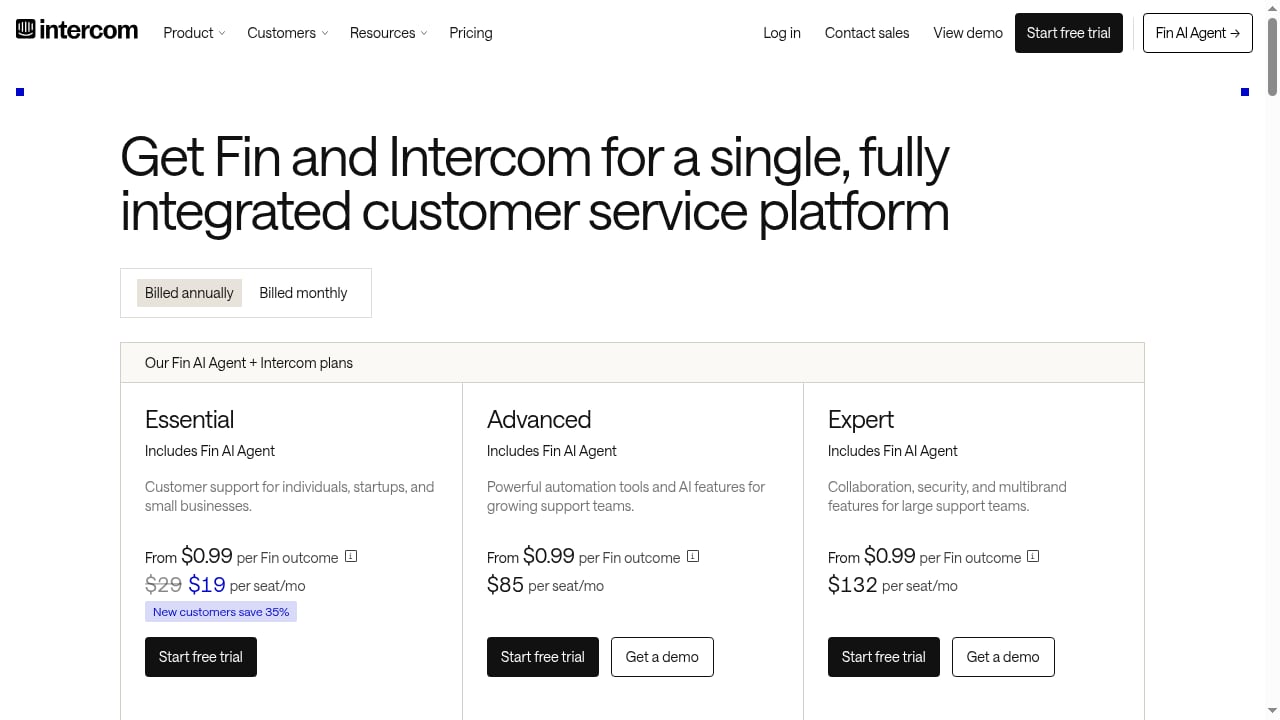
First viewport screenshot of www.intercom.com.
- All-in-one platform: Intercom combines helpdesk, AI agent, and agent assist (Copilot) in one system, reducing integration overhead.
- Omnichannel support: From chat to email to social, Intercom covers all major digital channels.
- Proven track record: With 30,000+ brands, Intercom has a robust ecosystem and extensive documentation.
- Transparent pricing: Published plans and a free trial lower the barrier to entry.
- Continuous AI improvement: Fin learns from every interaction, enhancing resolution rates over time.
Where Replicant May Fall Short
- Limited channel focus: Replicant's emphasis on voice may not suit businesses that rely heavily on chat or email.
- Lack of pricing transparency: Without public pricing, evaluating ROI is challenging.
- Narrower use case: As a dedicated AI contact center platform, Replicant may lack the broader helpdesk features that Intercom provides.
- Less established ecosystem: Intercom's larger user base and integration marketplace offer more flexibility.
Decision Guidance: Which Is Right for You?
Replicant pricing | Flexible AI for scalable customer support.
Choose Intercom if you need a comprehensive customer service platform that blends AI and human support across multiple digital channels, values pricing transparency, and wants a solution that scales from startup to enterprise.
Consider Replicant if your primary channel is voice and you require specialized AI agents focused on first-call resolution in a contact center environment. However, be prepared for a potentially higher learning curve and less pricing clarity.
For a deeper dive into how Intercom compares with other AI support platforms, see our Intercom vs Zendesk AI Agents vs Hiver comparison. If you're exploring IT service desk automation, our practical guide covers how Intercom combines rules, self-service, and AI agents.
Related reading
- Chatbase Review 2026: AI Agent Fit, Pricing & Limits - Evidence-based Chatbase review for 2026: ideal users, use cases, strengths, limitations, pricing signals, setup, and decision criteria for AI customer support.
- Top 10 Live Chat & Chatbot Software for 2026 - We rank the top 10 live chat and chatbot software products for 2026 on AI resolution, human handoff, pricing transparency, and setup effort.
- How to Use Intercom with Zoom: Connect Support and Meetings - Learn how to connect Intercom with Zoom to unify customer support and live meetings. Setup steps, workflows, and practical examples for support teams.
Sources and further reading
- Best Intercom alternatives - Looking for Intercom alternatives? We organized the top options by use case, covering enterprise ticketing, ecommerce, sales-led, flat-pricing, and AI-native support — so you can find the right fit fast.
Frequently Asked Questions
Can Intercom's Fin AI Agent handle voice interactions?
Intercom primarily focuses on digital channels like chat and email. For voice, you may need additional integrations or a specialized solution like Replicant.
Is Replicant suitable for small businesses?
Replicant targets enterprise contact centers, so it may be overkill and costly for small teams. Intercom offers scalable plans suitable for startups.
How does Intercom's pricing compare to Replicant's?
Intercom publishes per-seat and per-resolution pricing, while Replicant's pricing is custom and not publicly available. Intercom's transparency makes it easier to forecast costs.
Which platform offers better human handoff?
Intercom's native integration with its helpdesk ensures seamless handoff with full context. Replicant's handoff process is less documented but likely focuses on voice transfers.
Can I try Intercom before committing?
Yes, Intercom offers a 14-day free trial. Replicant typically requires a sales consultation.
Conclusion
Intercom stands out as a versatile, transparent, and well-integrated AI customer service platform, especially for businesses prioritizing digital channels and a unified helpdesk experience. Replicant, while strong in voice automation, lacks the breadth and pricing clarity that many support teams need. For most organizations, Intercom's Fin AI Agent offers a more balanced and scalable solution. Evaluate your channel mix and budget to make the best choice for your team.