Intercom vs Wonderchat vs Chatwoot: 2026 Comparison
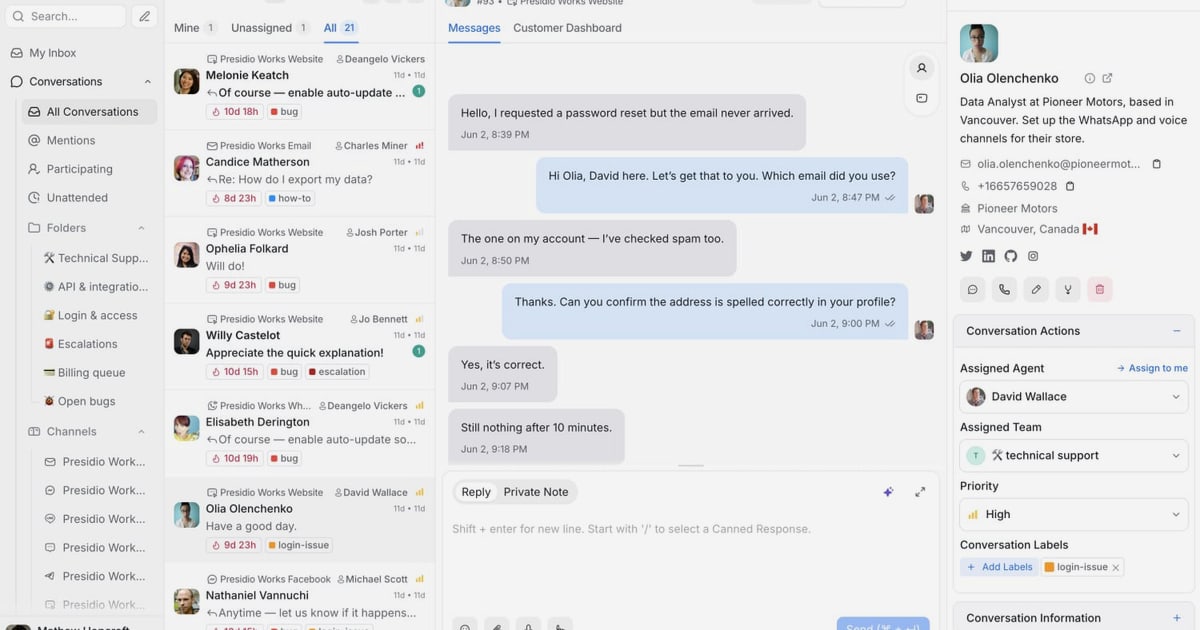
Intercom vs Wonderchat vs Chatwoot: Which Support Platform Fits Your Team in 2026?
Choosing a customer support platform is no longer just about shared inboxes and ticket routing. AI resolution, pricing predictability, data ownership, and deployment flexibility now drive the decision. Intercom, Wonderchat, and Chatwoot represent three distinct philosophies: an AI-first enterprise suite, a flat-rate AI support and conversion agent, and an open-source omnichannel helpdesk. This comparison breaks down where each platform genuinely excels and where it falls short, so you can match the tool to your operational reality.
Quick Verdict

Wonderchat product interface.
- Choose Intercom if you need a full customer service platform with a natively integrated AI agent, multi-channel support including phone, and enterprise-grade analytics — and you have the budget for outcome-based pricing.
- Choose Wonderchat if your priority is predictable flat-rate pricing, high autonomous resolution rates, and source-cited answers trained on your own content, with native live chat included.
- Choose Chatwoot if you want an open-source, privacy-focused omnichannel helpdesk that you can self-host for full data control, and you have technical resources to manage it.
Comparison at a Glance

Wonderchat product interface.
| Criteria | Intercom | Wonderchat | Chatwoot |
|---|---|---|---|
| Core focus | AI-first customer service suite | AI support and conversion agents | Open-source omnichannel helpdesk |
| Deployment | Cloud | Cloud | Cloud or self-hosted |
| AI agent | Fin AI Agent (native) | AI chatbot trained on your content | Captain AI assistant |
| Source citations | Not a headline feature | Every response cites its source | Not a headline feature |
| Pricing model | Outcome-based (Essential, Advanced, Expert) | Flat-rate, unlimited seats | Free tier, per-agent cloud plans |
| Data ownership | Vendor-managed | Vendor-managed | Full control via self-hosting |
| Best for | Mid-market to enterprise teams needing a complete suite | Teams wanting predictable AI-first support costs | Privacy-focused, technically capable teams |
AI Resolution: How Much Can You Actually Automate?
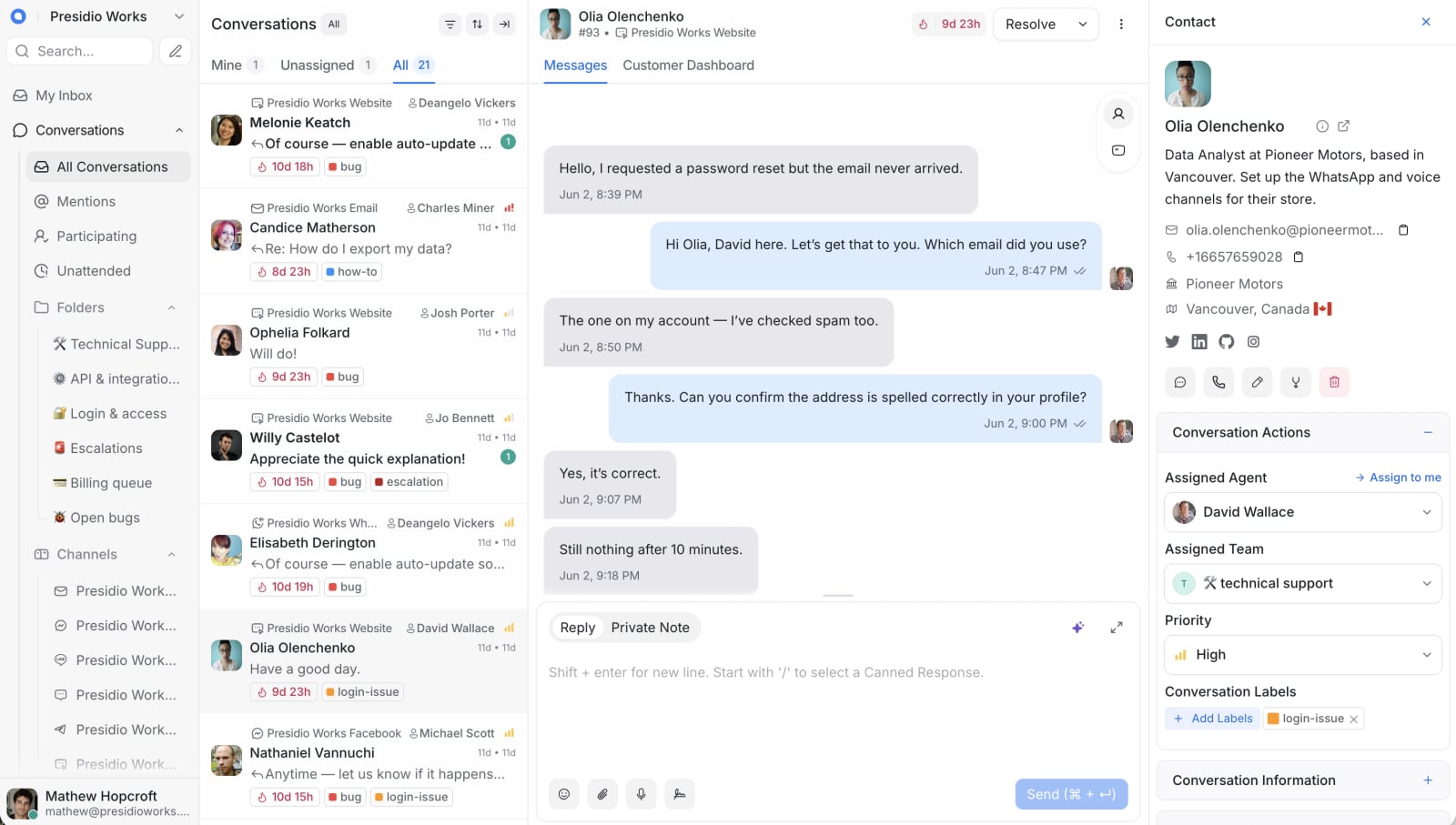
Chatwoot dashboard showing a customer conversation.
AI resolution is the metric that matters most in 2026. The question is not whether a platform has an AI assistant, but how much of your ticket volume it can close without human intervention.
Intercom: Fin AI Agent Built Into the Helpdesk
Intercom positions itself as an AI-first platform, with its Fin AI Agent natively integrated into the helpdesk rather than bolted on as a third-party add-on. Fin resolves conversations across live chat, email, and in-app messaging, and Intercom reports high resolution rates for supported use cases. The platform also includes Copilot, an AI assistant for human agents that drafts replies and summarizes conversations, plus AI Insights for analytics.
Intercom's advantage is integration depth. Because Fin lives inside the same workspace as the shared inbox, help center, and outbound messaging tools, handoffs between AI and human agents carry full conversation context. For teams that want AI and human support to feel like one continuous experience, this matters.
Wonderchat: Source-Cited Answers and Proven Deflection Rates
Wonderchat takes a different approach: train a chatbot on your website, PDFs, help center articles, and product documentation, then let it answer customer questions with a citation for every claim. This source-attribution model is designed to eliminate hallucination risk, which is especially valuable for regulated industries like finance, legal, and education.
The platform's published proof points are concrete. Dutch accounting software company Jortt reports that its Wonderchat agent resolves 92% of roughly 30,000 monthly queries. Broker's Bible achieved positive ROI within three months. 10xTravel deflects 10,000 monthly queries. These are specific, verifiable outcomes rather than vague efficiency claims.
Wonderchat also combines AI resolution with native live chat in a single product. When escalation is needed, the handoff to a human agent happens inside the same interface, with full context preserved.
Chatwoot: Captain as an Agent Assistant
Chatwoot's built-in AI assistant, Captain, learns from your help center, past chats, and FAQs to suggest answers and automate responses. It is positioned primarily as a productivity tool for agents — reducing the time spent searching for answers and drafting replies — rather than as a fully autonomous resolution engine.
For teams that want AI to assist human agents rather than replace them, Captain is a pragmatic fit. For teams expecting high autonomous resolution rates, Chatwoot's AI capabilities are more limited than dedicated AI-first platforms. This is not a hidden weakness; it reflects Chatwoot's design philosophy of keeping humans central to support.
Pricing: Predictability vs. Flexibility
Pricing is where these three platforms diverge most sharply, and the differences have real operational consequences.
Intercom: Outcome-Based, Scales With Usage
Intercom uses outcome-based pricing across Essential, Advanced, and Expert plans. Costs scale with the number of conversations resolved and the features you use. This model aligns cost with value delivered — you pay for resolutions, not just seats — but it can make budgeting harder as volume grows. Intercom is a premium platform, and its pricing reflects that positioning.
Wonderchat: Flat-Rate, Unlimited Seats
Wonderchat's flat-rate pricing is its most distinctive commercial feature. One fixed monthly or annual fee covers unlimited usage and unlimited seats, regardless of how many conversations your AI agent handles or how many team members access the platform. This model directly addresses the cost unpredictability that frustrates teams on per-seat or per-resolution plans.
For a growing business, the math is compelling: as your support volume increases, your cost per resolution decreases. The platform markets itself as delivering 24/7 support at roughly one-tenth the cost of a hire, which aligns with its flat-rate structure.
Chatwoot: Free Tier and Per-Agent Cloud Plans
Chatwoot offers the most accessible entry point: a free tier for up to two agents. Cloud plans then scale on a per-agent basis. For small teams, this is genuinely attractive — you can run a full omnichannel helpdesk without paying anything.
The trade-off is that per-agent pricing ties costs to headcount. As your team grows, so does your bill. However, the self-hosted option changes the calculus entirely: if you deploy Chatwoot on your own infrastructure, you pay only for hosting and maintenance, not per-seat licenses. For technically capable teams, this can be the most cost-effective option at scale.
Channels and Omnichannel Coverage
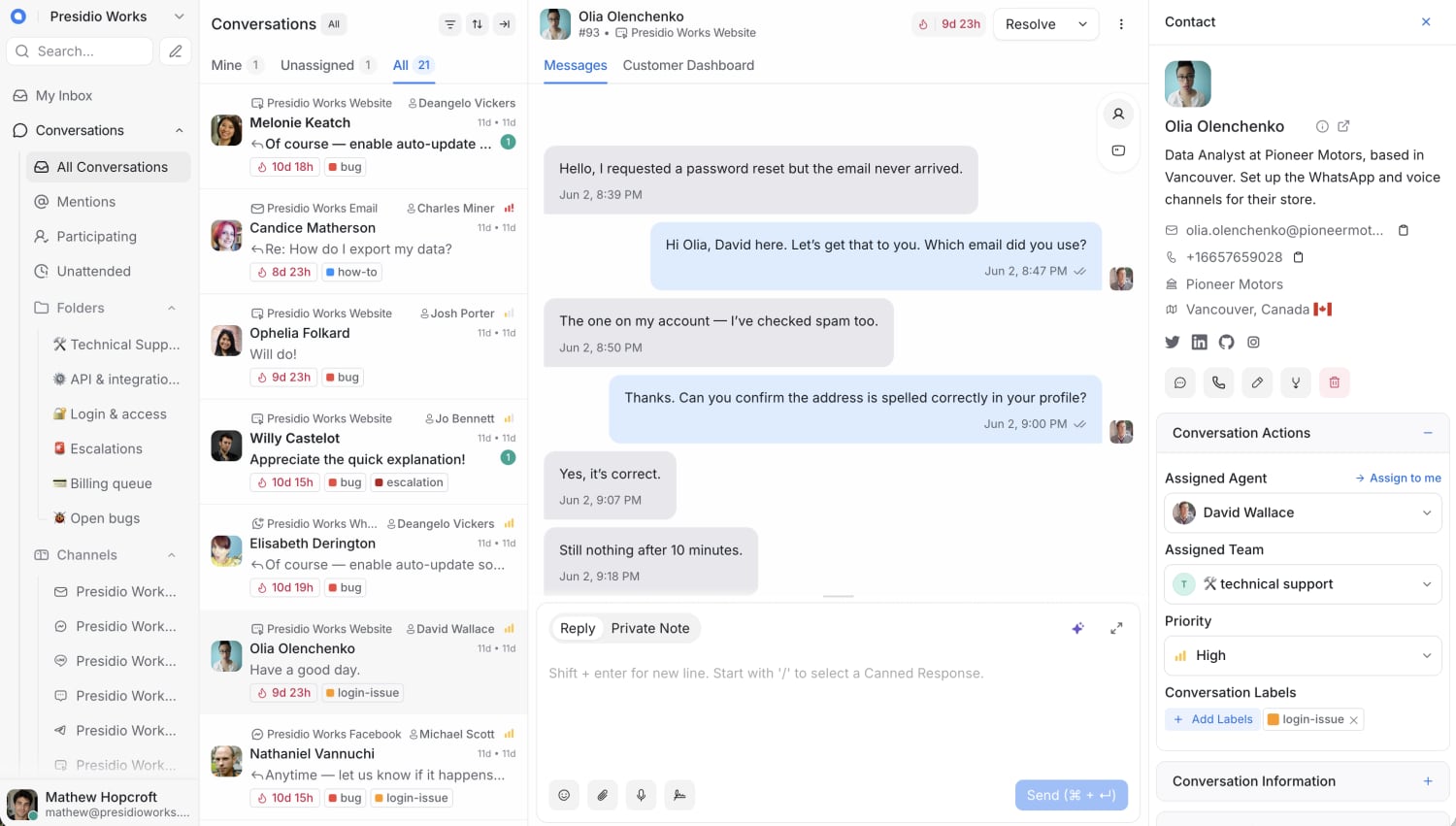
Chatwoot dashboard showing a customer conversation.
Intercom: Broad Channel Support Including Phone
Intercom supports live chat, email, in-app messaging, and phone — a combination that few competitors match. In-app messaging is a particular strength, making Intercom a natural fit for SaaS products that want to engage users contextually inside their product. Outbound messaging capabilities extend the platform beyond reactive support into proactive engagement.
Wonderchat: Web-Focused With Helpdesk Integrations
Wonderchat is primarily a web-based AI agent, designed to live on your website and handle visitor questions, qualify leads, and deflect support tickets. When escalation is required, it integrates with existing helpdesks like Zendesk and Freshdesk, passing full conversation context to human agents. This means Wonderchat does not try to replace your entire support stack — it automates the front line and defers to your existing tools for complex cases.
Chatwoot: True Omnichannel, Including WhatsApp and Voice
Chatwoot's omnichannel coverage is its most complete feature set. The platform consolidates live chat, email, WhatsApp, Instagram, Facebook, and voice calls into a single dashboard. For businesses whose customers reach out across many channels — particularly WhatsApp, which is dominant in many global markets — Chatwoot's breadth is a genuine advantage.
Data Ownership and Privacy
Chatwoot: Full Control Through Self-Hosting
Chatwoot's open-source nature is its defining differentiator. Self-hosting gives you complete control over where customer data lives, who can access it, and how it is secured. For organizations in regulated industries, government agencies, or companies with strict data residency requirements, this is not a nice-to-have — it is a hard requirement.
The trade-off is operational burden. Self-hosting requires technical resources for setup, maintenance, updates, and security patching. Chatwoot's cloud option removes this burden but returns you to a vendor-managed model.
Intercom and Wonderchat: Vendor-Managed Cloud
Both Intercom and Wonderchat are cloud-hosted platforms. Intercom serves over 30,000 brands and maintains enterprise-grade security and compliance standards. Wonderchat is SOC 2 and GDPR compliant, which addresses the security concerns of most businesses. Neither offers self-hosting, so teams with strict data sovereignty requirements will need to look elsewhere — or accept vendor-managed infrastructure.
Setup and Time to Value
Wonderchat: Five-Minute Deployment
Wonderchat's most striking operational claim is a five-minute setup. You connect your content sources — website, PDFs, DOCX files, help center articles — and the AI agent begins answering questions with citations. There is no complex workflow configuration or lengthy onboarding process. For teams that need automation live this week, not this quarter, this speed is a meaningful advantage.
Intercom: Configured for Your Workflow
Intercom is a comprehensive platform, and that comprehensiveness comes with setup complexity. You will configure inboxes, help center content, Fin's knowledge sources, automation rules, and potentially outbound campaigns. The platform offers a free trial and solution partners for implementation, but expect a longer time-to-value than a focused chatbot tool.
Chatwoot: Depends on Deployment Choice
Chatwoot's cloud version is straightforward to set up — sign up, connect channels, invite agents. The self-hosted version requires server provisioning, installation, SSL configuration, and ongoing maintenance. For teams with DevOps resources, this is manageable. For teams without them, the cloud version is the pragmatic choice, though it sacrifices the data-control benefit.
When Each Platform Wins
Choose Intercom When:
- You need a complete customer service suite with shared inbox, help center, and outbound messaging in one platform.
- Phone support and in-app messaging are core channels for your business.
- You want AI resolution natively integrated with human agent workflows, not layered on top.
- Your budget can accommodate outcome-based pricing that scales with resolution volume.
For a deeper look at how Intercom stacks up against other platforms, see our Intercom vs Chatwoot comparison and Intercom vs Ada analysis.
Choose Wonderchat When:
- Predictable flat-rate pricing is a top priority, and you want to avoid per-seat or per-resolution cost growth.
- You need source-cited answers to eliminate hallucination risk in customer-facing responses.
- Your primary support channel is your website, and you want AI resolution plus native live chat in one product.
- You want to deploy an AI agent in days, not weeks, without a dedicated implementation team.
Choose Chatwoot When:
- Data ownership and privacy are non-negotiable, and you have the technical resources to self-host.
- You need omnichannel coverage including WhatsApp, Instagram, Facebook, and voice calls.
- You want a free tier to start, with the option to scale on per-agent cloud plans or self-hosted infrastructure.
- You prefer AI as an agent assistant rather than a fully autonomous resolution engine.
For a broader comparison that includes Chatwoot alongside other platforms, see our Intercom vs OTRS vs Chatwoot comparison.
The Bottom Line
These three platforms are not direct substitutes — they represent different answers to the question of how customer support should work in 2026. Intercom bets on a deeply integrated AI-first suite for teams that want everything in one place. Wonderchat bets on flat-rate pricing and high autonomous resolution for teams that want predictable costs and fast deployment. Chatwoot bets on open-source flexibility and omnichannel breadth for teams that prioritize control and privacy.
The right choice depends on which bet aligns with your operational constraints. If budget predictability and AI resolution are your primary concerns, Wonderchat's flat-rate model and proven deflection rates are hard to ignore. If data sovereignty and channel coverage matter most, Chatwoot's self-hosted option is unmatched. And if you need a complete, enterprise-grade customer service platform with native AI, Intercom remains the reference point — at a price that reflects its scope.
Related reading
- ProProfs Help Desk Review 2026: Pros, Cons & Pricing - Evidence-based ProProfs Help Desk review covering AI features, pricing, setup, limitations, and ideal users. See if it fits your support team in 2026.
Sources and further reading
- Wonderchat - The AI Support & Conversion Agent Platform - The all-in-one platform for AI customer support and inbound conversion agents. Deflect support tickets, qualify website visitors, and answer with confidence using AI trained on your content. Every response cites its source.
- ChatLab vs Intercom - AI Chatbot Comparison 2026 | ChatLab - AI Chatbots for Customer Support and Sales - Compare ChatLab vs Intercom AI chatbot platforms side-by-side. Features, pricing, integrations, and AI capabilities compared. ChatLab starts at Free ($15/mo paid) while Intercom starts at $29/mo. Find the best AI chatbot for your business.
- Coherence - The Operating System for Your Business - The modern XRM that connects email, tasks, and any data type your business tracks. Not just contacts and deals.
FAQ
Is Wonderchat a full replacement for Intercom?
Not entirely. Wonderchat replaces the AI chatbot and live chat front line, but it does not offer Intercom's full helpdesk, phone support, in-app messaging, or outbound campaign tools. Many teams use Wonderchat alongside an existing helpdesk, integrating for seamless handoffs.
Can Chatwoot's AI match Intercom's Fin or Wonderchat's agent?
Chatwoot's Captain is designed primarily as an agent assistant — suggesting answers and automating routine responses — rather than as a fully autonomous resolution engine. If high autonomous resolution rates are your goal, Intercom's Fin or Wonderchat's agent are stronger fits.
Which platform is cheapest at scale?
It depends on your deployment choice. Wonderchat's flat-rate pricing becomes increasingly cost-effective as volume grows. Chatwoot self-hosted can be the cheapest option if you have in-house technical resources. Intercom's outcome-based pricing scales with value delivered but can become expensive at high volumes.
Does Wonderchat really resolve 92% of queries?
Wonderchat publishes specific customer proof points, including Jortt's reported 92% resolution rate on 30,000 monthly queries. Results depend on your content quality, query complexity, and how well the agent is trained on your knowledge base.
Is Chatwoot difficult to self-host?
Self-hosting Chatwoot requires server provisioning, installation, SSL configuration, and ongoing maintenance. Teams with DevOps experience will find it manageable. Teams without technical resources should use Chatwoot's cloud version or consider a managed alternative.
Which platform is best for a small team just starting out?
Chatwoot's free tier for two agents makes it the lowest-risk starting point. Wonderchat's flat-rate pricing and five-minute setup are also attractive for small teams that want AI resolution immediately. Intercom's free trial lets you evaluate its full suite before committing, though its pricing is geared toward teams with meaningful support volume.
Final Recommendation
Start by identifying your binding constraint. Is it budget predictability? Choose Wonderchat. Is it data ownership or channel breadth? Choose Chatwoot. Is it the need for a complete, integrated customer service platform with native AI? Choose Intercom. Each platform is excellent at what it is designed for — the key is choosing the one designed for your problem.