Intercom vs WotNot: Which AI Support Platform Wins in 2026?
Intercom vs WotNot: Which AI Support Platform Should You Choose in 2026?
Choosing between Intercom and WotNot comes down to a fundamental question: do you need a full customer service ecosystem with an embedded AI agent, or a focused, no-code AI agent platform that gets automation live quickly and keeps costs predictable? Both tools help teams automate support and engage customers, but they are built with very different philosophies, pricing models, and target users.
This comparison breaks down how Intercom and WotNot stack up on AI resolution, pricing, channels, setup speed, and scalability — so you can make an informed decision without the vendor hype.
Quick Verdict: Intercom vs WotNot at a Glance
First viewport screenshot of Customers | WotNot.
| Criteria | Intercom | WotNot |
|---|---|---|
| Core focus | AI-first customer service platform with helpdesk, inbox, and AI Agent Fin | No-code AI agent platform for chatbots and automation |
| Best for | Teams that want a complete support suite with native AI resolution | SMBs and mid-market teams that want fast, cost-effective AI deployment |
| AI resolution rate | Fin resolves roughly 65% of conversations end-to-end | Varies by configuration and LLM choice; no published universal resolution rate |
| Pricing model | Outcome-based; Fin AI at $0.99 per resolution plus platform fees | Chat-volume-based; starts at $29/month for 1,000 chats |
| Key channels | Live chat, email, in-app messaging, phone | Web chat, WhatsApp, Messenger, voice |
| Setup speed | Moderate; powerful but requires configuration | Fast; most customers go live within 2 weeks |
| G2 rating | Not listed in source data | 4.6/5 |
What Is Intercom?
Intercom vs WotNot: Which AI Support Platform Wins in 2026? - AI Resolution: Fin vs WotNot's Multi-LLM Approach.
Intercom is an AI-first customer service platform built for the AI Agent era. It combines a shared inbox, helpdesk, automation, and multi-channel support with Fin, a natively integrated AI Agent that resolves customer questions without human intervention. More than 30,000 brands use Intercom to deliver support across live chat, email, in-app messaging, and phone.
The platform includes three core AI components:
- Fin AI Agent — Resolves customer conversations end-to-end using your knowledge base, with a reported 96% accuracy rate and roughly 65% end-to-end resolution.
- Copilot AI Assistant — Supports human agents with suggested responses, summaries, and context during live conversations.
- AI Insights — Analyzes conversation data to surface trends, gaps, and opportunities.
Intercom also supports outbound messaging, a fully integrated Help Center, and a solution partner program for agencies and consultants.
What Is WotNot?
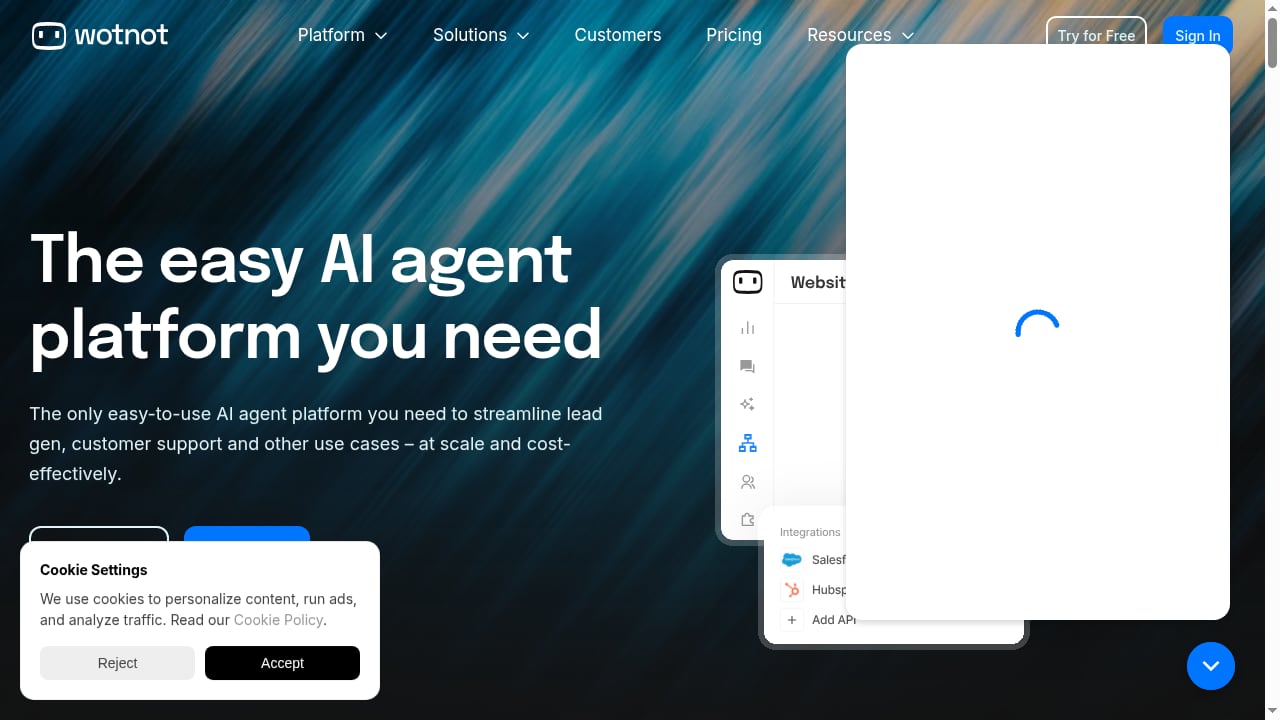
First viewport screenshot of WotNot | The Easy AI Agent Platform You Need.
WotNot is a no-code AI agent platform designed to help businesses build and deploy chatbots for customer support, lead generation, and workflow automation. It offers a visual drag-and-drop agent builder, integration with major LLM models including GPT, Claude, and Gemini, and deployment across web chat, WhatsApp, Messenger, and voice.
WotNot positions itself as a cost-effective alternative to heavier enterprise platforms. Trusted by brands like Merck, Ricoh, and Desoutter Tools, WotNot has demonstrated measurable results across industries:
- A pharmaceutical client educated 197K+ users on cancer risk across 17 countries.
- A marketing agency increased revenue by 42%.
- An education program reduced response time from 3 days to under 3 seconds.
- A travel company generated 90K leads.
WotNot offers both self-serve (Do It Yourself) and managed (Done For You) plans, making AI deployment accessible to teams without dedicated engineering resources.
AI Resolution: Fin vs WotNot's Multi-LLM Approach
WotNot | The Easy AI Agent Platform You Need.
The most significant difference between the two platforms is how their AI is architected.
Intercom Fin: A Proprietary, Resolution-First AI Agent
Fin is built directly into the Intercom helpdesk. It pulls from multi-source queries and adheres strictly to your knowledge base, which is why users report high accuracy without hallucinations. The key advantage is that Fin is not a bolt-on — it shares the same conversation context as your inbox, Help Center, and agent workflows.
For SaaS teams focused on retention and fast resolution, Fin's 65% end-to-end resolution rate is a meaningful benchmark. You pay only when Fin resolves a conversation, which aligns cost with successful outcomes.
WotNot: Flexible LLM Choice with RAG Grounding
WotNot takes a different approach. Instead of a proprietary AI engine, it lets you choose from multiple LLMs — GPT, Claude, or Gemini — and pairs them with Retrieval-Augmented Generation (RAG) to ground responses in your own data. This flexibility is attractive for teams that want to experiment with different models or have specific compliance or performance requirements.
However, WotNot does not publish a universal resolution rate. Performance depends heavily on how well you configure your agent, which LLM you select, and the quality of your training data. The platform gives you more control, but that control comes with more configuration responsibility.
Key takeaway: Intercom offers a more turnkey AI resolution experience with a published performance benchmark. WotNot offers greater model flexibility but requires more hands-on tuning to achieve comparable results.
Pricing: Outcome-Based vs Chat-Volume-Based
Pricing is often the deciding factor in this comparison, and the two platforms could not be more different.
Intercom Pricing
Intercom uses outcome-based pricing across Essential, Advanced, and Expert plans. The most notable component is Fin AI, which costs approximately $0.99 per resolution. This means you pay only when Fin successfully resolves a conversation without human intervention.
The challenge is predictability. As conversation volume grows, so does your Fin bill. Teams that experience seasonal spikes or rapid growth may find costs scaling in ways that are hard to forecast. Platform fees and add-ons for advanced features can also accumulate.
WotNot Pricing
WotNot uses a straightforward chat-volume model. Pricing starts at $29/month for 1,000 chats, with custom enterprise plans available for larger volumes. There is no per-resolution pricing and no per-agent seat fees.
This model is significantly more predictable. You know exactly what you will pay based on your chat volume, and costs do not spike unexpectedly when automation handles more conversations. For SMBs and mid-market teams watching their budgets, this is a compelling advantage.
Key takeaway: If you want to pay only for successful AI outcomes and have the budget to absorb variable costs, Intercom's model makes sense. If you need predictable, volume-based pricing without per-resolution fees, WotNot is the more cost-effective choice.
Channels and Omnichannel Support
Both platforms support multiple channels, but with different emphases.
Intercom is built around real-time messaging. Its core channels are live chat, email, in-app messaging, and phone. The in-app messaging capability is particularly strong — Intercom excels at proactive engagement within your product, which is why it is popular among SaaS companies.
WotNot emphasizes web chat and WhatsApp, with additional support for Messenger and voice. For businesses that serve customers primarily through WhatsApp — common in industries like travel, healthcare, and international e-commerce — WotNot's native WhatsApp deployment is a significant advantage.
Key takeaway: Intercom wins for in-app and product-led engagement. WotNot wins for WhatsApp-first communication strategies.
Setup Speed and Ease of Use
WotNot's biggest practical advantage is deployment speed. According to industry reviews, most WotNot customers go live within 2 weeks, compared to 6–12 weeks for enterprise-focused competitors. The drag-and-drop builder does not require constant developer involvement, and the platform is designed for non-technical teams.
Intercom is more powerful but also more complex to configure. The platform's strength is its ecosystem — messaging, support, product tours, and automation all tightly integrated. But that integration comes with a learning curve. Getting the most out of Fin, Copilot, and AI Insights requires thoughtful setup and ongoing optimization.
Key takeaway: If you need to launch AI support quickly without engineering resources, WotNot is faster. If you are willing to invest in configuration for a more comprehensive platform, Intercom delivers more long-term capability.
Scalability and Enterprise Readiness
Intercom is built for scale. With over 30,000 customers ranging from small teams to large enterprises, the platform has proven itself in high-volume, complex support environments. Its helpdesk, automation, and analytics are designed to handle enterprise-grade workflows.
WotNot serves a wide range of industries and has demonstrated impressive results for global brands like Merck and Ricoh. The platform includes SOC 2, GDPR, and HIPAA compliance, which matters for regulated industries. However, its positioning is primarily SMB and mid-market. Teams with complex enterprise requirements — advanced SLA management, sophisticated routing rules, deep CRM integrations — may find WotNot's capabilities more limited than Intercom's.
Key takeaway: Intercom is the stronger choice for large, complex support operations. WotNot is ideal for growing teams that need fast, compliant AI deployment without enterprise overhead.
When to Choose Intercom
Choose Intercom if:
- You want a complete customer service platform with helpdesk, inbox, AI Agent, and analytics in one place.
- Your support strategy is resolution-first, and you want a published AI resolution benchmark (65% end-to-end).
- You rely heavily on in-app messaging and proactive engagement within your product.
- You are willing to pay per-resolution pricing and can manage variable costs as volume grows.
- You need enterprise-grade scalability and are prepared for a more involved setup process.
For a deeper look at how Intercom compares to other platforms, see our Intercom vs LiveAgent comparison and Intercom vs Chatwoot analysis.
When to Choose WotNot
Choose WotNot if:
- You need to launch AI support quickly without dedicated engineering resources.
- Your budget requires predictable, chat-volume-based pricing with no per-resolution fees.
- WhatsApp is a primary customer communication channel.
- You want flexibility to choose your LLM (GPT, Claude, Gemini) rather than being locked into a proprietary engine.
- You are an SMB or mid-market team that prioritizes cost efficiency and fast time-to-value over enterprise feature depth.
The Bottom Line
Intercom and WotNot are both capable AI support platforms, but they serve different needs. Intercom is the more comprehensive, enterprise-ready solution with a proprietary AI Agent that delivers published resolution results — at a premium price. WotNot is the more accessible, cost-effective alternative that gets AI agents live quickly and keeps pricing predictable as you scale.
If you need a full customer service ecosystem and can justify the investment, Intercom remains the benchmark. If you need fast, no-code AI deployment with predictable costs, WotNot is a compelling substitute. For teams evaluating broader options, our Intercom vs HappyFox vs OTRS comparison and Ultimate AI review provide additional context on the 2026 support platform landscape.
Related reading
- Customer.io Review 2026: Pros, Cons, Pricing & Verdict - In-depth Customer.io review covering automation, segmentation, pricing, setup complexity, and ideal users. See if this engagement platform fits your team.
- Talkdesk Pricing Explained: Plans, Costs & Hidden Fees for 2026 - A practical breakdown of Talkdesk pricing for 2026: plan tiers, per-seat costs, add-ons, hidden fees, and how it compares to AI-first support platforms.
Sources and further reading
- Top Intercom Alternatives That Are Worth Your Time - Intercom getting too expensive? Explore top alternatives with powerful AI chatbots, better pricing, and no compromise on customer experience.
- Best AI Chatbot for Customer Service (2026): Reviews, Stats & Industry Use Cases - Discover the best AI chatbot for customer service, designed to resolve issues efficiently and reduce response times with advanced NLP and real-time system integration.
- How does WotNot's pricing model stand out compared to Intercom ... - Mar 21, 2022 ... I want to know the detailed pricing model of WotNot and how it is stand out from the competitors like Intercom, Drift, and Ada.
FAQ
Is WotNot cheaper than Intercom?
Yes, in most cases. WotNot starts at $29/month for 1,000 chats with no per-resolution fees or per-agent seat costs. Intercom's pricing includes platform fees plus approximately $0.99 per Fin AI resolution, which can scale unpredictably as conversation volume grows.
Does Intercom's Fin AI really resolve 65% of conversations?
According to 2026 industry reports, Fin resolves roughly 65% of conversations end-to-end with a 96% accuracy rate. Actual results vary based on knowledge base quality, conversation complexity, and configuration.
Can WotNot replace Intercom for my business?
It depends on your needs. WotNot covers the core functionality most teams expect — AI agents, omnichannel support including WhatsApp, live chat handover, and analytics — at a lower cost. However, Intercom offers deeper in-app messaging, a more integrated helpdesk, and enterprise-grade scalability that WotNot does not fully match.
How long does it take to set up each platform?
WotNot customers typically go live within 2 weeks thanks to its no-code builder. Intercom setup varies based on complexity but generally requires more configuration time, especially for advanced AI workflows and multi-channel orchestration.
Does WotNot support WhatsApp?
Yes. WotNot offers native deployment across WhatsApp, web chat, Messenger, and voice under one unified agent. This makes it particularly strong for businesses that serve customers primarily through WhatsApp.
What LLMs does WotNot support?
WotNot's AI Studio supports multiple LLMs including GPT, Claude, and Gemini, with RAG grounding to reduce hallucinations. Intercom uses its proprietary Fin AI engine rather than offering model choice.
Is Intercom worth the higher price?
For teams that need a complete customer service platform with a proven AI resolution rate, in-app messaging, and enterprise scalability, Intercom's higher price can be justified. For teams that primarily need fast, cost-effective AI automation, WotNot delivers better value.
Conclusion
The Intercom vs WotNot decision ultimately comes down to your priorities: comprehensiveness versus accessibility, proprietary AI versus flexible LLM choice, and outcome-based pricing versus predictable chat-volume pricing. Intercom remains the stronger choice for teams that need a full customer service ecosystem and can invest in it. WotNot is the smarter substitute for teams that want AI support automation live quickly, at a predictable cost, without sacrificing core functionality. Evaluate your support volume, channels, budget, and growth trajectory — then choose the platform that aligns with where your team is headed in 2026.