Intercom vs WotNot: AI Customer Service Platform Comparison
Intercom vs WotNot: Which AI Customer Service Platform Fits Your Team?
Choosing between Intercom and WotNot is not just a feature checklist exercise. The two products approach AI customer service from different starting points: Intercom is a full helpdesk with a natively integrated AI Agent, Fin, while WotNot is a no-code platform for building and deploying AI agents across channels. This comparison examines where each approach shines, what the evidence says about pricing and capabilities, and how to decide which one matches your support operation.
Quick comparison: Intercom and WotNot at a glance
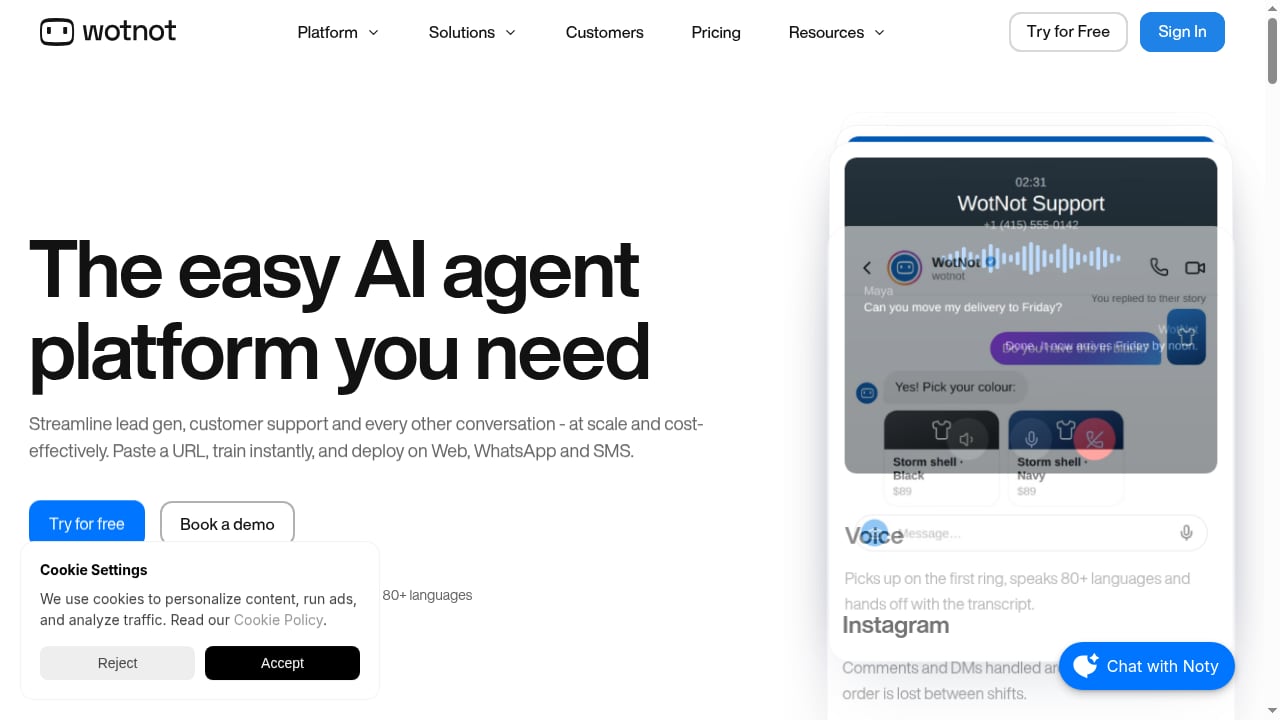
First viewport screenshot of wotnot.io.
| Dimension | Intercom | WotNot |
|---|---|---|
| Core positioning | AI-first customer service platform with a built-in helpdesk and the Fin AI Agent | No-code AI agent platform for support automation, lead qualification, and workflows |
| AI approach | Natively integrated AI Agent (Fin) inside the helpdesk, so every conversation can inform the next | Build AI agents with a drag-and-drop builder and AI Studio, trained on your data |
| Channels | Messaging, chat, email, and more within one support system | Web, WhatsApp, SMS, Messenger, and voice, according to vendor and third-party sources |
| Pricing model | Seat-based plans plus per-resolution pricing for Fin outcomes (commonly cited around $0.99 per outcome) | Subscription pricing; sources cite starting points around $29/month, with higher tiers for larger teams |
| Best fit | Teams that want AI and human support unified in one system with strong conversational design | SMBs and mid-market teams that want fast no-code agent deployment across messaging channels |
Why teams compare Intercom and WotNot
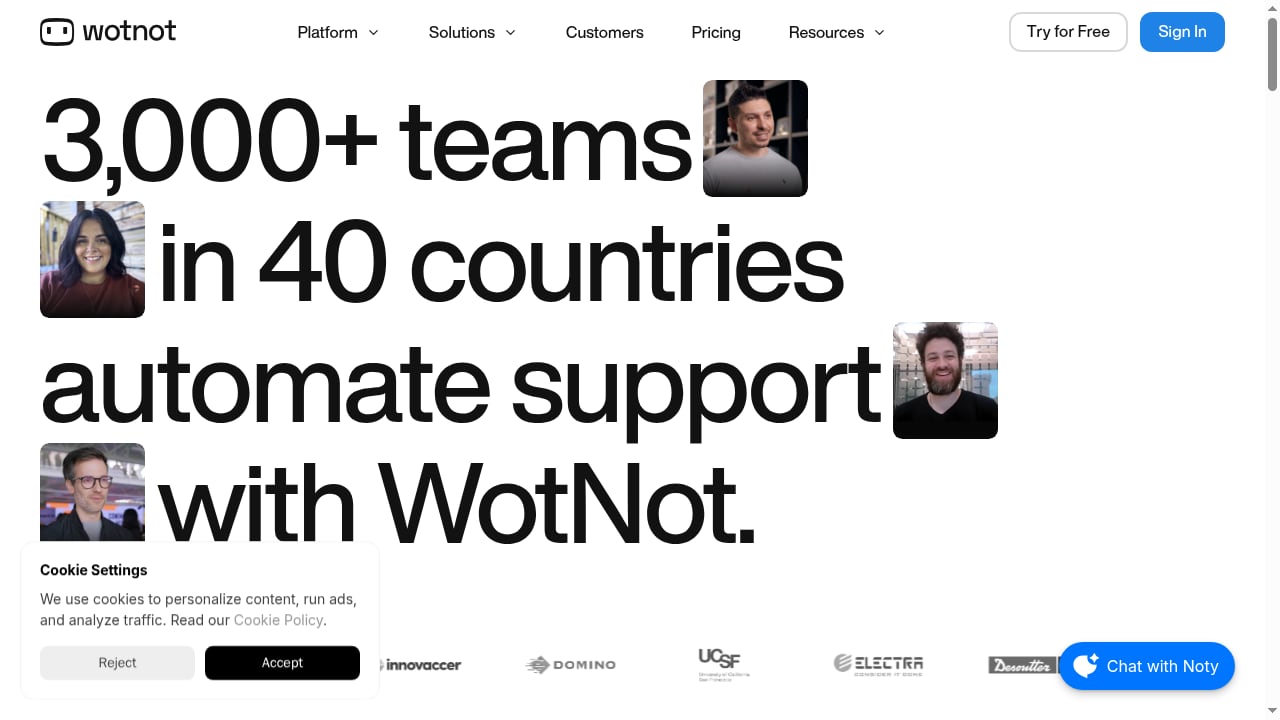
First viewport screenshot of wotnot.io.
Most buyers arrive at this comparison from one of two directions. Some are already using Intercom and are exploring lower-cost or more flexible alternatives. Others are evaluating no-code AI agent builders and want to know whether a full platform like Intercom is worth the additional structure and cost.
WotNot's own comparison content frames Intercom around two recurring concerns: pricing that scales with usage and support responsiveness. That framing is useful context, but it is also a vendor's perspective. A fair evaluation needs to weigh those concerns against what Intercom's integrated model delivers, and against WotNot's own trade-offs.
Where Intercom stands out
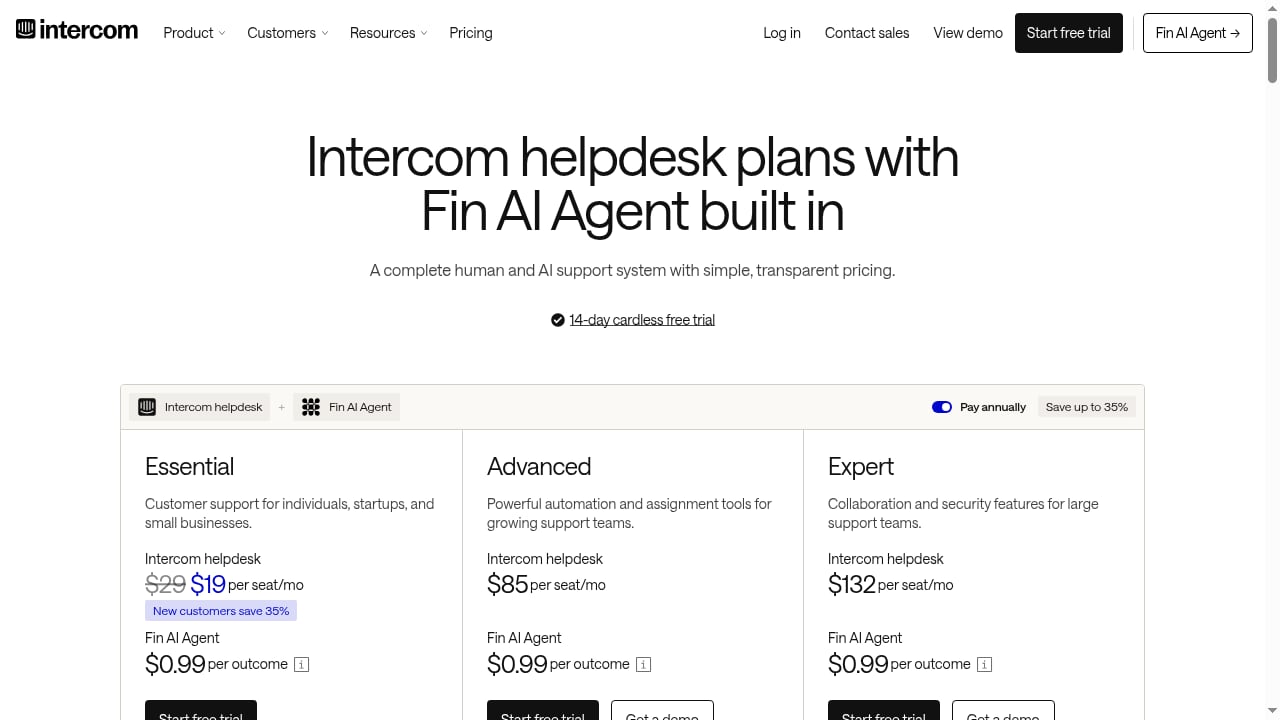
First viewport screenshot of www.intercom.com.
A natively integrated AI Agent, not a bolted-on bot
Intercom's central differentiator is that Fin is built into the helpdesk rather than added as a separate layer. The product context describes Intercom as the only helpdesk with a natively integrated AI Agent, meaning every customer conversation improves the next one. In practice, that integration matters for handoff quality: when Fin cannot resolve a question, the conversation history, customer context, and prior interactions are already in the same system where a human agent picks it up.
This is a meaningful advantage over platforms where the bot and the inbox are separate products that must be wired together. For a deeper look at how this works in practice, see automated query resolution.
A complete support system, not just an agent builder
WotNot is designed around building and deploying AI agents. Intercom is designed around running customer service end to end: messaging, a helpdesk, reporting, and AI resolution in one place. For teams that want to consolidate tools rather than assemble a stack, that completeness reduces integration work and vendor management.
Third-party comparisons support this positioning. Featurebase's roundup of customer service software describes Intercom as suited to product-led SaaS teams that want AI plus in-app chat, with Fin providing autonomous resolution. Tidio's chatbot builder comparison similarly categorizes Intercom Fin as fitting support teams that want a full help desk, while WotNot is positioned for mid-market teams running one bot across web, WhatsApp, and SMS.
Strong review volume and market validation
Tidio's comparison cites a G2 rating of 4.5 with more than 3,900 reviews for Intercom, compared with 4.6 from roughly 102 reviews for WotNot. Rating averages are close, but the volume difference is substantial. A larger review base generally means more observable patterns across team sizes, industries, and use cases, which is useful when you are trying to predict fit.
Conversational design and ecosystem depth
WotNot's own article acknowledges that Intercom's strength has always been its ecosystem: messaging, support, product tours, and more, tightly integrated. That breadth is relevant if your customer service strategy includes proactive engagement, in-app messaging, or product-led onboarding alongside support. WotNot's article also notes that Intercom is widely appreciated for its polished UI and broad capabilities.
Where WotNot has genuine strengths
A fair comparison should not hide the substitute's advantages. WotNot's case rests on a few credible points:
- No-code agent building. WotNot emphasizes creating AI agents without code, with a drag-and-drop builder and AI Studio. Teams without engineering resources can get agents live quickly.
- Channel coverage for messaging-first businesses. WotNot supports web, WhatsApp, SMS, Messenger, and voice, according to vendor and third-party descriptions. For businesses whose customers live in WhatsApp or SMS, that focus is relevant.
- Simpler pricing structure. WotNot's article states there is no per-resolution pricing and no charge based on agent seats. For teams worried about unpredictable usage-based costs, a flatter subscription can be easier to budget.
- Lead qualification and workflow automation. WotNot positions itself beyond support, covering lead capture and workflow streamlining, which may appeal to sales-led teams.
These are legitimate considerations. The question is whether they outweigh Intercom's integrated AI and helpdesk depth for your specific operation.
Pricing: per-resolution versus subscription
First viewport screenshot of wotnot.io.
Pricing is where the comparison gets most practical, and also where claims need careful reading.
Intercom's model combines seat-based plans with per-resolution pricing for Fin. Tidio's comparison lists Intercom Fin from $29/seat/month plus $0.99 per outcome, and Featurebase cites $19/seat/month billed annually plus $0.99 per Fin outcome. WotNot's article also references roughly $0.99 per Fin AI resolution. The key implication: costs scale with AI resolution volume. For teams with high conversation volume, that can be significant; for teams with moderate volume, it can be predictable and aligned with value delivered.
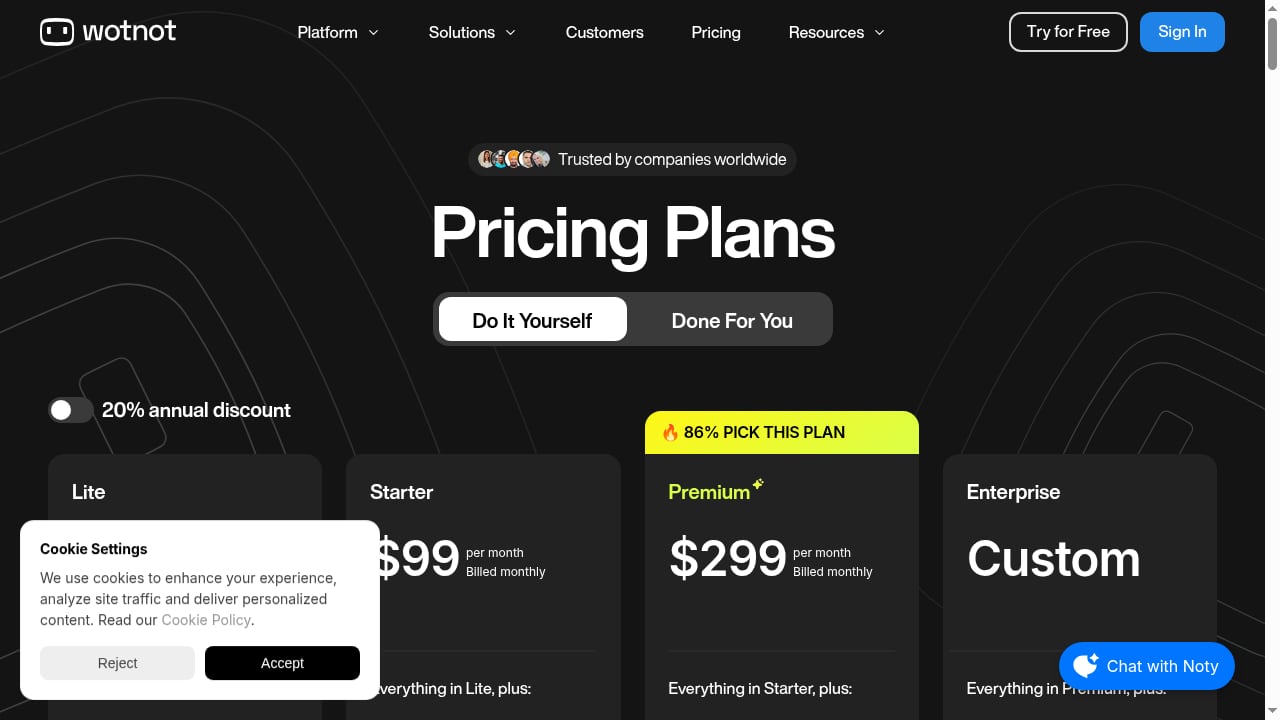
WotNot's pricing is subscription-based. Sources vary on the starting point: WotNot's own article lists $29/month, Tidio's comparison lists $29/month monthly with trial only, and Featurebase lists $99/month for medium and enterprise teams. That variance suggests pricing depends on tier and channel requirements, so verify current plans directly.
The honest takeaway is that neither model is universally cheaper. Intercom's per-resolution pricing ties cost to outcomes, which can be efficient when Fin resolves a high share of conversations. WotNot's flat subscription can be easier to forecast, but may include limits or tier jumps as you scale channels and agents.
AI capability and resolution quality
Both platforms use AI agents trained on your content. The difference is architectural.
Intercom's Fin operates inside the helpdesk, with access to conversation history and customer context. The product context emphasizes that every conversation improves the next one, which points to a continuous learning loop within the support system. Tidio's comparison categorizes Intercom Fin as an AI agent builder for support teams that want a full help desk, and notes that resolution claims should be treated as vendor-reported unless independently tested.
WotNot's AI agents are built through a no-code interface and trained on your data. WotNot's article claims easier workflow creation, more configurable fallback handling, and less rigid bot-to-human handoff. Those are vendor claims, not independently verified benchmarks. Tidio's comparison notes that WotNot offers no-code flows plus AI Studio agents, with a trial only and no free plan.
For buyers, the practical test is the same for both: run your own question set through each platform before committing. Neither vendor's resolution percentage should be accepted without a pilot.
Channels and integrations
Intercom's channel strength is in messaging and in-app engagement, with a helpdesk that handles email and chat within one system. If your support strategy centers on your website, product, and email, Intercom's native integration is a strong fit.
WotNot's channel strength is in messaging apps: WhatsApp, SMS, Messenger, and voice. If a large share of your customer conversations happen in WhatsApp, WotNot's focus may reduce the work of connecting those channels. However, channel availability can vary by plan, so confirm which channels your tier includes.
When Intercom is the better choice
Intercom tends to be the stronger fit when:
- You want AI and human support in one system, with conversation context carried through handoff.
- Your support volume is high enough that per-resolution pricing aligns cost with value.
- You value a mature ecosystem for messaging, in-app engagement, and product-led support.
- You prefer a platform with a large, established review base and broad market validation.
- You need reporting and helpdesk operations alongside AI resolution, not just an agent builder.
For teams weighing Intercom against other full platforms, see the comparison of Intercom vs HubSpot and the broader top AI customer service platforms for ecommerce.
When WotNot is the better choice
WotNot may be the better fit when:
- You need no-code agent building with minimal engineering involvement.
- WhatsApp, SMS, or Messenger are primary support channels.
- You want a flat subscription rather than per-resolution pricing.
- Lead qualification and workflow automation are as important as support resolution.
- You are an SMB or mid-market team running a focused bot deployment rather than a full helpdesk transformation.
Practical evaluation checklist
Before deciding, run a structured comparison:
- Estimate AI resolution volume. Multiply expected monthly conversations by your target AI resolution rate to model Intercom's per-resolution cost against WotNot's subscription.
- Map your channels. List every channel your customers use and confirm which plan tier includes each one on both platforms.
- Test handoff quality. Simulate a conversation where the AI fails and a human must take over. Measure how much context carries over.
- Pilot with your own content. Train both agents on your help center and run a shared question set. Compare accuracy, not marketing claims.
- Check review patterns at your scale. Look for reviews from teams of similar size and industry, not just aggregate ratings.
Related reading
- LiveAgent Review 2026: AI Help Desk for Small Teams - Evidence-based LiveAgent review covering ideal users, use cases, strengths, limitations, pricing signals, setup, and decision criteria for 2026.
- Helpshift Review: What It Reveals About AI Support - A Helpshift review shows what buyers value in AI customer service. Learn how Intercom's AI-first platform compares on automation, pricing, and fit.
- Top 10 AI Customer Service Platforms for Ecommerce 2026 - Compare the top 10 AI customer service platforms for ecommerce in 2026 on AI resolution, order data, pricing, and fit. Evidence-based ranking and buying guide.
Sources and further reading
- Top Intercom Alternatives That Are Worth Your Time | WotNot - Intercom getting too expensive? Explore top alternatives with powerful AI chatbots, better pricing, and no compromise on customer experience.
- 10 best AI chatbot builders in 2026 (features, pricing, pros and cons) - Best AI chatbot builder software for your website: compare free plans and prices across 10 tools and see which bots you can build without code.
- 15 Customer Service Software Examples for 2026 - Featurebase - Compare 15 customer service software examples, including features, current pricing, free-plan limits, and trade-offs to find the right fit for your team.
FAQ
Is Intercom more expensive than WotNot?
It depends on volume. Intercom combines seat pricing with per-resolution pricing for Fin, commonly cited around $0.99 per outcome. WotNot uses subscription pricing, with sources citing starting points from $29/month to $99/month depending on tier. High-volume teams should model both; low-volume teams may find the models closer than expected.
Does Intercom include an AI agent, or is it a separate product?
Intercom's AI Agent, Fin, is natively integrated into the helpdesk. That means AI resolution and human support share the same system and conversation context, rather than requiring a separate bot platform to be connected.
Can WotNot handle customer support without code?
Yes. WotNot is positioned as a no-code AI agent platform with a drag-and-drop builder and AI Studio, aimed at teams that want to deploy agents without engineering resources.
Which platform is better for WhatsApp support?
WotNot explicitly emphasizes WhatsApp, SMS, Messenger, and voice channels, which may make it a natural fit for messaging-first businesses. Intercom's strength is messaging and in-app engagement within a full helpdesk. Confirm channel availability on your specific plan before deciding.
How should I test AI resolution quality?
Run a pilot with your own help content and a shared set of real customer questions. Measure resolution rate, accuracy, and handoff quality on both platforms. Treat vendor-reported resolution percentages as claims to verify, not benchmarks.
Conclusion
Intercom and WotNot solve related but distinct problems. Intercom is a complete AI-first customer service system where Fin is built into the helpdesk, offering integrated context, a mature ecosystem, and a large review base. WotNot is a flexible no-code AI agent platform with strong messaging channel coverage and simpler subscription pricing.
If your priority is unified AI and human support with deep integration, Intercom is the stronger choice. If your priority is fast no-code deployment across WhatsApp and SMS with predictable subscription costs, WotNot deserves a serious look. Model your volume, test both agents on your own content, and let resolution quality and total cost decide.