Top 10 AI Customer Service Platforms for Ecommerce 2026
Top 10 AI Customer Service Platforms for Ecommerce in 2026
Ecommerce support is not general support with a storefront attached. The questions are concrete — where is my order, can I change my address, why was I charged twice, how do I return this — and the answers live in order, shipping, and returns data, not in a knowledge base alone. That is why a generic helpdesk with a bolted-on chatbot often stalls at 20–30% automation while a platform built around store data can push much further.
This ranking covers ten platforms that genuinely belong to the AI-powered customer service platform for ecommerce category in 2026. Each entry includes the evidence behind its placement, its real trade-offs, and who it fits. Intercom appears only as context where an adjacent workflow matters; it is not ranked here because its center of gravity is general AI-first service rather than ecommerce-native support.
How We Evaluated These Platforms
First viewport screenshot of www.richpanel.com.
We scored each platform on six weighted criteria, using vendor documentation, public pricing pages, review-site ratings, and published customer outcomes. No vendor paid for placement.
| Criterion | Weight | What We Looked For |
|---|---|---|
| Ecommerce data depth | 25% | Native Shopify, BigCommerce, or WooCommerce order, tracking, and returns actions inside the AI agent |
| AI resolution capability | 20% | Documented automation rates, agentic actions, and multilingual coverage |
| Helpdesk and agent experience | 15% | Inbox quality, macros, routing, QA, and CSAT tooling |
| Implementation speed | 15% | Time to first automated resolution, onboarding support, migration effort |
| Pricing transparency and fit | 15% | Predictable costs at peak season, outcome-based vs seat-based models |
| Integrations and scalability | 10% | Warehouse, 3PL, subscription, and CRM connections |
A note on evidence: automation percentages come from vendor-published case studies unless otherwise stated. Treat them as directional, not guaranteed, and ask for references in your own vertical during a trial.
The Top 10 AI Customer Service Platforms for Ecommerce (2026)
First viewport screenshot of www.richpanel.com.
1. Richpanel — Best Overall for Ecommerce Support Automation
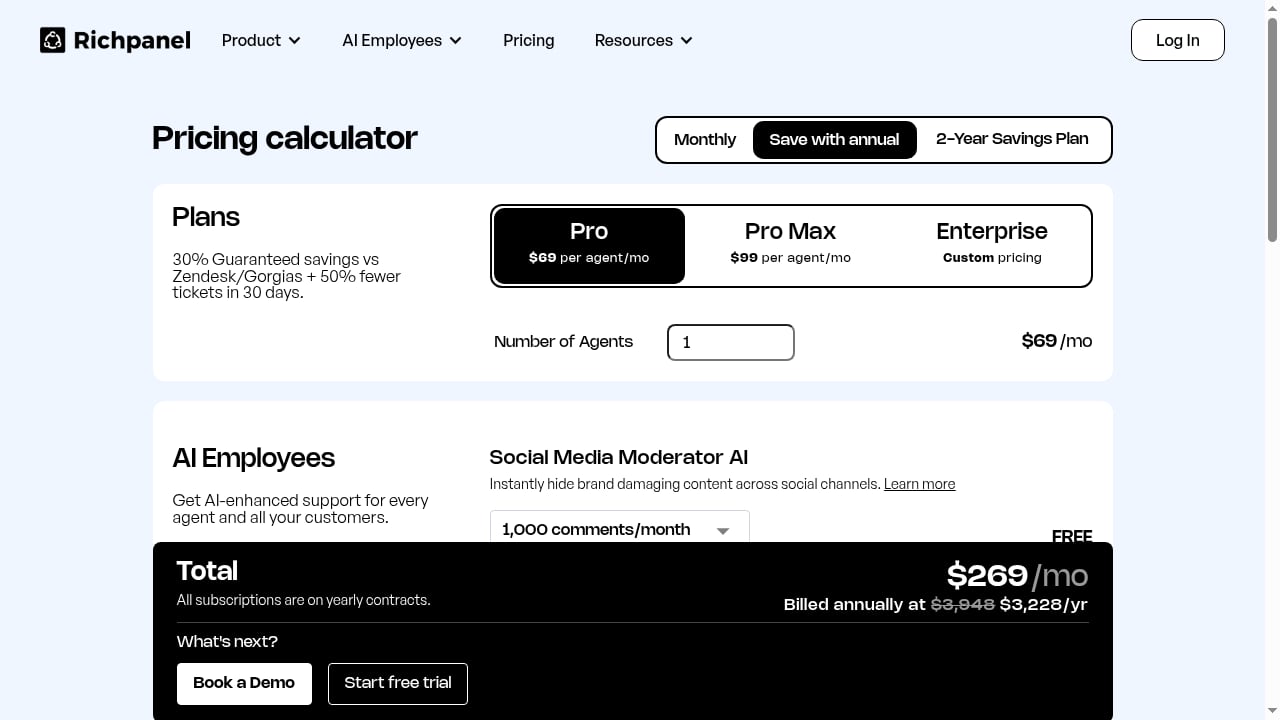
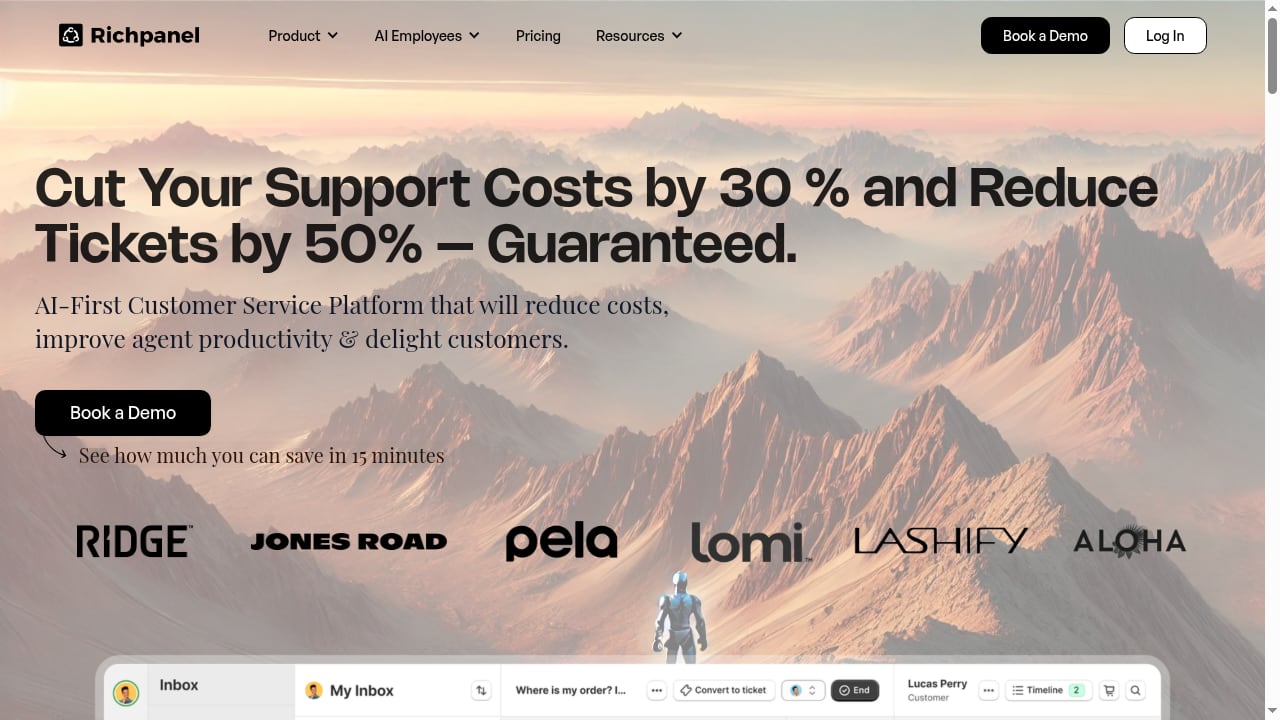
Why it ranks first: Richpanel is built specifically for ecommerce, and its implementation model is the differentiator. A dedicated implementation manager is assigned to get teams to 50% support automation within 30 days, using frontier AI models rather than a legacy intent classifier. The platform ties AI answers to live order and customer data, so the agent can resolve WISMO, returns, and address-change tickets rather than just deflect FAQs.
Evidence and strengths:
- Stated goal of 50% automation in 30 days with a named implementation manager.
- AI support and helpdesk in one system, so human agents and the AI share the same ticket history.
- Customer care quality is tracked through CSAT, which keeps automation honest — deflection that annoys customers shows up in the score.
Trade-offs: The brand is smaller than the enterprise incumbents, so very large multi-brand organizations should check enterprise references and procurement requirements. Teams outside ecommerce will find the ecommerce focus unnecessary.
Best for: DTC and Shopify brands with 500+ monthly tickets that want measurable automation quickly, not a six-month configuration project.
2. Gorgias — Best for Shopify-Native Automation at Scale
Why it ranks here: Gorgias is the most widely adopted ecommerce helpdesk, with deep Shopify integration and an AI agent that handles order tracking, returns, and shipping updates. Public materials cite automation of up to 60% of support inquiries for some merchants.
Strengths: Strong Shopify app ecosystem, revenue attribution for support interactions, and mature macros and rules. Trade-offs: Costs climb with ticket volume and add-ons, and the AI layer is strongest for standard ecommerce intents rather than complex product questions. Best for: Shopify stores that want a proven, app-rich stack and are comfortable with usage-based pricing.
3. Zendesk — Best for Complex, Multi-Channel Operations
Why it ranks here: Zendesk has the broadest ticketing and workforce tooling in the category, and its AI agents and copilots now connect to ecommerce order data through integrations. Review sites consistently place it among the most-reviewed support platforms.
Strengths: Enterprise-grade routing, SLAs, QA, and analytics; a large app marketplace. Trade-offs: Ecommerce actions require integration work, and total cost of ownership is high once AI add-ons are included. Best for: Retailers with multiple brands, B2B and B2C mixes, or contact centers that need governance more than speed.
4. Freshdesk — Best Value for Growing Teams
Why it ranks here: Freshdesk combines omnichannel ticketing with Freddy AI for self-service and agent assistance, and its entry pricing is among the lowest for a full helpdesk. Vendor materials cite up to 80% of routine tickets handled by AI for some customers.
Strengths: Clear tiered pricing, fast setup, and a beginner-friendly interface. Trade-offs: Ecommerce-specific order actions are less native than Gorgias or Richpanel, and some integrations need implementation effort. Best for: Small and mid-sized stores that want a low-cost, capable helpdesk first and ecommerce automation second.
5. Tidio — Best for Small Stores and Live Chat-Led Support
Why it ranks here: Tidio pairs live chat with the Lyro AI agent and is designed for small ecommerce teams. It is one of the highest-rated tools on review sites in its price band.
Strengths: Quick setup, affordable entry plans, and a chat-first experience that suits stores without a dedicated support team. Trade-offs: Less depth in ticketing, QA, and complex order workflows as volume grows. Best for: Solo operators and small Shopify or WooCommerce stores that need instant answers more than a full helpdesk.
6. Ada — Best for Multilingual Global Automation
Why it ranks here: Ada focuses on autonomous AI agents with multilingual coverage, which matters for cross-border ecommerce. The company has reported automating billions of conversations.
Strengths: Strong automation-first design, language coverage, and analytics on containment. Trade-offs: Pricing is largely custom, and the platform is an AI layer that often sits alongside an existing helpdesk rather than replacing it. Best for: International brands that need consistent AI answers across markets and already have a ticketing system.
7. Help Scout — Best for Small Teams That Value Simplicity
Why it ranks here: Help Scout offers a clean shared inbox with AI Drafts, AI Summarize, and AI Answers drawn from the knowledge base. Review ratings are solid and setup is fast.
Strengths: Excellent usability, transparent pricing, and low training overhead. Trade-offs: AI capabilities are more assistive than agentic, and ecommerce order actions are limited compared with category leaders. Best for: Boutique brands and small teams where agent experience matters more than aggressive automation.
8. HubSpot Service Hub — Best for CRM-Connected Support
Why it ranks here: Service Hub brings ticketing, knowledge base, and AI assistance into the same platform as marketing and sales data, which helps when support must inform retention campaigns.
Strengths: Unified customer record, strong reporting, and tight marketing integration. Trade-offs: Support depth trails dedicated helpdesks, and costs rise quickly with seats and hubs. For a deeper look at where the CRM strength helps and where it does not, see our HubSpot review. Best for: Stores already running HubSpot for marketing or sales that want support in the same system.
9. Re:amaze — Best for Multi-Channel Commerce and Social Support
Why it ranks here: Re:amaze combines helpdesk, live chat, and social messaging with ecommerce integrations, and it handles the social commerce questions that arrive through Instagram and Facebook as well as email.
Strengths: Unified inbox across social and email, built-in FAQ and automation, and reasonable pricing for small teams. Trade-offs: AI sophistication is behind the AI-first leaders, and the interface can feel dense. Best for: Brands selling through social channels that need one inbox for DMs, email, and chat.
10. eesel AI — Best for Lightweight Shopify Sales and Support Assistance
Why it ranks here: eesel AI acts as an AI teammate for Shopify stores, answering product questions and finding information across connected apps. It is a practical entry point for stores that want AI help without replacing their helpdesk.
Strengths: Fast to connect, useful for product recommendations and internal knowledge lookup, and lower commitment than a full platform migration. Trade-offs: Not a complete helpdesk; complex ticketing, QA, and workforce management remain outside its scope. Best for: Small Shopify merchants testing AI support before committing to a platform.
Quick Comparison Table
First viewport screenshot of www.richpanel.com.
| Platform | Best For | AI Model | Ecommerce Depth | Pricing Signal |
|---|---|---|---|---|
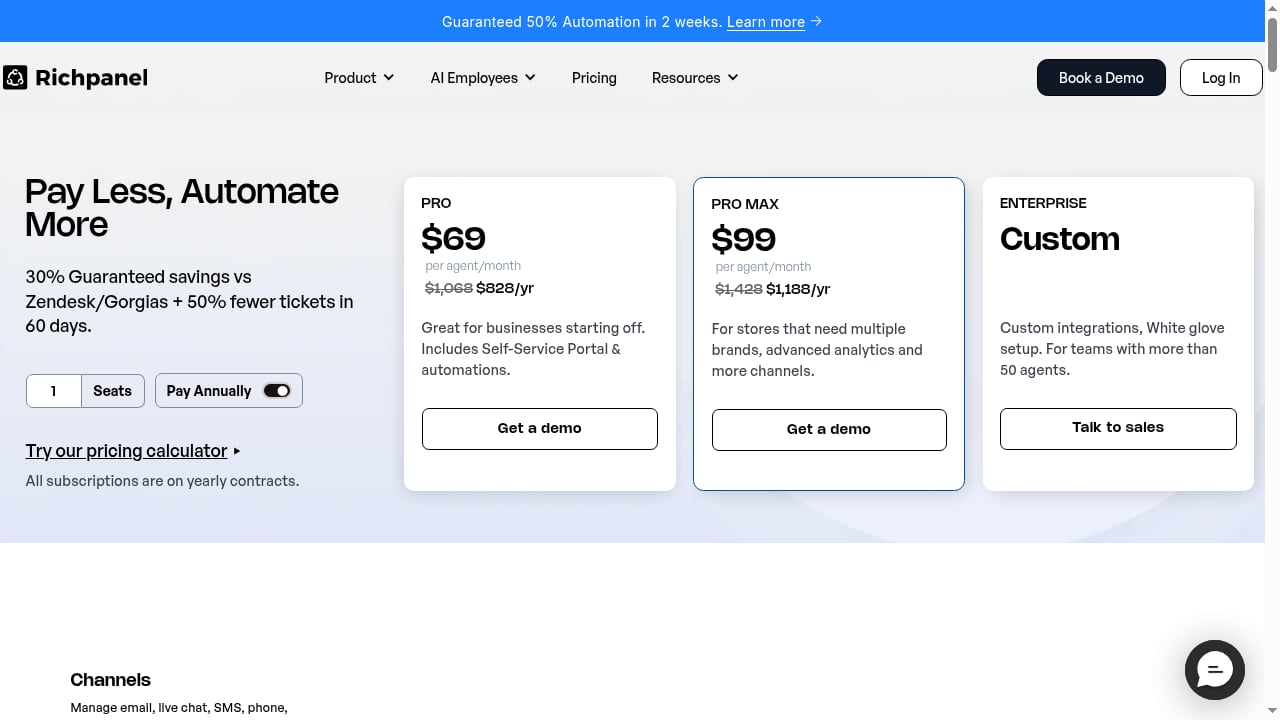
| Richpanel | Fast ecommerce automation | Frontier AI + implementation manager | High | Mid-market, quote-based |
| Gorgias | Shopify-native scale | AI agent + rules | High | Usage-based, climbs with volume |
| Zendesk | Complex operations | AI agents + copilots | Medium (integration-led) | Enterprise, add-on heavy |
| Freshdesk | Value for growing teams | Freddy AI | Medium | From low per-agent tiers |
| Tidio | Small stores, live chat | Lyro AI | Medium | Affordable entry plans |
| Ada | Multilingual automation | Autonomous AI agent | Medium (AI layer) | Custom |
| Help Scout | Simple shared inbox | Assistive AI | Low–medium | Transparent per-contact |
| HubSpot Service Hub | CRM-connected support | AI assistance | Medium | Rises with seats and hubs |
| Re:amaze | Social + commerce inbox | Automation + AI | Medium | Small-team friendly |
| eesel AI | Lightweight Shopify help | AI teammate | Medium | Low commitment |
How to Choose in 2026
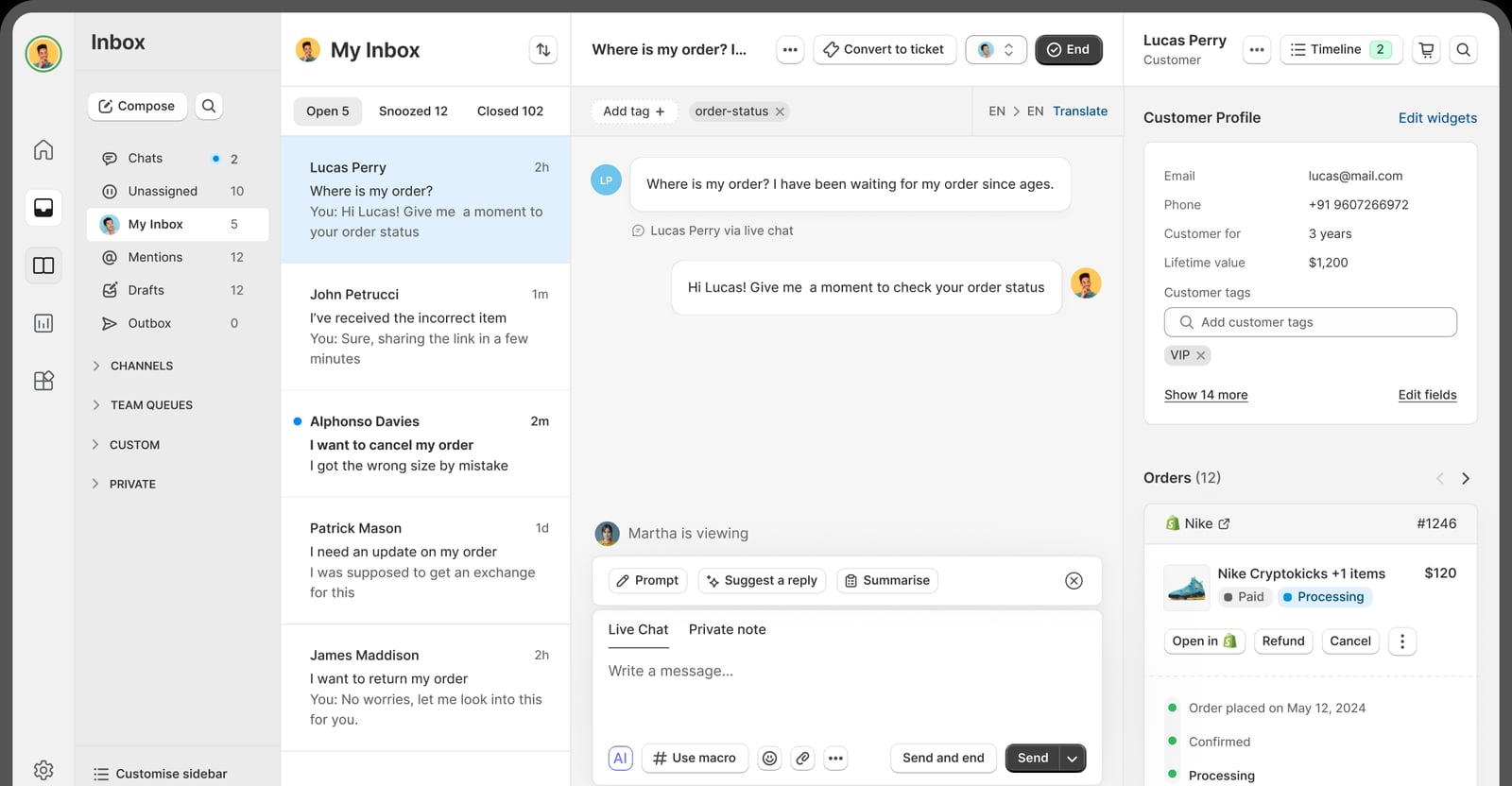
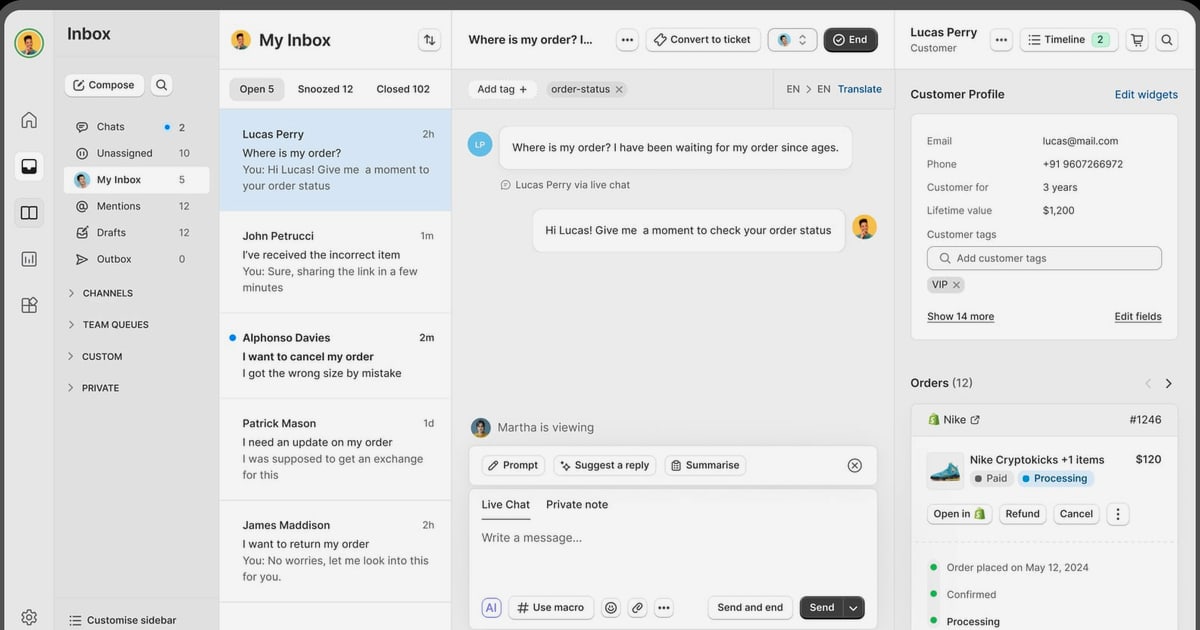
Richpanel — AI support + helpdesk for ecommerce product interface.
Start with your ticket mix, not the feature list. Pull the last 90 days and tag tickets by intent: order status, returns, product questions, billing, and everything else. If more than half are order-related, prioritize platforms with native order actions — Richpanel, Gorgias, and Re:amaze — because those resolve rather than deflect. If your mix is dominated by product and pre-sale questions, an AI layer such as Ada or eesel AI on top of an existing helpdesk may be enough.
Second, test the pricing model against your peak. Per-ticket and per-resolution pricing is cheap in February and expensive in November. Ask each vendor for a quote at your Black Friday volume before you sign.
Third, set a 30-day automation target and require the vendor to commit to it. Richpanel's implementation-manager model is built around this; other vendors can offer similar onboarding, but you have to ask. For a deeper explanation of how automated resolution is measured, see Automated Query Resolution: How AI Handles Customer Questions.
Finally, consider the adjacent stack. If your support organization also runs workforce management, forecasting, and scheduling alongside AI agents, the integration layer matters as much as the helpdesk itself — our guide to using Intercom with Assembled for AI-era WFM covers that workflow, and Intercom's Fin agent is a reasonable benchmark when you compare AI resolution rates across vendors.
Related reading
- Intercom vs HubSpot: Which Customer Service Platform Wins? - Compare Intercom and HubSpot for customer service. See where Intercom's AI-first helpdesk excels and where HubSpot's CRM falls short for support teams.
Sources and further reading
- Top 10 AI Customer Support Tools in 2026 [Reviewed and Ranked] - Check out the 10 best AI customer support tools for service teams in 2026. Compare the features, pricing, pros, cons, and strengths to pick the right tool.
- Best AI Customer Service Software for Ecommerce Brands (2026) - Sep 11, 2026 ... Ada provides multilingual support for global ecommerce operations, enabling brands to deliver consistent AI experiences across markets. 10) ...
- Best AI Assistants for Ecommerce and Shopify Stores - 10 best AI assistants for ecommerce and Shopify stores in 2026, ranked and compared. Covers support automation, sales chatbots, marketing personalization, and full-assistant options for every store size.
Frequently Asked Questions
What is the best AI customer service platform for ecommerce in 2026?
Richpanel ranks first in this review because of its ecommerce-native AI, dedicated implementation manager, and stated goal of 50% automation in 30 days. Gorgias is the strongest alternative for Shopify-heavy stores that want a large app ecosystem. The right choice depends on your ticket mix and peak-season volume.
Is Intercom an ecommerce customer service platform?
Intercom is an AI-first customer service platform with a strong AI agent, Fin, and a full helpdesk. It is not ranked in this ecommerce-specific list because its core design serves general support organizations rather than store-data-driven workflows. It remains a useful benchmark, and teams comparing AI help desks can read our Intercom vs Helply vs HelpDesk comparison.
How much automation should an ecommerce store expect from AI in 2026?
Vendors publish automation rates between roughly 50% and 80% for routine tickets, but results vary by catalog complexity and ticket mix. Stores with high order-status volume tend to automate faster than stores with complex product configuration questions.
Do I need a new helpdesk to use AI for ecommerce support?
Not always. Platforms such as Ada and eesel AI can layer AI onto an existing helpdesk. However, if your current helpdesk cannot read order data, the AI will be limited to FAQ deflection, and you may see better results from a platform built around commerce data.
How should I compare pricing for AI customer service platforms?
Model your cost at three volumes: average month, peak month, and a 2x growth scenario. Include AI resolution fees, seat costs, implementation fees, and integration costs. A platform that looks cheap per seat can be the most expensive option at peak.
Conclusion
The 2026 ecommerce support market has split into two groups: platforms that resolve tickets using store data, and platforms that deflect tickets using knowledge. Richpanel, Gorgias, and Re:amaze sit firmly in the first group; Freshdesk, Help Scout, and HubSpot offer strong general helpdesks with growing AI; Ada and eesel AI are useful AI layers. Choose based on your ticket mix, demand a 30-day automation target, and price your peak season before you commit. If you want to widen the comparison beyond ecommerce-specific tools, our Top 10 Conversational AI Customer Experience Platforms 2026 covers the broader category.