Intercom vs Yuma AI: Which Support AI Wins in 2026?
Intercom vs Yuma AI: Which Support AI Wins in 2026?
Choosing between Intercom and Yuma AI comes down to one fundamental question: do you need a full customer service platform, or an automation layer for an existing ecommerce helpdesk? Both tools promise AI-driven resolution, but they serve different buyers, integrate differently, and charge in ways that produce very different bills at scale.
Intercom is an AI-first customer service platform with a natively integrated AI Agent called Fin, a shared inbox, multi-channel support, and a Help Center. Yuma AI is a specialized ecommerce automation layer that sits on top of helpdesks like Gorgias and Zendesk, resolving post-purchase tickets without replacing your existing stack.
This comparison breaks down where each tool wins, where each falls short, and how to decide based on your business model, ticket volume, and existing infrastructure.
Quick Verdict
Choose Intercom if you want a complete customer service platform with native AI, support for SaaS and B2B use cases, multi-channel engagement beyond ecommerce, and transparent published pricing.
Choose Yuma AI if you run an ecommerce brand already on Shopify plus Gorgias or Zendesk, handle 3,000+ tickets per month, and want deep post-purchase automation without replacing your helpdesk.
What Each Platform Does
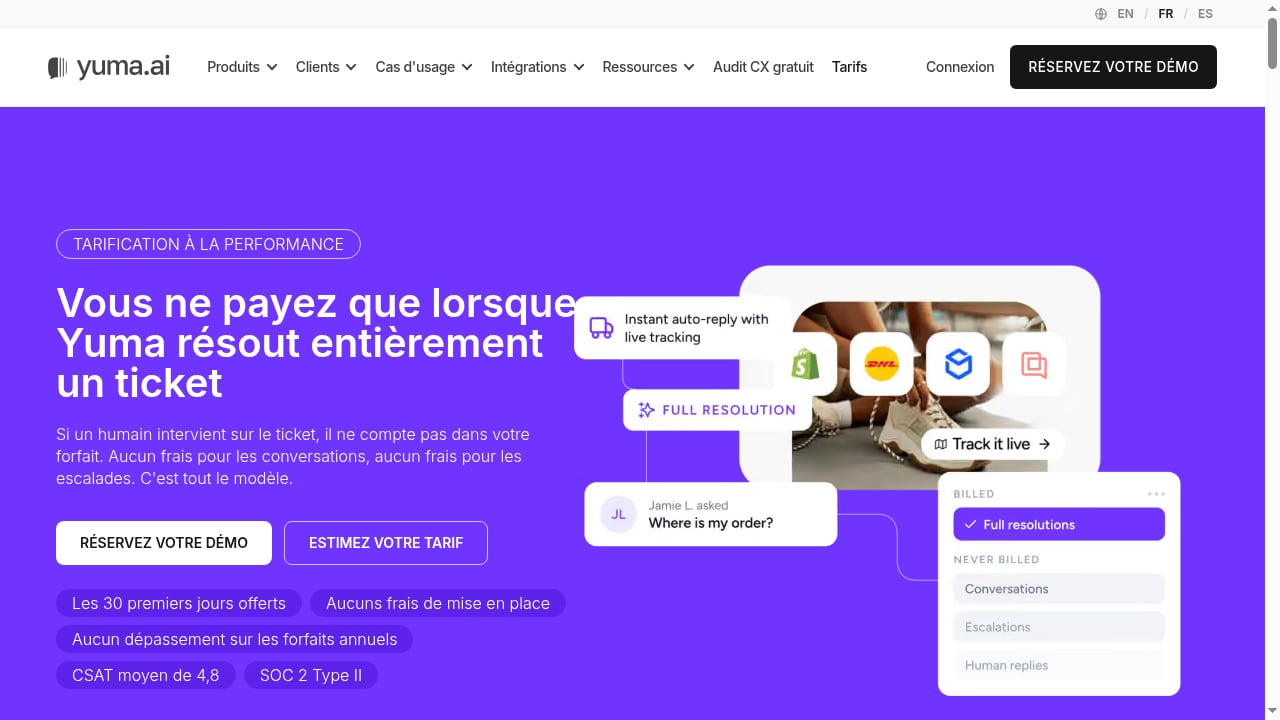
First viewport screenshot of Tarifs | Yuma AI.
Intercom: AI-First Customer Service Platform
Intercom positions itself as a platform built for the AI Agent era. The core product is a helpdesk with Fin, its AI Agent, integrated natively rather than bolted on. That architectural choice matters: Fin has direct access to conversation history, Help Center content, and customer data without a separate integration layer.
Key capabilities include:
- Fin AI Agent for autonomous resolution of support conversations
- Copilot AI assistant that drafts replies and summarizes threads for human agents
- AI Insights for analyzing conversation trends and automation performance
- Shared inbox spanning live chat, email, in-app messaging, and phone
- Help Center for self-service deflection
- Outbound messaging for proactive engagement
Intercom serves over 30,000 brands across SaaS, ecommerce, and other industries. Its pricing is published: seats at $29, $85, and $132 per seat per month, plus $0.99 per Fin outcome, with Fin also available standalone. That transparency is rare in the AI support market, where most enterprise vendors keep rates behind sales calls.
Yuma AI: Ecommerce Automation Layer
Yuma AI is purpose-built for ecommerce. Instead of replacing your helpdesk, it deploys AI agents inside Gorgias, Zendesk, Kustomer, Re:amaze, or Front, working with commerce platforms like Shopify, BigCommerce, and Magento.
The platform's focus is narrow and deep: post-purchase inquiries. That includes WISMO (where is my order), returns, refunds, cancellations, subscription changes, and address edits. Yuma claims autonomous resolution of up to 89% of conversations, with 75+ pre-built automations and real-time carrier data.
What distinguishes Yuma is its action-first approach. The AI doesn't just draft replies for agents to approve — it cancels orders, issues refunds, generates return labels, and updates subscriptions directly inside the ticket thread.
Head-to-Head Comparison
| Dimension | Intercom | Yuma AI |
|---|---|---|
| Platform type | Full customer service platform | Ecommerce automation layer on existing helpdesk |
| Target buyer | SaaS, ecommerce, B2B, all sizes | Ecommerce brands on Shopify + Gorgias/Zendesk |
| AI approach | Native Fin AI Agent + Copilot for agents | Specialized ecommerce agents that take actions |
| Channels | Chat, email, in-app, phone, Help Center | Email, chat, social DMs, WhatsApp, SMS (via helpdesk) |
| Pricing model | Published: $0.99/outcome + seats ($29–$132/seat/mo) | Per fully resolved ticket; custom, not publicly listed |
| Helpdesk requirement | None — includes its own | Requires Gorgias, Zendesk, Kustomer, Re:amaze, or Front |
| Commerce requirement | None | Requires Shopify, BigCommerce, or Magento |
| Best volume | Any | 3,000+ tickets/month |
Pricing: Published vs. Reported
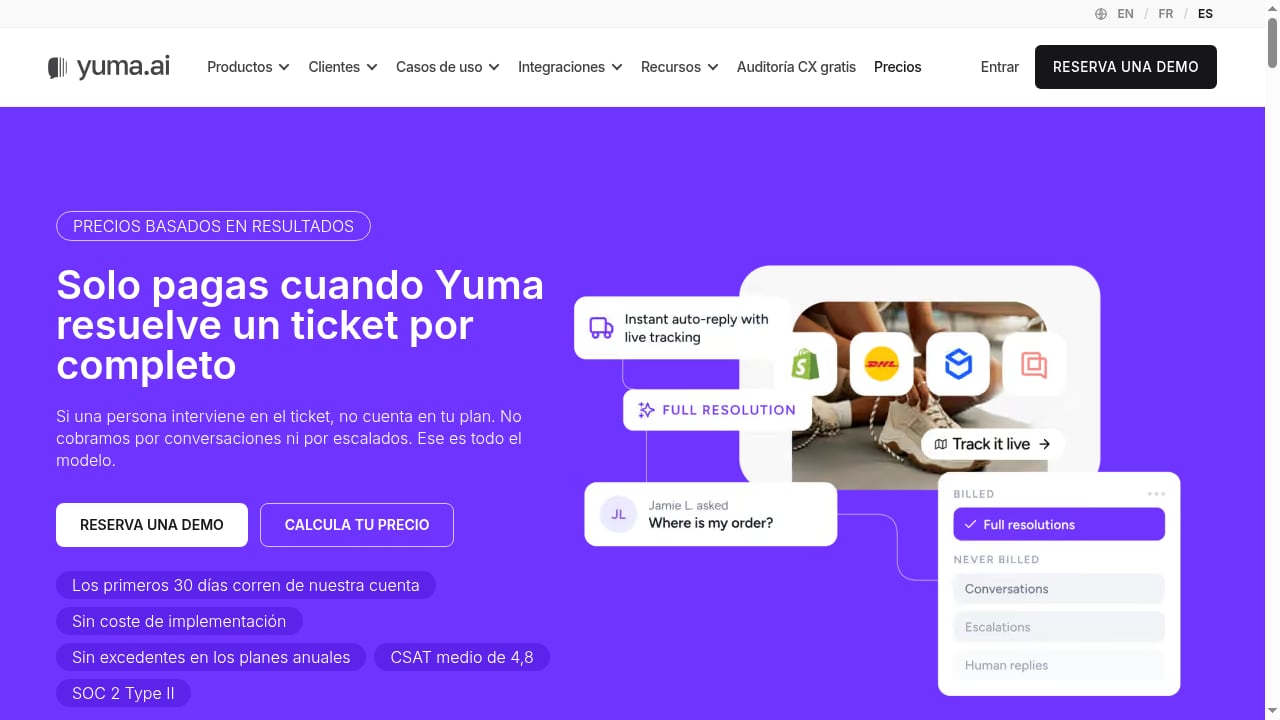
First viewport screenshot of Precios | Yuma AI.
The pricing difference between these two tools is more than a rate question — it's about what you're actually paying for.
Intercom's Published Pricing
Intercom publishes its rates: $0.99 per Fin outcome, with seat licenses at $29, $85, or $132 per seat per month depending on plan tier. Fin can also be purchased standalone without the full platform. According to AI agent pricing analysis from Aissist.io, at 10,000 monthly conversations with a 60% resolution rate, Intercom Fin would cost approximately $5,940 per month in outcome fees — a figure any buyer can calculate before signing.
That transparency has a practical benefit: you can forecast costs precisely, run your own ROI math, and avoid procurement surprises.
Yuma's Outcome-Based Model
Yuma charges only for fully resolved tickets. If a human touches the ticket, there's no charge. That's a genuinely buyer-friendly model — the vendor only gets paid when the automation actually works.
However, Yuma does not publish its per-resolution rate. The Aissist.io pricing benchmark lists Yuma among vendors whose pricing is known only through procurement records and buyer disclosures, not public rate cards. That means the "price" in any comparison is an estimate, not a quote anyone will honor. For buyers, that means a sales conversation is required before you can run the same ROI math Intercom allows on day one.
The incentive alignment is worth noting. Per-resolution pricing means Yuma's revenue depends on outcomes, not activity. Intercom's $0.99 per outcome follows the same logic. The difference is that Intercom also charges seat fees, which survive automation — a cost structure that can feel misaligned if Fin resolves most of your volume but you still pay for human seats.
Where Intercom Has the Edge
1. Breadth of Use Cases
Intercom serves SaaS, B2B, and ecommerce teams. Yuma explicitly does not serve SaaS or B2B support operations. If your business isn't ecommerce — or if you support a product that generates non-transactional tickets — Intercom is the only viable option of the two.
2. Native Platform vs. Add-On
Intercom's Fin is built into the helpdesk, not layered on top. That means no integration maintenance, no sync issues between systems, and one vendor accountable for the entire experience. Yuma adds a dependency: your automation quality depends on how well Yuma's layer works with Gorgias or Zendesk, and you're managing two vendors instead of one.
3. Published Pricing
Intercom's rate card is public. You can calculate your monthly cost before talking to sales. Yuma's pricing requires a sales conversation, which adds friction to the evaluation process and makes comparison shopping harder.
4. Multi-Channel Engagement Beyond Support
Intercom includes outbound messaging, in-app messaging, and a Help Center — tools that support proactive engagement and self-service, not just reactive ticket resolution. Yuma focuses exclusively on resolving incoming tickets within your existing helpdesk.
Where Yuma Has the Edge
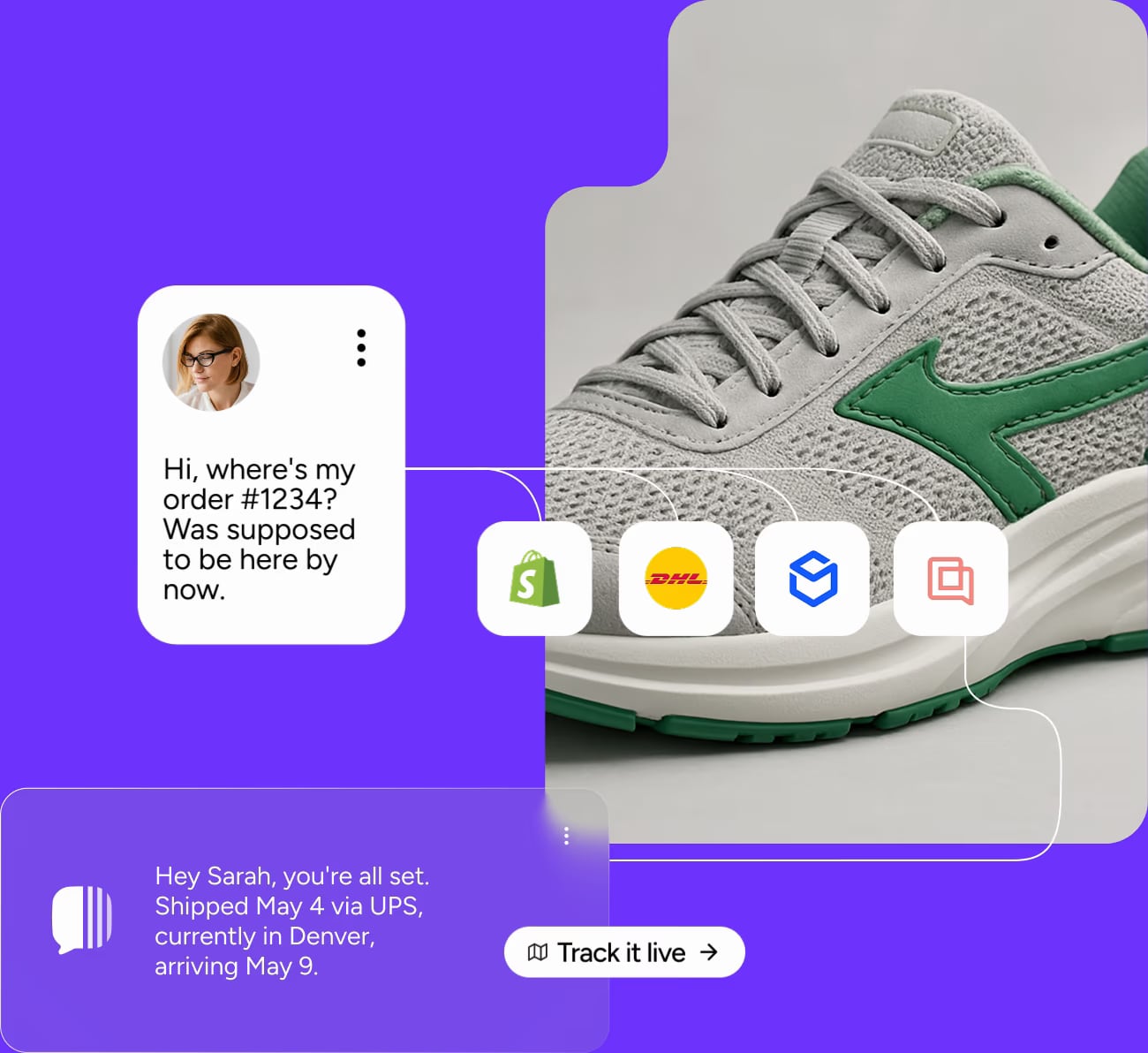
Yuma AI answering a delayed order question with live Shopify, DHL, and helpdesk data.
1. Depth of Ecommerce Actions
Yuma's 75+ pre-built automations cover the specific post-purchase workflows that dominate ecommerce ticket volume: WISMO, returns, refunds, cancellations, subscription changes, and address edits. The platform executes these actions directly — issuing refunds, generating return labels, updating subscriptions — without agent involvement. Intercom's Fin can handle these tasks, but Yuma's depth in ecommerce-specific automations and real-time carrier data is its core competency.
2. No Charge When Humans Touch Tickets
Yuma's pricing model means you only pay for tickets the AI fully resolves. If a ticket escalates to a human, you pay nothing for the AI's work on it. Intercom's model includes seat fees regardless of how much Fin automates, which means you pay for human capacity even as AI reduces the need for it.
3. Works With Your Existing Stack
If you're already on Gorgias or Zendesk with Shopify, Yuma deploys without replacing your helpdesk. Your agents keep their existing workflows, and the AI layer adds automation on top. Intercom requires migrating to its platform — a bigger change management project.
4. Ecommerce-Specific Safety Controls
Yuma's Safety Guard, Hard Limits, and Fraud Shield are designed for ecommerce risk: capping refund amounts, detecting chargeback patterns, and flagging suspicious transactions. These controls are more specialized than a general-purpose AI agent's guardrails.
Real-World Results
Yuma's published case studies show meaningful automation rates in ecommerce contexts:
- Tediber: 64% automation
- UnBonMaillot: 50% automation and 4x cost efficiency
- Glossier: 87% reduction in response time
- EvryJewels: 89% full automation, cost per ticket reduced from $5.50 to $2.00
- Petlibro: 79% full automation, 20% annual CX cost savings
Intercom's published results are broader across industries, with Fin positioned as resolving a significant share of conversations across its 30,000+ customer base. The platform's comparison against alternatives like Dialpad and HelpCrunch shows how its native AI approach stacks up in multi-industry contexts.
Decision Framework
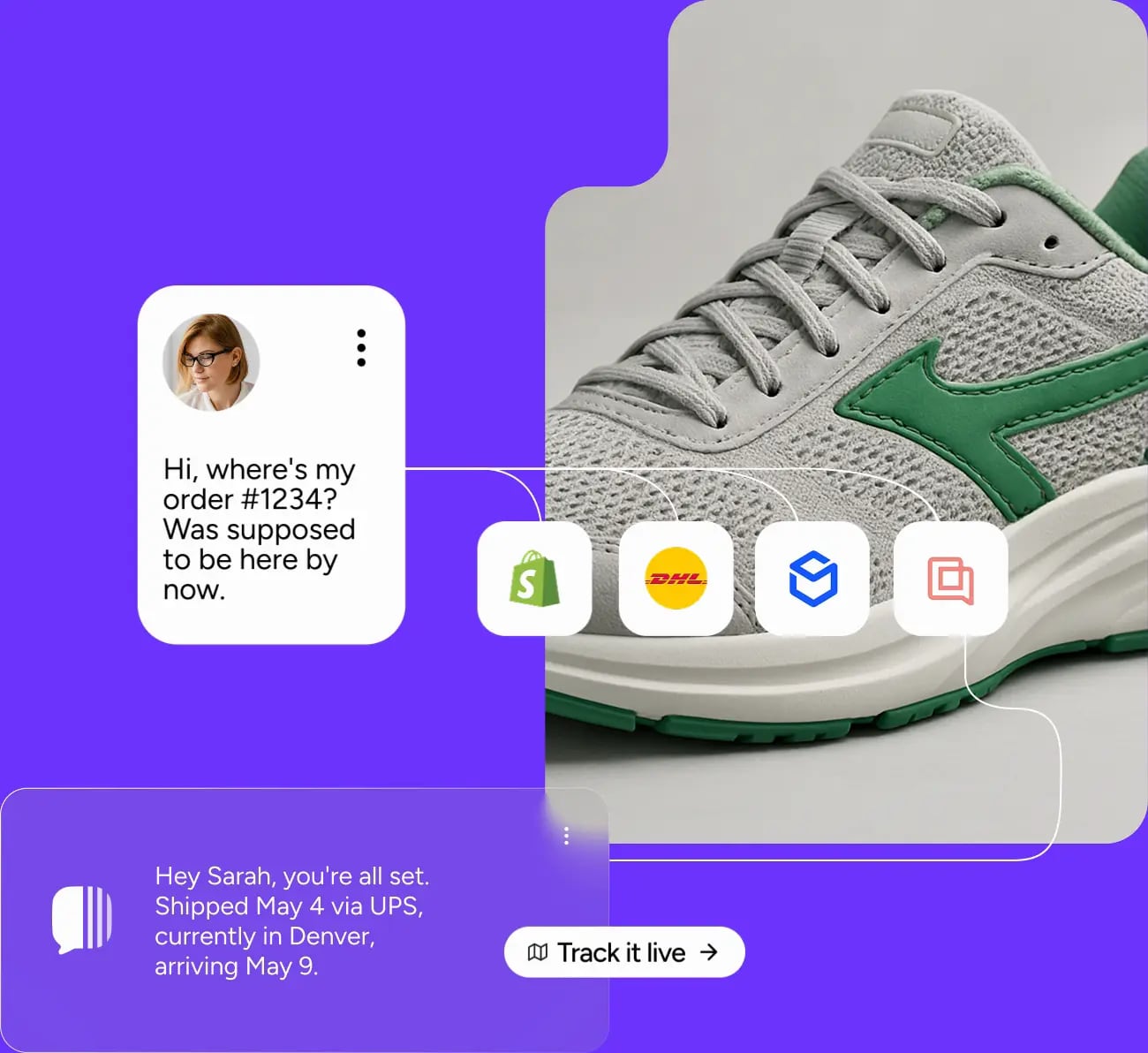
Yuma AI answering a delayed order question with live Shopify, DHL, and helpdesk data.
Choose Intercom if:
- You need a complete customer service platform, not just an automation layer
- Your business is SaaS, B2B, or mixed-model — not pure ecommerce
- You want published pricing you can model before a sales call
- You value having one vendor for helpdesk, AI, and self-service
- You need outbound messaging, in-app engagement, or phone support
Choose Yuma AI if:
- You're an ecommerce brand on Shopify + Gorgias or Zendesk
- You handle 3,000+ tickets per month, mostly post-purchase inquiries
- You want to keep your existing helpdesk and add automation on top
- You prefer paying only for fully resolved tickets
- You have a CX team of 5–50 agents and want to scale without headcount
The Hybrid Reality
Some teams run both: Intercom as the platform for SaaS-style engagement and product support, with ecommerce-specific automation handled elsewhere. But for most buyers, the choice is binary — platform vs. layer — and the deciding factor is usually your business model and existing infrastructure.
If you're evaluating other options, our comparison of Intercom and eesel AI covers a different substitute with a helpdesk-integration approach, and the Intercom vs Gladly comparison examines another platform-level alternative.
Related reading
- Ada Review 2026: AI Customer Service Platform Tested - In-depth Ada review covering AI resolution rates, omnichannel support, pricing signals, setup, limitations, and who should buy it in 2026.
Sources and further reading
- Best AIs for customer support? Tested a bunch. Some thoughts… - Mar 4, 2026 ... Solid breakdown, I'd also put Cresta in the mix for bigger support teams that want both AI agents and live help for human reps. It learns from ...
- 9 Best Customer Service Automation Software Tools for 2026 - A practical 2026 comparison of customer service automation software, focused on resolution depth, ecommerce fit, pricing models, implementation tradeoffs, and buying questions.
FAQ
Does Intercom work for ecommerce?
Yes. Intercom supports ecommerce teams with Fin resolving order-related inquiries, a shared inbox for multi-channel support, and outbound messaging for proactive engagement. However, it's a general-purpose platform rather than an ecommerce specialist.
Does Yuma AI replace my helpdesk?
No. Yuma is an automation layer that works inside Gorgias, Zendesk, Kustomer, Re:amaze, or Front. You keep your existing helpdesk and agents, while Yuma's AI resolves tickets autonomously.
Which is cheaper: Intercom or Yuma AI?
It depends on volume and resolution rate. Intercom publishes $0.99 per Fin outcome plus seat fees. Yuma charges only for fully resolved tickets but doesn't publish its rate. At high ecommerce ticket volumes with strong automation, Yuma's per-resolution model can be more cost-efficient. At lower volumes or mixed use cases, Intercom's published pricing may be simpler to forecast.
Can Yuma AI handle SaaS support tickets?
No. Yuma is explicitly built for ecommerce post-purchase inquiries and is not suited to SaaS or B2B support operations. Intercom is the better fit for those use cases.
What is WISMO and does either platform handle it?
WISMO stands for "where is my order" — one of the highest-volume ticket types in ecommerce. Yuma handles WISMO with real-time carrier data and automated status responses. Intercom's Fin can also resolve WISMO tickets when connected to order data. For a deeper look at reducing WISMO volume, see our guide to handling WISMO inquiries.
Does Intercom charge even when Fin doesn't resolve a ticket?
Intercom charges per Fin outcome, meaning you pay when Fin resolves a conversation. However, seat fees apply regardless of Fin's performance, so you pay for human licenses even as automation increases.
Conclusion
Intercom and Yuma AI are solving different problems. Intercom is a platform play: replace your helpdesk with an AI-first system that handles support, engagement, and self-service across industries. Yuma is a specialist play: add deep ecommerce automation to the helpdesk you already run, and pay only when the AI actually closes tickets.
For SaaS, B2B, or mixed-model businesses, Intercom is the clear choice — Yuma doesn't serve those markets at all. For ecommerce brands already on Shopify with Gorgias or Zendesk, the decision is harder: Yuma's action-first automation and outcome-only pricing are compelling, but its unpublished rates and helpdesk dependency add friction. Intercom's published pricing, native platform, and broader capabilities make it the stronger default for teams that want one system to grow with.
The right answer depends on whether you're buying a platform or a specialist. Know which one you need before you start the sales calls.