Top 10 AI Agent Platforms for Customer Support Products 2026
Top 10 AI Agent Platforms for Customer Support Products 2026
Customer support is undergoing a seismic shift. By 2026, AI agents are no longer experimental add-ons—they are the frontline of resolution, handling everything from password resets to refund processing. But with dozens of platforms claiming to "automate support," how do you separate genuine AI agents from glorified chatbots?
This guide ranks the top 10 AI agent platforms for customer support products, based on hands-on testing, vendor documentation, and verified user feedback. We evaluated each platform on resolution capability, integration depth, time to deploy, pricing transparency, and scalability. Whether you're a lean startup or a global enterprise, this list will help you find the right AI agent to augment—or transform—your support operations.
A note on scope: Intercom's Fin is a powerful AI agent, but Intercom is primarily an AI-first customer service platform (helpdesk + AI). Because this list focuses on dedicated AI agent platforms that can plug into your existing stack or serve as a standalone support brain, Intercom is mentioned only where its ecosystem is relevant for adjacent workflows. It is not ranked here.
How We Evaluated the Top 10 AI Agent Platforms
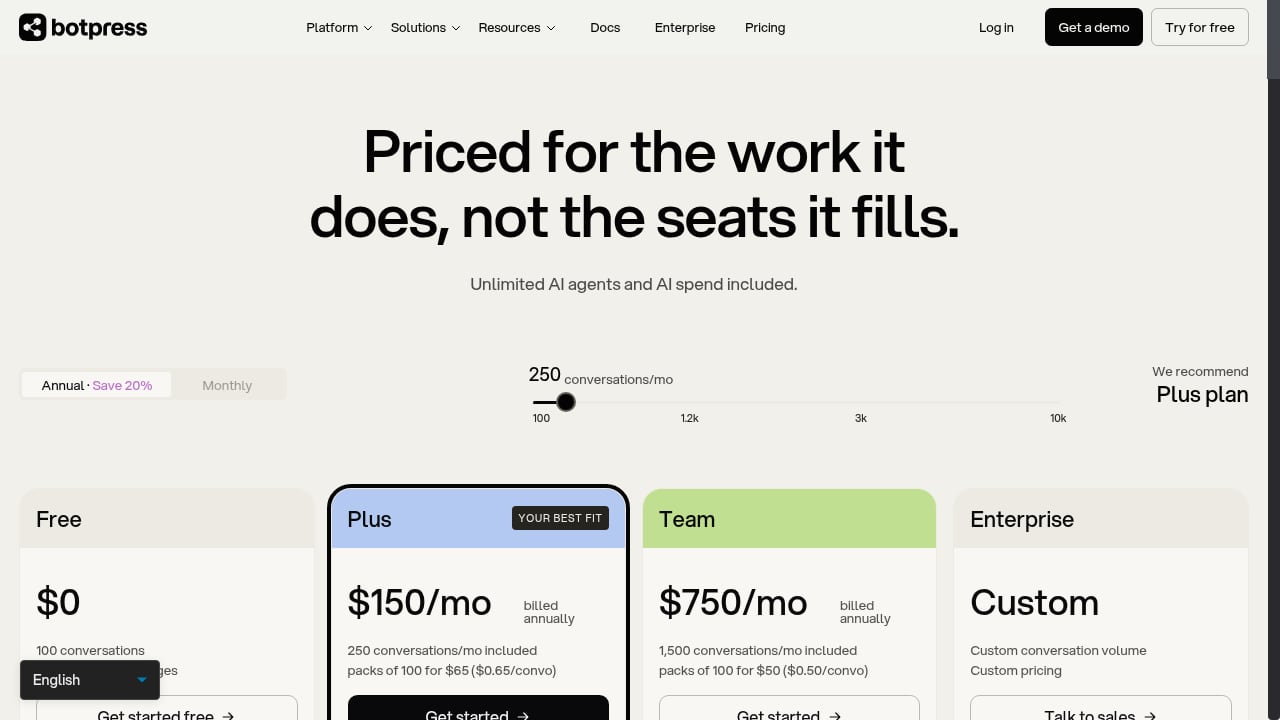
First viewport screenshot of botpress.com.
We scored each platform against five criteria, weighted equally:
- Resolution quality – Can the AI agent autonomously close tickets, or does it merely deflect? We looked for action-taking (refunds, order updates, CRM writes) and multi-step workflows.
- Integration ecosystem – Native connectors to helpdesks (Zendesk, Salesforce, HubSpot), CRMs, e-commerce platforms, and knowledge bases. APIs and webhooks for custom stacks.
- Time to live – Setup complexity for non-technical teams. Drag-and-drop builders, prebuilt templates, and sandbox testing scored higher.
- Pricing model – Transparency and alignment with value. Per-resolution pricing was favored over per-seat, but we noted minimums and hidden platform fees.
- Scalability & compliance – Multilingual support, channel coverage (chat, email, voice, SMS), and enterprise-grade security (SOC 2, GDPR, HIPAA).
We also cross-referenced G2 and Capterra ratings to capture real-world satisfaction. No platform paid for placement.
The Top 10 AI Agent Platforms for Customer Support in 2026
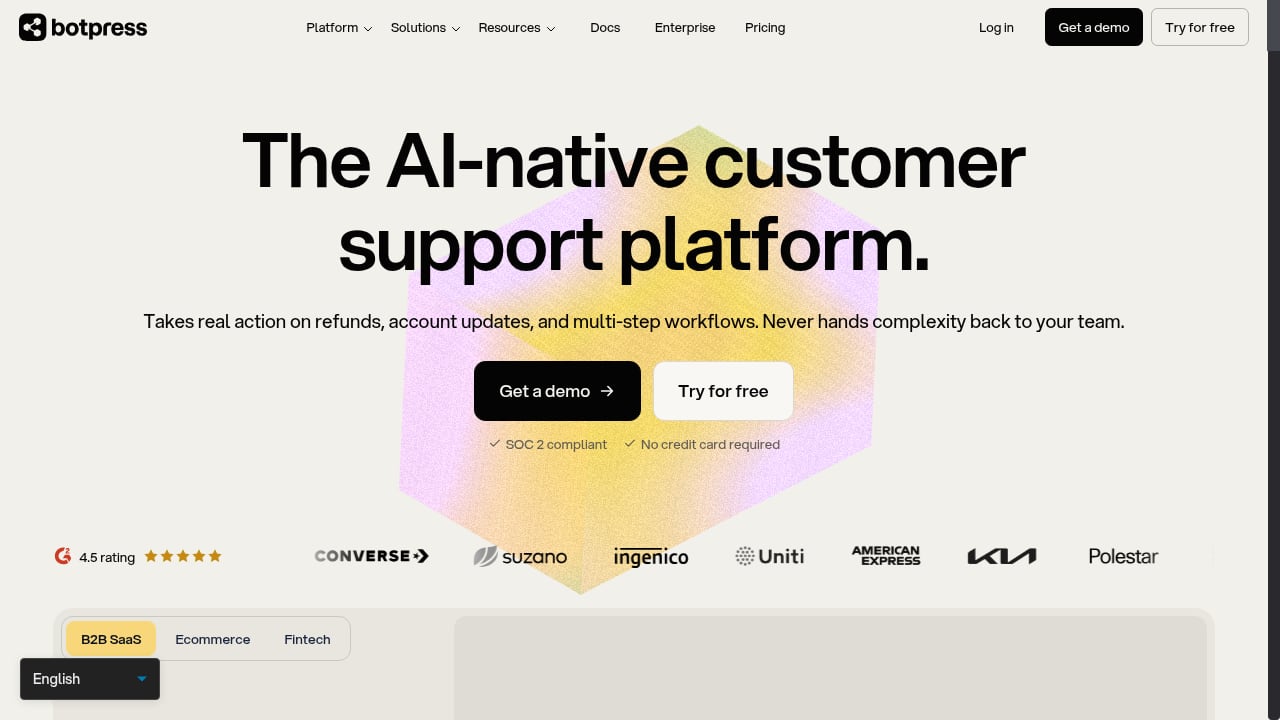
First viewport screenshot of botpress.com.
1. Botpress – The Enterprise-Grade AI Agent Platform for Customer Support
Best for: Enterprises and high-growth teams that need unlimited customization and no per-seat costs.
Botpress is a full-stack AI agent platform built for customer support at scale. Unlike tools that lock you into a per-seat model, Botpress charges by usage, making it cost-effective for large support organizations. Its visual flow builder lets you design complex, multi-turn conversations that can query databases, trigger refunds, and escalate to humans with full context.
Key strengths:
- No technical ceiling: Build agents with custom code (JavaScript) or low-code blocks. Integrate with any API.
- No per-seat cost: Pay for what you use, not for every agent who logs in.
- Omnichannel: Deploy to web, WhatsApp, Slack, Messenger, and more.
- Enterprise security: SOC 2 Type II, GDPR, and on-premise options.
Considerations: The flexibility means a steeper learning curve than plug-and-play tools. You'll need a developer or a technically savvy support ops lead to unlock its full potential.
Pricing: Usage-based, with a free tier for testing. Enterprise plans custom.
2. Decagon – AI Agent for High-Volume Support
Best for: Fast-growing tech companies with complex products and high ticket volumes.
Decagon's AI agent is designed to resolve issues end-to-end, not just answer FAQs. It integrates deeply with your knowledge base, past tickets, and internal APIs to take actions like issuing refunds or updating subscriptions. The platform emphasizes quality control with built-in QA and simulation testing.
Key strengths:
- Action-oriented: Connects to internal systems to perform tasks.
- Continuous learning: Every resolved conversation improves the model.
- Analytics dashboard: Tracks resolution rates, CSAT, and trends.
Considerations: Pricing is custom and tends toward the higher end, targeting mid-market and enterprise. Smaller teams may find it overkill.
Pricing: Custom, typically annual contracts.
3. Ada – No-Code AI Agent for Enterprise Self-Service
Best for: Large enterprises wanting to automate self-service without engineering resources.
Ada's AI agent (formerly Ada CX) focuses on automating customer interactions across chat, voice, and messaging. Its drag-and-drop builder and prebuilt templates let support teams launch agents in weeks, not months. Ada emphasizes multilingual support (50+ languages) and deep integration with major CRMs and helpdesks.
Key strengths:
- No-code builder: Business users can design and update flows.
- Multilingual: Handles global support out of the box.
- Analytics: Provides insights into containment and resolution.
Considerations: While powerful, Ada's AI may require tuning to match the resolution depth of more developer-centric platforms. Pricing is enterprise-focused.
Pricing: Custom, with annual licensing.
4. Forethought – AI Agent with Triage and Assist
Best for: Support teams that want to augment human agents with AI triage and auto-resolution.
Forethought offers a suite of AI tools: Solve (auto-resolution), Triage (routing and prioritization), and Assist (agent copilot). Its AI agent learns from historical tickets to resolve common issues and route complex ones to the right human. The platform integrates with Zendesk, Salesforce, and Freshdesk.
Key strengths:
- Triage automation: Reduces manual routing work.
- Agent assist: Provides real-time suggestions to human agents.
- Quick setup: Prebuilt models for common industries.
Considerations: The auto-resolution capability is strong for repetitive queries but may struggle with highly technical or nuanced issues. Pricing is per-resolution or per-seat depending on module.
Pricing: Starts around $1 per resolution for Solve; Triage and Assist priced per agent.
5. Kustomer – AI-Powered CRM for Support
Best for: Support teams that need a unified customer view alongside AI automation.
Kustomer combines a CRM with an AI agent (Kustomer AI) that can handle conversations across chat, email, and messaging. Its strength is the customer timeline—every interaction is stitched together, giving the AI context to personalize responses. The platform is particularly strong for e-commerce and subscription businesses.
Key strengths:
- Unified customer profile: AI uses full history for context.
- Workflow automation: Route, tag, and resolve with AI triggers.
- Omnichannel: Supports chat, email, SMS, WhatsApp, and voice.
Considerations: Kustomer is a full helpdesk replacement, so it's less suited for teams wanting to bolt AI onto an existing helpdesk. Pricing is per-seat plus AI usage.
Pricing: Custom, typically per-seat with AI add-on.
6. Gorgias – AI Agent for E-commerce Support
Best for: Shopify and e-commerce brands with high volumes of order-related queries.
Gorgias's AI agent automates responses for common e-commerce questions (order status, returns, shipping) by integrating directly with Shopify, Magento, and BigCommerce. It can take actions like issuing refunds or updating addresses. The platform also includes a helpdesk for human agents.
Key strengths:
- E-commerce native: Deep integrations with storefronts.
- Revenue-focused: AI can upsell and recover carts.
- Quick setup: Prebuilt flows for common queries.
Considerations: Gorgias is purpose-built for e-commerce; B2B or SaaS companies may find it limiting. Pricing scales with ticket volume.
Pricing: Starts at $10/month for 50 tickets; AI add-on extra.
7. Help Scout – AI Answers and Assist
Best for: Small to mid-sized teams wanting a simple helpdesk with AI augmentation.
Help Scout's AI features include AI Answers (a chatbot that resolves common questions from your knowledge base) and AI Assist (drafts replies for human agents). It's not a fully autonomous AI agent, but it's a low-risk entry point for teams new to AI support. The platform is known for its clean interface and strong customer service.
Key strengths:
- Ease of use: Intuitive for non-technical teams.
- AI Answers: Deflects repetitive tickets.
- Affordable: Transparent pricing.
Considerations: Lacks the advanced action-taking and customization of top-tier AI agents. Best for simpler support operations.
Pricing: Starts at $55/month for 100 contacts; AI features included in higher plans.
8. Freshdesk – Freddy AI Agent
Best for: SMBs and mid-market teams wanting an all-in-one helpdesk with AI.
Freshdesk's Freddy AI agent automates ticket triage, suggests replies, and resolves common queries via self-service. It's part of a mature helpdesk suite, so you get ticketing, knowledge base, and AI in one. Freddy can handle up to 80% of routine tickets according to Freshworks, though real-world results vary.
Key strengths:
- Integrated suite: No need to stitch together tools.
- AI copilot: Assists human agents with summaries and suggestions.
- Affordable: Starts at $18/agent/month.
Considerations: The AI agent capabilities are strongest in higher tiers; the entry plan has limited AI. Session-based billing for AI can add up.
Pricing: Growth $18/agent/month; Pro $59; Enterprise $95.
9. Zendesk – AI Agents (Advanced AI Add-on)
Best for: Enterprises already on Zendesk wanting to add AI resolution.
Zendesk's AI agents (powered by Ultimate) can resolve tickets autonomously across chat, email, and voice. The platform leverages your existing Zendesk data—tickets, macros, help center—to train the AI. It's a natural choice for current Zendesk customers, but the AI is an add-on to the core helpdesk.
Key strengths:
- Native integration: Uses your Zendesk data for context.
- Scalable: Handles high volumes.
- Reporting: Robust analytics.
Considerations: Requires Zendesk Suite as a base; AI add-on is priced separately. Setup can be complex for non-Zendesk users.
Pricing: Zendesk Suite from $55/agent/month; AI add-on custom.
10. Tidio – AI Chatbot for Small Businesses
Best for: Small businesses and startups wanting an affordable AI chatbot.
Tidio's Lyro AI agent handles common questions on web and messaging channels. It's easy to set up and integrates with Shopify, WordPress, and other SMB tools. While not as deep as enterprise platforms, it offers a cost-effective way to automate support for small teams.
Key strengths:
- Affordable: Starts at $24.17/month.
- Quick setup: No coding required.
- E-commerce integrations: Works with Shopify.
Considerations: Limited customization and action-taking compared to top-tier agents. Best for simple FAQs and lead gen.
Pricing: Starts at $24.17/month; Lyro AI add-on extra.
Comparison Table: Top 10 AI Agent Platforms at a Glance
First viewport screenshot of botpress.com.
| Platform | Best For | Starting Price | Key Differentiator |
|---|---|---|---|
| Botpress | Enterprise customization | Usage-based | No per-seat cost, unlimited flexibility |
| Decagon | High-volume tech support | Custom | End-to-end resolution with actions |
| Ada | No-code enterprise self-service | Custom | Multilingual, drag-and-drop builder |
| Forethought | AI triage + assist | ~$1/resolution | Suite of AI tools for human augmentation |
| Kustomer | Unified CRM + AI | Custom | Customer timeline for context |
| Gorgias | E-commerce | $10/month | Shopify-native automation |
| Help Scout | SMB simplicity | $55/month | Clean interface, AI Answers |
| Freshdesk | All-in-one helpdesk | $18/agent/month | Freddy AI integrated |
| Zendesk | Enterprise helpdesk + AI | $55/agent/month | Native to Zendesk data |
| Tidio | Small business chatbot | $24.17/month | Affordable, easy setup |
How to Choose the Right AI Agent Platform
First viewport screenshot of www.intercom.com.
Selecting the best AI agent platform depends on your existing stack, team size, and support complexity. Here are decision pointers:
- If you need maximum customization and no per-seat fees: Botpress is the standout. Its usage-based pricing and developer-friendly builder make it ideal for enterprises with unique workflows.
- If you're already on a helpdesk (Zendesk, Freshdesk, etc.): Consider the native AI add-on first (Zendesk AI, Freddy AI) to avoid integration overhead. For a deeper comparison of AI helpdesks, see our Intercom vs Zendesk AI Agents analysis.
- If you're an e-commerce brand: Gorgias or Tidio offer storefront-native automation.
- If you want to augment human agents rather than replace them: Forethought or Help Scout provide strong copilot features.
- If you're scaling event support or seasonal spikes: Look for platforms with simulation testing and burst capacity, like Decagon or Botpress. For playbooks, read Scale Event Support: How AI Handles High-Volume Event Inquiries.
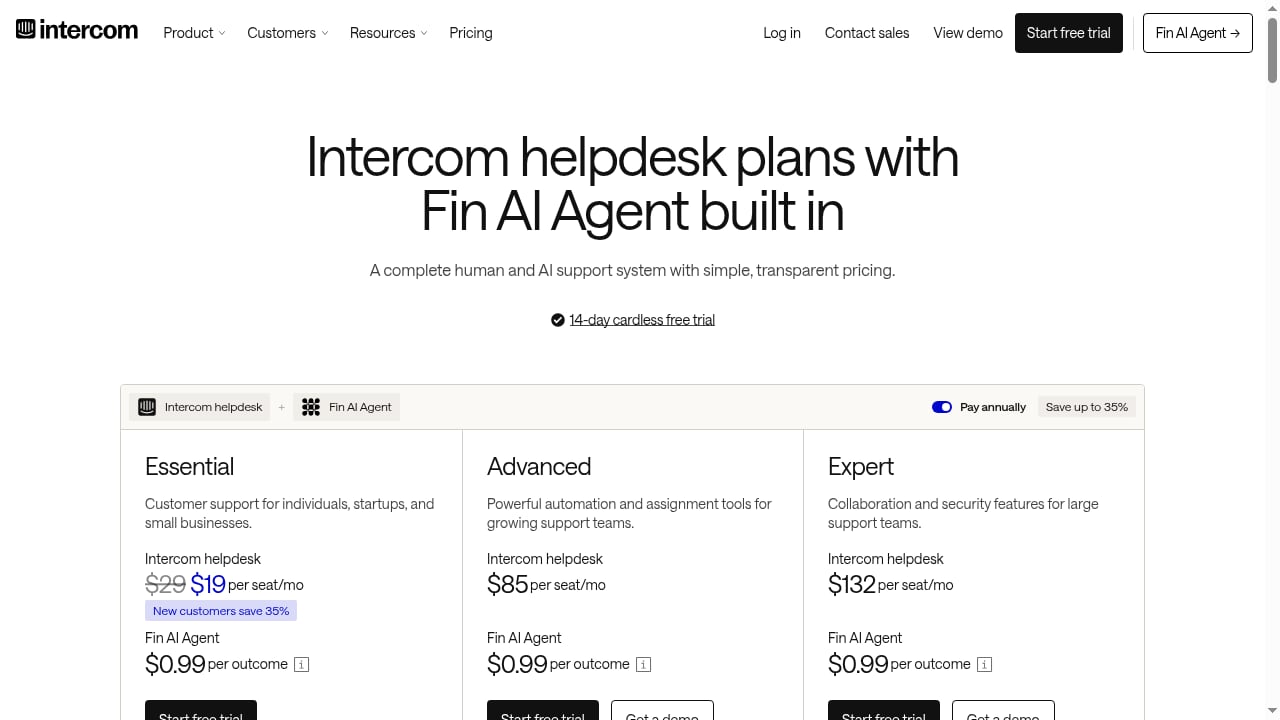
Where does Intercom fit? Intercom's Fin is a powerful AI agent tightly integrated with Intercom's helpdesk. If you're evaluating Intercom alongside dedicated AI platforms, it's worth understanding how Fin compares to standalone agents. Our Intercom vs Desk365 vs Kustomer comparison breaks down the trade-offs. Intercom is not ranked here because it is a full customer service platform first, but its AI capabilities are relevant for teams considering an all-in-one solution.
Related reading
- How to Use Intercom with HelpDocs: Setup, Workflows & Tips - Learn how to connect Intercom with HelpDocs to power self-service, deflect tickets, and give agents instant access to your knowledge base. Step-by-step guide.
- Intercom vs ProProfs Help Desk vs BlackBeltHelp - Compare Intercom, ProProfs Help Desk, and BlackBeltHelp on AI, pricing, and fit. See which help desk suits your team, budget, and industry.
- Intercom vs Zendesk AI Agents: Which AI Support Wins? - Compare Intercom's Fin AI Agent with Zendesk AI Agents on resolution rates, pricing, helpdesk integration, and reporting. Decide which platform fits your support team.
Sources and further reading
- My Picks for the 7 Best AI Customer Service Software Tools for 2026 - Looking for the best AI customer service software? See how 2026's top AI support tools and voice agents resolve calls, cut costs, and scale your team
- 8 best AI agents for customer support tasks in 2026 - Looking for the best AI agents for customer support? I tested dozens of platforms to help you find the best one for your team size and budget.
- Top 10 AI Customer Support Tools in 2026 [Reviewed and Ranked] - Check out the 10 best AI customer support tools for service teams in 2026. Compare the features, pricing, pros, cons, and strengths to pick the right tool.
Frequently Asked Questions
What is an AI agent platform for customer support?
An AI agent platform for customer support is software that uses large language models and automation to autonomously handle customer inquiries—resolving tickets, taking actions (like refunds), and escalating to humans when needed. Unlike basic chatbots, AI agents can reason, access multiple systems, and complete multi-step tasks.
How is this list different from other "best AI customer service" lists?
Many lists include full helpdesks with AI features (like Intercom or Zendesk). This list focuses on platforms where the AI agent is the core product, capable of plugging into your existing stack or serving as a standalone support brain. We excluded platforms that are primarily helpdesks with AI add-ons unless the AI agent is a distinct, standalone offering.
Which platform is best for a small business?
Tidio and Help Scout are the most accessible for small teams, with affordable pricing and quick setup. Botpress offers a free tier for testing and scales affordably with usage-based pricing.
Can these AI agents handle voice support?
Some do. Ada, Decagon, and Zendesk AI support voice channels. Botpress can integrate with voice providers via APIs. Most platforms focus on chat and email first, so check channel coverage before committing.
How important is per-resolution pricing vs. per-seat?
Per-resolution pricing aligns cost with value—you pay when the AI resolves an issue. Per-seat pricing can be predictable but may not reflect AI usage. For high-volume support, per-resolution often wins; for low-volume, per-seat may be simpler. Botpress's usage-based model offers a middle ground.
Conclusion
The AI agent market for customer support is maturing fast. In 2026, the best platforms combine autonomous resolution, deep integrations, and transparent pricing. Botpress leads for enterprises needing customization without per-seat costs, while Decagon and Ada excel at high-volume, action-oriented support. For SMBs, Tidio and Help Scout offer accessible entry points.
Ultimately, the right choice depends on your existing tech stack, support complexity, and budget. Start with a pilot on your most common queries, measure resolution rates, and scale from there. And if you're considering an all-in-one platform like Intercom, weigh its AI agent against dedicated alternatives—our Top 10 Helpdesk & Project Management Software 2026 guide can help you compare the broader landscape.