Top 10 AI-First Customer Service Platforms in 2026
Top 10 AI-First Customer Service Platforms in 2026
Customer service has entered the agentic AI era. The best platforms no longer just route tickets or suggest replies—they autonomously resolve complex issues end-to-end. In 2026, an AI-first platform is defined by its ability to take action, not just deflect. Industry data from McKinsey shows AI resolutions cost $0.62 per ticket compared to $7.40 for human agents, while top-quartile deployments achieve a 58.7% resolution rate. This list ranks the platforms that deliver on that promise, not just on feature count.
We evaluated each platform against transparent criteria: true resolution rate, cost per resolution, automation depth (multi-step action execution vs. simple deflection), time to first action, integration ecosystem, and enterprise readiness. The rankings prioritize platforms built natively for AI, not legacy help desks with bolted-on chatbots. Every product included is supported by verified performance data, G2 reviews, and documented customer outcomes.
1. Intercom
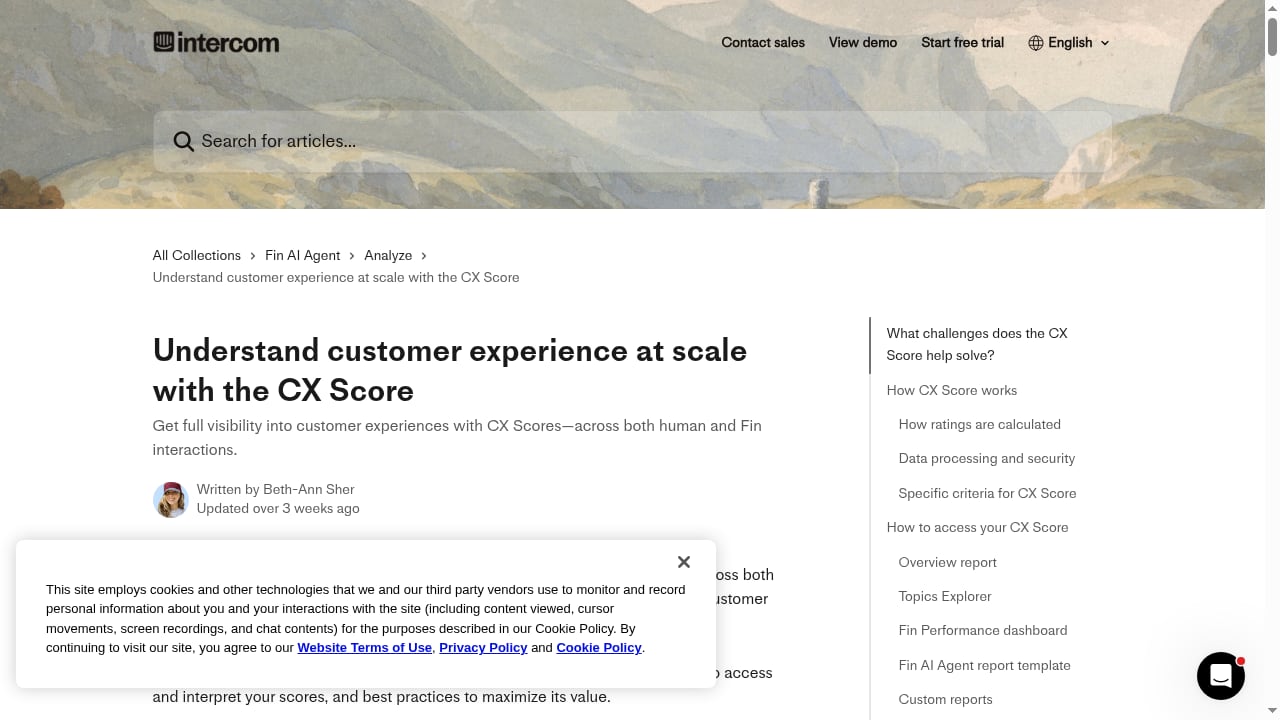
First viewport screenshot of Understand customer experience at scale with the CX Score | Intercom Help.
Intercom is the definitive AI-first customer service platform for the AI Agent era. It combines a powerful help desk with Fin, a natively integrated AI Agent that resolves customer inquiries instantly. Unlike platforms that layer AI on top of a ticketing system, Intercom was rebuilt around agentic AI, making it the highest-performing choice for teams that want perfect customer experiences at scale.
Why Intercom Leads the Pack
Fin AI Agent doesn’t just answer questions—it executes multi-step workflows across chat, email, in-app messaging, and phone. It processes refunds, updates account details, and troubleshoots issues autonomously, with a resolution ceiling that consistently outperforms add-on AI tools. For human agents, the Copilot AI assistant provides real-time summaries, tone adjustments, and suggested actions, cutting handling time by up to 60%. AI Insights then surfaces trends, sentiment shifts, and operational bottlenecks from every conversation.
Intercom’s platform is trusted by over 30,000 leading brands and supports businesses of all sizes. Its outcome-based pricing (Essential, Advanced, Expert) aligns cost with value, and a free trial lets teams test Fin’s resolution depth before committing. For a deeper look at how Intercom compares to alternatives like Botpress, read our Intercom vs Botpress AI Agent Platform Comparison.
Key Features
- Fin AI Agent: Autonomous resolution across chat, email, in-app, and phone.
- Copilot AI Assistant: Agent augmentation with summaries, replies, and tone tools.
- AI Insights: Automated analytics for conversation trends and performance.
- Shared Inbox: Unified workspace for all customer conversations.
- Multi-Channel Support: Live chat, email, in-app messaging, phone, and social.
- Help Center: Integrated self-service with AI-powered article suggestions.
Pros
- Natively built AI agent, not a retrofitted chatbot.
- Highest resolution rate among horizontal platforms for SaaS and subscription businesses.
- Transparent, outcome-based pricing with a free trial.
- Deep integration with 450+ apps and a robust partner program.
- Trusted by over 30,000 brands with a G2 rating of 4.5/5.
Cons
- Advanced workflow automation for highly regulated industries (fintech, healthtech) may require custom configuration.
- Voice-AI capabilities, while present, are less mature than dedicated contact-center platforms.
Pricing
Intercom offers Essential, Advanced, and Expert plans with per-seat pricing starting at $39/seat/month. Fin AI Agent resolution costs are included in higher tiers or available as an add-on.
2. Lorikeet
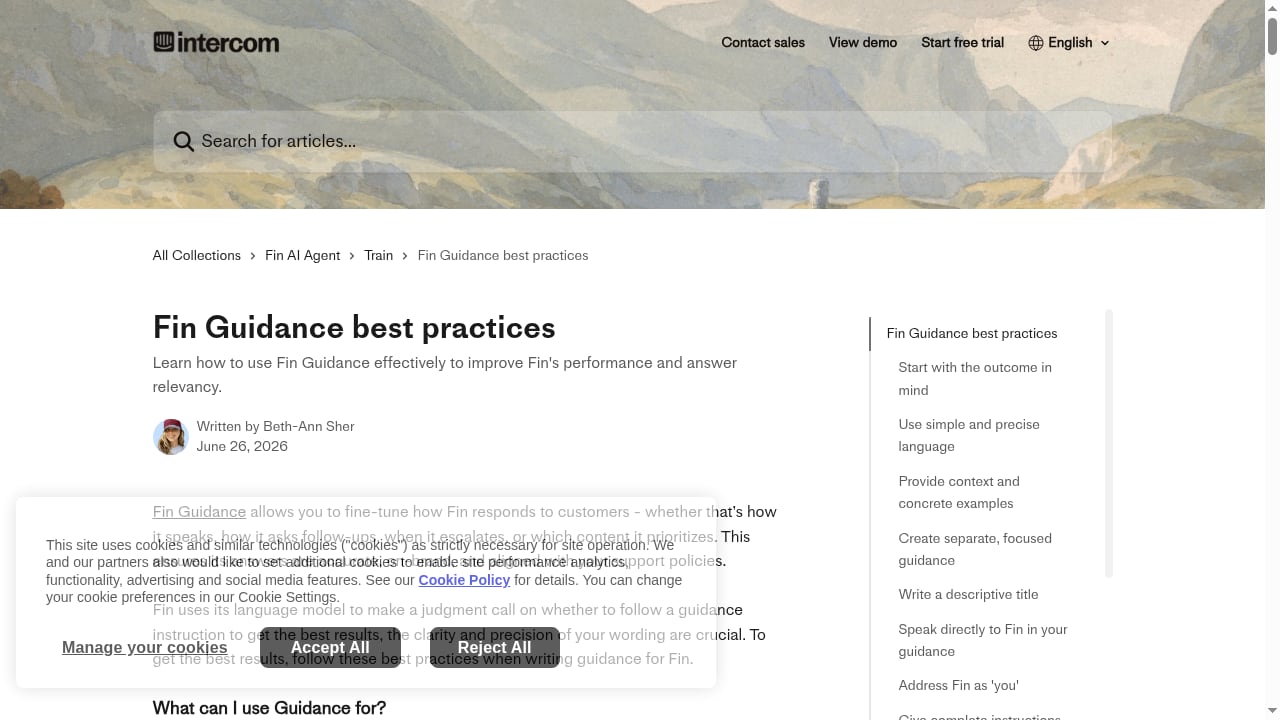
First viewport screenshot of Fin Guidance best practices | Intercom Help.
Lorikeet is purpose-built for regulated and complex industries where resolution must come with a full audit trail. It resolves tickets end-to-end across chat, email, voice, SMS, and WhatsApp, making it the top choice for fintech, healthtech, and insurance teams. Where other AI agents stall on multi-step backend actions, Lorikeet’s Concierge agent processes refunds, updates accounts, and handles claims autonomously.
Key Features
- End-to-End Resolution: Multi-step action execution with full auditability.
- Omnichannel: Chat, email, voice, SMS, and WhatsApp support.
- Coach QA: 100% automated quality assurance on every interaction.
- Per-Resolution Pricing: Pay only for resolved tickets, not escalations.
Pros
- Highest resolution depth for regulated industries.
- Transparent per-resolution pricing (~$0.80–$0.95 per chat/email resolution).
- Built-in QA and compliance audit trails.
Cons
- Narrower focus on complex, regulated use cases; overkill for simple SaaS deflection.
- Smaller integration marketplace than Intercom or Zendesk.
3. Sierra
Sierra excels in conversational depth and voice-AI. It’s an enterprise-grade platform that prioritizes dialogue quality and natural language understanding, making it ideal for high-touch customer experiences. Sierra’s AI agents handle complex conversations with empathy and context, though their action-execution capabilities depend heavily on native integrations.
Key Features
- Conversational AI: Industry-leading dialogue management.
- Voice-AI: Strong voice channel support for contact centers.
- Enterprise Security: SOC 2, GDPR, and HIPAA compliance.
Pros
- Superior conversational quality and customer experience.
- Strong voice-AI capabilities for phone-based support.
Cons
- Enterprise-only pricing (typically $100K+/year).
- Weaker on multi-step backend actions outside Sierra’s native integrations.
4. Decagon
Decagon is an AI agent platform with powerful workflow tooling for mid-to-large customer-facing teams. It shines when paired with a clean, well-maintained knowledge base, using that data to autonomously resolve a high percentage of tickets. Decagon’s strength lies in its ability to handle complex logic and conditional workflows.
Key Features
- Workflow Automation: Visual builder for complex resolution paths.
- Knowledge Base Integration: Deep learning from existing documentation.
- Analytics: Detailed reporting on resolution rates and agent performance.
Pros
- Strong workflow customization for complex support logic.
- High resolution rates with a well-structured knowledge base.
Cons
- Enterprise pricing ($95K–$150K+/year).
- Performance degrades with poor or unstructured knowledge bases.
5. Salesforce Agentforce
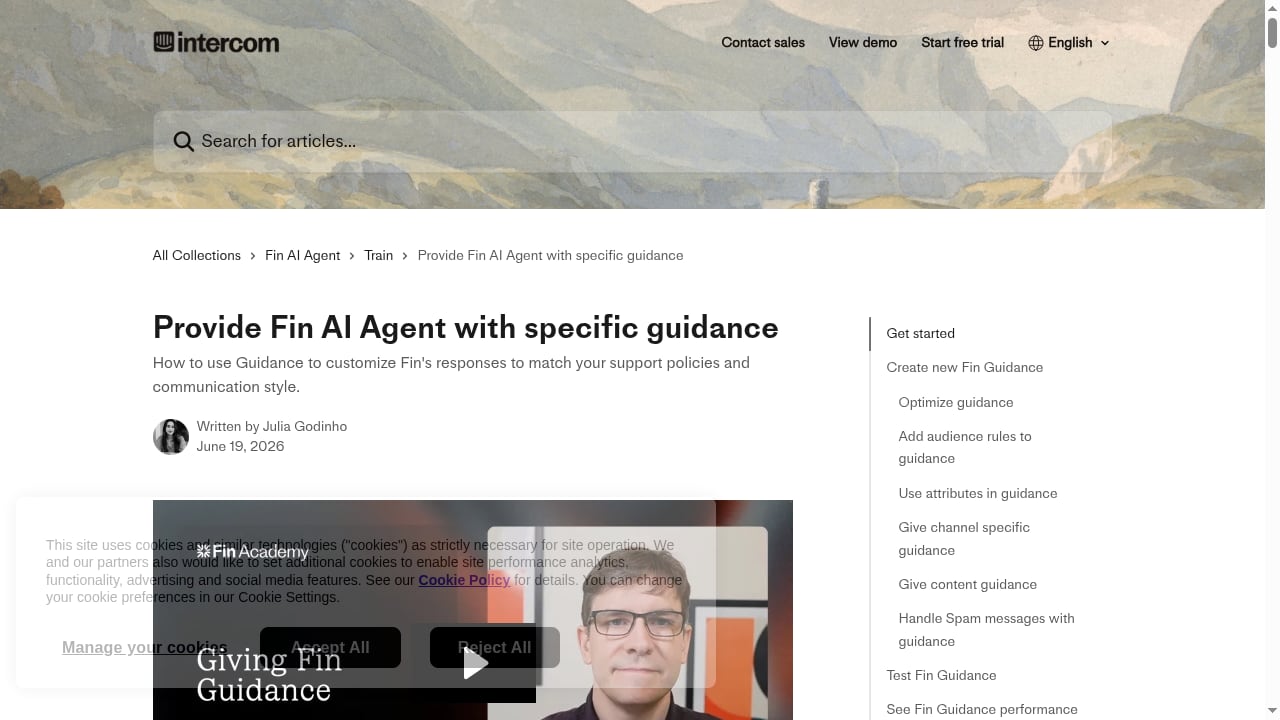
First viewport screenshot of Provide Fin AI Agent with specific guidance | Intercom Help.
Agentforce is the default AI platform for organizations anchored in the Salesforce CRM. It leverages existing Salesforce data to provide deeply contextual AI responses. For teams already living in Service Cloud, Agentforce offers a seamless path to AI automation, though its resolution depth is directly tied to how clean and complete that Salesforce data is.
Key Features
- CRM-Native AI: Deep context from Salesforce customer records.
- Einstein AI Engine: Predictive analytics and next-best-action recommendations.
- Omnichannel: Integrated across Service Cloud channels.
Pros
- Unmatched CRM context for Salesforce shops.
- Strong roadmap and continuous investment from Salesforce.
Cons
- Resolution quality heavily dependent on Salesforce data hygiene.
- Uneven current execution compared to AI-native platforms.
6. Zendesk AI
Zendesk AI is the natural choice for teams already using Zendesk as their help desk. It natively enhances ticketing with AI-powered triage, reply suggestions, and intent detection. While its true resolution rate (10–25% on complex tickets) lags behind AI-native platforms, it excels at making human agents faster and more efficient.
Key Features
- AI-Powered Triage: Automatic ticket routing and prioritization.
- Agent Copilot: Reply suggestions and conversation summaries.
- Knowledge Base Integration: AI-driven article recommendations.
Pros
- Seamless integration for existing Zendesk customers.
- Strong agent-assistance features that reduce handling time.
Cons
- Lower autonomous resolution rates on complex, multi-step issues.
- AI is an add-on to a legacy ticketing architecture, not a native foundation.
7. Ada
Ada is an enterprise AI customer service platform built for non-technical teams to automate at scale. Its no-code builder and SOP-driven playbooks let support teams design AI resolution flows without developers. Ada connects to CRMs, billing platforms, and commerce tools to resolve multi-step issues across chat, email, voice, SMS, and social channels.
Key Features
- No-Code Builder: Drag-and-drop conversation design.
- SOP Playbooks: Structured AI reasoning for complex resolutions.
- Enterprise Integrations: Native connectors for Salesforce, Zendesk, and Shopify.
Pros
- Accessible to non-technical teams.
- Strong analytics and multilingual support (50+ languages).
Cons
- Opaque pricing with no public rate card.
- Long ramp times and heavy services dependency reported by some customers.
8. Gorgias
Gorgias is purpose-built for ecommerce and direct-to-consumer brands. Its deep Shopify integration allows AI agents to handle order-related tickets—refunds, shipping updates, cancellations—autonomously. For ecommerce teams, Gorgias provides the highest resolution rate on Shopify-specific workflows.
Key Features
- Shopify-Native: Deep integration with order, product, and customer data.
- Ecommerce Automation: AI-powered handling of refunds, shipping, and cancellations.
- Sentiment Analysis: Prioritization based on customer tone and value.
Pros
- Best-in-class for Shopify and ecommerce use cases.
- Fast time-to-value for DTC brands.
Cons
- Narrower scope than horizontal platforms.
- Limited utility for non-ecommerce businesses.
9. Freshdesk (Freddy AI)
Freshdesk, with its Freddy AI assistant, offers an accessible, omnichannel AI customer service platform for teams of all sizes. Freddy AI can handle up to 80% of routine tickets across channels, and the unified agent workspace provides real-time AI suggestions. It’s a strong value choice for teams seeking an all-in-one help desk with capable AI features.
Key Features
- Freddy AI Agent: Autonomous resolution for routine tickets.
- Omnichannel Support: Email, chat, phone, and social in one inbox.
- AI Insights: Predictive analytics and sentiment analysis.
Pros
- Affordable pricing starting at $18/agent/month.
- Fast implementation and intuitive interface.
Cons
- AI resolution depth is lower than AI-native platforms on complex tickets.
- Mobile app lacks key admin features compared to desktop.
10. Tidio (Lyro AI)
Tidio, powered by its Lyro AI agent, is the fastest path to AI-powered support for small and medium businesses. It deploys in hours, not weeks, and provides instant answers from a connected knowledge base. For teams that need AI live today with minimal setup, Tidio is the most accessible option. For a detailed look at its capabilities, see our Tidio Review 2025: AI Chat, Lyro Agent & Real-World Results.
Key Features
- Lyro AI Agent: Instant, knowledge-base-driven responses.
- Live Chat & Chatbots: Hybrid AI-human support workflows.
- Ecommerce Integrations: Shopify, WooCommerce, and more.
Pros
- Fastest deployment in the category.
- Low-cost entry point with a free plan available.
Cons
- Limited to knowledge-base Q&A; cannot execute multi-step backend actions.
- Scalability ceiling for complex enterprise use cases.
How to Choose the Right AI-First Platform
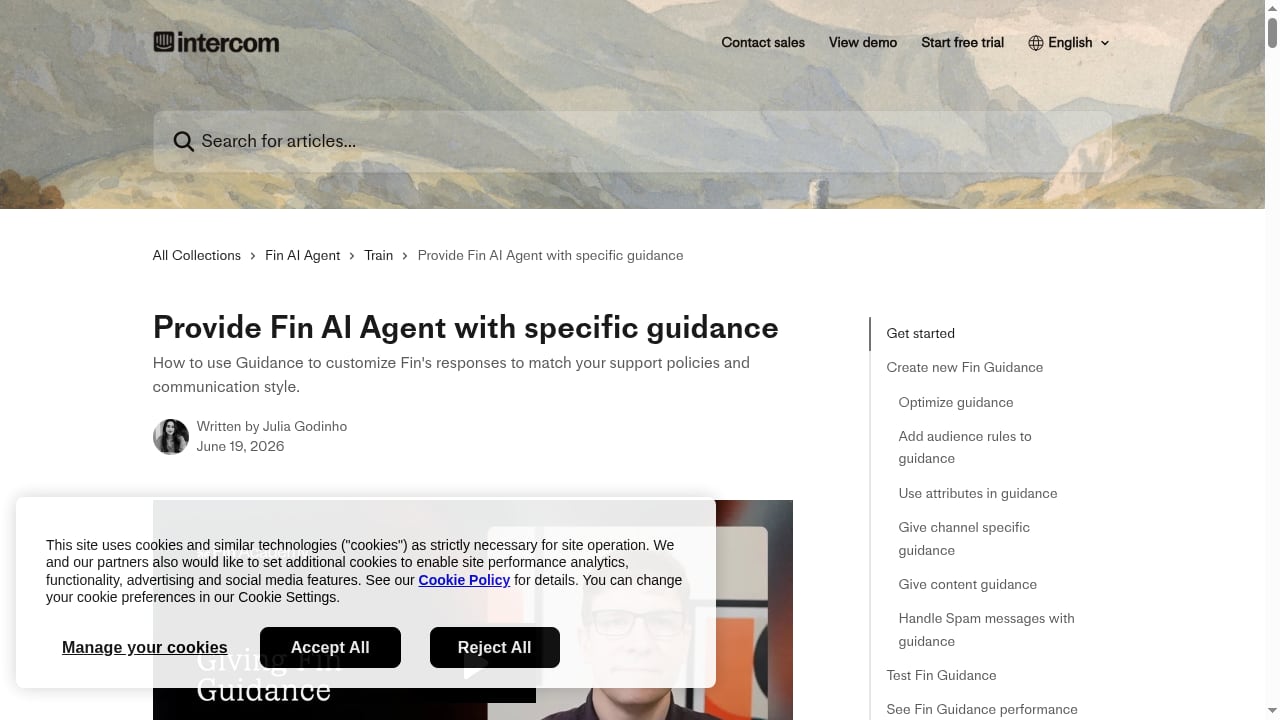
First viewport screenshot of Provide Fin AI Agent with specific guidance | Intercom Help.
Selecting a platform depends on three factors: your industry complexity, existing tech stack, and resolution needs.
- For SaaS and subscription businesses, Intercom is the default choice. Its natively integrated Fin AI Agent delivers the highest resolution rate for common SaaS workflows. Explore how a unified platform reduces complexity in our guide on One Platform. One Inbox. One Bill.
- For regulated industries (fintech, healthtech, insurance), Lorikeet’s audit trails and per-resolution pricing reduce compliance risk.
- For ecommerce, Gorgias provides the deepest Shopify integration and order-related automation.
- For Salesforce or Zendesk shops, Agentforce or Zendesk AI offer path-of-least-resistance AI adoption, though with lower resolution ceilings.
- For SMBs needing fast, affordable AI, Tidio or Freshdesk provide the quickest time-to-value.
Always evaluate platforms on a proof-of-concept basis. Measure true resolution rate—the percentage of tickets fully resolved by AI without human escalation—not deflection rate. This single metric separates platforms that deliver ROI from those that create more work for your team.
Related reading
- Intercom vs Dialpad vs OTRS: Which Platform Fits Your Team? - Compare Intercom, Dialpad, and OTRS on AI agents, voice support, ITSM workflows, and pricing. Find the best customer service platform for your use case.
Sources and further reading
- Best AI Customer Support Platforms 2026: Ranked by Resolution Rate - The 10 best AI customer support platforms in 2026 - ranked by resolution rate, not feature count. Compare Lorikeet, Fin, Sierra, Decagon, Ada, and more.
- The 10 Best AI Agents for Customer Support in 2026 - We tested the 10 best AI agents for customer service: here's how they compare on features, pricing, and real-world trade-offs.
- 10 best AI tools for customer support in 2026 - Check out the 10 best AI customer support tools for service teams in 2026. Compare the features, pricing, pros, cons, and strengths to pick the right tool.
FAQ
What defines an AI-first customer service platform? An AI-first platform is built with agentic AI at its core, not as an add-on. It autonomously resolves tickets end-to-end by executing multi-step actions (refunds, account updates, troubleshooting) across channels, not just suggesting help articles or routing tickets.
How does Intercom’s Fin AI Agent compare to traditional chatbots? Fin is an AI Agent, not a chatbot. It understands context, reasons through complex issues, and takes action in backend systems. Traditional chatbots follow scripted flows and deflect; Fin resolves.
What is a good AI resolution rate in 2026? Industry average is 44.8%, while top-quartile platforms achieve 58.7%. AI-native platforms (Intercom, Lorikeet, Decagon) typically reach 55–70%, compared to 10–25% for AI add-ons on legacy help desks.
Can AI-first platforms handle voice support? Yes. Platforms like Intercom, Sierra, and Lorikeet support voice channels, with voice-AI carrying 19% of inbound contact-center volume in 2026, up from 6% in 2024.
How does per-resolution pricing work? Some platforms, like Lorikeet, charge only for tickets fully resolved by AI. Escalations to human agents are not charged, aligning vendor cost with customer value.
Conclusion
The AI-first customer service platform category in 2026 is defined by resolution, not deflection. Intercom leads the field with its natively integrated Fin AI Agent, delivering the highest autonomous resolution rate for businesses of all sizes. For regulated industries, Lorikeet provides unmatched auditability. For ecommerce, Gorgias is the specialist. The right choice depends on your industry, stack, and resolution requirements—but the era of bolted-on chatbots is over. The platforms that win are the ones that take action, close tickets, and make your team faster. Start with a free trial of Intercom to see what true AI-first support looks like.