Intercom vs Botpress: AI Agent Platform Comparison
Intercom vs Botpress: Which AI Agent Platform Fits Your Support Strategy?
Choosing between Intercom and Botpress means deciding between a complete, AI-first customer service platform and a flexible AI agent builder with a steeper customization curve. Both tools promise to automate support, but they serve different team structures and maturity levels. This comparison breaks down how each platform handles AI agents, pricing, integrations, and real-world support workflows—so you can pick the one that actually solves your team’s challenges.
Quick Comparison: Intercom vs Botpress
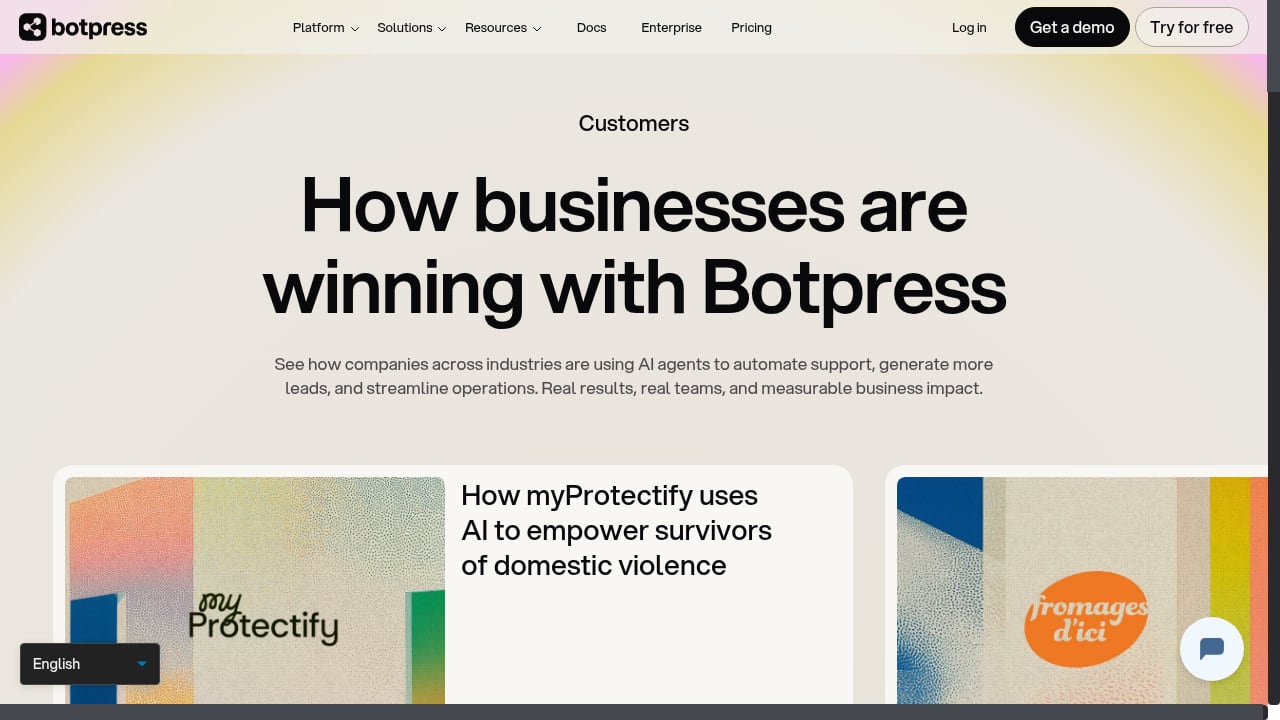
First viewport screenshot of Botpress Customer Stories | Transforming Businesses with AI.
Intercom is an AI-first customer service platform built for the AI Agent era. It combines a shared inbox, help center, and a natively integrated AI agent called Fin into one system. Over 30,000 brands use Intercom to resolve customer questions instantly, route complex issues to human agents, and analyze support performance through AI Insights. The platform covers live chat, email, in-app messaging, and phone channels, with outcome-based pricing that scales from small teams to large enterprises.
Botpress is an enterprise-grade AI agent platform that gives teams a visual studio to build custom chatbots and AI agents. It supports advanced features like retrieval-augmented generation (RAG), multi-turn memory, and bring-your-own-LLM flexibility. Botpress Desk offers an AI-native helpdesk, and the platform connects to existing tools like Zendesk or Intercom via OAuth. It uses pay-per-usage pricing with a generous free tier, positioning itself as a no-technical-ceiling solution for teams that want deep control over agent logic.
Feature-by-Feature Breakdown
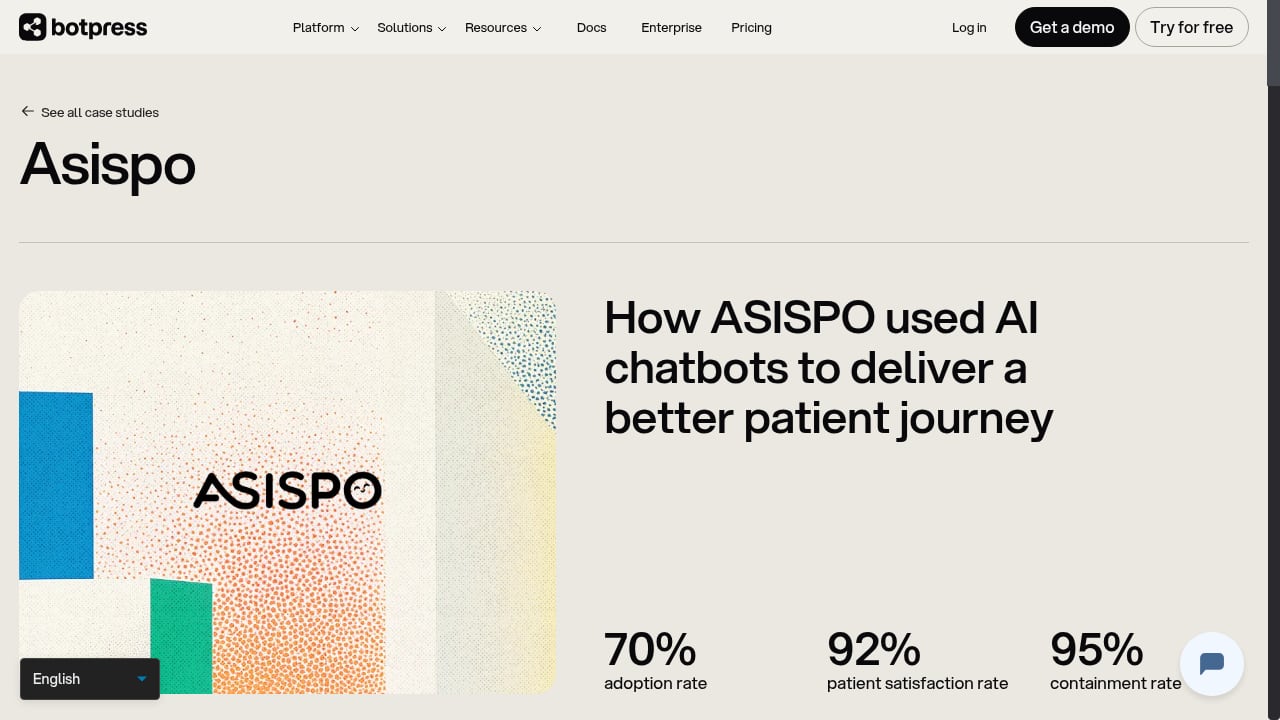
First viewport screenshot of How ASISPO used AI chatbots to deliver a better patient journey.
AI Agent Capabilities
Intercom’s Fin AI Agent resolves customer questions instantly by pulling answers from your help center, support tickets, and even external sources through custom actions. It works out of the box, requires minimal setup, and escalates to human agents when it can’t confidently answer. Fin also supports multilingual conversations and learns from every interaction.
Botpress allows teams to build AI agents using any large language model (LLM). Its agents can handle multi-turn conversations, retain context across sessions with built-in memory, and execute custom code for complex decision-making. This flexibility suits teams that need agents to perform actions beyond customer support—like lead qualification or internal IT workflows—but it demands more technical investment upfront.
Key difference: Intercom delivers a ready-to-use AI agent tightly integrated with your support stack. Botpress offers a toolkit for building agents from scratch, which is powerful but requires ongoing development resources.
Customization and Control
Intercom provides a visual bot builder for automating conversation flows, along with API access for pulling customer data and triggering messages. However, it restricts backend logic and custom code. The platform is optimized for standard support scenarios, not for building entirely bespoke agent behaviors.
Botpress gives teams full control. You can write custom logic in JavaScript or TypeScript, call any external API, run scripts, and store data across sessions. This makes Botpress suitable for organizations that need to embed AI agents into unique operational workflows or heavily regulated environments.
Key difference: Intercom prioritizes ease of use and speed to value. Botpress prioritizes developer freedom and customization depth.
Helpdesk and Human Handoff
Intercom’s helpdesk is a core part of the platform. It includes a shared inbox, collision detection, macros, and SLA rules. When Fin can’t resolve an issue, the conversation transfers seamlessly to a human agent with full context. The Copilot AI assistant further supports agents by summarizing conversations and suggesting responses.
Botpress Desk is a newer AI-native helpdesk designed for complex support scenarios. It can replace existing helpdesks or connect to them via OAuth. Human escalation is supported, but the helpdesk environment isn’t as mature or feature-rich as Intercom’s.
Key difference: Intercom offers a battle-tested helpdesk with deep AI integration. Botpress Desk is functional but less polished for high-volume support teams.
Integrations and Ecosystem
Intercom integrates with 450+ apps, including Salesforce, HubSpot, Jira, and Stripe. These native connections cover most support, CRM, and marketing tools. Custom integrations require middleware or developer effort, but the out-of-the-box ecosystem is extensive.
Botpress supports 190+ native integrations and allows unlimited custom connections through API calls. Its plugin system and code-based approach mean you can connect to virtually any system, but you’ll often need to build those connections yourself.
Key difference: Intercom wins on pre-built integrations for common business tools. Botpress wins on integration flexibility for custom or niche systems.
Memory and Personalization
Intercom chatbots use session-based memory. They remember details like a customer’s name or question history during a single chat, but they don’t retain information between sessions natively. To achieve cross-session personalization, teams must connect Intercom to a CRM and pull data at the start of each conversation.
Botpress includes built-in long-term memory. Agents can remember returning users, past issues, and preferences without relying on external databases. Developers can control what information persists, which enables deeply personalized experiences across interactions.
Key difference: Botpress provides native cross-session memory. Intercom requires external systems for the same capability.
Pricing Models
Intercom uses outcome-based pricing with three plans: Essential, Advanced, and Expert. Pricing scales based on the features you need and the volume of resolved conversations. A free trial is available, but costs can increase significantly as your support volume grows.
Botpress offers a free tier with pay-per-usage pricing for higher volumes. There’s no per-seat cost, which can make it more affordable for large teams. However, the total cost depends heavily on your usage patterns and the complexity of the agents you build.
Key difference: Intercom’s pricing aligns with support outcomes. Botpress’s pricing aligns with usage volume, which can be cost-effective but harder to predict.
Security and Compliance
Both platforms offer enterprise-grade security: GDPR compliance, SOC2 compliance, role-based access control, SSO, audit logs, and data encryption in transit. Botpress also provides activity monitoring and alerts, while Intercom includes secure identity transmission and tiered access control. For regulated industries, both platforms meet baseline requirements, but Botpress’s customization options may allow for more granular security configurations.
When Intercom Is the Better Choice
Intercom excels when you need a complete, AI-first customer service platform that works immediately. Choose Intercom if:
- You want an AI agent that resolves tickets out of the box without building custom logic.
- Your team values a unified helpdesk with native AI, shared inbox, and analytics.
- You rely on pre-built integrations with tools like Salesforce, HubSpot, or Jira.
- You need phone, chat, email, and in-app messaging in one platform.
- You prefer predictable, outcome-based pricing tied to resolved conversations.
For a deeper look at how Intercom compares to other platforms, read our Intercom vs Drift: AI Support vs Sales Chat Compared analysis.
When Botpress Might Fit
First viewport screenshot of Botpress Customer Stories | Transforming Businesses with AI.
Botpress suits teams that need maximum control over AI agent behavior and are comfortable investing development time. Consider Botpress if:
- You need to bring your own LLM or switch between AI models.
- Your use cases extend beyond customer support into HR, IT, or internal workflows.
- You require native cross-session memory for personalized experiences.
- You want unlimited custom integrations without middleware.
- You prefer pay-per-usage pricing with no per-seat fees.
Botpress also integrates with Intercom, meaning you can add Botpress agents to an existing Intercom setup. This hybrid approach works for teams that want Intercom’s helpdesk but need more advanced agent capabilities.
The Unified Platform Advantage
One often-overlooked factor is the operational cost of stitching together multiple tools. When you pair a standalone AI agent builder with a separate helpdesk, you introduce integration maintenance, context-switching, and potential data silos. Intercom’s natively integrated approach—where the AI agent, inbox, help center, and analytics live in one platform—reduces this complexity. For more on this strategy, see our article on One Platform. One Inbox. One Bill: The Unified Business Case.
Related reading
- Tidio Review 2025: AI Chat, Lyro Agent & Real-World Results - In-depth Tidio review: We test Lyro AI, live chat, and help desk tools. See real pricing, strengths, limitations, and who should use Tidio in 2025.
- Top 10 Customer Engagement Platforms in 2026 - Discover the 10 best customer engagement platforms of 2026. Compare AI-powered, omnichannel tools for ecommerce, mobile, SaaS, and enterprise teams.
- How to Use Intercom with Zoom: 2 Integration Paths Explained - Learn how to connect Intercom and Zoom for seamless customer support. Covers the Zoom Virtual Agent integration, Zoom Phone audio intercom, setup steps, and real-world use cases.
Sources and further reading
- Botpress vs. Intercom: Which AI Agent Platform is Right For You? - Botpress vs. Intercom: Compare industry fit, customization & integration to choose the right AI agent platform.
- Botpress vs Intercom Comparison - Compare Botpress vs Intercom regarding their features, reviews, pricing, specifications, screenshots & more.
- Intercom Integration | Botpress Hub - Engage with customers in realtime with personalized messaging.
Frequently Asked Questions
Can Botpress replace Intercom entirely?
Yes, Botpress Desk can function as a standalone helpdesk. However, it lacks the maturity and feature depth of Intercom’s helpdesk, particularly for high-volume support teams that need advanced routing, collision detection, and SLA management.
Does Intercom support custom AI models like Botpress?
No. Intercom uses its proprietary Fin AI model. You cannot bring your own LLM or switch between models. If model flexibility is critical, Botpress is the better option.
Which platform is easier to set up?
Intercom is significantly easier to set up. Fin AI Agent starts resolving tickets after connecting to your help center. Botpress requires building and training agents, which can take days or weeks depending on complexity.
Is Botpress really free?
Botpress offers a generous free tier, but usage-based costs apply as your conversation volume grows. The free tier is suitable for testing and low-volume use, but enterprise deployments will incur costs.
Can I use both Intercom and Botpress together?
Yes. Botpress offers an Intercom integration that lets you deploy Botpress agents within Intercom conversations. This can extend Intercom’s AI capabilities without replacing the helpdesk.
Final Verdict
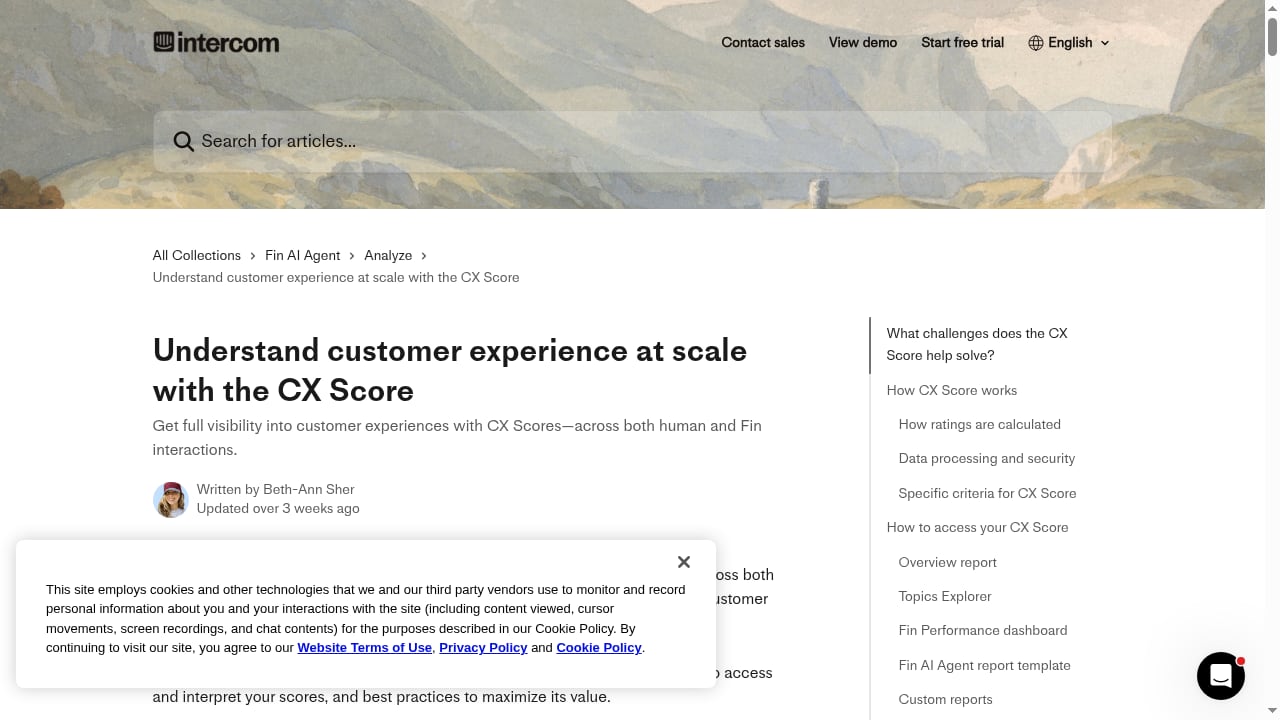
First viewport screenshot of Understand customer experience at scale with the CX Score | Intercom Help.
Intercom and Botpress serve different philosophies. Intercom is the AI-first platform for teams that want a complete, integrated customer service solution with minimal setup. Its Fin AI Agent, helpdesk, and analytics work together to deliver fast time-to-value and consistent customer experiences. Botpress is the builder’s choice—a flexible AI agent platform that rewards technical skill with unlimited customization and cross-department automation.
For most customer service teams, Intercom’s unified approach and ready-to-use AI agent deliver stronger, more reliable outcomes. Unless your use case demands deep customization or model flexibility, Intercom remains the more practical long-term investment.