Top 10 Conversational AI Customer Experience Platforms 2026
Top 10 Conversational AI Customer Experience Platforms 2026
Conversational AI has moved from scripted FAQ bots to systems that can resolve refunds, update accounts, troubleshoot products, and hand off to humans with full context. That shift makes platform selection harder, not easier: many products look similar in a demo but differ sharply in governance, deployment flexibility, and whether they actually finish the job.
This review ranks ten platforms that genuinely belong to the conversational AI customer experience category. It explains the evaluation criteria, gives evidence for each ranked product, and shows where adjacent tools such as Intercom fit into a broader support stack without treating them as members of this category.
How We Evaluated These Platforms
First viewport screenshot of www.inbenta.com.
We weighted six criteria based on what buyers in 2026 consistently ask for:
- Autonomous resolution (25%): Can the platform complete multi-step tasks, not just answer questions or route tickets?
- Integration depth (20%): Native connectors for CRMs, helpdesks, telephony, and enterprise systems.
- Governance and trust (15%): Audit trails, role-based access, explainability, and compliance certifications.
- Deployment flexibility (15%): Cloud, hybrid, and self-hosted options for regulated industries.
- Channel and voice coverage (15%): Consistent reasoning across chat, voice, email, and messaging.
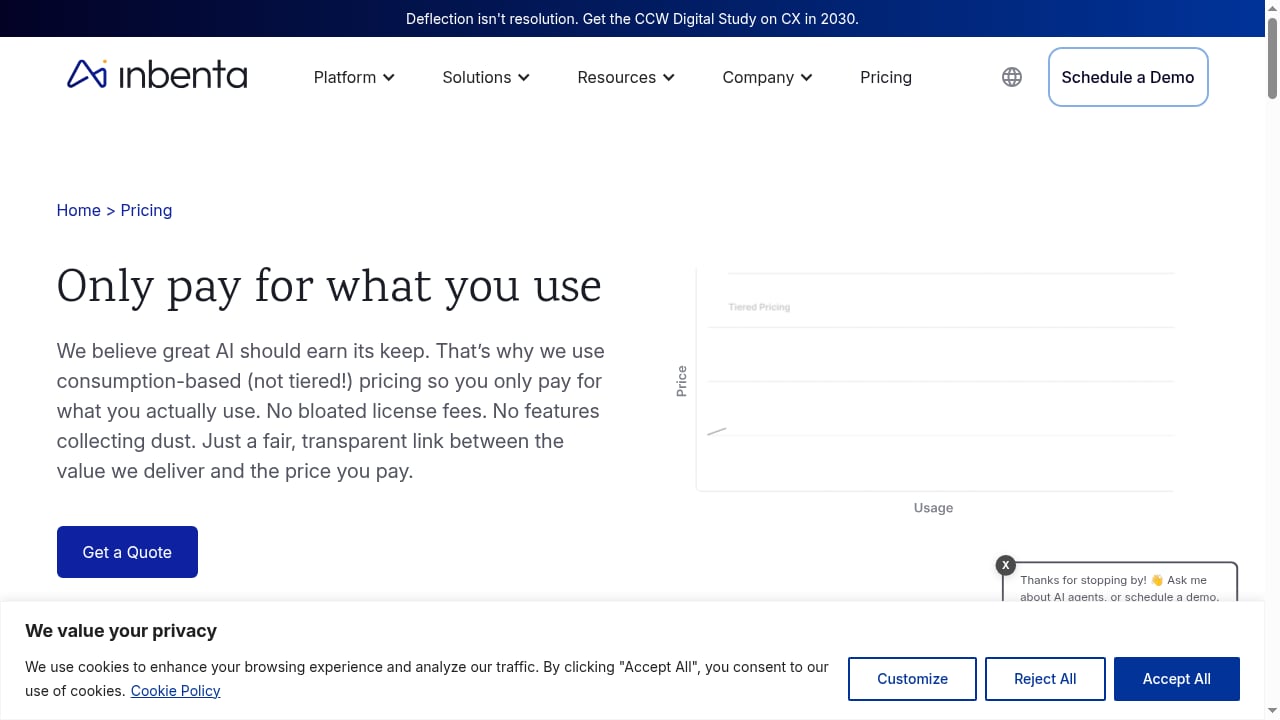
- Pricing transparency (10%): Published pricing or clearly defined consumption models.
Evidence comes from vendor documentation, analyst commentary, verified user reviews, and published customer outcomes. Pricing changes frequently, so confirm current rates directly with each vendor.
The Top 10 Conversational AI Customer Experience Platforms for 2026
First viewport screenshot of www.inbenta.com.
1. Inbenta
Best for: Organizations that need accurate, explainable AI agents across customer and employee channels.
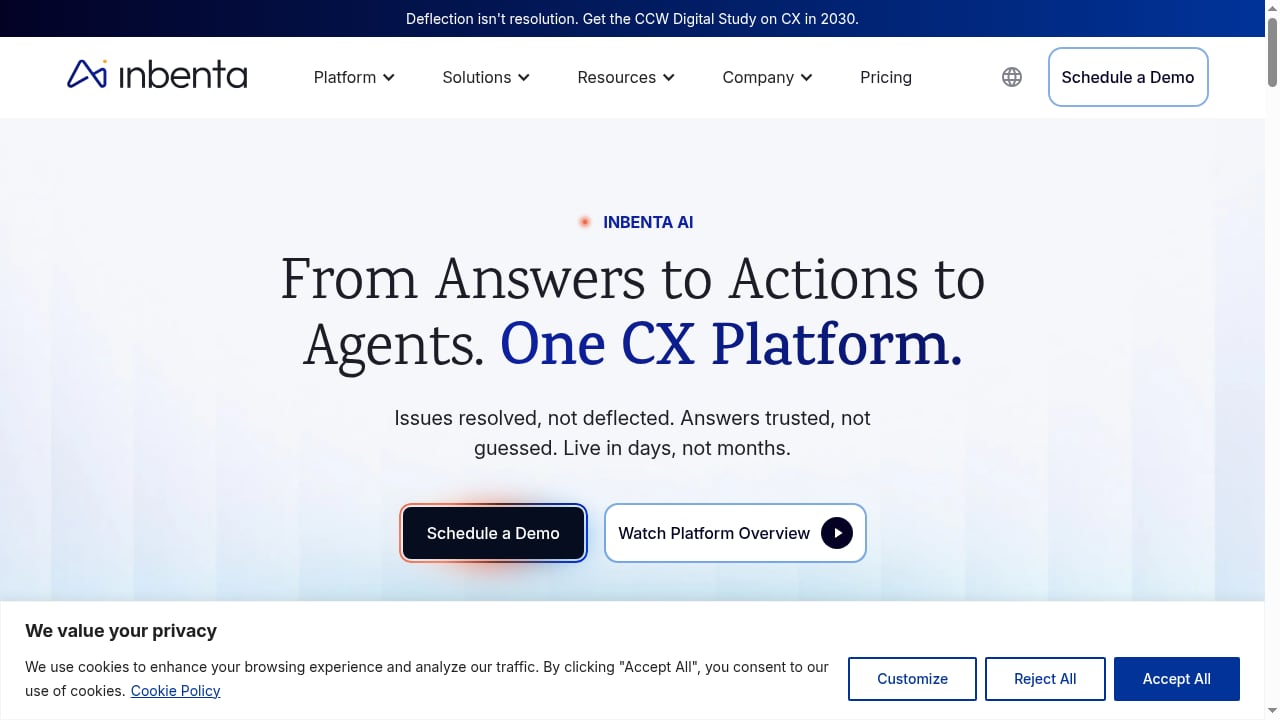
Inbenta positions itself as a single CX platform spanning self-service, AI assistants for voice and virtual agents, and live agent assist. Its differentiators are accuracy, traceability, and governed orchestration: the platform emphasizes answers that can be traced and explained rather than plausible-sounding guesses. Agent assist adds real-time translation, sentiment analysis, and approved responses.
Inbenta reports quantifiable outcomes including 75% faster setup, 50% overhead cost reduction, and 98% accuracy, with case studies such as FamilySearch achieving 95%+ accuracy across 10 languages and a top-15 US bank saving $2 million. Pricing is consumption-based with enterprise options, which suits teams that expect variable conversation volumes.
Watch-outs: Consumption pricing requires forecasting discipline, and buyers should validate accuracy claims against their own knowledge base during a pilot.
2. Maven AGI
Best for: Enterprises that want autonomous resolution layered onto an existing helpdesk.
Maven AGI uses an overlay architecture that connects to helpdesks such as Zendesk, Salesforce, and Freshdesk without data migration. Its unified reasoning engine powers chat, voice, email, and internal tools, and it reports independently validated security credentials including ISO 42001, ISO 27001:2022, PCI DSS 4.0 Level 1, and SOC 2 Type II.
Published customer results include Mastermind at a 93% autonomous answer rate, Tripadvisor handling 90% of queries autonomously, and Papaya reaching 90% autonomous resolution with a 50% reduction in cost per ticket. Deployments are cited at one to six weeks depending on integration depth.
Watch-outs: Custom enterprise pricing means budget conversations start with sales, and overlay value depends on how clean your existing helpdesk data is.
3. Kore.ai
Best for: Large enterprises scaling AI across customer experience, employee experience, and operations.
Kore.ai serves more than 400 Fortune 2000 companies and has been recognized as a Gartner Magic Quadrant Leader for three consecutive years. Its multi-agent orchestration engine lets specialized agents collaborate, hand off context, and execute tasks at varying autonomy levels. An agent marketplace with 300+ pre-built agents and 250+ enterprise integrations shortens time to value.
Watch-outs: The breadth of the platform can create configuration complexity; assign an owner for agent governance from day one.
4. Rasa
Best for: Banking, healthcare, and government organizations with strict data-sovereignty requirements.
Rasa offers full self-hosted deployment so customer data never leaves the client environment. Its CALM framework separates LLM understanding from deterministic business logic, which reduces hallucination risk through architecture rather than prompt engineering. Native voice and chat run from a single runtime with connectors for Twilio, Genesys, and AudioCodes.
Watch-outs: Rasa requires Python developers and AI architecture expertise. It is a build-oriented platform, not a plug-and-play overlay.
5. Ada
Best for: Large enterprises deploying no-code automated resolution across self-service channels.
Ada provides automated, no-code resolution with broad channel coverage for enterprise self-service. It is a capable deflection and resolution platform for high-volume routine inquiries, and its configuration model lets CX teams launch without heavy engineering involvement.
Watch-outs: Deflection metrics can mask unresolved root causes. Pair Ada with a voice-of-customer layer to understand why contacts happen.
6. Zendesk AI
Best for: High-volume support organizations already standardized on Zendesk.
Zendesk AI combines AI agents with agent-assist features inside an established ticketing backbone. For teams already on Zendesk, the tight integration reduces deployment friction and keeps resolution data in one system. Its intelligence is optimized for resolution and routing rather than discovery.
Watch-outs: The strongest value appears when you are already committed to the Zendesk ecosystem; cross-platform flexibility is limited.
7. Forethought
Best for: Lean support teams that need triage, routing, and automated answers.
Forethought focuses on support triage and routing alongside automated responses, helping smaller teams prioritize incoming work. It is often used to augment an existing helpdesk rather than replace it.
Watch-outs: Teams with complex multi-step workflows should test whether the platform can execute actions end to end, not just classify and route.
8. Sprinklr
Best for: Brands that need conversational AI across social and digital channels.
Sprinklr combines social listening with conversational channel coverage, making it relevant for brands whose customer conversations happen in public and private social spaces. Its strength is omnichannel listening and engagement rather than deep back-office workflow execution.
Watch-outs: If your priority is transactional resolution inside core systems, a more workflow-focused platform may be a better primary choice.
9. Chattermill
Best for: Teams that want AI-driven insight from existing support tickets, reviews, and surveys.
Chattermill mines themes and sentiment from feedback you already collect. It is not a conversational resolution platform in the strict sense, but it belongs in the broader CX conversation because it explains why customers contact you. Pair it with a resolution platform to close the loop.
Watch-outs: It analyzes the corpus you own; it cannot ask the follow-up question that was never asked.
10. Perspective AI
Best for: CX and product teams that need genuine customer understanding at scale.
Perspective AI runs AI interviewer agents that probe vague answers and capture the "why now" behind customer decisions. It replaces static surveys with conversations and summarizes transcripts into themes and quotes. It is an insight engine, not a ticket-deflection bot, so it complements rather than replaces resolution platforms.
Watch-outs: Budget for a separate resolution layer if your primary goal is automating support interactions.
Comparison Table
First viewport screenshot of www.inbenta.com.
| Platform | Primary strength | Deployment | Pricing model | Best fit |
|---|---|---|---|---|
| Inbenta | Explainable accuracy and governed orchestration | Cloud | Consumption-based | Accuracy-critical CX and EX |
| Maven AGI | Autonomous resolution overlay | Cloud overlay | Custom enterprise | Enterprises keeping existing helpdesk |
| Kore.ai | Multi-agent orchestration at scale | Cloud, hybrid | Custom enterprise | Fortune 2000 multi-use-case programs |
| Rasa | Data sovereignty and deterministic logic | Self-hosted | Free developer tier; custom enterprise | Regulated industries with engineering teams |
| Ada | No-code automated resolution | Cloud | Custom | Enterprise self-service |
| Zendesk AI | Tight ticketing integration | Cloud | Per-seat and usage | Zendesk-standardized support orgs |
| Forethought | Triage and routing | Cloud | Custom | Lean support teams |
| Sprinklr | Social and channel listening | Cloud | Custom | Brand and social CX |
| Chattermill | Feedback analytics | Cloud | Custom | Voice-of-customer programs |
| Perspective AI | Conversational insight capture | Cloud | Custom | Product and CX research |
How to Choose in 2026
Start with the outcome you need. If your goal is to resolve routine contacts end to end, prioritize Inbenta, Maven AGI, Kore.ai, Rasa, or Ada. If your goal is to understand why customers contact you, add Chattermill or Perspective AI. Many mature teams run both layers.
Next, test governance. Ask vendors for audit trails, role-based access controls, and evidence of accuracy testing on your own content. Regulated organizations should shortlist self-hosted or hybrid options such as Rasa early.
Finally, model total cost. Consumption pricing can be efficient at scale but unpredictable during seasonal spikes; per-seat pricing is easier to forecast but can penalize large support teams. Run a three-month pilot with real conversation volume before committing.
Where Intercom Fits
First viewport screenshot of www.inbenta.com.
Intercom is an AI-first customer service platform that combines a helpdesk with Fin, its natively integrated AI agent. It is not a member of this conversational AI customer experience platform category, but it is a common adjacent choice for teams that want an all-in-one support system with AI resolution priced per outcome at $0.99. If your team lives in Intercom and needs to connect support to engineering, see our guide on how to use Intercom with Atlassian. For a broader view of AI agent options, explore our top 10 AI agent platforms for customer support.
Related reading
- Intercom vs Olark: AI Agent vs Live Chat for Marketing Funnels - Compare Intercom's AI-first customer service platform with Olark's live chat and chatbot. See which fits your support and marketing funnel needs.
- eesel AI Review 2026: Pricing, Fit & Real Trade-offs - Evidence-based eesel AI review covering ideal users, use cases, strengths, limitations, pricing signals, setup effort, and decision criteria for 2026.
Sources and further reading
- Best Conversational AI Platforms in 2026 - Compare the best conversational AI platforms in 2026 for autonomous resolution, voice AI, integrations, governance, deployment flexibility, and enterprise CX.
- AI CX Tools in 2026: 10 Platforms Compared by What They Actually Improve - The best AI CX tools in 2026 fall into two outcome categories — tools that deflect tickets faster and tools that actually explain why customers contact you …
- Best Conversational AI Platforms Reviews 2026 | Gartner Peer Insights - Find the top Reviews for Conversational AI Platforms with Gartner. Compare and filter by verified product reviews and choose the software that’s right for your organization.
Frequently Asked Questions
What is a conversational AI customer experience platform?
It is software that uses natural language processing and AI agents to handle customer conversations across chat, voice, email, and messaging, ideally resolving issues end to end rather than only answering questions.
How is this different from a helpdesk with a chatbot?
A helpdesk with a chatbot typically answers questions and routes tickets. A conversational AI customer experience platform can execute multi-step workflows, apply business policies, and hand off full context to humans.
Which platform is best for regulated industries?
Rasa is the strongest fit when self-hosting and data sovereignty are mandatory. Inbenta and Kore.ai also offer governance features worth evaluating for regulated use cases.
How should I measure success?
Track autonomous resolution rate, cost per interaction, escalation quality, and customer satisfaction together. Deflection alone can hide unresolved problems.
Is Intercom part of this category?
No. Intercom is an AI-first customer service platform and a useful adjacent option, but it is not ranked in this conversational AI customer experience platform list.
Conclusion
The 2026 market rewards platforms that resolve issues, not just deflect them. Inbenta leads this list for explainable accuracy and governed orchestration, while Maven AGI, Kore.ai, Rasa, and Ada offer strong alternatives depending on deployment and workflow needs. Choose based on the outcome you need, validate governance during a pilot, and model total cost before signing.
For teams comparing adjacent support automation tools, our Intercom vs Capacity vs Hesk comparison and shared team inbox guide offer additional decision context.