Top 10 Customer Support Software Products 2026
Top 10 Customer Support Software Products 2026
Choosing customer support software in 2026 means deciding how much of your service operation should be automated, how many channels you need to cover, and how much context your agents can see before they reply. The market has split into three rough groups: classic help desks built around tickets, shared inbox tools built around conversations, and AI-first platforms that try to resolve questions before a human ever opens them.
This review ranks ten products that genuinely belong to the customer support software category. Each entry states who it fits, what it does well, and where it falls short. Evaluation criteria are listed below so you can judge the rankings yourself rather than trusting a summary.
How We Evaluated These Products
Every product was scored against the same six criteria:
- Core support capability: Can it manage incoming customer questions end to end, including assignment, status, and history?
- Channel coverage: Email, live chat, phone, social messaging, in-app messaging, and self-service.
- Automation and AI: Chatbots, AI agents, suggested replies, routing rules, and deflection rates where vendors publish them.
- Agent experience: Shared views, collision detection, internal notes, macros, and mobile access.
- Reporting: Volume, response time, resolution time, CSAT, and the ability to export or act on the data.
- Pricing transparency: Whether public pricing exists, what a realistic team of five or fifty agents would pay, and how AI usage is billed.
No single product wins on all six. The ranking reflects overall balance rather than a single standout feature.
1. Zendesk
Top 10 Customer Support Software Products 2026 - 1. Zendesk.
Zendesk remains the reference point for ticketing at scale. Its strength is breadth: email, chat, voice, social channels, and a mature marketplace of integrations all sit on one data model. Support leaders who need consistent workflows across regions tend to end up here.
Best for: Mid-market and enterprise teams with complex routing and compliance needs.
Watch out for: Costs add up quickly. AI features and advanced reporting are typically sold as separate packages, so the entry price is rarely the real price. Teams that want a natively integrated AI agent rather than a bolted-on one often compare Zendesk against Intercom's Fin agent, which is covered in this Intercom vs Zendesk AI agents comparison.
2. Salesforce Service Cloud
Top 10 Customer Support Software Products 2026 - 2. Salesforce Service Cloud.
Service Cloud's advantage is that support data lives next to sales and marketing data. If your organization already runs Salesforce, case management, entitlements, and field service connect without a middleware layer.
Best for: Enterprises already standardized on Salesforce.
Watch out for: Implementation effort is real. Smaller teams frequently find the configuration overhead outweighs the benefit, and licensing is priced for enterprise budgets.
3. Freshdesk
Top 10 Customer Support Software Products 2026 - 3. Freshdesk.
Freshdesk is the pragmatic middle option. It covers ticketing, chat, phone, and a knowledge base, and its published per-agent pricing makes budgeting straightforward. Automation rules are approachable for teams without a dedicated admin.
Best for: Growing teams that want a full help desk without enterprise pricing.
Watch out for: Advanced AI and analytics sit on higher tiers, and the interface can feel dense once you enable many modules.
4. Help Scout
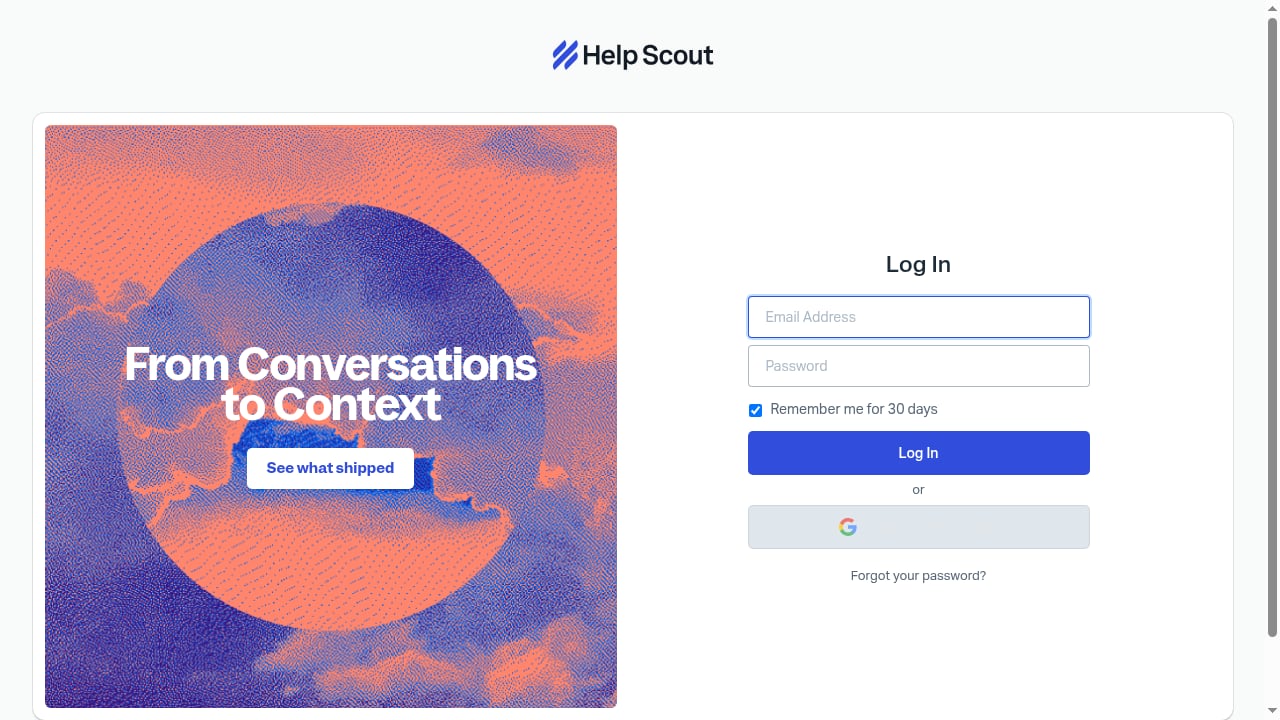
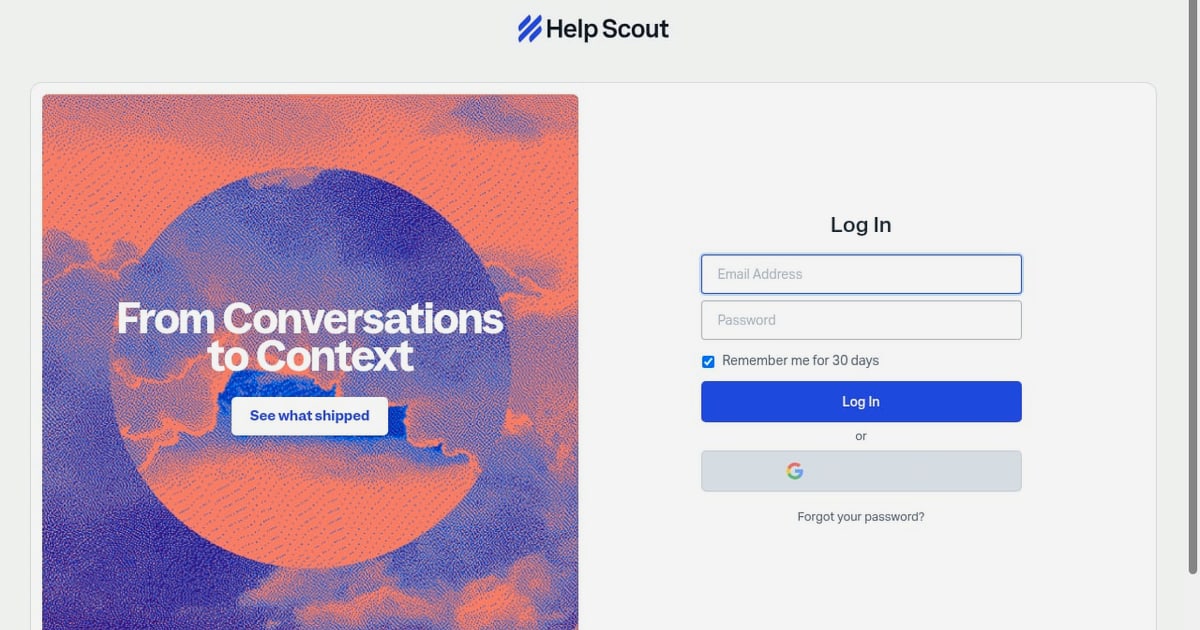
First viewport screenshot of Help Scout - Log In.
Help Scout is built around conversations rather than ticket numbers. Its shared inbox keeps email-based support readable, and the product's stated direction — turning conversations into context — shows up in how customer history and contact details sit alongside each thread. Agents can sign in with Help Scout credentials or Google single sign-on, and password recovery is handled through a standard reset flow.
Best for: Support teams that live in email and want a calm, low-clutter workspace.
Watch out for: Teams needing heavy voice or complex ITIL-style workflows will outgrow it. The web app also expects JavaScript to be enabled, which matters if you support locked-down browsers.
5. Zoho Desk
Zoho Desk offers strong value for organizations already inside the Zoho ecosystem. Ticket management, SLA tracking, and a self-service portal are all present, and the pricing ladder is one of the gentler ones in this list.
Best for: Small and mid-sized businesses using Zoho CRM or Zoho One.
Watch out for: The wider Zoho suite can be overwhelming, and some integrations feel shallower than those of dedicated help desks.
6. HubSpot Service Hub
Service Hub wins when support and marketing need to share one customer record. Tickets, live chat, a knowledge base, and feedback surveys all connect to the same contact timeline used by the CRM.
Best for: Companies where support is part of a broader customer platform strategy.
Watch out for: Contact-tier pricing can escalate fast, and deep help desk features sometimes lag behind dedicated ticketing vendors.
7. Front
Front treats email, chat, and messaging as shared team inboxes with strong internal collaboration. Assignments, comments, and SLAs sit inside the conversation, which suits teams handling high-touch B2B accounts.
Best for: Account management and support teams that collaborate heavily on individual threads.
Watch out for: Reporting is less granular than classic ticketing tools, and per-seat costs are on the higher side. For a three-way view of how Front, Zendesk, and AI-first platforms differ, see this Intercom vs Zendesk vs Front comparison.
8. LiveAgent
LiveAgent covers live chat, ticketing, call center, and social channels in one package with notably low entry pricing. It is a common pick for teams that want multi-channel coverage without a long procurement cycle.
Best for: Budget-conscious teams that need chat and tickets together.
Watch out for: The interface feels dated in places, and AI capabilities are more limited than newer entrants.
9. TeamSupport
TeamSupport focuses on B2B support, with account-level views that show every ticket, contact, and product associated with a customer organization. That structure helps when one issue affects multiple people at the same account.
Best for: B2B software and hardware companies managing account hierarchies.
Watch out for: Pricing starts higher than general-purpose help desks, and the learning curve is steeper for new agents.
10. eDesk
eDesk is purpose-built for ecommerce support. It pulls orders, messages, and marketplace conversations into one queue, which reduces the tab-switching that online sellers know well.
Best for: Online retailers selling across marketplaces and their own storefront.
Watch out for: Outside ecommerce the feature set is narrower, and advanced automation requires higher plans.
Comparison: Which Product Fits Which Team
| Team profile | Strongest fits | Why |
|---|---|---|
| Small email-first team | Help Scout, Freshdesk | Low setup overhead, readable inboxes |
| Enterprise with complex routing | Zendesk, Salesforce Service Cloud | Deep workflow and integration depth |
| Support inside a CRM strategy | HubSpot Service Hub, Zoho Desk | Shared customer records |
| High-touch B2B accounts | Front, TeamSupport | Collaboration and account-level context |
| Ecommerce and marketplaces | eDesk | Order data next to conversations |
| Budget-first multi-channel | LiveAgent | Broad channel coverage at low cost |
Where AI Agents Change the Decision
AI resolution is now a first-class buying criterion. Some platforms ship an AI agent as a native part of the help desk; others rely on marketplace apps or partner integrations. The practical questions to ask are: How is AI usage billed — per resolution, per seat, or per conversation? Can the AI hand off to a human with full context? And can you measure deflection separately from containment?
Intercom is a relevant reference point here even though it sits outside this ranking. Its Fin AI agent is natively integrated with its helpdesk, and published customer stories include AgriWebb reporting an 80% reduction in support costs and AI21 Labs automating 82% of support. Those numbers are useful benchmarks when you are evaluating AI claims from any vendor, and they are covered in more depth in this analysis of AI tools and CX strategy for customer experience professionals.
If your support stack also touches marketing or sales conversations, the overlap is worth mapping before you buy. The top conversational marketing and sales platforms for 2026 covers that adjacent category.
How to Run a Selection Process
- List your channels. Count the actual volume per channel for the last quarter, not the channels you hope to add.
- Define your must-have automation. Decide whether you need deflection, routing, or just canned replies.
- Price a realistic seat count. Include admins, not just agents, and model AI usage separately.
- Run a two-week pilot with real conversations and measure first response time and resolution time.
- Check the exit path. Export your ticket history before you commit; migration pain is a hidden cost.
Related reading
- The Next-Gen Helpdesk in Slack Powered by AI Agents Review - Evidence-based review of the next-gen AI helpdesk in Slack: ideal users, use cases, strengths, limits, pricing signals, setup, and buying criteria.
Sources and further reading
- 10 Best Customer Experience Software For 2026 - Discover the top customer experience software and find the best option for your team. Compare features, pros & cons, prices, and more in my complete guide.
Frequently Asked Questions
What is the best customer support software for small teams in 2026?
For small, email-heavy teams, Help Scout and Freshdesk are the most common starting points because setup is fast and pricing is published. If support is tightly coupled to sales, HubSpot Service Hub is worth the extra cost.
How much should customer support software cost per agent?
Entry tiers for general help desks commonly start in the range of roughly $15 to $30 per agent per month when billed annually, with enterprise platforms and AI add-ons pushing well beyond that. Always price the tier that includes the automation you actually need.
Do I need an AI agent in my help desk?
Only if you have repetitive, high-volume question types that can be answered from existing documentation. If your conversations are mostly complex or high-value, invest in agent experience and routing first.
Can I use Intercom as customer support software?
Intercom is an AI-first customer service platform with a helpdesk and a natively integrated AI agent. It is a legitimate option for support teams, but it is positioned differently from the ticketing-centric products ranked here, so it was evaluated as an adjacent reference rather than a ranked entry.
How long does migration take?
A small team moving under 10,000 tickets can often migrate in one to three weeks. Larger histories with attachments and custom fields take longer, and the data export quality of your current vendor is the biggest variable.
Conclusion
There is no universal winner in 2026. Zendesk and Salesforce Service Cloud reward complexity; Freshdesk and Zoho Desk reward budget discipline; Help Scout and Front reward conversation quality; eDesk and TeamSupport reward specific vertical needs. Start with your channel mix and your automation goal, pilot two products with real tickets, and let measured response and resolution times make the decision for you.
For further reading, G2 publishes a ranking of best customer service software products, and PCMag maintains independent CRM testing that is useful when support and CRM decisions overlap.