Top 10 UCaaS Platforms in 2026: Ranked & Reviewed
Top 10 UCaaS Platforms in 2026: Ranked & Reviewed
Unified Communications as a Service (UCaaS) has moved from a nice-to-have upgrade to the operational backbone of modern work. Gartner defines UCaaS as a multitenant, cloud-delivered subscription service offering business telephony, PSTN connectivity, and collaboration capabilities such as messaging and meetings. In 2026, the category has evolved further: native AI, integrated contact center features, and compliance-ready architectures now separate the leaders from the laggards.
The market is crowded. Over 90% of organizations have implemented some form of UCaaS, according to Metrigy's 2025 workplace study, and the global market is projected to grow from roughly $161 billion in 2025 to more than $415 billion by 2034. That growth has attracted dozens of vendors with overlapping feature sets and aggressive marketing claims.
This guide ranks the ten most credible UCaaS platforms for 2026 using transparent, buyer-focused criteria. Every ranking is supported by published pricing, verified customer reviews, and independent analyst research — not vendor marketing. The goal is to help you match the right platform to your headcount, compliance requirements, integration stack, and budget.
How We Evaluated These UCaaS Platforms

Live video chat screenshot from a webinar, featuring multiple participants interacting and presenting information..
We applied the following criteria consistently across all ten platforms:
- Feature completeness: Does the platform deliver calling, video, messaging, SMS, and collaboration in a single subscription without requiring third-party add-ons?
- Native AI capabilities: Are call transcription, meeting summaries, smart routing, and message translation built into the base product rather than sold as premium upsells?
- Reliability and uptime SLA: We treat 99.999% uptime as the gold standard. At 99.99%, a platform permits up to 52 minutes of unplanned downtime per year — a meaningful difference for revenue-generating teams.
- Integration depth: Native connections to CRMs, productivity suites, helpdesks, and developer APIs reduce total cost of ownership and IT overhead.
- Security and compliance: HIPAA, SOC 2, GDPR, and FedRAMP certifications determine whether a platform clears procurement in regulated industries.
- Pricing transparency: Advertised price versus actual cost after add-ons, international calling fees, and first-year renewal increases.
- Support quality: Availability, response time, and whether support is included at the plan level you will actually buy.
- Global scalability: PSTN coverage, local number availability, and international calling rates for distributed workforces.
Top 10 UCaaS Platforms for 2026

Zoom product interface.
1. RingCentral RingEX
Best for: Small, mid-size, and enterprise businesses that need a full-stack communications platform with mature AI and deep integrations.
RingCentral RingEX consolidates voice, video, messaging, SMS, and fax into a single application, eliminating the app-switching friction that fragments focus and drives shadow IT adoption. The platform carries a 99.999% uptime SLA — less than six minutes of unplanned downtime per year — backed by a contractual commitment.
What sets RingEX apart in 2026 is the breadth of its native AI. Call transcription, meeting summaries, and message translation work across every channel without a third-party add-on. The platform also offers more than 500 native integrations, including Salesforce, Microsoft Teams, Google Workspace, and ServiceNow, which means it fits the stack you already run rather than forcing a rip-and-replace.
For organizations migrating off legacy PBX systems, RingCentral provides a structured transition path rather than a hard cutover — a meaningful risk reducer for mid-market and enterprise buyers. The RingCentral unified communications platform comparison provides additional detail on how RingEX stacks up across SMB, mid-market, and enterprise use cases.
Standout feature: Native AI across voice, video, and messaging with a 99.999% uptime SLA.
2. Microsoft Teams Phone
Best for: Organizations already standardized on Microsoft 365 that want telephony without leaving the Teams environment.
Microsoft Teams Phone extends the Teams collaboration hub — chat, video meetings, file storage, and threaded conversations — with enterprise-grade PSTN calling. For organizations already paying for Microsoft 365 licenses, Teams Phone is often the lowest-friction path to UCaaS because it requires no new user interface and no additional training.
Gartner Peer Insights reviewers consistently rate Teams highly for integration with the Microsoft ecosystem and for supporting remote and distributed work environments. The platform supports direct routing, operator connect, and Microsoft calling plans, giving IT teams flexibility in how they source PSTN connectivity.
The trade-off is that Teams Phone is strongest when your organization is already committed to Microsoft. Teams that use Google Workspace or a mix of productivity suites may find the integration advantage less compelling, and some advanced contact center capabilities require pairing Teams with a separate CCaaS solution.
Standout feature: Deep Microsoft 365 integration with flexible PSTN connectivity options.
3. Cisco Webex Suite
Best for: Mid-size and enterprise businesses in regulated or compliance-driven industries that prioritize security.
Webex Suite brings together meetings, messaging, calling, webinars, events, polling, whiteboarding, and video messaging in a single collaboration experience. All workloads are managed through Control Hub, a single-pane-of-glass administration portal that simplifies governance for IT teams.
Cisco's differentiator is security architecture. The platform is built with enterprise-grade security from the ground up, with end-to-end encryption options, data residency controls, and compliance certifications that clear procurement in financial services, healthcare, and government. For organizations where a compliance audit failure is a board-level risk, Webex Suite's security posture is a primary buying trigger.
AI features are integrated across the suite, including meeting transcription, translation to remove language barriers, and noise removal. The platform also supports flexible deployment models for organizations that need to maintain some on-premises components alongside cloud services.
Standout feature: End-to-end Cisco security with flexible deployment for compliance-driven industries.
4. Zoom Workplace with Zoom Phone
Best for: Mid-size and enterprise businesses that are video-first and want to expand into telephony without leaving the Zoom environment.
Zoom has evolved from a video conferencing tool into an AI-first unified communications platform. Zoom Workplace combines video meetings, team chat, VoIP phone, webinars, whiteboarding, and contact center capabilities in one subscription. Zoom Phone offers PSTN coverage in 49+ countries and territories, with the flexibility to bring your own carrier.
The platform's AI Companion now handles meeting summaries, next-step automation, and agentic search across enterprise connectors. Zoom's voice translation and custom AI avatars push beyond basic transcription into workflow automation territory. For organizations that already run meetings on Zoom, adding Zoom Phone is a natural expansion that consolidates the communications stack.
Zoom's 99.999% uptime architecture and global partner ecosystem make it a credible enterprise option, though buyers should evaluate whether the full feature set justifies the price premium over more telephony-centric competitors.
Standout feature: Video-first collaboration quality with AI Companion and global PSTN coverage.
5. 8x8
Best for: Small and mid-size businesses that want UCaaS and contact center capabilities in a single platform.
8x8 differentiates by combining unified communications and contact center functionality under one roof. For businesses that handle meaningful customer interaction volume but don't want to manage separate UCaaS and CCaaS vendors, 8x8's integrated approach reduces contract surface area and data silos.
The platform covers voice, video, chat, and contact center with a single administrative interface. AI features include call transcription, sentiment analysis, and smart routing across both internal collaboration and customer-facing interactions. This unified data model is valuable for organizations that want a complete view of customer conversations without building custom integrations.
Pricing is competitive for the SMB segment, though buyers should verify which AI features are included at the tier they will actually purchase, as some capabilities sit in higher-priced plans.
Standout feature: Combined UC and CCaaS in a single system with unified analytics.
6. Dialpad
Best for: Small and mid-size businesses that want AI-native calling and real-time intelligence.
Dialpad built its platform on proprietary speech recognition and natural language processing, which means AI is not bolted on — it is the foundation. Real-time call transcription, live sentiment analysis, and automated note-taking work during the call itself, not after the fact. This makes Dialpad particularly strong for sales teams and customer-facing roles that need immediate insight rather than post-call summaries.
The platform includes voice calling, messaging, and video conferencing in a unified interface, with integrations for CRM platforms like Salesforce and HubSpot. Dialpad's AI can surface action items, track talk-to-listen ratios, and generate follow-up tasks automatically.
For organizations that prioritize AI depth over breadth of collaboration features, Dialpad is a strong fit. Buyers should note that the platform's meeting and webinar capabilities are less mature than Zoom or Webex, so teams with heavy external meeting requirements may need a complementary tool.
Standout feature: Real-time AI call intelligence and transcription built into the calling experience.
7. Nextiva
Best for: Small and mid-size businesses that want business phone tightly connected to customer engagement.
Nextiva positions its platform as a Unified Customer Experience Management (Unified-CXM) hub rather than a pure UCaaS play. The platform combines VoIP calling, video, messaging, and SMS with CRM-connected communication and call analytics. For small businesses that want their phone system to feed directly into customer relationship workflows, Nextiva's integrated approach reduces the need for separate tools.
Nextiva powers over a million users and processes billions of interactions annually. The platform's strength is practical: call routing, analytics, and administrative controls are designed for teams without dedicated IT staff. The customer engagement layer surfaces conversation history and customer context alongside the call, which helps small teams deliver more personalized service without a full contact center deployment.
Pricing is competitive for the SMB segment, though some advanced AI features and analytics sit in higher tiers. Buyers should map their must-have features against the specific plan they will purchase.
Standout feature: CRM-connected communication and call analytics for customer-facing small teams.
8. GoTo Connect
Best for: Mid-size businesses that want simplified cloud phone and UCaaS with rapid deployment.
GoTo Connect prioritizes ease of configuration. The platform's call routing setup is designed to be completed without professional services, which matters for mid-size organizations that need to deploy quickly across departments without a lengthy implementation cycle.
The platform includes cloud VoIP, video meetings, team messaging, and SMS in a single application. GoTo Connect's administrative interface is consistently rated as approachable by users without deep telephony expertise, reducing the IT burden for organizations with lean technical teams.
For businesses that value deployment speed and simplicity over advanced AI or deep customization, GoTo Connect is a pragmatic choice. The trade-off is fewer native integrations and less sophisticated AI than RingCentral or Dialpad, so teams with complex automation requirements may outgrow the platform.
Standout feature: Simplified call routing configuration and rapid deployment for lean IT teams.
9. Vonage Business Communications
Best for: Mid-size businesses that want hosted UCaaS plus developer API access for custom communications.
Vonage Business Communications integrates voice, messaging, video, and conferencing in a cloud platform accessible from desktops and mobile devices. Features include VoIP calling, SMS messaging, call recording, team messaging, and CRM integrations.
What distinguishes Vonage is the developer layer. The Vonage Communications APIs allow organizations to build custom communication workflows — programmable voice, messaging, and video — alongside the hosted UCaaS platform. For mid-size businesses with development resources that want to embed communications into proprietary applications, this dual capability is unique in the category.
The hosted UCaaS platform itself is solid but less differentiated than RingCentral or Webex on AI depth. Buyers should evaluate whether they will actually use the API layer; if not, other platforms may offer more value per dollar.
Standout feature: Programmable communications APIs alongside hosted UCaaS.
10. PanTerra Networks (Streams.AI)
Best for: Small businesses that need HIPAA-compliant UCaaS with transparent pricing and US-based support.
PanTerra Networks operates its own cloud infrastructure — no third-party subcontractors or outsourced engineering — and delivers cloud business phone, video conferencing, team messaging, SMS/MMS, enterprise file sharing, and an AI receptionist in a single HIPAA/HITECH-certified application.
What sets PanTerra apart for small businesses is what is included in the base tier. SmartBox enterprise file sharing, Luna AI Receptionist, a 99.999% uptime SLA, US-based 24/7 live support with 30-second response times, and HIPAA certification are standard rather than premium add-ons. The platform also includes phone number reputation management, which actively monitors and remediates spam labels across AT&T, Verizon, and T-Mobile — an often-overlooked feature that directly impacts whether customers answer outbound calls.
Pricing starts at $17.50 per user per month for the Business Plus plan, with Professional at $20.95 and Call Center at $29.95. For small businesses in healthcare, legal, insurance, or financial services, PanTerra's compliance posture and pricing transparency are compelling. The PanTerra UCaaS comparison provides additional detail on small-business-specific evaluation criteria.
Standout feature: HIPAA compliance, file sharing, and phone number reputation management included in base pricing.
Side-by-Side Comparison

A woman engaged in a conversation on Zoom Phone, smiling as she talks..
| Platform | Best Fit | Standout Strength | Uptime SLA | AI Depth |
|---|---|---|---|---|
| RingCentral RingEX | SMB to enterprise | Full-stack UC with 500+ integrations | 99.999% | High |
| Microsoft Teams Phone | Microsoft 365 shops | Zero-friction telephony in Teams | 99.99%+ | Medium |
| Cisco Webex Suite | Regulated enterprises | Security and compliance architecture | 99.99%+ | High |
| Zoom Workplace + Phone | Video-first organizations | Meeting quality + global PSTN | 99.999% | High |
| 8x8 | SMB with contact center needs | UC + CCaaS in one platform | 99.99%+ | Medium-High |
| Dialpad | Sales and customer-facing teams | Real-time AI call intelligence | 99.99%+ | Very High |
| Nextiva | Customer-focused SMBs | CRM-connected communication | 99.99%+ | Medium |
| GoTo Connect | Lean IT mid-size teams | Rapid deployment and simple routing | 99.99%+ | Medium |
| Vonage Business Communications | Mid-size with dev resources | UCaaS + programmable APIs | 99.99%+ | Medium |
| PanTerra Networks | Regulated small businesses | HIPAA + transparent pricing | 99.999% | Medium |
How to Choose the Right UCaaS Platform
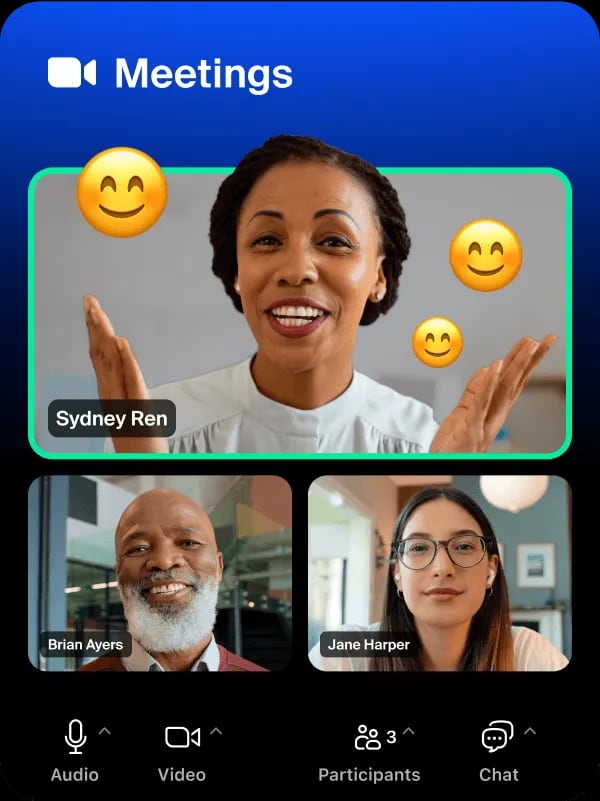
Meetings: Zoom Meetings app interface featuring various emoticons for enhanced communication and engagement..
The right platform depends on your context, not a universal ranking. Use this decision framework to narrow the field:
If you are a small business in a regulated industry: Start with PanTerra Networks. HIPAA compliance, file sharing, and US-based support included at the base tier eliminate the most common compliance and support surprises.
If you are already committed to Microsoft 365: Microsoft Teams Phone is the lowest-friction option. You keep the interface your teams already use and add telephony without a new training burden.
If you are video-first and expanding into phone: Zoom Workplace with Zoom Phone consolidates your stack without sacrificing meeting quality. The AI Companion adds workflow automation on top of core communications.
If you need UCaaS and contact center together: 8x8 offers the tightest integration between internal collaboration and customer-facing interactions in a single platform.
If AI intelligence during calls is your priority: Dialpad's real-time transcription and sentiment analysis deliver insight in the moment, not after the fact.
If you are an enterprise with compliance audits on the line: Cisco Webex Suite's security architecture and deployment flexibility clear procurement in the most demanding environments.
A Note on Customer Support Platforms
UCaaS platforms handle internal collaboration and business telephony. They are not a replacement for a dedicated customer service platform. If your team manages high volumes of support conversations across live chat, email, in-app messaging, and phone, you may want to pair your UCaaS choice with an AI-first helpdesk like Intercom. Intercom's Fin AI Agent resolves support requests automatically, while its shared inbox and Copilot assistant support human agents. For teams evaluating support platforms alongside UCaaS, our Freshdesk review and Intercom vs Pylon vs Gorgias comparison provide evidence-based guidance. The key distinction: UCaaS powers your phone and meetings; a support platform powers your customer conversations.
Related reading
- How to Use Intercom with Twilio: Setup & Workflows - Learn how to connect Intercom and Twilio for omnichannel support, phone routing, and customer data sync. Step-by-step setup, workflows, and examples.
- Intercom vs Pylon vs Gorgias: Which Support Platform Wins? - Compare Intercom, Pylon, and Gorgias on AI agents, channel coverage, pricing models, and ideal use cases. Find the right support platform for your team.
- Intercom vs ProProfs Help Desk: Which Platform Wins? - Compare Intercom vs ProProfs Help Desk on AI agents, pricing, channels, scalability, and ease of use. See which support platform fits your team in 2026.
Sources and further reading
- Best Unified Communications as a Service Reviews 2026 | Gartner Peer Insights - Find the top Unified Communications as a Service Platforms with Gartner. Compare and filter by verified product reviews and choose the software that’s right for your organization.
Frequently Asked Questions
What is the difference between UCaaS and VoIP?
VoIP (Voice over Internet Protocol) is a technology for making phone calls over the internet. UCaaS is a broader cloud-delivered subscription service that includes VoIP calling plus video conferencing, team messaging, SMS, and often contact center capabilities in a single platform. Think of VoIP as one component of a UCaaS platform.
How much does UCaaS cost per user in 2026?
Pricing varies widely by provider and tier. Entry-level plans start around $15 to $20 per user per month when billed annually, while enterprise plans with advanced AI, analytics, and compliance features can exceed $40 per user per month. The key is to verify what is included at each tier — AI features, file sharing, and support quality are common upsell points that inflate the effective cost.
What uptime SLA should I require from a UCaaS provider?
A 99.999% uptime SLA means approximately 5.26 minutes of downtime per year. At 99.99%, that number jumps to about 52 minutes. For revenue-generating teams, the difference matters. RingCentral, Zoom, and PanTerra all offer 99.999% SLAs; verify whether the SLA applies to all plans or only premium tiers before signing.
Do I need a separate contact center platform if I have UCaaS?
It depends on your customer interaction volume. Many UCaaS platforms now integrate midgrade contact center capabilities, and some — like 8x8 — offer full CCaaS functionality in the same platform. If your team handles complex support workflows, omnichannel routing, or high-volume inbound queues, a dedicated CCaaS or AI-first support platform may still be necessary alongside your UCaaS choice.
Which UCaaS platform is best for HIPAA compliance?
PanTerra Networks is the strongest option for HIPAA-regulated small businesses because HIPAA/HITECH certification and a Business Associate Agreement are included at the base tier. Cisco Webex Suite and RingCentral also offer HIPAA-compliant configurations for larger organizations, though compliance features may require specific plans or add-ons.
Can UCaaS replace my customer support software?
No. UCaaS platforms handle internal collaboration, business telephony, and meetings. Customer support software — helpdesks, shared inboxes, AI agents, and knowledge bases — serves a different function: managing customer conversations at scale. Many organizations run both, integrating the two so that phone calls from the UCaaS platform can route into the support platform when needed. For example, teams can connect a support platform like Intercom with telephony tools to sync customer data and route calls intelligently — see our guide on connecting Intercom with Twilio for a practical workflow example.
Conclusion
The UCaaS market in 2026 rewards buyers who evaluate platforms on criteria that matter after the contract is signed: uptime SLAs, native AI depth, compliance posture, pricing transparency, and support quality. The ten platforms ranked here represent the most credible options across SMB, mid-market, and enterprise segments, each with a distinct strength.
RingCentral RingEX leads for full-stack capability and integration breadth. Microsoft Teams Phone wins for Microsoft-centric organizations. Cisco Webex Suite is the security-first enterprise choice. Zoom Workplace excels for video-first teams expanding into telephony. Dialpad leads on real-time AI intelligence. PanTerra Networks delivers the best value for regulated small businesses.
Your decision should start with your existing stack, compliance requirements, and headcount trajectory — not a vendor's marketing page. Shortlist two or three platforms from this guide, run a pilot with real users, and verify the features you actually need are included in the tier you will actually buy. The platform you choose today will shape how your teams communicate for the next two to three years.
For a deeper look at how AI is reshaping adjacent categories, see our top 10 AI agentic automation platforms for 2026.