Intercom vs Ada vs Capacity: 2026 AI Support Platform Comparison
Intercom vs Ada vs Capacity: Which AI Customer Service Platform Fits Your Team in 2026?
Choosing an AI customer service platform in 2026 means weighing more than feature checklists. Intercom, Ada, and Capacity each take a distinct approach to automating support: Intercom pairs an AI agent with a native helpdesk, Ada focuses on enterprise-grade automated resolution across channels, and Capacity positions itself as a unified CX automation layer for contact centers and support teams. The right choice depends on your volume shape, existing tooling, and how much control you want over the AI agent itself.
This comparison breaks down where each platform genuinely excels, where the trade-offs live, and which buyer profile each one serves best.
How the Three Platforms Approach AI Customer Service

The agentic customer experience platform.
Before comparing specific criteria, it helps to understand the architectural difference that shapes everything else.
Intercom is an AI-first customer service platform built around Fin, its AI Agent. Fin resolves conversations across live chat, email, SMS, WhatsApp, and other channels, while the Intercom helpdesk handles human escalations, a shared inbox, and proactive outbound messaging. The key structural advantage is that the AI agent and the human support layer live in one system, which removes handoff friction and unifies reporting between automated and human conversations.
Ada is an agentic customer experience (ACX) platform aimed squarely at enterprise brands. Its AI agents are designed to autonomously resolve over 80% of support inquiries, operating across every channel and language. Ada layers a guided implementation practice and dedicated experts on top of the platform, which signals that it expects customers to invest in ongoing optimization rather than a purely self-serve setup. It does not include a native helpdesk, so it typically sits on top of an existing system like Zendesk or Salesforce.
Capacity is a unified customer experience automation platform built for contact centers and support teams. It combines autonomous AI agents, real-time agent assist, and post-interaction automation in one system. Capacity emphasizes knowledge orchestration so the same information reaches customers across SMS, chat, voice, and email, and it markets measurable outcomes like cost-per-call savings and CSAT improvements. Its sweet spot is organizations that want automation layered across both self-service and human-assisted channels.
AI Resolution Capability: What "Resolved" Actually Means

The agentic customer experience platform.
Resolution rate is the most cited metric in AI agent evaluations, but definitions vary significantly between vendors. A meaningful comparison requires asking each vendor exactly what counts as a resolved conversation.
Ada builds its entire positioning around automated resolution. The company claims its AI agents resolve over 80% of support inquiries, and it has publicly argued that resolution-based pricing punishes a bot for improving. Ada's focus on resolution as a core metric is backed by thousands of enterprise deployments, and its ACX operating model is designed to continuously raise that number through guided practice and expert involvement. For enterprise teams where automated resolution is the primary KPI, Ada's depth of focus is a credible strength.
Capacity approaches resolution from a contact center angle. Its AI agents autonomously resolve routine requests, while agent assist tools support human agents on complex interactions. Capacity reports measurable outcomes across its customer base, including 66% cost-per-call savings and 4.5/5 CSAT scores. The platform's knowledge orchestration layer is designed to ensure the AI agent and human agents draw from the same source of truth, which reduces inconsistent answers across channels.
Intercom publishes a concrete resolution benchmark: Fin averages 76% resolution across its customer base, with ecommerce deployments reaching up to 84%. Independent head-to-head testing has placed Fin ahead of several competitors on resolution quality. Because Fin and the helpdesk share one system, resolved conversations and human escalations are tracked in the same reporting view, which makes it easier to verify what the AI actually handled end-to-end.
Practical takeaway: All three platforms can resolve a meaningful share of routine inquiries. The differentiator is how transparently each vendor defines and reports resolution, and whether the AI agent shares infrastructure with your human support layer. Ask for the definition of "resolved" in writing before comparing rates across platforms.
Pricing Models: Outcome-Based, Conversation-Based, and Platform-Based

The agentic customer experience platform.
Pricing is where these three platforms diverge most sharply, and the right model depends heavily on your ticket volume shape.
Intercom uses outcome-based pricing for Fin at $0.99 per billable outcome, which includes resolutions, procedure handoffs, and disqualified sales leads. The helpdesk itself is priced per seat starting around $19 per user per month, with a Copilot add-on for human agents at $35 per user per month. This model is fully published and predictable: you pay only when the AI produces a defined outcome. The trade-off is that costs scale with success. As your bot resolves more conversations, the bill grows.
Ada deliberately moved away from resolution-based pricing to a conversation-based model. The company argues that charging per resolution penalizes a bot for improving, since better performance means higher costs for the same volume. Ada does not publish pricing on its website; procurement data aggregators report starting engagements near $30,000 per year, median contracts around $70,000, and enterprise deployments at $300,000 or more. This is an enterprise-only model. Small teams looking for self-serve pricing will not find it here.
Capacity positions pricing around platform value rather than per-resolution metering. The company markets outcomes like cost-per-call savings, which suggests a model built around contact center economics rather than AI agent consumption. Capacity does not publish a detailed public price list, so budgeting requires a direct conversation. For organizations already managing contact center costs, Capacity's framing around total cost reduction may align better than per-outcome metering.
Practical takeaway: If you want transparent, usage-based pricing that scales with outcomes, Intercom's model is the clearest. If you are an enterprise willing to negotiate a custom contract and prefer conversation-based billing, Ada's approach removes the penalty for improving resolution. If you are optimizing a contact center's total cost structure, Capacity's platform-level pricing deserves a conversation.
Omnichannel Support and Channel Coverage
All three platforms support multiple channels, but the depth and native integration differ.
Ada emphasizes omnichannel as a core enterprise requirement. Its AI agents operate across every channel and language, which matters for global brands serving customers on web, mobile, social, and messaging apps. Ada positions channel coverage as table stakes for enterprise deployments, and its 100+ language support is a meaningful advantage for international teams.
Capacity covers SMS, chat, voice, and email with a unified automation layer. Its voice capabilities are a differentiator: intelligent voice assistants and speech recognition for call quality are built into the platform, which makes it a strong fit for contact centers where phone support remains a significant channel. Email automation aimed at achieving inbox zero is another practical strength for teams drowning in repetitive email inquiries.
Intercom supports live chat, email, in-app messaging, SMS, WhatsApp, and phone through Fin Voice. The in-app messaging capability is a structural advantage for SaaS and product-led businesses, because support conversations can happen inside the product experience rather than in a separate browser tab. The shared inbox unifies all channels for human agents when escalation is needed.
Practical takeaway: If voice is a primary channel, Capacity's native voice AI and speech analytics deserve attention. If in-app support is central to your product experience, Intercom's native messaging is hard to match. If you need broad multilingual coverage across many channels at enterprise scale, Ada's omnichannel depth is a credible strength.
Setup, Control, and Ongoing Management
How fast you can go live, and who controls changes after launch, varies significantly.
Intercom is designed for self-serve deployment. Non-technical teams can configure Fin in days, run simulations to test changes, and modify procedures and knowledge immediately without vendor involvement. This self-serve model keeps iteration speed high, which matters when your product or policies change frequently. For a deeper look at how AI support platforms handle implementation, see our Forethought setup guide, which covers similar deployment considerations.
Ada falls between self-serve and vendor-assisted. The platform offers visual builders and coaching tools, but enterprise deployments typically involve Ada's professional services and the ACX Practice, which guides implementation based on thousands of prior deployments. This white-glove approach can accelerate time-to-value for complex enterprise environments, but it also means ongoing changes may require coordination with Ada's team.
Capacity emphasizes seamless integration with existing tools and workflows. The platform is built to automate across systems, which means setup involves connecting Capacity to your CRM, ticketing, and knowledge sources. Its knowledge orchestration layer is designed to reduce the manual work of keeping information consistent across touchpoints, but the initial integration effort depends heavily on your existing stack.
Practical takeaway: If you want full control and fast iteration without vendor dependency, Intercom's self-serve model is the strongest fit. If you want guided implementation and are willing to invest in ongoing optimization, Ada's practice-led approach has proven value for enterprise teams. If your priority is automation across an existing contact center stack, Capacity's integration-first design is worth evaluating.
When Each Platform Is the Best Fit
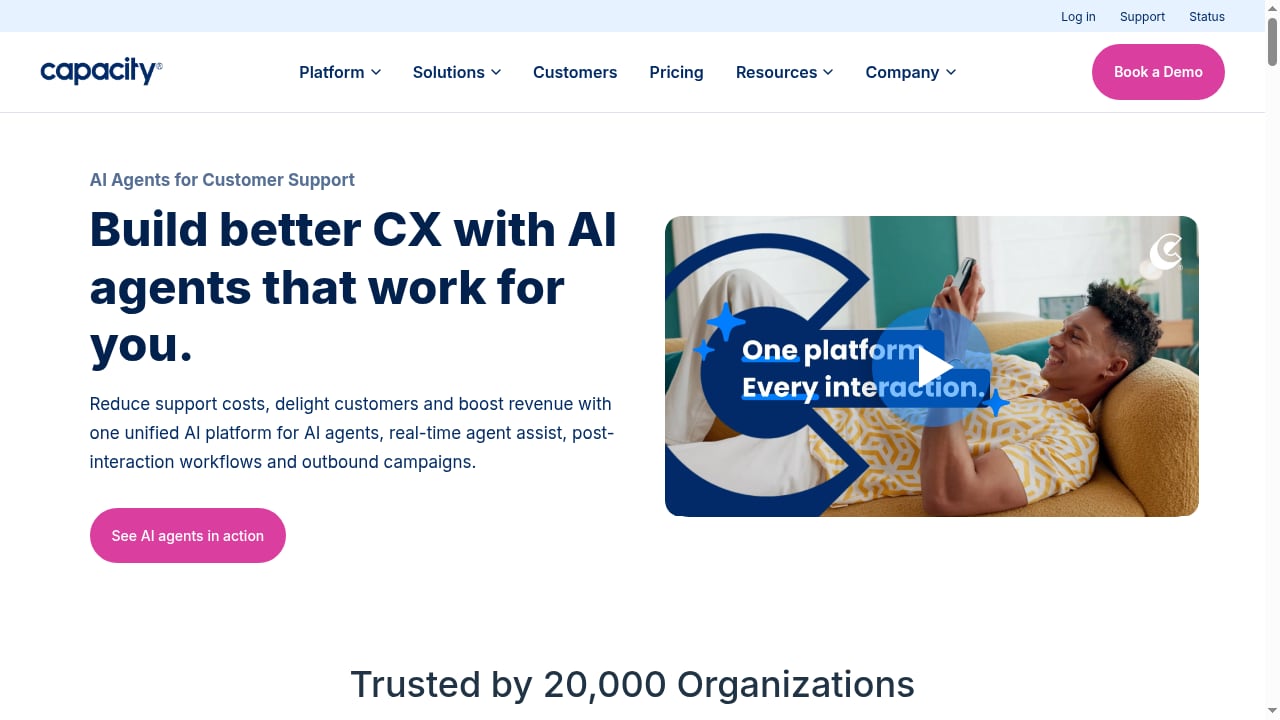
First viewport screenshot of Capacity CX Automation Platform.
Choose Intercom when:
- You want one platform for both AI automation and human support, without stitching together a separate helpdesk
- You value transparent, published pricing that scales with outcomes
- In-app messaging and proactive outbound engagement are core to your customer experience
- Your team wants to configure and iterate on the AI agent without vendor dependency
Choose Ada when:
- You are an enterprise brand with high support volume across many channels and languages
- Automated resolution rate is your primary KPI, and you want a vendor whose entire operating model is built around improving it
- You are comfortable with custom enterprise pricing and a guided implementation process
- You already have a helpdesk in place and want a specialized AI agent layer on top
Choose Capacity when:
- You run a contact center where voice and phone support are significant channels
- You want automation across self-service, agent assist, and post-interaction workflows in one platform
- Your priority is reducing total cost per interaction rather than paying per AI outcome
- You need knowledge orchestration to keep AI and human agents aligned across SMS, chat, voice, and email
How to Decide: A Practical Evaluation Framework
Before signing with any of these platforms, work through this sequence:
Model your volume shape. Estimate monthly conversations, the share that are routine versus complex, and how that mix changes seasonally. Outcome-based pricing (Intercom) rewards you early but scales with success. Conversation-based pricing (Ada) removes the penalty for improving. Platform-based pricing (Capacity) may be more predictable for stable contact center volumes.
Define "resolved" in writing. Ask each vendor for their exact definition. Does it mean the customer's problem was fixed, or that the AI responded without escalation? Does it count customer silence as success? The definition does quiet work in every resolution rate you are quoted.
Map your channel mix. If voice is 40% of your volume, Capacity's native voice AI matters more than Ada's multilingual chat coverage. If in-app support drives retention, Intercom's native messaging is a structural advantage. Match the platform to your actual channels, not the demo.
Assess your team's operating model. Do you have engineering resources to manage integrations, or do you need a self-serve tool your CX team can run independently? Intercom is built for the latter. Ada assumes you want expert involvement. Capacity sits in between, depending on your existing stack.
Budget the bad month. Product recalls, viral complaint threads, and seasonal spikes happen. Model what a 2x or 3x volume month costs under each pricing model before signing. The headline number is rarely the number you actually pay.
For a broader comparison of Intercom against other AI support platforms, see our Intercom vs Decagon analysis and the Intercom vs HelpCrunch vs Drift comparison.
Related reading
- Intercom vs Talkdesk: Which Platform Wins in 2026? - Compare Intercom and Talkdesk on AI agents, pricing, omnichannel support, setup complexity, and scalability. See which customer service platform fits your team in 2026.
- Drift Review 2026: Conversational Sales Platform Tested - Evidence-based Drift review covering AI chatbots, live chat, pricing signals, setup, limitations, and ideal users. See if Drift fits your revenue team in 2026.
Sources and further reading
- Intercom Fin vs Zendesk AI Agents vs Ada: Which Actually Resolves Tickets - Fin, Zendesk AI Agents and Ada resolve tickets and price them in three different ways, and none of the three is quite the same company it was two years ago. A repair shop's view of what that means before you sign in 2026.
- AI Customer Service Platforms Compared (2026) - Compare 8 AI customer service platforms: Fin, Ada, Decagon, Sierra, Kore.ai, Cognigy, Zowie, Gorgias. Resolution rates, pricing, and capabilities.
- Top 10 Ada Alternatives — Kayako - Explore the top 10 Ada alternatives for customer support. Compare platforms by live chat features, multichannel support, automation, and pricing to find your perfect fit.
Frequently Asked Questions
Is Intercom the same as Fin?
Fin is Intercom's AI Agent, priced separately from the Intercom helpdesk. Fin can run standalone against other helpdesks like Salesforce or HubSpot, or paired natively with Intercom's own helpdesk. The combined platform is what Intercom sells as its AI-first customer service solution.
Does Ada include a helpdesk?
No. Ada is an AI agent layer that sits on top of existing helpdesks like Zendesk or Salesforce. You will need a separate helpdesk for human agents, which adds integration complexity and total cost of ownership compared to platforms with a native helpdesk.
What does Capacity cost?
Capacity does not publish a detailed public price list. The company positions pricing around platform value and measurable outcomes like cost-per-call savings. Budgeting requires a direct conversation with Capacity's sales team, and the final number depends heavily on your channel mix, volume, and integration requirements.
Which platform has the best resolution rate?
Direct comparison is difficult because each vendor defines "resolved" differently. Intercom publishes a 76% average resolution rate for Fin, with ecommerce deployments reaching up to 84%. Ada claims its AI agents resolve over 80% of support inquiries. Capacity reports outcomes like 66% cost-per-call savings rather than a single resolution benchmark. Ask each vendor for their definition in writing before comparing.
Can small teams use Ada?
Ada's pricing model is enterprise-oriented. Procurement data aggregators report starting engagements near $30,000 per year, and Ada does not offer self-serve pricing. Small teams are better served by platforms with published, usage-based pricing like Intercom, or by evaluating Capacity's fit through a direct sales conversation.
Which platform is best for voice support?
Capacity has the strongest native voice capabilities of the three, with intelligent voice assistants and speech recognition built into the platform. Intercom offers Fin Voice for phone support, and Ada supports voice as part of its omnichannel coverage, but Capacity's contact center heritage gives it an edge for voice-heavy operations.
Conclusion
Intercom, Ada, and Capacity all deliver credible AI customer service automation, but they optimize for different buyers. Intercom wins on platform cohesion, pricing transparency, and self-serve control. Ada wins on enterprise-grade automated resolution at scale, backed by a practice-led implementation model. Capacity wins on contact center automation, voice support, and total cost reduction across self-service and human-assisted channels.
The decision comes down to three questions: What does your channel mix actually look like? How much control do you want over the AI agent after launch? And what pricing model aligns with your volume shape? Answer those honestly, and the right platform becomes clear.