Intercom vs Talkdesk: Which Platform Wins in 2026?
Intercom vs Talkdesk: Which Customer Service Platform Wins in 2026?
Choosing between Intercom and Talkdesk means deciding between two fundamentally different approaches to customer service. Intercom is an AI-first customer service platform built around a helpdesk with a natively integrated AI Agent called Fin. Talkdesk is a contact center platform that has layered AI capabilities onto a voice-first CCaaS foundation. Both promise AI-driven efficiency, but they serve different operational realities.
This comparison breaks down how the two platforms differ in AI capabilities, pricing, omnichannel support, setup complexity, and overall fit. By the end, you will have a clear picture of which tool aligns with your support or contact center goals.
How Intercom and Talkdesk Approach AI Differently
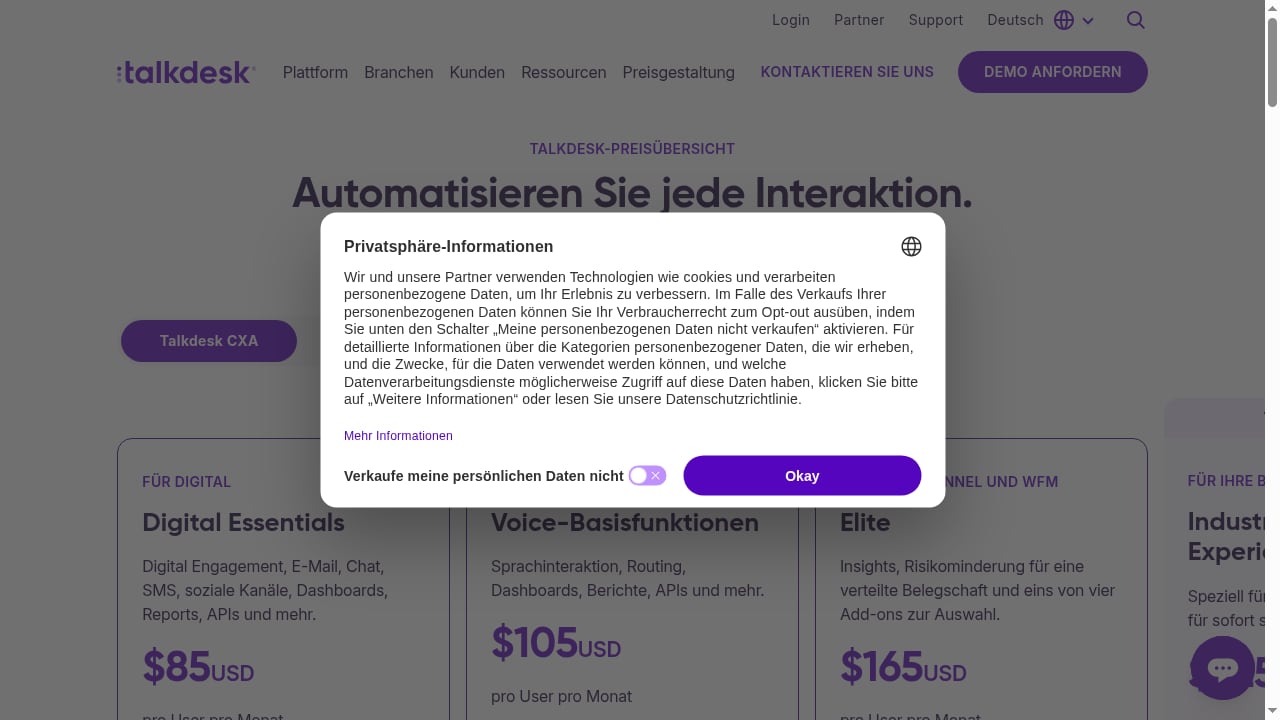
First viewport screenshot of Preise der Contact Center-Software | Talkdesk.
The most important distinction between these platforms is architectural. Intercom was designed from the ground up as an AI-first customer service platform. Its AI Agent, Fin, is natively embedded in the helpdesk, meaning it can resolve conversations across chat, email, and in-app messaging without requiring a separate integration layer. Fin pulls from your existing Help Center content and past conversations to answer customer questions immediately, escalating to human agents only when necessary.
Talkdesk takes a different path. Its AI capabilities, including Talkdesk Copilot and Talkdesk Autopilot, are powerful but operate within a contact center framework that was originally built for voice. Copilot assists human agents with next best actions and automatic summaries. Autopilot provides agentic AI virtual assistants for voice and digital channels. While these tools are sophisticated, they sit on top of a platform whose core architecture predates the AI Agent era.
This architectural difference matters in practice. Intercom's Fin is designed to resolve a high percentage of routine inquiries without any human involvement, which directly reduces ticket volume. Talkdesk's AI tools are more focused on augmenting human agents within a traditional contact center workflow. If your goal is to deflect repetitive questions at scale, Intercom's native AI Agent approach is more direct. If you need AI to support a large team of phone agents, Talkdesk's Copilot features may feel more familiar.
AI Resolution vs. AI Assistance
Intercom positions Fin as an AI Agent that resolves conversations end-to-end. It can answer questions, collect information, and complete actions like updating records or processing simple requests. The platform reports that Fin resolves a significant share of customer conversations without human intervention, which translates into faster response times and lower support costs.
Talkdesk's Autopilot offers autonomous AI agents for voice and digital channels, but the platform's messaging emphasizes a hybrid workforce where human agents focus on judgment and empathy while AI agents execute specific tasks. This is a valid model for complex contact center environments, but it requires more human oversight than Intercom's resolution-first approach.
Pricing: Transparent Tiers vs. Tiered Paywalls
Pricing is where Talkdesk faces the most consistent criticism from verified users. According to a detailed comparison of Talkdesk alternatives, the platform's $85 per user per month entry price covers only basic inbound calls. Call recording, API access, and CRM integrations require upgrading to the $115 Elevate tier. AI features like transcription, Copilot, and Autopilot require the $145 to $165+ Elite tier.
This tiered structure means the true cost of running a functional contact center on Talkdesk is often significantly higher than the advertised starting price. Teams that need AI capabilities, omnichannel digital channels, or reliable CRM sync will find themselves paying enterprise-level prices.
Intercom uses outcome-based pricing with Essential, Advanced, and Expert plans. The platform offers a free trial, and its pricing is designed to scale with the outcomes you achieve rather than gating essential features behind arbitrary tiers. While Intercom is not the cheapest option on the market, its pricing structure is more transparent about what you get at each level.
For a deeper look at how Intercom's pricing compares to other platforms, see our Intercom vs HelpCrunch vs Drift comparison.
Omnichannel Support: Native vs. Bolted-On
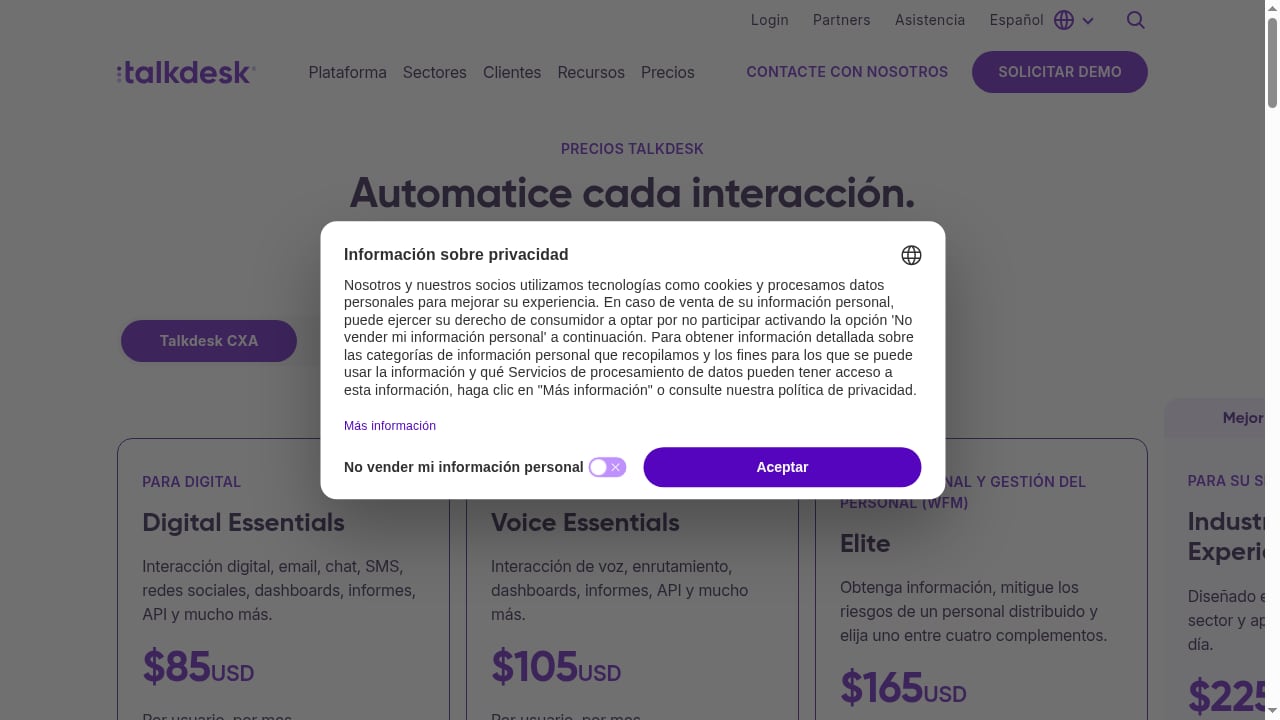
First viewport screenshot of Precios del Software para Centro de Contacto | Talkdesk.
Intercom was built as a messaging-first platform. Live chat, email, in-app messaging, and phone support all live within the same shared inbox. This means conversations flow naturally across channels without requiring complex routing configurations. The Help Center is natively integrated, so Fin can pull from your knowledge base to resolve inquiries across every channel.
Talkdesk built its reputation on voice, and that legacy shows in how the platform handles other channels. According to a 2026 analysis of Talkdesk alternatives, email, chat, SMS, and social media can feel like additions rather than native components of the platform. The voice-first architecture means omnichannel workflows often require more configuration and may not feel as seamless as they do in a messaging-native platform like Intercom.
This distinction is critical if your support volume skews heavily toward digital channels. Intercom's shared inbox treats every conversation the same way, regardless of where it originated. Talkdesk's omnichannel capabilities exist, but they operate within a contact center paradigm that prioritizes voice routing and queue management.
Setup Complexity and Time to Value
Intercom vs Talkdesk: Which Platform Wins in 2026? - Setup Complexity and Time to Value.
Intercom is known for relatively fast deployment. Teams can connect the helpdesk, import Help Center content, and activate Fin within days rather than weeks. The platform's focus on self-service and AI resolution means you can start deflecting tickets almost immediately after setup.
Talkdesk implementations tend to be more involved. The platform's depth creates a steeper learning curve, and verified users report that training agents takes longer than expected due to nested menus and complex feature interactions. One analysis noted that connection problems, including cookie deletion issues and call recording failures across CRM systems, compound the setup challenges.
For teams that need to move quickly, Intercom's simpler onboarding is a meaningful advantage. For enterprises with dedicated IT resources and complex routing requirements, Talkdesk's depth may justify the longer implementation timeline.
CRM Integrations and Data Reliability
Intercom integrates with major CRMs and business tools, and because it is a helpdesk at its core, customer conversation data lives natively within the platform. This reduces the risk of sync failures that plague contact center tools that must push call data into external systems.
Talkdesk advertises deep Salesforce and HubSpot connections, but verified users on G2 and Reddit have reported audio dropouts mid-call, blank agent screens, and failed Salesforce case creation. When CRM sync fails during a live conversation, agents fall back on manual data entry, which erodes the efficiency gains the platform promises.
If your support team relies on accurate, real-time CRM data, Intercom's native helpdesk architecture offers a more reliable foundation.
Reporting and Analytics
Intercom provides AI Insights that surface trends, resolution rates, and customer sentiment directly from conversation data. Because Fin handles a large volume of conversations autonomously, the analytics reflect both human and AI performance in a unified view.
Talkdesk offers Interaction and Quality Analytics, but mid-market teams on G2 have reported that historical reports occasionally return different figures for the same query at different times. Inconsistent reporting creates operational risk for workforce management and quality assurance teams that depend on accurate data.
When to Choose Intercom
Intercom is the stronger choice when:
- AI resolution is your top priority. Fin's native integration means you can automate a large share of routine inquiries without building custom workflows.
- Digital channels dominate your support volume. Live chat, email, and in-app messaging are first-class citizens in Intercom's shared inbox.
- You need fast time to value. Intercom's setup is straightforward, and Fin can start resolving conversations shortly after your Help Center is connected.
- You want predictable pricing. Outcome-based plans avoid the enterprise paywall problem that Talkdesk users frequently cite.
- Your team is small to mid-sized. Intercom serves businesses of all sizes, but its simplicity is especially valuable for teams without dedicated contact center IT staff.
For a closer look at how Intercom compares to other AI support platforms, see our Intercom vs Decagon comparison.
When Talkdesk Might Still Fit
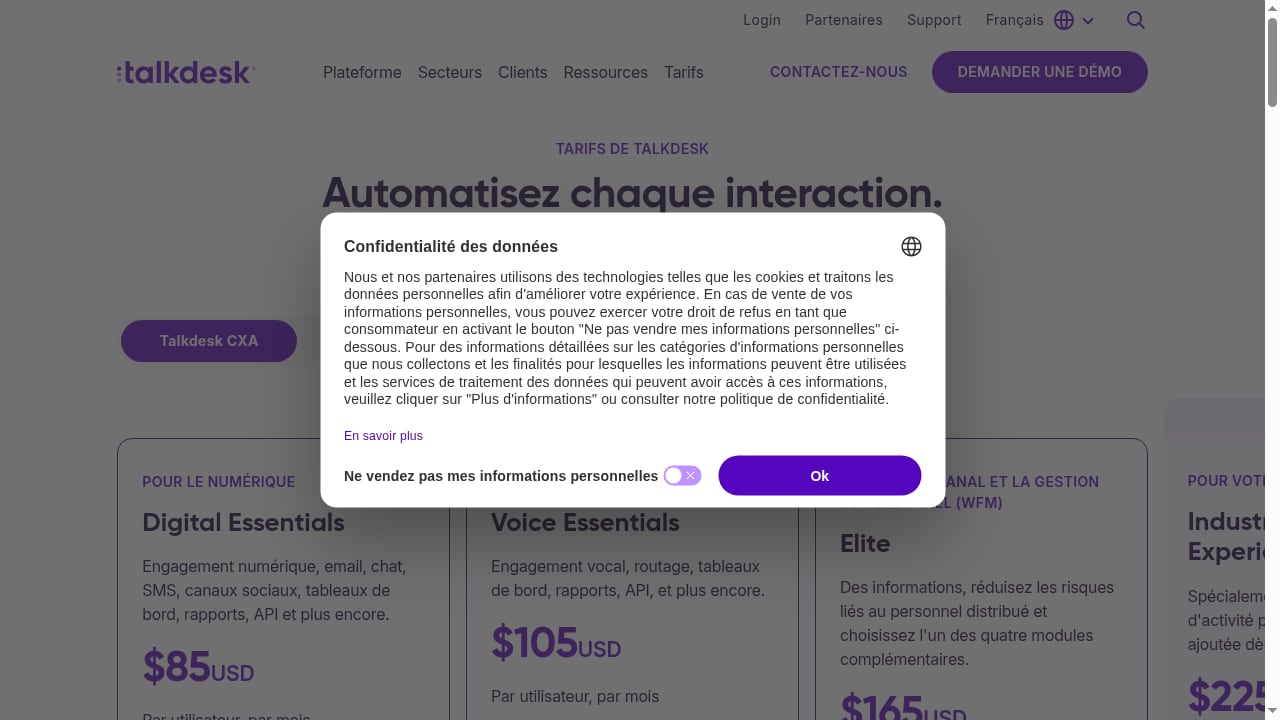
First viewport screenshot of Tarifs des solutions de centre de contact | Talkdesk.
Talkdesk remains a viable option for:
- Large enterprise contact centers with heavy voice volume and complex routing requirements.
- Organizations that need industry-specific compliance and have the budget for enterprise-tier pricing.
- Teams that prefer a hybrid human-AI model where AI assists agents rather than resolving conversations independently.
- Companies already invested in the Talkdesk ecosystem with dedicated technical account management.
However, even for these use cases, the pricing structure and reported integration issues warrant careful evaluation. Explore our complete Talkdesk features breakdown for a detailed look at what the platform offers and where it falls short.
Side-by-Side Comparison
| Feature | Intercom | Talkdesk |
|---|---|---|
| Core architecture | AI-first helpdesk | Voice-first CCaaS |
| Native AI Agent | Fin, fully integrated | Autopilot, layered on top |
| AI agent assistance | Copilot for agents | Talkdesk Copilot |
| Omnichannel support | Native shared inbox | Voice-first with digital add-ons |
| Starting price | Outcome-based tiers | $85/user/month (basic only) |
| True cost with AI | Transparent tiers | $145–$165+/user/month |
| Setup complexity | Low to moderate | Moderate to high |
| CRM integration reliability | Native helpdesk data | Reported sync issues |
| Best for | AI-driven support teams | Enterprise voice contact centers |
Related reading
- Forethought Setup: A Practical 2026 Implementation Guide - Learn how to set up Forethought AI step by step: platform selection, conversation design, integrations, training, deployment, and post-launch monitoring.
Sources and further reading
- 10 Best Talkdesk Alternatives in 2026: Tested & User Rated - Trapped by a $115 paywall and broken CRM syncs? Explore the 10 best Talkdesk alternatives and discover why scaling SMBs choose CloudTalk as their #1 upgrade.
- Top Intercom Omnichannel (Legacy) Alternatives & Competitors 2026 | Gartner Peer Insights - Learn more about the top Intercom Omnichannel (Legacy) alternatives. Easily compare competitors and read verified real user reviews on Gartner Peer Insights.
- 21 Best Talkdesk Alternatives for Smarter Call Centers - Explore 21 best Talkdesk Alternatives for smarter call centers. Compare features, pricing, and integrations to find the right fit.
Frequently Asked Questions
Is Intercom cheaper than Talkdesk?
Intercom's outcome-based pricing is generally more transparent than Talkdesk's tiered structure. Talkdesk's $85 entry price excludes call recording, API access, and CRM integrations, which require the $115 tier. AI features require the $145 to $165+ Elite tier. Intercom's plans include AI capabilities more consistently across tiers, making the total cost of ownership easier to predict.
Can Intercom replace a contact center like Talkdesk?
For teams whose support volume is primarily digital, Intercom can absolutely replace a traditional contact center. Its shared inbox, native AI Agent, and integrated Help Center cover the core functions most support teams need. However, organizations with heavy inbound phone volume and complex voice routing may still require a dedicated CCaaS platform.
Does Talkdesk have an AI agent like Intercom's Fin?
Talkdesk offers Autopilot, which provides agentic AI virtual assistants for voice and digital channels. However, Autopilot operates within Talkdesk's contact center framework and requires more configuration than Intercom's Fin, which is natively embedded in the helpdesk and can start resolving conversations with minimal setup.
Which platform is easier to set up?
Intercom is generally easier to set up, especially for teams without dedicated contact center IT resources. Talkdesk implementations tend to be more involved, with a steeper learning curve and reported technical issues during deployment.
Does Talkdesk integrate with Salesforce and HubSpot?
Yes, Talkdesk advertises Salesforce and HubSpot integrations, but verified users on G2 and Reddit have reported audio dropouts, blank agent screens, and failed case creation during live conversations. Intercom's native helpdesk architecture reduces the risk of CRM sync failures.
Conclusion
Intercom and Talkdesk represent two different philosophies of customer service. Talkdesk is a contact center platform that has added AI capabilities to a voice-first foundation. Intercom is an AI-first helpdesk where the AI Agent is the core of the product, not an add-on.
For most support teams in 2026, Intercom's native AI resolution, transparent pricing, and faster time to value make it the stronger choice. Talkdesk remains relevant for large enterprises with heavy voice volume and the budget to absorb its enterprise-tier pricing, but its reported integration issues and paywalled features are significant drawbacks.
If you are evaluating platforms for a support team that wants to automate routine inquiries and scale without enterprise complexity, Intercom is the platform to beat. For additional context on how Intercom stacks up against other tools, explore our Intercom vs Featurebase vs CXone comparison or read our Drift review to see how conversational sales platforms compare.