Intercom vs HelpCrunch vs Drift: 2026 Comparison
Intercom vs HelpCrunch vs Drift: Which Platform Fits Your Team in 2026?
Choosing between Intercom, HelpCrunch, and Drift is no longer a simple feature comparison. In March 2026, Clari and Salesloft announced that Drift is being phased out gradually, which changes the stakes for any team evaluating these tools. Intercom has pushed hard into AI-first customer service, while HelpCrunch has quietly built a cost-effective all-in-one alternative that covers support, marketing, and sales communication.
This guide compares the three platforms across AI capabilities, core features, pricing, support quality, and ideal use cases. You will learn where each tool genuinely excels, where it falls short, and which one makes sense for your team right now.
Quick Comparison Table
Intercom vs HelpCrunch vs Drift: 2026 Comparison - Intercom: The AI-First Customer Service Platform.
| Criteria | Intercom | HelpCrunch | Drift |
|---|---|---|---|
| Primary focus | AI-first customer service | All-in-one customer communication | Conversational marketing and sales |
| AI agent | Fin AI Agent resolves tickets autonomously | AI Agents answer from knowledge base and escalate when needed | Bionic Chatbots qualify leads and book meetings |
| Core channels | Live chat, email, in-app messaging, phone | Website chat, email, WhatsApp, Instagram, in-app messaging | Live chat, email, video messaging |
| Knowledge base | Included | Included with SEO optimization | Limited |
| Email marketing | Basic outbound messaging | Full email campaigns and automation | Drift Email for sales sequences |
| Starting price | $39 per seat/month | $15 per seat/month | ~$2,500/month (unconfirmed) |
| Free trial | 14 days, no credit card | 14 days, no credit card | Sales-led only |
| G2 rating | 4.5/5 | 4.7/5 | 4.4/5 |
| Capterra rating | 4.5/5 | 4.8/5 | 4.5/5 |
| Product status | Active, AI-first roadmap | Active, growing | Phased sunset announced March 2026 |
Intercom: The AI-First Customer Service Platform
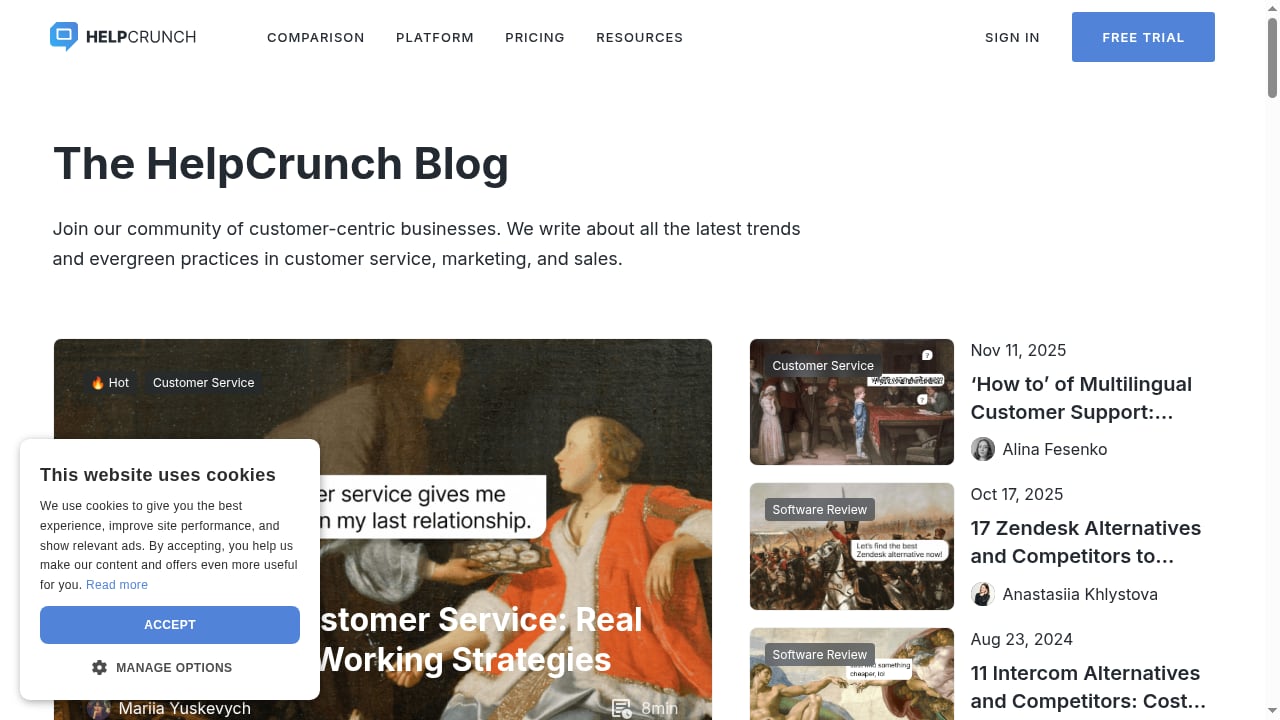
First viewport screenshot of The HelpCrunch blog.
Intercom has repositioned itself around one central promise: letting AI handle the repetitive work of customer support. The platform's flagship feature, Fin AI Agent, can resolve customer questions end-to-end without human involvement. Fin pulls answers from your help center and knowledge resources, closes tickets, and escalates only when genuinely necessary.
For human agents, Fin AI Copilot works inside the inbox. It suggests replies, summarizes long conversations, and helps agents respond faster. This combination of autonomous AI resolution and agent assistance is where Intercom currently holds a meaningful advantage over both HelpCrunch and Drift.
The platform also offers a shared inbox for multichannel support, outbound messaging across chat and email, product tours, and customizable bots for routing and automation. Intercom's help center supports self-service, and the platform serves over 30,000 brands, from small teams to enterprises.
Where Intercom Leads
- Autonomous AI resolution: Fin AI Agent is designed to resolve conversations without agent involvement, not just suggest articles.
- Enterprise scale: Intercom supports large teams with advanced workflows, product tours, and a broad integration ecosystem.
- Multi-channel depth: Live chat, email, in-app messaging, and phone support live in one workspace.
Where Intercom Struggles
Pricing remains the most common complaint. Intercom charges per seat and per active person, and the structure can become difficult to predict as contact volume grows. Some users also report that support response times can be slow, and the platform's marketing automation tools are less visual and flexible than dedicated email platforms.
If you are evaluating Intercom against alternatives, our Intercom vs Decagon comparison breaks down how the AI resolution and pricing stack up against another AI-native competitor.
HelpCrunch: The Cost-Effective All-in-One Alternative
Intercom vs HelpCrunch vs Drift: 2026 Comparison - HelpCrunch: The Cost-Effective All-in-One Alternative.
HelpCrunch takes a different approach. Instead of specializing in AI support or sales conversations, it combines live chat, AI agents, a knowledge base, email marketing, popups, and a shared inbox into one platform. The goal is to replace multiple tools with a single subscription that covers support, marketing, and sales communication.
HelpCrunch's AI Agents answer common customer questions based on your knowledge base and custom answers. When the AI cannot resolve a query, it escalates to a human agent. An AI Editor also helps agents rewrite and improve replies in real time.
The platform supports website chat, email, WhatsApp, Instagram, and in-app messaging from one dashboard. Its knowledge base editor includes SEO optimization, and its email marketing tools support automated campaigns and targeted popups for lead generation.
Where HelpCrunch Leads
- Pricing predictability: Starting at $15 per seat/month, with an all-in-one unlimited-seat plan around $620/month, HelpCrunch is significantly more affordable than Intercom or Drift.
- Marketing tooling: Email campaigns, popups, and SEO-friendly knowledge base tools go beyond what either competitor offers natively.
- Support quality: HelpCrunch consistently earns high ratings for responsive customer support, with a 4.7/5 on G2 and 4.8/5 on Capterra.
- Flexibility: No long-term contracts and free migration reduce switching risk.
Where HelpCrunch Falls Short
HelpCrunch does not match Intercom's depth of autonomous AI resolution or enterprise-grade workflow automation. Teams with complex, high-volume support operations may find its AI and automation capabilities lighter than Fin AI Agent. The platform is also less established than Intercom in large enterprise deployments.
For a broader look at AI ticketing and multichannel inbox capabilities, our HelpDesk review covers how modern helpdesk tools handle automation and setup in 2026.
Drift: The Conversational Sales Platform in Transition

Intercom vs HelpCrunch vs Drift: 2026 Comparison - Drift: The Conversational Sales Platform in Transition.
Drift built its reputation on one idea: replace lead forms with conversations. The platform connects website visitors with sales reps in real time, using Bionic Chatbots to qualify leads, detect buying intent, and book meetings automatically.
Drift's feature set centers on sales acceleration. Drift Video lets reps record and share demo clips in chat. Drift Email automates sales sequences. Meeting scheduling happens directly in the chat window. Account-based marketing tools help B2B teams target high-value accounts.
The Bionic Chatbots are Drift's most advanced AI feature. They train on your brand content, website, and past conversations, then hold free-form conversations with visitors, adopt your brand's tone, and route qualified leads to the right sales rep.
The Drift Sunset Problem
In March 2026, Clari and Salesloft announced that Drift is being phased out gradually. Existing customers are being migrated to other platforms. This makes Drift a risky choice for any new implementation, even though the product still has strengths in conversational sales.
If you are mid-contract with Drift or actively migrating, the practical question is which platform replaces its sales-focused chat capabilities. HelpCrunch covers live chat and lead generation at a lower cost. Intercom offers stronger AI support but is priced higher and focuses more on post-sale customer service than pre-sale revenue acceleration.
Feature-by-Feature Comparison
AI Capabilities
Intercom's Fin AI Agent is the most autonomous of the three. It resolves customer questions and closes tickets without agent involvement, and Fin AI Copilot assists agents with real-time suggestions.
HelpCrunch's AI Agents answer from your knowledge base and escalate when no answer is found. The AI Editor helps agents improve replies. It is practical and effective, but less autonomous than Fin.
Drift's Bionic Chatbots focus on lead qualification rather than support resolution. They are strong at detecting buying intent and routing visitors to sales reps, but they do not aim to resolve support tickets.
Live Chat and Messaging
All three platforms offer live chat. Intercom and HelpCrunch both support multi-channel messaging, including email and in-app messaging. HelpCrunch adds WhatsApp and Instagram support. Drift focuses on website chat with video messaging and meeting scheduling built in.
Knowledge Base and Self-Service
Intercom includes a help center for self-service. HelpCrunch offers a WYSIWYG knowledge base editor with SEO optimization, which is a practical advantage for teams that want their help content to rank in search. Drift's knowledge base capabilities are limited, reflecting its sales-first positioning.
Email Marketing and Automation
HelpCrunch is the strongest here, with automated email campaigns, targeted popups, and full marketing automation. Intercom offers outbound messaging but lacks a visual email sequence builder. Drift offers Drift Email for sales sequences, but it is not a general-purpose marketing tool.
Pricing and Value
| Platform | Starting Price | All-in-One Option | Free Trial |
|---|---|---|---|
| Intercom | $39/seat/month | Expert plan from ~$139/seat/month | 14 days, no credit card |
| HelpCrunch | $15/seat/month | $620/month unlimited seats | 14 days, no credit card |
| Drift | ~$2,500/month (unconfirmed) | Quotation-based | Sales-led only |
HelpCrunch is the clear value leader. Intercom's pricing scales with both seats and active contacts, which can become expensive as your audience grows. Drift's enterprise pricing puts it out of reach for most small and medium businesses.
Which Platform Should You Choose?
Choose Intercom if:
- You want the most autonomous AI agent for support resolution
- You serve a large customer base and need enterprise-grade workflows
- You are willing to invest in a premium platform with outcome-based pricing
- Your primary goal is post-sale customer retention and support efficiency
Choose HelpCrunch if:
- You need live chat, AI, knowledge base, and email marketing in one affordable platform
- You want predictable pricing without long-term contracts
- Your team handles support, marketing, and sales communication from one dashboard
- You are migrating from Drift and want a cost-effective replacement
Avoid Drift if:
- You are starting a new implementation in 2026 or later
- You need long-term platform stability
- You want support-focused features rather than sales acceleration
If you are already using Drift and planning a migration, start by mapping your must-have features: live chat, lead qualification, meeting booking, and AI assistance. Both Intercom and HelpCrunch cover the first three. HelpCrunch adds email marketing and knowledge base tools at a lower price, while Intercom adds deeper AI support resolution.
For teams weighing Intercom against other AI support platforms, our Intercom vs Featurebase vs CXone comparison explores how feedback tools and omnichannel support factor into the decision.
Related reading
- Talkdesk Features: A Complete 2026 Breakdown - Explore Talkdesk features in 2026: routing, AI tools, reporting, integrations, and pricing. See where it excels, where it falls short, and how it compares.
Sources and further reading
- Drift vs Intercom: An Honest Comparison for 2026 - If you’re comparing Drift vs Intercom, you’re probably a bit late on the Drift side. In March 2026, Clari + Salesloft announced Drift's gradual sunset. The…
- 9 Best Intercom Alternatives for Customer Messaging in 2019: Drift, Crisp... - We compared 9 Intercom Alternatives and 8 Help Desk Intercom Alternatives vs Crisp vs Drift vs GoSquared vs HelpCrunch vs Zendesk vs Kayako vs HelpScout ...
- Top 14 Fin (Intercom) alternatives and competitors for 2026 - Zendesk - Side-by-side Fin (Intercom) alternatives with pricing, key features, and selection criteria to improve response times, CSAT, and support consistency.
Frequently Asked Questions
Is Drift shutting down?
Yes. In March 2026, Clari and Salesloft announced that Drift is being phased out gradually. Existing customers are being migrated to other platforms. New teams should not start a Drift implementation.
Is HelpCrunch a good alternative to Intercom?
For small and medium businesses, yes. HelpCrunch offers live chat, AI agents, a knowledge base, email marketing, and popups at a fraction of Intercom's cost. It consistently earns higher ratings for customer support quality. However, Intercom's Fin AI Agent is more autonomous and better suited to high-volume enterprise support.
What is the main difference between Intercom and Drift?
Intercom focuses on post-sale customer service and retention, while Drift focuses on pre-sale lead generation and sales acceleration. Intercom's Fin AI Agent resolves support tickets; Drift's Bionic Chatbots qualify leads and book meetings.
Which platform has the best AI?
Intercom's Fin AI Agent is the most advanced for autonomous support resolution. Drift's Bionic Chatbots are strong for sales lead qualification. HelpCrunch's AI Agents are practical for answering common questions from a knowledge base, with escalation to human agents when needed.
How much does HelpCrunch cost compared to Intercom?
HelpCrunch starts at $15 per seat/month, while Intercom starts at $39 per seat/month. HelpCrunch also offers an unlimited-seat plan around $620/month. Intercom's Expert plan starts around $139 per seat/month.
Conclusion
The choice between Intercom, HelpCrunch, and Drift depends on where your team sits in the customer journey and what you can afford. Drift is no longer a viable long-term option due to its announced sunset. Intercom remains the strongest AI-first support platform, but its pricing and complexity can be barriers for smaller teams. HelpCrunch offers the most balanced combination of support, marketing, and sales communication at a predictable price.
If you are migrating from Drift, HelpCrunch is the most direct cost-effective replacement. If you need enterprise-grade AI support resolution, Intercom is the stronger choice. Either way, the 2026 landscape rewards teams that prioritize AI efficiency and pricing clarity over brand familiarity.