Intercom vs Zendesk vs Front: AI Customer Service Compared

Intercom vs Zendesk vs Front: AI Customer Service Compared
Choosing a customer service platform in 2026 means deciding how much of your support you want AI to handle, and how much you want humans to own. Intercom, Zendesk, and Front all answer that question differently. This comparison breaks down where each platform is genuinely strong, so you can match the tool to how your team actually works.
The three platforms at a glance
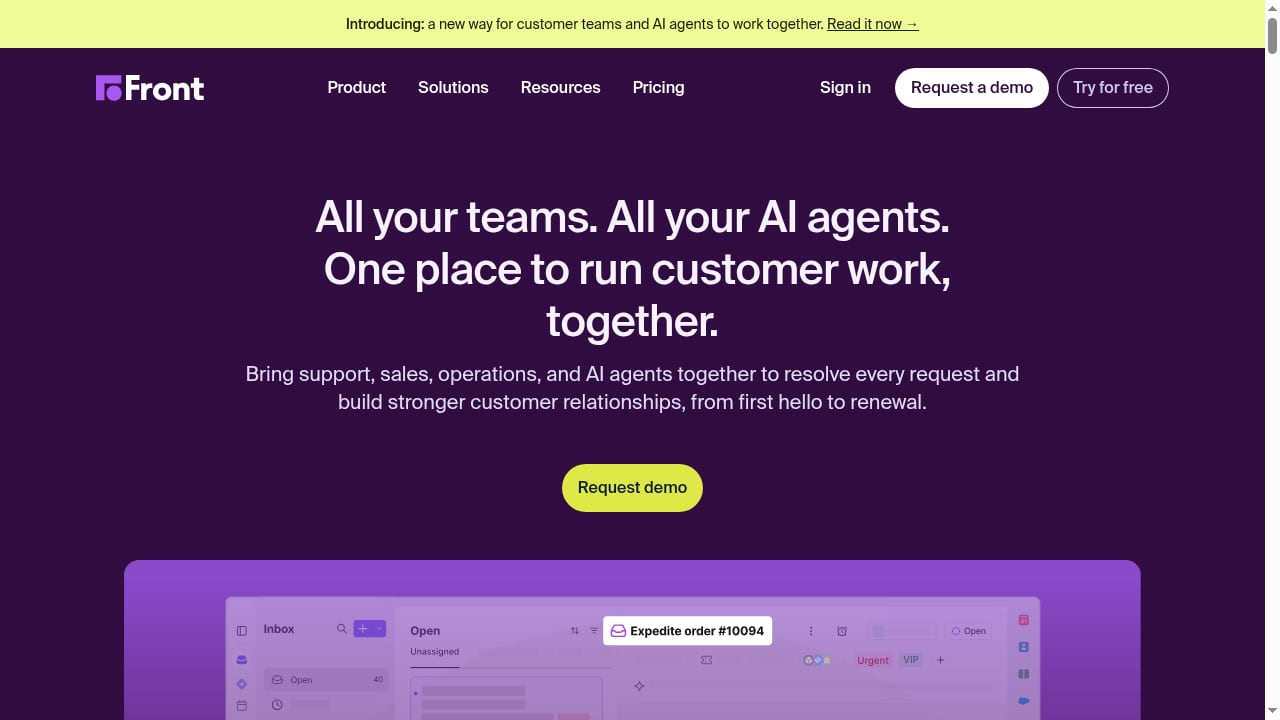
First viewport screenshot of Front | Customer service platform, powered by AI.
- Intercom is an AI-first customer service platform that pairs a helpdesk with a natively integrated AI Agent called Fin. Fin resolves an average of 76% of customer queries at $0.99 per outcome, and hands unresolved conversations to human agents in the same inbox with full context.
- Zendesk is an enterprise-grade service platform built around structured ticketing. Its AI agents resolve up to 80% of customer interactions, and the platform adds native quality assurance, workforce management, and deep reporting on top of a mature ticketing core.
- Front is a conversation-first customer service platform where support, sales, operations, and AI agents work together in shared inboxes. It is built for teams that coordinate heavily across departments to resolve complex customer work.
Each platform covers the same basic ground: email, chat, some form of AI, and some form of automation. The differences that matter show up in resolution depth, collaboration model, and pricing structure.
How each platform approaches AI resolution
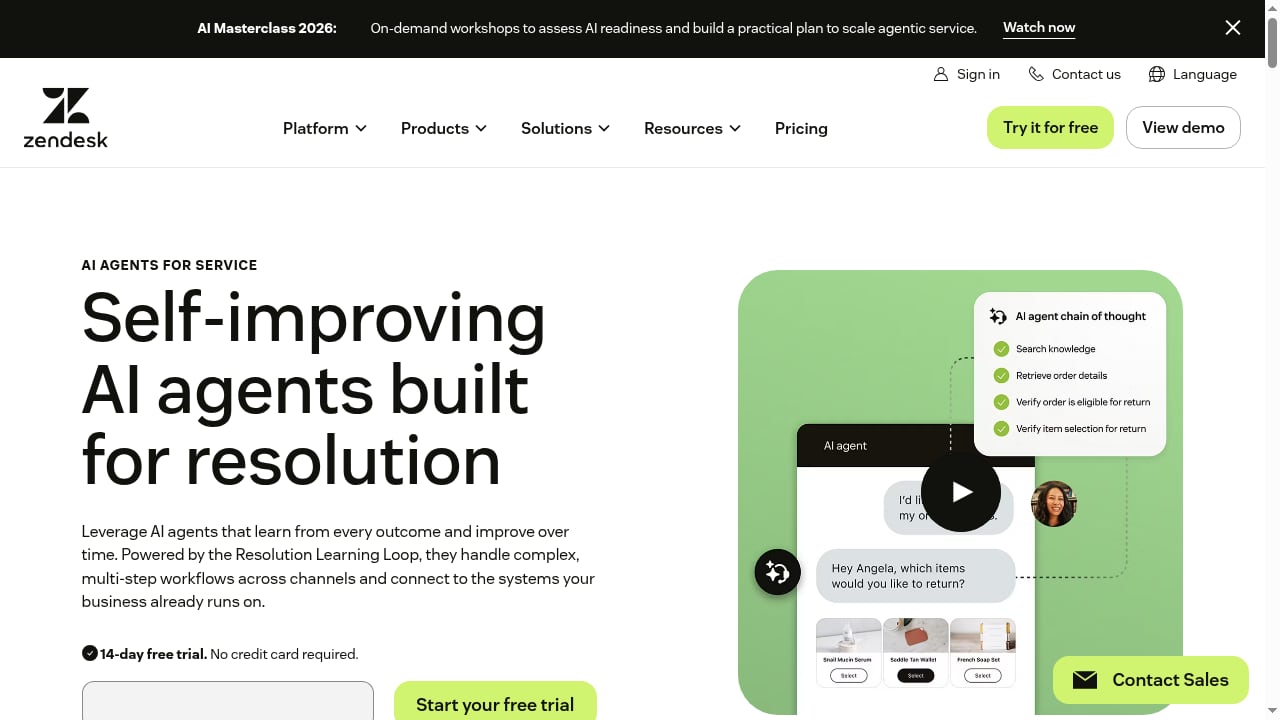
First viewport screenshot of AI Agents for Customer Service | Zendesk.
Intercom: Fin as a native AI Agent
Intercom's core claim is architectural: Fin and the helpdesk are built as one system rather than AI layered on top of a ticketing tool. Fin is designed to resolve multi-step queries, not just deflect them, by connecting to your systems and taking action on a customer's behalf. The Fin Flywheel gives teams a repeatable process for analyzing performance and refining how Fin resolves questions over time.
Intercom reports that Fin resolves an average of 76% of queries at $0.99 per outcome, and that AI is included on every plan rather than sold as a separate add-on. Customer examples include AgriWebb reducing support costs by 80% and AI21 Labs automating 82% of support. Intercom is trusted by more than 30,000 brands and offers a 14-day free trial with no credit card required.
Zendesk: AI agents inside a mature service operation
Zendesk positions its AI agents as capable of resolving up to 80% of customer interactions, and its Resolution Learning Loop improves automation by learning from every interaction. Where Zendesk stands apart is operational depth: native quality assurance reviews 100% of human and AI interactions, native workforce management handles staffing and forecasting, and reporting supports SLA and OLA management across channels.
Zendesk also emphasizes governance and control. Built-in security, QA, and visibility give leaders a clear view of how AI and human agents perform across the service journey. For organizations running high-volume, reporting-heavy support operations, that structure is a real advantage. Zendesk's integration ecosystem spans 1,800+ apps, and its AI is pre-trained on 18B+ service interactions.
Front: human-in-control AI with conversation-first collaboration
Front takes a deliberately different stance. Its "Automate, Analyze, Assist" framework keeps judgment with human reps: Autopilot handles high-volume FAQs, while Copilot helps agents draft accurate responses. Every decision is owned by a person.
Front's real strength is collaboration. Shared inboxes, assignments, internal comments, and workflow automation turn each conversation into a shared workspace where support, operations, finance, and other teams can coordinate without losing customer context. Front's analytics track workload distribution, collaboration patterns, recurring topics, Smart CSAT, and Smart QA in ways teams can act on quickly. For B2B teams juggling high-touch accounts across multiple departments, that conversation-first model often means faster decisions and fewer restarts.
Where Intercom has a supported advantage
First viewport screenshot of AI Agents for Customer Service | Zendesk.
Intercom's strongest differentiator is the native integration between its AI Agent and its helpdesk. Because Fin and the inbox are one system, customers are never bounced between tools, and teams get holistic insights across AI and human service. Fin also works with other helpdesks, including Zendesk, Salesforce, and Freshdesk, which makes it viable even if you are not ready to switch your entire stack.
On pricing transparency, Intercom's outcome-based model is straightforward: $0.99 per Fin outcome and $29 per month per human seat, with AI included on every plan rather than sold as an add-on. Teams that want to estimate costs before committing can use Intercom's pricing calculator to model spend based on team size and expected outcomes.
If your priority is fast, personalized AI resolution on digital channels with a single integrated system, Intercom is built for exactly that.
Where Zendesk and Front are stronger
Zendesk is the better fit when your operation depends on structured ticketing, SLA enforcement, native QA, and workforce management at scale. Its reporting depth and governance controls are designed for large service organizations that need to measure and standardize performance across teams and channels. Zendesk's 1,800+ app ecosystem also gives it broader integration coverage for complex enterprise environments.
Front is the better fit when customer work moves across departments and context is the bottleneck. Its shared inbox model, internal commenting, and workflow automation are built for teams where support and operations constantly overlap. Front's analytics focus on operational visibility, workload distribution, and collaboration patterns, which helps B2B teams managing high-touch accounts make faster decisions without digging through dashboards.
Decision guide: which platform fits your team
First viewport screenshot of What’s New | Front.
| If your priority is... | Consider |
|---|---|
| Native AI Agent plus helpdesk in one system, with outcome-based pricing | Intercom |
| Structured ticketing, native QA, WFM, and enterprise-scale reporting | Zendesk |
| Cross-department collaboration in shared inboxes with human-controlled AI | Front |
| Fast AI resolution on digital channels with transparent per-outcome costs | Intercom |
| High-volume support with SLA and OLA enforcement | Zendesk |
| B2B operations where support, sales, and finance coordinate on the same conversation | Front |
A practical way to decide: map where your support work actually gets stuck. If it stalls because AI cannot resolve complex queries end to end, Intercom's native Fin agent is designed for that gap. If it stalls because you cannot measure, staff, or govern service quality at scale, Zendesk's operational depth is the answer. If it stalls because context gets lost between teams, Front's conversation-first model addresses it directly.
For a deeper head-to-head on the AI agent question specifically, see our Intercom vs Zendesk AI agents comparison. If your team is exploring how AI agents fit into a broader CX strategy, our guide for customer experience professionals evaluating AI tools covers metrics and ROI.
Pricing models compared
- Intercom: $0.99 per Fin outcome plus $29 per seat per month for human agents, with AI included on every plan.
- Zendesk: Support Team at $19 per agent/month, Support Professional at $55, and Support Enterprise at $115, with resolution-based pricing for AI agents on top.
- Front: Pricing scales with seats and platform tier, with AI capabilities included in its service platform.
Pricing structures are not directly comparable because each platform charges for different units of value. Intercom charges per AI resolution outcome, Zendesk charges per agent seat with AI priced separately, and Front bundles AI into its collaboration platform. Model your expected monthly conversation volume against each structure before deciding.
Related reading
- The Next-Gen Helpdesk in Slack Powered by AI Agents Review - Evidence-based review of the next-gen AI helpdesk in Slack: ideal users, use cases, strengths, limits, pricing signals, setup, and buying criteria.
- Top 10 Conversational Marketing & Sales Platforms 2026 - Ranked 2026 review of the top 10 conversational marketing and sales platforms, scored on AI agents, channels, pricing, and fit for B2B and ecommerce teams.
Sources and further reading
- Intercom vs. Zendesk vs. Front: Which platform fits complex B2B workflows? - Compare Intercom vs. Zendesk vs. Front across AI, collaboration, reporting, and support models to choose the right fit for complex B2B workflows.
- Compare Intercom vs Zendesk | AI-First Customer Service - See how Intercom compares to Zendesk. The highest-performing AI Agent, a natively integrated helpdesk, and transparent outcome-based pricing, built for the AI era.
- Zendesk vs. Fin (formerly Intercom): A comparison guide for 2026 - Zendesk vs Fin (formerly Intercom) compared: AI resolution depth, omnichannel workflows, pricing predictability, and which approach improves CSAT and agent efficiency.
FAQ
Does Intercom's Fin AI Agent work with other helpdesks?
Yes. Fin works with any helpdesk, including Zendesk, Intercom, Salesforce, and Freshdesk. That means you can adopt Fin's AI resolution without replacing your existing ticketing system.
How do Zendesk AI agents and Intercom's Fin compare on resolution rates?
Zendesk states its AI agents resolve up to 80% of customer interactions, while Intercom reports Fin resolves an average of 76% of queries. Resolution rate depends heavily on your query mix, knowledge base quality, and how well your AI is configured, so treat both figures as directional rather than guaranteed.
Is Front a full AI customer service platform or mainly a shared inbox?
Front is a customer service platform powered by AI, built around shared inboxes and cross-team collaboration. Its AI framework keeps humans in control: Autopilot handles high-volume FAQs while Copilot assists reps with drafting and accuracy.
Which platform is best for a small support team?
Small teams that want AI resolution without a large operational overhead often favor Intercom's integrated AI Agent and outcome-based pricing. Teams that primarily need shared inbox coordination may find Front's conversation-first model simpler to adopt.
What should I test during a free trial?
Test your real query mix, not demo scenarios. Measure how many conversations your AI resolves without escalation, how often context survives handoffs to human agents, and what your projected monthly cost looks like at your actual volume.
Conclusion
Intercom, Zendesk, and Front are not variations of the same product. Intercom is an AI-first platform where Fin and the helpdesk operate as one system, with transparent per-outcome pricing and AI included on every plan. Zendesk is a mature service operation with native QA, workforce management, and enterprise reporting depth. Front is a collaboration-first platform where AI assists humans and context moves with the conversation across departments.
The right choice depends on where your support breaks down today. If you want AI to resolve complex queries end to end inside one integrated system, start with Intercom's 14-day free trial. If you need governance, QA, and reporting at enterprise scale, Zendesk is built for it. If your bottleneck is cross-team coordination, Front is designed around that problem.