Intercom vs Zendesk AI Agents for Customer Service
Intercom vs Zendesk AI Agents for Customer Service
Choosing an AI agent for customer service in 2026 means weighing two very different philosophies. Intercom offers an AI-first platform where the Fin AI Agent and the helpdesk are built as one system. Zendesk offers AI agents layered onto a mature ticketing suite. Both claim high automation rates. The real differences show up in pricing models, native capabilities, and how much work your team does to fill gaps.
This comparison uses vendor documentation and independent reporting to break down where each platform is strong, where it falls short, and which type of team each one suits.
What each platform actually is
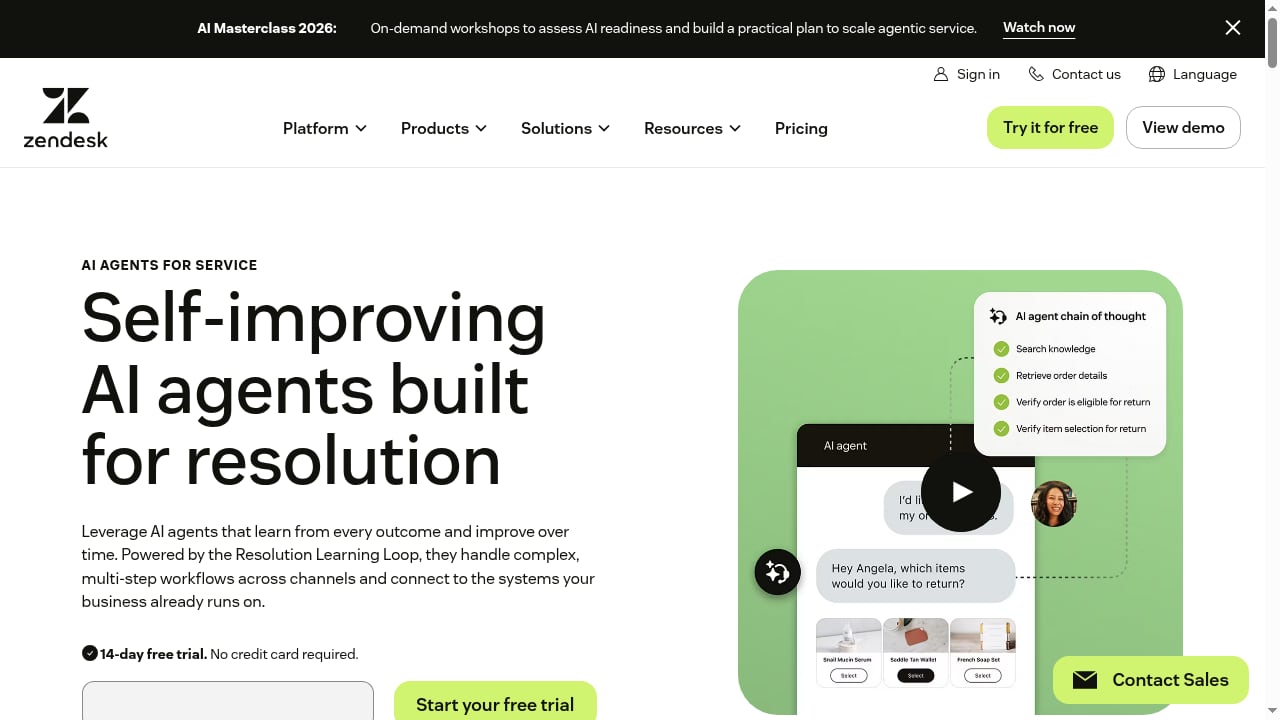
First viewport screenshot of AI Agents for Customer Service | Zendesk.
Intercom: AI-first with a natively integrated agent
Intercom positions itself as the only helpdesk with a natively integrated AI Agent. Fin handles complex, multi-step queries across channels, connects to your systems to take action for customers, and hands unresolved conversations to human agents in the same inbox with full context.
Key characteristics from Intercom's own comparison page:
- Fin resolves an average of 76% of customer queries at $0.99 per outcome.
- AI is included on every plan rather than sold as a separate add-on.
- Fin can also run on third-party helpdesks including Zendesk, Salesforce, and Freshdesk.
- The Fin Flywheel provides a repeatable process to analyze performance and refine resolution over time.
- Intercom reports 30,000+ companies using the platform.
Zendesk: AI agents on a mature service platform
Zendesk describes its AI as trained on billions of real interactions, resolving up to 80% of questions autonomously across 80+ languages. It positions itself as purpose-built for service, with 18 years of operational maturity and a large customer base.
Key characteristics from Zendesk's comparison page:
- Zendesk AI resolves up to 80% of questions autonomously.
- The platform includes native QA, workforce management, and advanced reporting.
- Zendesk cites a marketplace of 1,800+ integrations.
- Zendesk reports 99.9% uptime and compliance certifications including SOC 2 and ISO 27001.
- Zendesk claims companies switching from Intercom reduced response times by 61%, citing Nucleus Research.
Pricing models: outcome-based vs. add-on
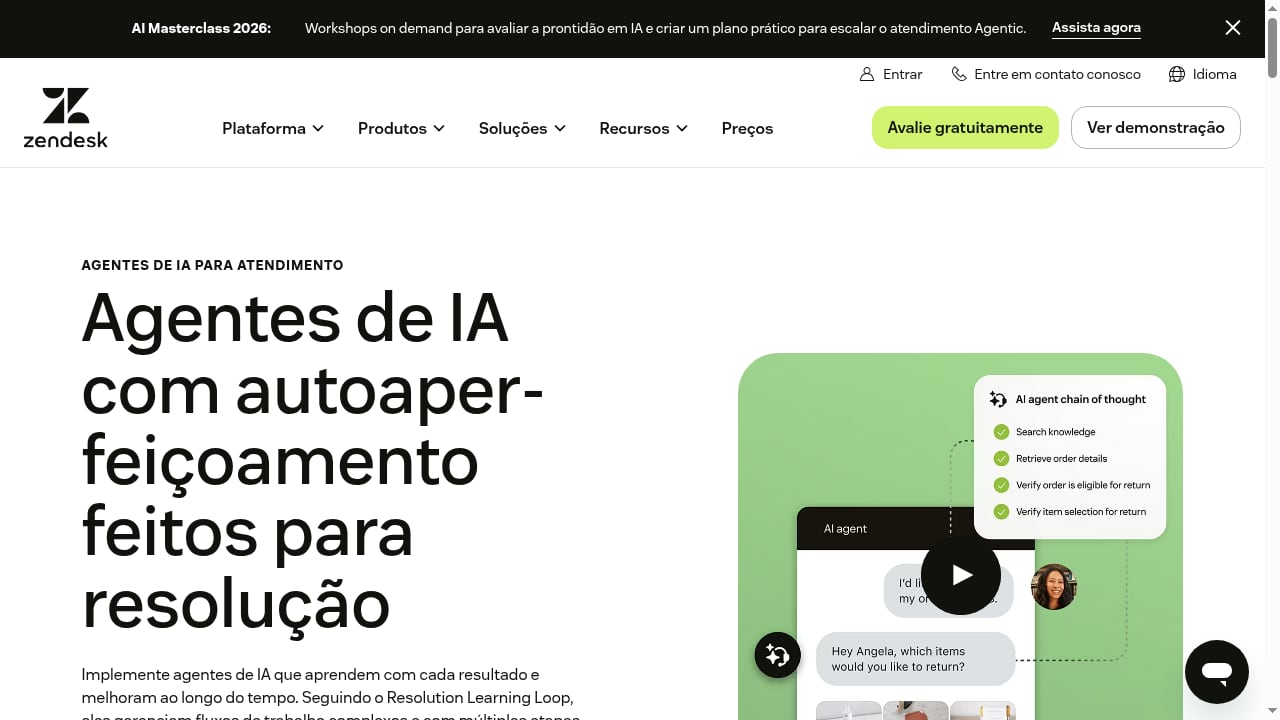
First viewport screenshot of AI Agents for Customer Service | Zendesk.
The pricing structures differ in ways that matter at scale.
| Dimension | Intercom | Zendesk |
|---|---|---|
| AI pricing model | $0.99 per outcome | $1.20–$2.00 per verified resolution (per independent reporting) |
| AI availability | Included on every plan | Add-on or bundled feature |
| Human agent seat pricing | $29/month (Essential tier) | $19–$115/month depending on tier |
| Resolution definition | Strict: no human handoff, no quick re-open | Varies by contract |
Independent reporting from Tech Insider notes that at 10,000 monthly conversations, the annual AI bill can swing by well over $100,000 depending on which billing model a team signs. That makes pricing model selection a budgeting decision, not just a product decision.
Intercom's $0.99 per outcome is the lowest per-unit price among the major platforms compared in that reporting. Zendesk's AI charges $1.20 to $2.00 per verified resolution depending on contract type. The gap compounds quickly at volume.
One caveat worth noting: Zendesk's page argues that Intercom's model charges for "resolved" interactions even when issues go unanswered, and cites reviewer reports of unpredictable costs. Intercom's page counters that its definition of a successful outcome requires the AI to resolve the issue without human intervention and without the customer re-opening the conversation.
Resolution capability and complexity handling
Both vendors claim strong automation rates, but they describe their agents differently.
Intercom says Fin resolves complex, multi-step queries that most AI agents leave for human teams. It emphasizes deep integration with channels, workflows, and third-party tools so the agent takes action rather than escalating hard questions.
Zendesk says its AI works independently, handles complex flows, and can be launched in minutes without technical expertise. Zendesk's page argues that Fin remains reactive and struggles with complexity.
Independent reporting adds nuance. Tech Insider notes that Fin's cross-platform design lets it run on top of Intercom's helpdesk or third-party platforms including Salesforce Service Cloud, Freshdesk, and HubSpot, without requiring Intercom seats. That flexibility is a genuine differentiator for teams that do not want to replace their existing ticketing system.
Native capabilities: where each platform stands
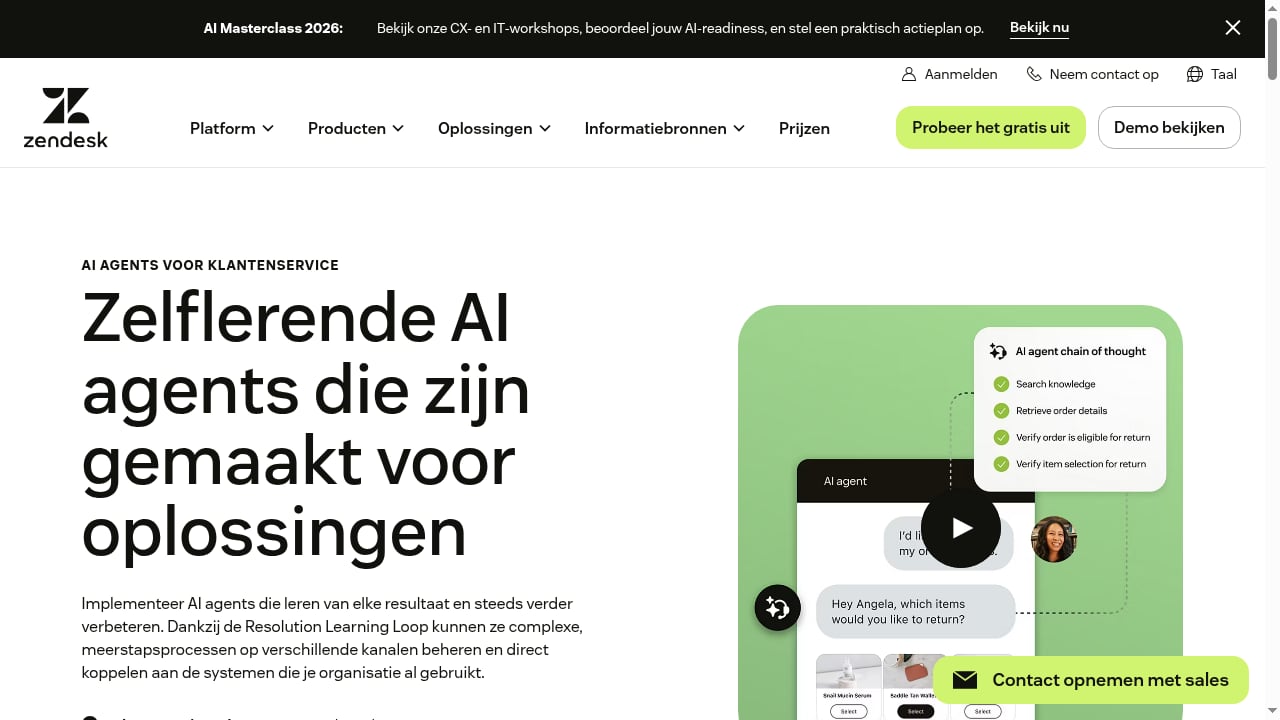
First viewport screenshot of AI Agents for Customer Service | Zendesk.
Zendesk's comparison page makes specific claims about gaps in Intercom's native feature set:
- No native quality assurance
- No native workforce management
- Lightweight reporting that may require third-party tools
- Restricted SLA options compared to Zendesk's granular SLA and OLA management
- A smaller integration library (~450 apps vs. Zendesk's 1,800+)
Intercom's comparison page counters with different strengths:
- A modern, intuitive interface that agents enjoy using
- A natively integrated AI agent and helpdesk in one platform
- Insights that provide complete visibility across the support operation
- Proprietary models trained on millions of real customer service interactions
- AI included on every plan rather than sold as an add-on
For teams that need deep QA, WFM, and granular SLA management out of the box, Zendesk's native capabilities are a real advantage. For teams that prioritize AI-first design, transparent outcome-based pricing, and a unified AI-plus-human workflow, Intercom's approach is more aligned.
Vendor stability and ownership considerations
One factor that changed the market in 2026: Salesforce closed its $3.6 billion acquisition of Fin, the company formerly known as Intercom, on September 10, 2026, according to Tech Insider. Fin's AI Agent now sits inside the same portfolio as Salesforce's own Agentforce.
What that means in practice:
- Fin remains separately sold, priced, and marketed as of October 2026.
- Salesforce has not announced plans to merge Fin into Agentforce or discontinue either product.
- Zendesk is now the only major AI customer service vendor in that comparison not absorbed by a larger CRM company.
- Contracts signed today could see pricing, support, or product direction shift as Salesforce integrates the acquisition.
For procurement teams doing multi-year comparisons, this is a material consideration. It does not mean Fin's product quality changes overnight, but it does add a layer of uncertainty that Zendesk's independent status does not carry.
Which platform fits which team
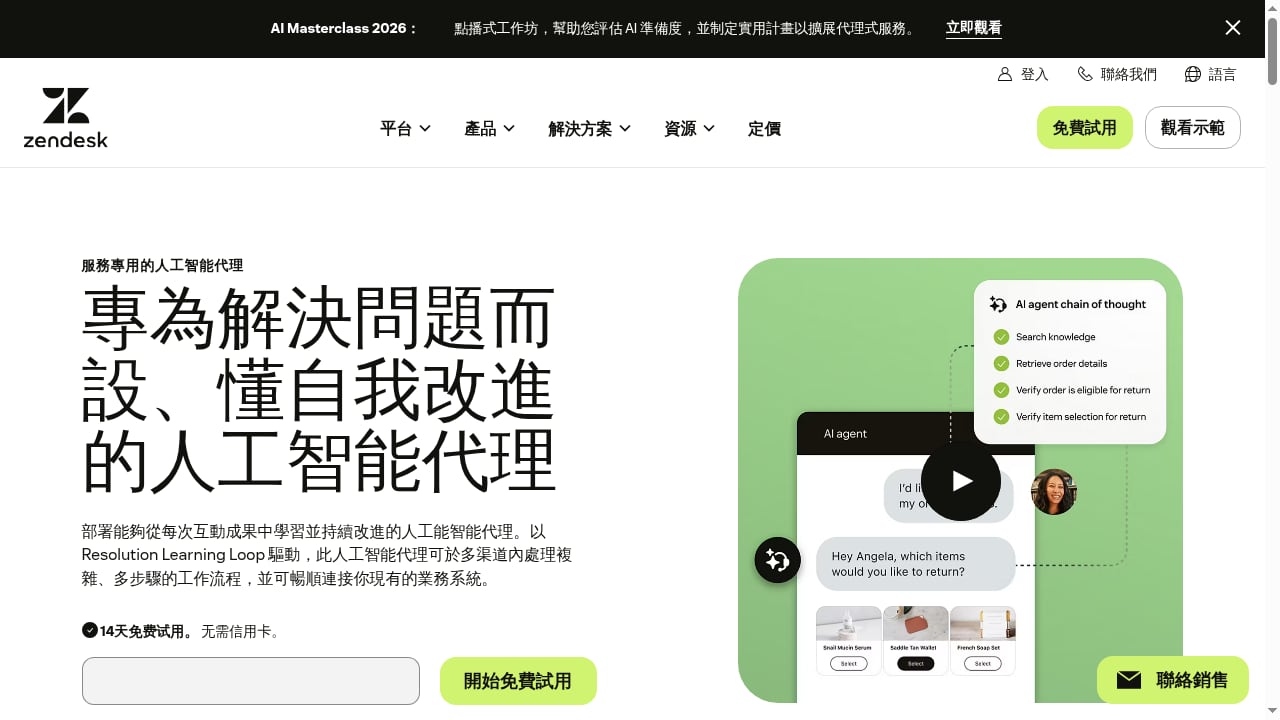
First viewport screenshot of AI Agents for Customer Service | Zendesk.
Choose Intercom if:
- You want an AI agent and helpdesk built as one system, not layered together.
- Outcome-based pricing at $0.99 per resolution fits your volume and budget model.
- You value AI included on every plan rather than sold as an add-on.
- You want the option to run Fin on a third-party helpdesk if you are not ready to migrate.
- You prioritize a modern agent interface and unified AI-plus-human workflows.
Choose Zendesk if:
- You need native QA, workforce management, and granular SLA management out of the box.
- A larger integration marketplace (1,800+ apps) matters for your stack.
- You prefer a platform with 18 years of operational maturity and a large enterprise customer base.
- You want to avoid vendor concentration under a single CRM parent company.
- Your team handles high-volume, multi-brand, or multi-tier support operations.
Consider a hybrid approach if:
Fin can run on top of Zendesk, Salesforce, Freshdesk, and HubSpot. If you already have a helpdesk you like but want a capable AI agent, running Fin on your existing platform is a legitimate option that does not require a full migration.
Practical example: what 10,000 monthly conversations cost
Using figures from independent reporting:
- Intercom Fin at $0.99 per outcome: $9,900/month if all conversations resolve.
- Zendesk AI at $1.20 per verified resolution: $12,000/month.
- Zendesk AI at $2.00 per verified resolution: $20,000/month.
The spread between the cheapest and most expensive per-unit price is roughly $1.01. At 10,000 conversations per month, that gap turns into tens of thousands of dollars per year. Before signing a contract, ask each vendor to define exactly what counts as a billable resolution and whether abandoned or re-opened conversations are included.
Related reading
- The Next-Gen Helpdesk in Slack Powered by AI Agents Review - Evidence-based review of the next-gen AI helpdesk in Slack: ideal users, use cases, strengths, limits, pricing signals, setup, and buying criteria.
- Customer Experience Professionals: AI Tools and CX Strategy - How customer experience professionals use AI agents, helpdesk data, and CX metrics to cut support costs and prove ROI. Includes Intercom examples and FAQs.
- Top 10 Conversational Marketing & Sales Platforms 2026 - Ranked 2026 review of the top 10 conversational marketing and sales platforms, scored on AI agents, channels, pricing, and fit for B2B and ecommerce teams.
Sources and further reading
- Compare Intercom vs Zendesk | AI-First Customer Service - See how Intercom compares to Zendesk. The highest-performing AI Agent, a natively integrated helpdesk, and transparent outcome-based pricing, built for the AI era.
- AI built for resolutions: Why Zendesk outperforms Intercom - Compare Zendesk vs. Intercom across CX, features, security, and integrations—and see why more teams are switching to Zendesk.
- Intercom Fin vs Zendesk AI vs Agentforce Pricing 2026 - Intercom Fin, Zendesk AI, and Salesforce Agentforce compared on AI customer service agent pricing, specs, and the Sept. 2026 Fin acquisition.
FAQ
Does Intercom's Fin AI Agent work with Zendesk?
Yes. According to Intercom's comparison page, Fin works with any helpdesk, including Zendesk, Salesforce, Freshdesk, and more. This means you can deploy Fin without migrating your existing ticketing system.
How much does Intercom's Fin AI Agent cost?
Intercom charges $0.99 per outcome, with AI included on every plan. Human agent seats start at $29 per month on the Essential tier, according to Zendesk's comparison page.
How much does Zendesk AI cost?
Zendesk AI pricing varies. Independent reporting cites $1.20 to $2.00 per verified resolution depending on contract type. Zendesk's own page lists Support Team at $19 per agent/month and Suite Professional at $115 per agent/month, with AI capabilities as add-ons.
What is the difference between an outcome and a resolution?
Intercom's "successful outcome" generally requires the AI to resolve the issue without a human stepping in and without the customer re-opening the same conversation shortly afterward. Zendesk's "verified resolution" definition varies by contract. The definitions matter because they determine what you actually pay for.
Does Zendesk have native quality assurance and workforce management?
Yes. Zendesk's comparison page states that Zendesk includes native QA and WFM, while Intercom does not offer native QA or WFM and requires third-party tools to fill those gaps.
Was Intercom acquired?
Salesforce closed its $3.6 billion acquisition of Fin, the company formerly known as Intercom, on September 10, 2026, according to Tech Insider. Fin's AI Agent now sits inside the same portfolio as Salesforce's Agentforce, though both remain separately sold and priced as of October 2026.
Which platform resolves more customer queries?
Intercom reports Fin resolves an average of 76% of customer queries. Zendesk reports its AI resolves up to 80% of questions autonomously. Both figures are vendor-reported and should be validated against your own use cases during a trial.
Conclusion
Intercom and Zendesk represent two different bets on the future of customer service AI. Intercom bets on a natively integrated AI agent and helpdesk with transparent outcome-based pricing at $0.99 per resolution. Zendesk bets on a mature service platform with native QA, WFM, and a larger integration ecosystem, with AI as an add-on.
The right choice depends on what your team values most. If you want AI-first design, unified AI-plus-human workflows, and predictable per-outcome pricing, Intercom is the stronger fit. If you need deep native service operations features and vendor independence from a larger CRM parent, Zendesk has the edge.
Either way, run a trial with your own conversation data. Vendor-reported resolution rates are a starting point, not a guarantee. The pricing model you sign matters as much as the AI that answers your customers.