Intercom vs Desk365 vs Kustomer: AI Helpdesk Comparison 2026
Intercom vs Desk365 vs Kustomer: Which AI Helpdesk Fits Your Team?
Choosing an AI-powered helpdesk in 2026 is less about feature checklists and more about architectural fit. Intercom, Desk365, and Kustomer all promise faster support and AI automation, but they start from different foundations: Intercom is built around conversations and a native AI agent, Desk365 targets affordable ticketing with Microsoft Teams integration, and Kustomer organizes everything around a customer timeline and CRM data model. This comparison breaks down where each platform genuinely excels so you can match the tool to your team's size, budget, and data needs.
How each platform is built
First viewport screenshot of www.desk365.io.
The underlying architecture shapes pricing, AI behavior, and deployment effort.
Intercom organizes work around conversations. Every interaction flows through a shared inbox, with Fin AI Agent handling frontline resolution and escalating to humans when needed. AI is native to the platform, not bolted on. The helpdesk, messenger, knowledge hub, workflows, and reporting live in one connected system. Intercom serves over 30,000 brands and offers a 14-day free trial.
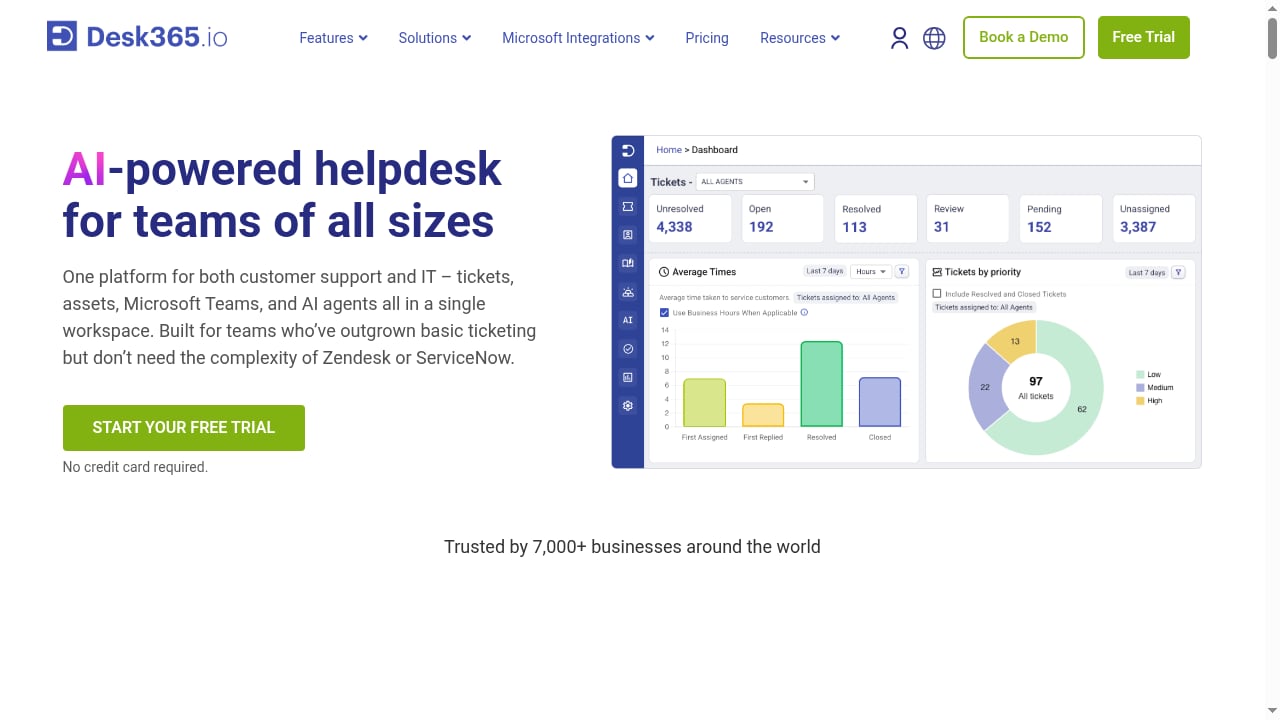
Desk365 is an AI-powered helpdesk built for businesses of all sizes. It simplifies customer support with integrated ticketing, automation, and a knowledge base. Its standout differentiator is deep Microsoft Teams integration, making it a natural fit for organizations already standardized on Microsoft 365. Pricing starts around $12 per agent per month, according to Desk365's published comparison.
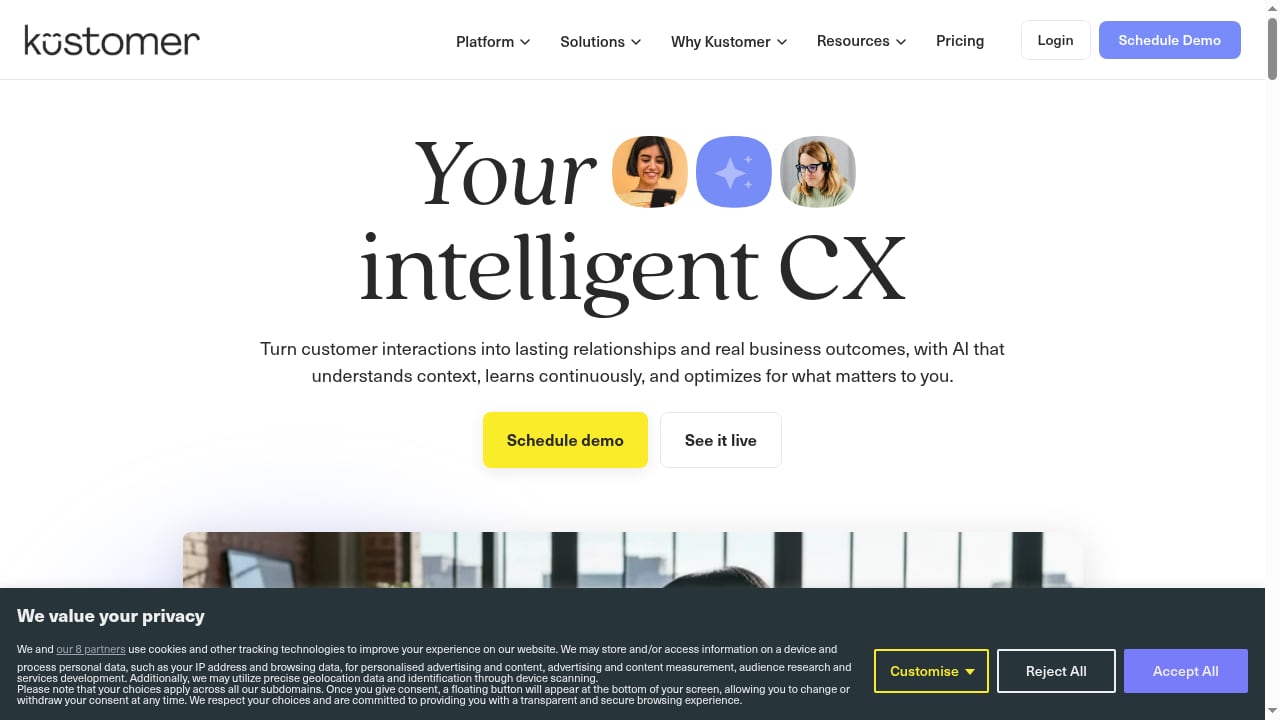
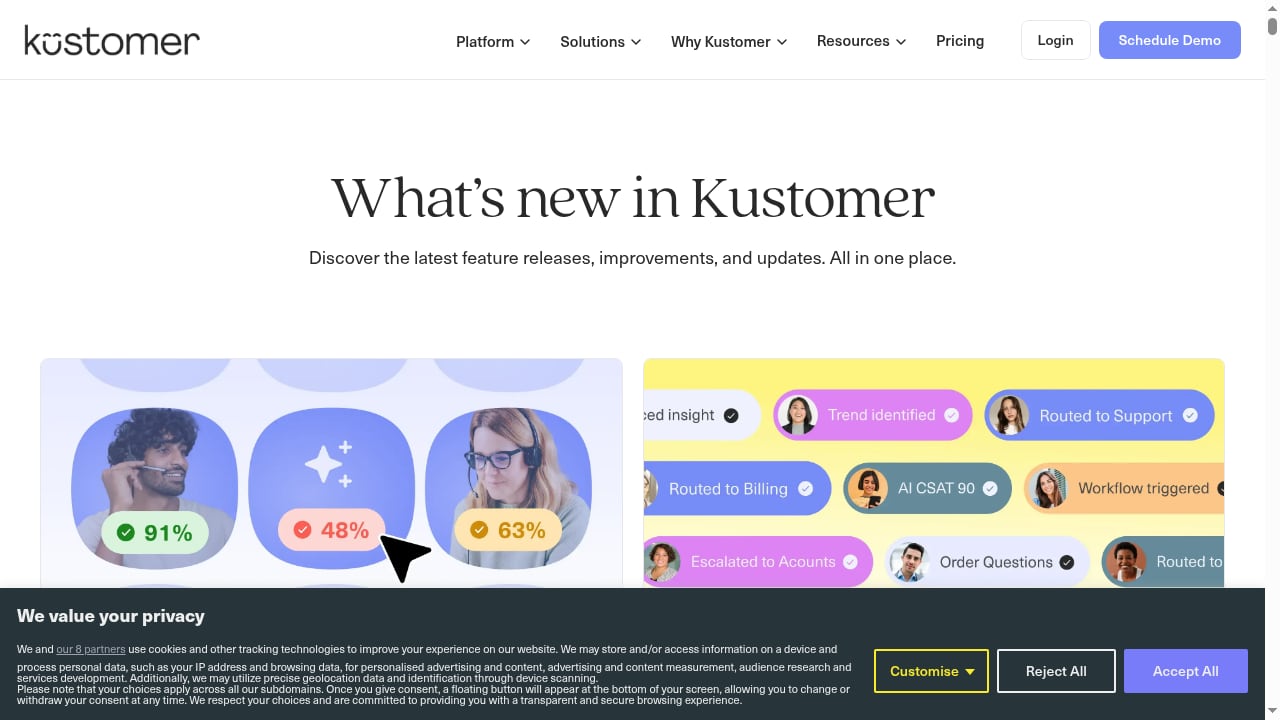
Kustomer organizes work around the customer. Instead of a ticket queue, it builds a chronological timeline for each customer that aggregates every interaction, order, and event across channels. The CRM data model underneath—built on custom objects called KObjects and Klasses—lets teams store and query complex relationship data. AI agents were added as a separate layer on top of this CRM foundation.
AI agent capabilities
This is where the platforms diverge most sharply.
Intercom's Fin AI Agent is powered by a purpose-built architecture with custom-trained retrieval and reranking models. It operates across a continuous improvement loop—Train, Test, Deploy, Analyze—and teams configure it using natural language Procedures for multi-step workflows. Simulations let you test before going live. Fin averages a 76% resolution rate across 12,000+ customers, improving at roughly 1% per month, and resolves over 2 million conversations per week.
Kustomer splits its AI into two separately priced products: AI Agents for Customers (customer-facing autonomous agent) and AI Agents for Reps (an agent copilot that drafts replies and summarizes conversations). Kustomer claims its AI agents resolve up to 70% of inquiries, and an AI Agent Studio provides a no-code builder. However, there is no comparable published testing framework like Intercom's Simulations.
Desk365 includes AI capabilities within its helpdesk—automation rules, ticket triage, and a knowledge base that supports self-service. Its AI is more assistive than fully autonomous, which suits teams that want automation without handing full resolution to an AI agent.
| Dimension | Intercom (Fin) | Desk365 | Kustomer AI |
|---|---|---|---|
| AI pricing model | $0.99 per resolution | Included in per-agent plan | $0.60 per engaged conversation (add-on) |
| Resolution claim | 76% average | Assistive automation | Up to 70% |
| Testing framework | Simulations, batch testing | Standard workflow testing | No published framework |
| Agent copilot | Copilot at $29/agent/month | Included | AI for Reps add-on (~$40/user/month) |
CRM and customer data depth
First viewport screenshot of www.kustomer.com.
Kustomer has a genuine architectural advantage here. Its unified customer timeline consolidates every interaction, order, and data point into a single chronological view per customer. Agents see the full relationship history without switching tabs. The flexible CRM data model lets teams create custom objects to track information unique to their business—consistently the most praised feature across G2 reviews.
Intercom stores customer data, conversation history, and behavioral events in a customer data platform. Data Connectors pull real-time information from external systems like Shopify, Stripe, and Salesforce during conversations. Fin uses this data to personalize responses, verify identity, and take actions. The difference is that Intercom's data model is designed to power conversations and AI resolution, while Kustomer's is designed to be a system of record for the full customer relationship.
Desk365 offers standard contact and ticket data with knowledge base integration. It is not a CRM replacement, but for teams that need straightforward ticketing without complex relationship modeling, it keeps setup simple.
Channels and omnichannel support
All three platforms support email, chat, and common messaging channels, but with different depth.
Intercom leads with in-app messaging through the Messenger and adds Fin Voice for AI-powered phone resolution. Fin operates across every channel from a single deployment configuration—the same AI agent, knowledge base, and Procedures work everywhere. Fin supports 45+ languages with automatic detection.
Kustomer treats all channels equally in its timeline architecture, which is a strength for teams fielding high volume across many contact points. Voice and SMS are available through telephony partners rather than natively, and run as pay-as-you-go channels on top of the base plan.
Desk365 supports email, chat, and web portals, with its strongest channel advantage being Microsoft Teams—support requests can be handled directly within Teams, which reduces context switching for internal teams and customers alike.
Pricing comparison
First viewport screenshot of www.desk365.io.
The pricing structures differ fundamentally, which matters at scale.
| Component | Intercom | Desk365 | Kustomer |
|---|---|---|---|
| Platform plans | Essential $29/seat/mo; Advanced $85/seat/mo; Expert $132/seat/mo | From ~$12/agent/mo | Enterprise ~$89/seat/mo (third-party reported) |
| Minimum commitment | No seat minimum | No seat minimum | 8-seat minimum |
| Billing | Monthly or annual | Monthly or annual | Annual only |
| AI agent | $0.99 per resolution (included with all plans) | Included in plan | $0.60 per engaged conversation (add-on) |
| Free trial | 14-day free trial | Available | No free trial |
A 15-agent team handling 5,000 AI conversations per month illustrates the difference. On Intercom Advanced, platform cost is 15 × $85 = $1,275/month. At a 76% resolution rate, Fin resolves ~3,800 conversations at $0.99 each = $3,762/month. Total: ~$5,037/month. On Kustomer Enterprise, platform cost is 15 × $89 = $1,335/month, AI cost is 5,000 × $0.60 = $3,000/month, and agent copilot is 15 × $40 = $600/month. Total: ~$4,935/month. The headline totals look similar, but Intercom's cost reflects 3,800 resolved conversations, while Kustomer's reflects 5,000 engaged conversations regardless of resolution outcome. Unresolved conversations still require human follow-up, adding labor cost not visible in the software bill.
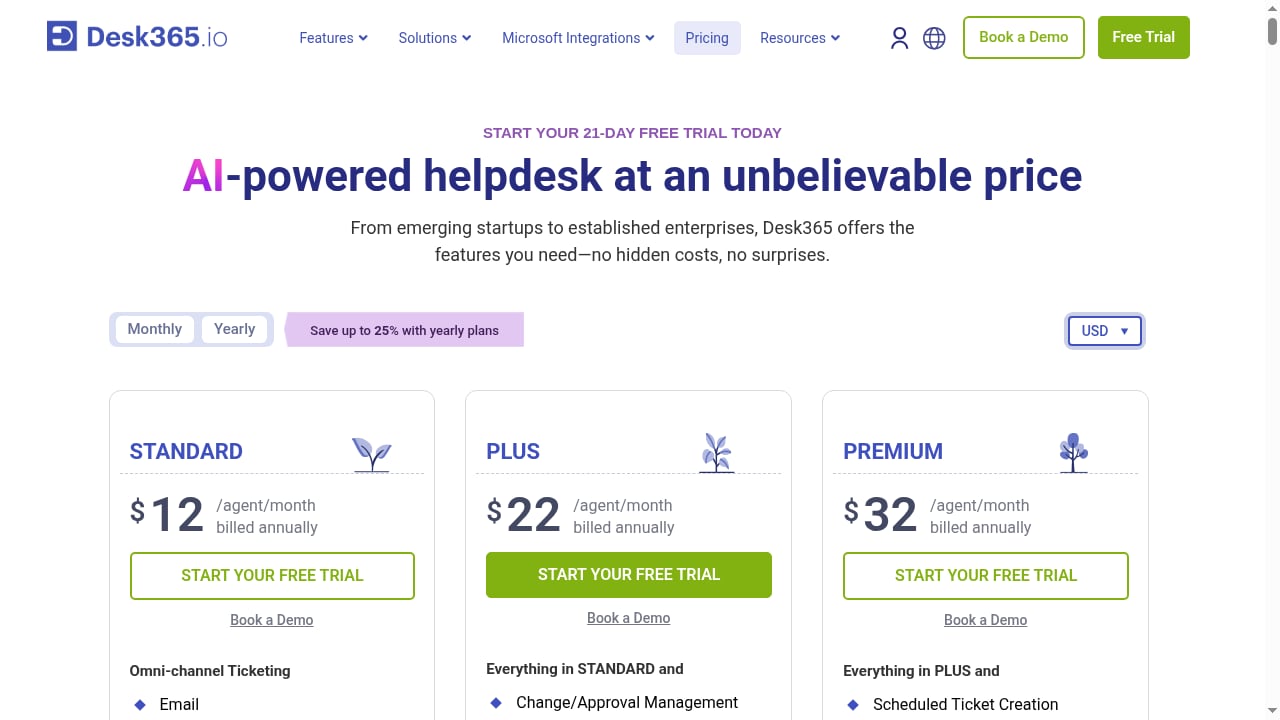
Desk365's per-agent pricing is the most predictable for budget-conscious teams. At roughly $12 per agent per month, a 15-agent team pays about $180/month for the platform—a fraction of the other two—though with less autonomous AI resolution.
Deployment and time to value
Intercom is designed for self-serve deployment. Teams can sign up, connect knowledge sources, configure Fin, and go live within days. No engineering resources are required, and a structured Blueprint framework guides deployment and scaling.
Kustomer's CRM data model is powerful but takes real setup work. Configuring custom objects, populating the customer timeline with data from external systems, and building workflows requires planning and, for complex implementations, technical resources. G2 reviewers consistently note a steeper learning curve. There is no self-serve signup path; every purchase begins with a sales conversation.
Desk365 is positioned as a seamless, quick-to-deploy helpdesk. Its simplicity is an advantage for small and mid-sized teams that want ticketing, automation, and a knowledge base without a lengthy implementation project.
Helpdesk capabilities
Intercom includes a full helpdesk with shared inbox, ticketing, SLA management, workflows, knowledge hub, and Copilot for human agents. Proactive messaging and product tours extend the platform beyond reactive support.
Desk365 covers the core helpdesk essentials: ticketing, automation rules, knowledge base, and reporting. It is less feature-dense than Intercom but covers the needs of teams that want a clean, affordable ticketing system.
Kustomer includes ticketing within its timeline model, along with workflow automation and reporting. Its strength is the unified customer view rather than helpdesk depth.
Which platform fits your team?
First viewport screenshot of www.kustomer.com.
Choose Intercom if you want the strongest autonomous AI resolution, fast self-serve deployment, and a platform that improves over time without heavy configuration. It suits teams from startups to large enterprises that prioritize AI performance and speed to value. For a deeper look at how Intercom's AI compares with other platforms, see our Intercom vs Replicant comparison and our IT service desk automation guide.
Choose Desk365 if you are standardized on Microsoft Teams, need affordable per-agent pricing, and want a straightforward helpdesk with automation and a knowledge base. It is a strong fit for small and mid-sized teams that do not need a fully autonomous AI agent.
Choose Kustomer if deep CRM data modeling and a unified customer timeline are your top priorities. It suits teams planning a larger CRM-plus-support consolidation project over several months, where the setup investment pays off in data richness.
Related reading
- Chatbase Review 2026: AI Agent Fit, Pricing & Limits - Evidence-based Chatbase review for 2026: ideal users, use cases, strengths, limitations, pricing signals, setup, and decision criteria for AI customer support.
Sources and further reading
- Intercom vs Kustomer 2026: AI, Pricing, Features - Intercom vs Kustomer compared on AI agents, pricing, CRM depth, channels, and deployment speed. Data-backed guide for CX leaders choosing in 2026.
- Best Intercom Alternatives for Customer Support Teams - Find the best Intercom alternatives for customer support teams. Compare features, pricing, pros, cons, and use cases to find the right fit.
- 15 Best Customer Service Ticketing Systems in 2026 - Explore the 15 best customer service ticketing systems for 2026, with real pricing & honest limitations. Here’s everything you need to make the right call.
FAQ
Is Intercom more expensive than Desk365?
Yes, on a per-seat basis. Intercom's Essential plan starts at $29 per seat per month, while Desk365 starts around $12 per agent per month. However, Intercom includes Fin AI Agent with all plans at $0.99 per resolution, which can reduce the number of human-handled tickets and change the total cost equation.
Does Kustomer have a free trial?
No. Kustomer requires a sales conversation and does not offer a self-serve free trial. Intercom offers a 14-day free trial with no credit card required.
Which platform has the best AI resolution rate?
Intercom's Fin AI Agent averages a 76% resolution rate across 12,000+ customers, according to Intercom's published data. Kustomer claims up to 70% for its AI agents. Desk365's AI is more assistive than fully autonomous, so direct resolution-rate comparison is less applicable.
Can Desk365 replace Intercom for small teams?
For small teams that need ticketing, automation, and a knowledge base at a low per-agent price, Desk365 can be a practical alternative—especially if you work in Microsoft Teams. If you need autonomous AI resolution across many channels, Intercom's Fin is more capable.
Which platform is best for CRM-heavy support?
Kustomer. Its customer timeline and custom object model (KObjects and Klasses) are designed for teams that need a system of record for the full customer relationship, not just conversations.
Conclusion
There is no universal winner among Intercom, Desk365, and Kustomer—only the best fit for your team's priorities. Intercom leads on AI resolution performance, deployment speed, and omnichannel consistency. Desk365 wins on affordability and Microsoft Teams integration. Kustomer excels at CRM depth and unified customer data. Match the platform to your biggest constraint: if AI resolution is the goal, Intercom is the strongest choice; if budget and simplicity matter most, Desk365 delivers; if customer data modeling is central, Kustomer is built for it. For a broader view of the market, explore our top live chat and chatbot software ranking.