Intercom vs Dialpad vs OTRS: Which Platform Fits Your Team?
Intercom vs Dialpad vs OTRS: Honest Comparison for Modern Support Teams
Choosing the right customer service platform isn't just about feature lists—it's about matching the tool to how your team actually works. Intercom, Dialpad, and OTRS each represent a distinct philosophy. One is an AI-first helpdesk built for the agentic era. Another is a voice-native contact center that's grown omnichannel. The third is a deeply customizable service management engine rooted in ITIL processes. This comparison strips away the marketing noise to help you decide which one deserves a seat at your table.
We'll examine where each platform excels, where they diverge, and which operational challenges they solve best. The goal isn't to crown a universal winner, but to give you a clear framework for your own evaluation.
Platform Overview: Three Different DNA
Dialpad product interface.
Before diving into features, it's worth understanding the core identity of each platform. This shapes everything from the user interface to the pricing model.
Intercom: AI-First Customer Service
Intercom is built for the AI Agent era. Its helpdesk comes with a natively integrated AI agent, Fin, that resolves customer questions instantly using your existing support content. The platform unifies a shared inbox with AI-powered automation, a help center, and outbound messaging tools. Over 30,000 brands use it to deliver what Intercom calls "perfect customer experiences." The philosophy is proactive, conversational, and increasingly autonomous.
Dialpad: AI-Native Contact Center and Communications
Dialpad began as a cloud voice platform and evolved into an AI-powered omnichannel contact center. Its standout capability is always-on AI Agents that autonomously execute complex workflows—think processing refunds or rebooking appointments—across voice and digital channels. Real-time coaching, sentiment analysis, and deep CRM integrations make it a strong fit for sales and support teams that live on the phone. Dialpad positions itself as the next-generation alternative to legacy contact centers.
OTRS: Flexible Service Management
OTRS is a service management platform that provides ready-to-use solutions for IT service management (ITSM), customer service, and even cyber defense. It's designed for organizations that need to manage inquiries, incidents, requests, and assets from a single system. With AI-assisted ticket classification and summaries, plus integrations with tools like SAP and Salesforce, OTRS appeals to teams that value process control, compliance, and deep customization over out-of-the-box simplicity.
AI Agents and Automation: Autonomous vs. Assistive

Dialpad product interface.
AI is no longer a nice-to-have. The question is whether the AI acts as a full-resolution agent or an assistive copilot.
Intercom's Fin AI Agent
Fin is a fully integrated AI agent that resolves customer questions without human intervention. It pulls answers from your help center, knowledge base, and even external content sources. When Fin can't resolve an issue, it hands off seamlessly to a human agent with full context. The Copilot AI assistant also supports agents during conversations by suggesting responses and summarizing threads. This combination of autonomous resolution and agent augmentation is central to Intercom's value proposition. For a deeper look at how Intercom's AI compares to other agentic platforms, see our Intercom vs Botpress comparison.
Dialpad's Always-On AI Agents
Dialpad's AI Agents are designed to autonomously execute complex, multi-step workflows. They can handle tasks like processing refunds, rebooking appointments, or qualifying leads across voice and digital channels. This goes beyond answering FAQs—it's about completing transactions. Real-time coaching cards and sentiment analysis also support live agents during calls, making Dialpad a powerful tool for high-volume contact centers that need to slash resolution times.
OTRS AI-Assisted Operations
OTRS incorporates AI for ticket classification, AI-assisted summaries, and workflow automation. It's less about a standalone conversational agent and more about making back-office processes smarter. For IT teams managing incidents and service requests, this AI layer reduces manual triage and speeds up resolution. However, it doesn't offer the same type of customer-facing autonomous agent that Intercom and Dialpad provide.
Communication Channels: Where Conversations Happen
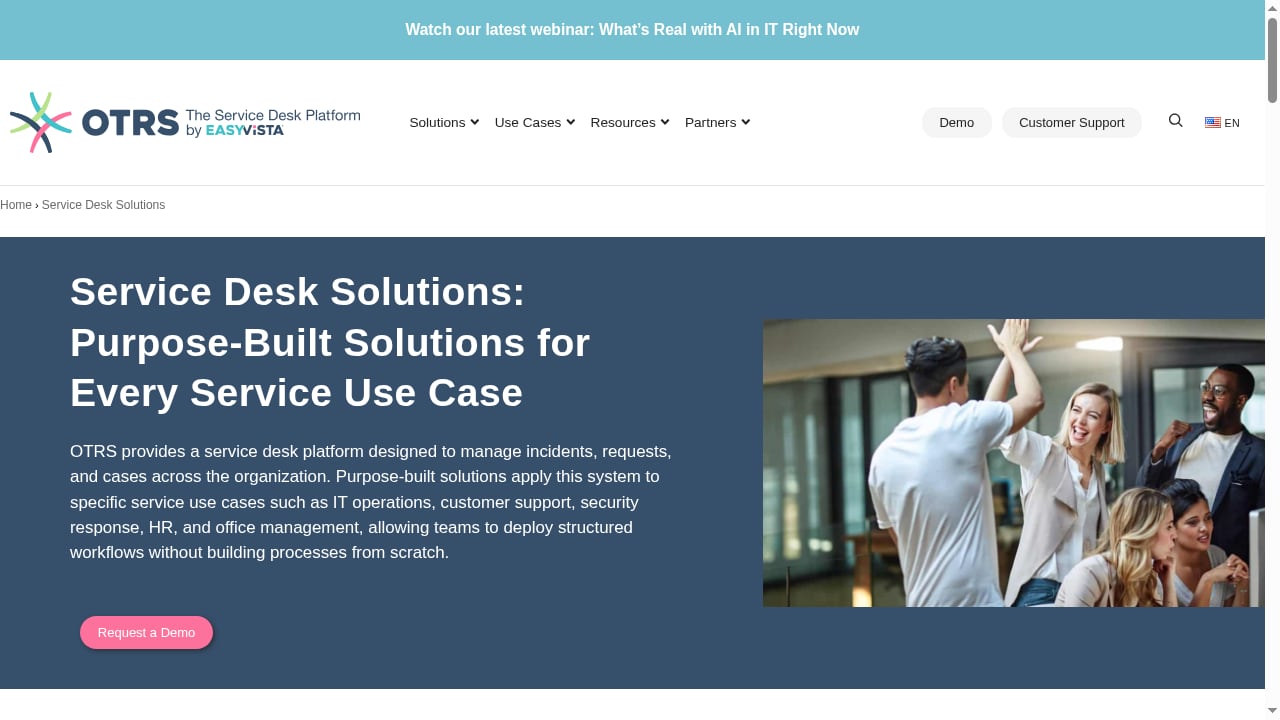
First viewport screenshot of Service Desk Solutions.
Your channel mix should dictate your platform choice. A team that handles 80% phone support will have very different needs from one that's chat-first.
Intercom's Multi-Channel Inbox
Intercom centralizes live chat, email, in-app messaging, and phone into a single shared inbox. The platform's strength is in digital-first, asynchronous conversations. In-app messaging and outbound capabilities are particularly strong, making it ideal for SaaS and ecommerce businesses that want to engage users where they are. The unified business case for one platform and one inbox explains why consolidating these channels matters for customer experience.
Dialpad's Voice-First Omnichannel
Dialpad's roots are in voice, and it shows. The platform offers a seamless calling experience with live transcription, real-time coaching, and AI-generated call summaries. It also supports digital channels like chat, SMS, and social messaging, but voice remains the centerpiece. The Dialpad-Intercom integration even allows agents to initiate calls directly from an Intercom chat window, bridging the gap between digital and voice support.
OTRS's Ticket-Centric Approach
OTRS consolidates inquiries from email, phone, web forms, and chat into a unified ticketing system. It's less about real-time conversational engagement and more about structured request management. For IT and HR teams following ITIL best practices, this ticket-centric model provides the control and audit trails they need.
ITSM and Internal Service Management
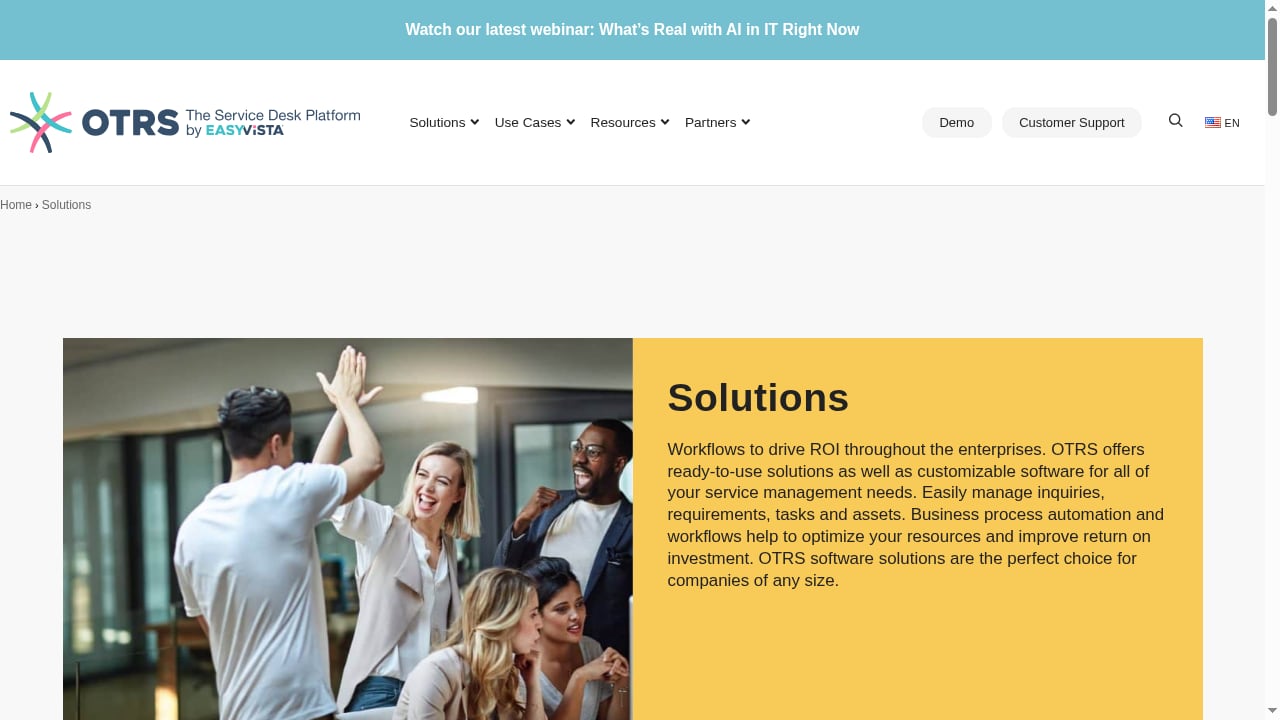
First viewport screenshot of Solutions.
If your primary need is IT service management, the comparison shifts dramatically.
OTRS: Purpose-Built for ITSM
OTRS is a leading solution for ITSM, with ready-to-use modules for incident management, change management, and asset management. It supports multiple service domains—IT, HR, facilities—from a single platform. Compliance with international standards and integrations with security tools like VirusTotal and VMRay make it a trusted choice for over 12,000 companies. For organizations that need to deploy ITSM in days, OTRS offers rapid time-to-value.
Intercom and Dialpad: External-Facing Focus
Neither Intercom nor Dialpad is designed for internal IT service management. They focus on external customer support and sales engagement. While you could theoretically use their ticketing or messaging features for internal requests, they lack the ITIL-aligned processes, asset management, and change control that OTRS provides natively.
Pricing and Scalability
Cost structures vary significantly and can influence long-term platform decisions.
Intercom uses outcome-based pricing with Essential, Advanced, and Expert plans. You pay based on the value you receive—resolutions, seats, and engagement—rather than just user count. A free trial is available to test the AI features. This model scales with your support volume and can be cost-effective for growing teams that want to automate more over time.
Dialpad offers plans for Support, Sell, and unified Communications. Pricing is typically per-user per-month, with AI features available on higher tiers. The platform is built for enterprise scale, with official partnerships that demonstrate its ability to handle massive fan experience workloads.
OTRS emphasizes a low barrier to entry with a free community edition and upgrade paths to advanced solutions. Its pricing is transparent and designed for organizations that need to manage costs while gaining enterprise-grade service management. The rapid deployment promise—ITSM in days—also reduces implementation costs.
Which Platform Should You Choose?
Your decision hinges on three questions:
What's your primary channel? If voice is your main support channel and you need AI to autonomously handle transactions, Dialpad is a strong contender. If digital-first, in-app engagement is your focus, Intercom's AI agent and multi-channel inbox will feel more natural.
Do you need ITSM? If you're managing internal IT services, incidents, and assets, OTRS is the clear choice. Neither Intercom nor Dialpad competes in this category.
How autonomous do you want your AI? Intercom's Fin is designed for full-resolution autonomy on customer questions. Dialpad's AI Agents handle complex transactional workflows. OTRS uses AI to assist human agents with classification and summaries. Match the AI capability to your automation ambition.
For teams evaluating the broader landscape, our top 10 customer engagement platforms for 2026 provides additional context on where these tools fit.
Related reading
- Tidio Review 2025: AI Chat, Lyro Agent & Real-World Results - In-depth Tidio review: We test Lyro AI, live chat, and help desk tools. See real pricing, strengths, limitations, and who should use Tidio in 2025.
Sources and further reading
- Dialpad vs Intercom - 2026 Comparison - Dialpad vs Intercom - See how these products stack up against each other with real user reviews, product feature comparisons and screenshots. Find out which one is best for your organization.
- Intercom vs Dialpad: Communication Comparison - Compare Intercom vs Dialpad 2026. Intercom has 163913 and Dialpad has 1119 customers in Communication industry. Know more.
- Dialpad + Intercom Integration - Sep 17, 2025 — The Dialpad-Intercom integration allows you to call a customer right from the chat box, increasing productivity and customer satisfaction.
Frequently Asked Questions
Can I use Dialpad and Intercom together?
Yes. The official Dialpad-Intercom integration allows agents to initiate voice calls directly from an Intercom chat conversation. Call details, recordings, and AI summaries are logged back into Intercom, creating a unified experience.
Is OTRS only for IT teams?
No. While OTRS is a leader in ITSM, the platform also provides solutions for customer service, HR management, and cyber defense. Its flexibility makes it suitable for any department that needs structured request management.
Does Intercom replace a contact center like Dialpad?
Intercom offers phone support as part of its multi-channel platform, but it is not a full-scale contact center. If your team handles high volumes of voice calls and needs advanced call routing, workforce management, or real-time voice coaching, Dialpad is purpose-built for that use case.
How do AI Agents in Dialpad differ from Intercom's Fin?
Dialpad's AI Agents focus on autonomously executing transactional workflows (refunds, rebookings) across channels. Intercom's Fin focuses on resolving customer questions by pulling from your knowledge base. Both can operate autonomously, but they solve different types of problems.
What kind of support does OTRS offer for compliance?
OTRS emphasizes compliance with international standards and provides features like audit trails, role-based access control, and integrations with security tools. This makes it suitable for regulated industries and organizations with strict data governance requirements.
The Bottom Line
Intercom, Dialpad, and OTRS are all powerful platforms, but they serve different masters. Intercom is the choice for digital-first teams that want AI to handle a growing share of customer conversations. Dialpad excels when voice is the backbone of your support or sales operation and you need AI to execute complex tasks. OTRS is the go-to when structured service management, ITIL compliance, and internal process control are non-negotiable.
Your best next step is to map your team's actual workflows against these strengths. Start a free trial, request a demo, and let your agents test the tools in real scenarios. The right platform is the one that makes your team faster, not the one with the longest feature list.