Intercom vs Dixa: AI-First Helpdesk or Ecommerce Substitute?
Intercom vs Dixa: AI-First Helpdesk or Ecommerce Substitute?
Intercom and Dixa both sell AI-powered customer service, but they were built for different buyers. Intercom is a broad AI-first helpdesk with a natively integrated AI Agent, Fin, serving more than 30,000 brands from small teams to large enterprises. Dixa is an agentic customer service platform purpose-built for mid-market ecommerce and consumer brands, with its own AI agent, Mim, and native voice in every plan.
The choice rarely comes down to a feature checklist. It comes down to who your customers are, which channels they use, and how you want to pay for AI. This comparison walks through the real differences, including the pricing models, the channel coverage, and the ecommerce-specific capabilities that separate the two platforms.
Quick verdict: which platform fits which team
First viewport screenshot of Dixa Roadmap Update - Q1 2026.
- Choose Intercom if your customers are software users inside your product, you need in-app messaging, product tours, outbound messaging, and a helpdesk with a natively integrated AI Agent that works across live chat, email, in-app messaging, and phone.
- Choose Dixa if you run a mid-market ecommerce or consumer brand, your support volume is dominated by post-purchase questions about orders, deliveries, and returns, and you want native phone plus AI priced per conversation rather than per resolution.
Neither answer is universal. Dixa's own comparison pages acknowledge that Intercom is the stronger fit for product-led software companies, while Dixa is built for teams whose support runs primarily through order-related conversations.
How Intercom approaches AI-first customer service
The Agentic CS Platform Behind Exceptional Ecommerce Brands.
Intercom positions itself as an AI-first customer service platform designed for the AI Agent era. The helpdesk and the AI Agent are not separate products bolted together; Fin is natively integrated into the platform.
Fin AI Agent
Fin resolves customer questions instantly across channels, drawing on your Help Center and connected knowledge sources. It is the centerpiece of Intercom's outcome-based pricing, and it is also sold as a standalone AI agent that can run on other helpdesks. If you want a deeper look at how Fin performs in practice, including resolution rates and setup effort, see this hands-on Fin review.
Copilot and AI Insights
Copilot is an AI assistant for human agents, surfacing suggested replies and relevant context inside the inbox. AI Insights turns conversation data into analytics that managers can act on. Together they support the hybrid model most teams actually run: AI resolves the repeatable questions, humans handle the nuanced ones.
Channel coverage and use cases
Intercom supports live chat, email, in-app messaging, and phone, plus a Help Center for self-service. Its strongest fit is businesses that treat customer communication as part of the product experience, including SaaS companies that rely on in-app messaging and targeted outbound messages.
How Dixa approaches agentic customer service
First viewport screenshot of The Agentic CS Platform Behind Exceptional Ecommerce Brands.
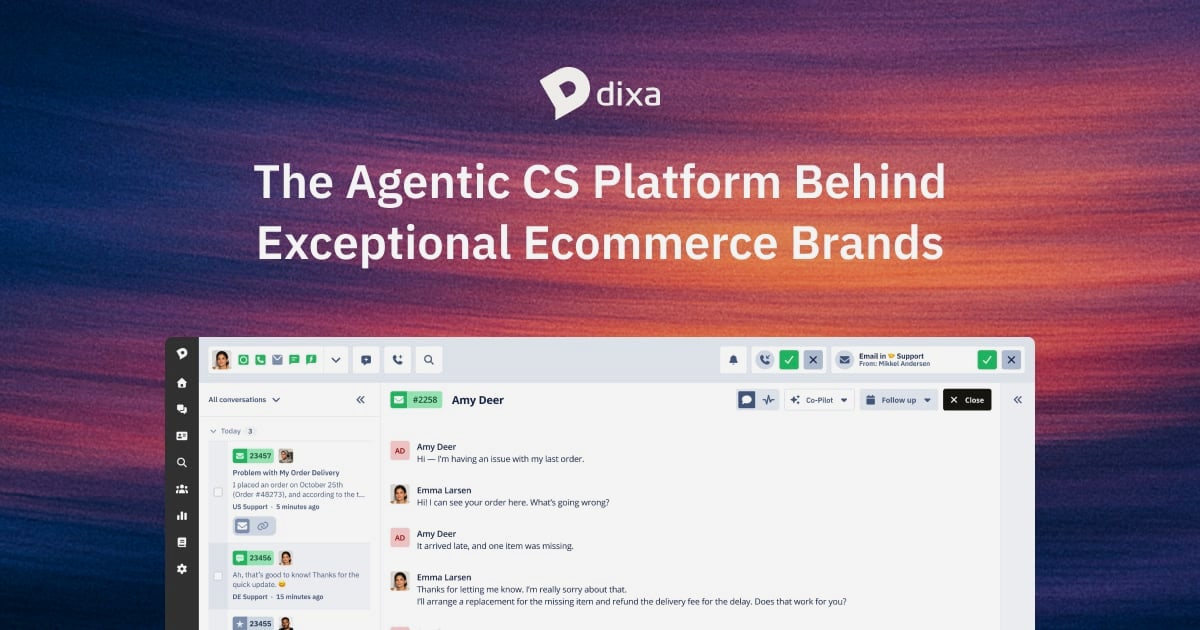
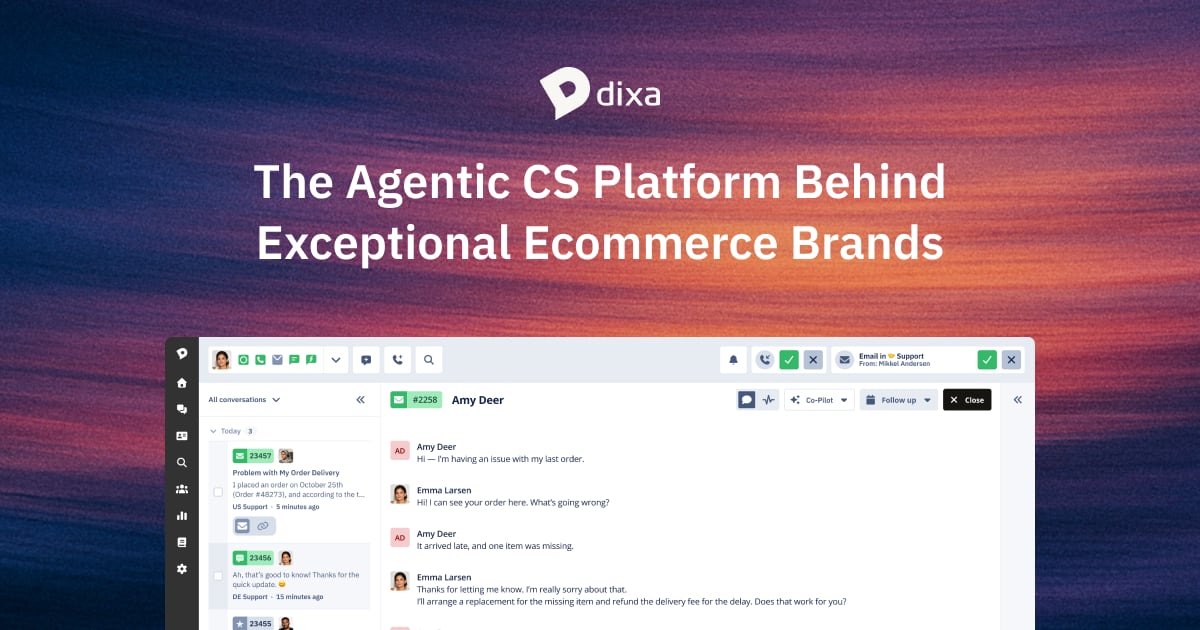
Dixa describes itself as an agentic customer service platform purpose-built for ecommerce brands where customer experience is critical. It combines AI agents, a helpdesk, and contact center capabilities into a single omnichannel solution covering phone, email, chat, social media, and more.
Mim AI Agent
Dixa's AI agent, Mim, goes beyond answering questions. It autonomously resolves inquiries and performs tasks that human agents normally handle, such as processing refunds and updating orders, with intelligent handovers to live agents when judgment or empathy is needed.
Native voice and routing
Dixa emphasizes that every channel, including phone, is native and unified from day one rather than added as a separate module. Routing can be based on skill, language, and VIP status, and conversations are offered to the best available rep in real time rather than assigned into a shared team inbox.
Ecommerce integrations
Dixa highlights native integrations with Shopify, Magento, and WooCommerce, plus more than 35 other integrations including Klaviyo. The company reports that customers see efficiency gains, with some reporting nearly doubled daily workloads, and it serves brands across fashion, pet care, baby care, health and wellness, and subscription services in 42 countries.
Intercom vs Dixa: side-by-side comparison
| Dimension | Intercom | Dixa |
|---|---|---|
| Primary fit | SaaS, software, and product-led businesses of all sizes | Mid-market ecommerce and consumer brands |
| AI agent | Fin, natively integrated into the helpdesk | Mim, included in every plan |
| AI pricing model | Per resolution, including assumed resolutions | Per conversation at a flat rate agreed upfront |
| Voice | Supported | Native in every plan |
| Ecommerce integrations | Shopify | Shopify, Magento, WooCommerce, and 35+ others |
| In-app messaging and product tours | Core strength | Not offered |
| Onboarding | Self-serve trial, with paid Premier Onboarding and Support add-ons | Guided rollout with a dedicated success manager on every plan |
A note on the table: pricing and packaging change frequently on both sides. Verify current details on each vendor's site before you commit.
The pricing question: per resolution vs per conversation
This is the sharpest practical difference between the two platforms, and it deserves its own section.
Dixa's comparison pages state that Intercom's Fin charges $0.99 per resolution, and that Intercom's documentation defines two kinds of resolutions: a confirmed resolution, where the customer says the answer helped, and an assumed resolution, where the customer receives an answer and leaves without asking for anything further. Both are billed. Dixa argues that a customer who gives up and closes the chat still counts as a resolution under that model.
Dixa prices its AI per conversation at a flat rate agreed in your contract, which the company says is $0.40 per conversation on its comparison page. The argument for per-conversation pricing is predictability: cost follows how many customers you serve, not how outcomes are counted, and improvements in underlying AI models do not raise your bill.
The counter-argument is that per-resolution pricing aligns cost with value delivered. If Fin resolves more conversations, you pay for more resolutions, but you also deflect more human work. Which model is cheaper depends on your volume, your resolution rate, and how many customers abandon conversations without a clear outcome.
If you are comparing AI pricing across more vendors, this AI support platform comparison covers how Intercom, Ada, and Decagon structure their AI economics.
Where Intercom has a supported advantage

The Agentic CS Platform BehindExceptional Ecommerce Brands.
Based on the sources reviewed, Intercom's clearest advantages are:
- Breadth of use cases. Intercom serves businesses of all sizes and industries, not just ecommerce. Its in-app messaging, product tours, and outbound messaging capabilities are core strengths that Dixa's own comparison page lists as "not offered."
- A natively integrated AI Agent. Fin is built into the helpdesk rather than added on, and it is also sold as a standalone agent that runs on other helpdesks, including Salesforce.
- Self-serve evaluation. Intercom offers a free trial with no credit card, which lets teams test the platform before committing. Dixa's comparison page states that Dixa does not offer a self-serve trial and instead uses a guided rollout.
- Scale and ecosystem. Intercom reports more than 30,000 customers and offers a solution partner program for agencies and consultants, plus Essential, Advanced, and Expert plans with outcome-based pricing.
Where Dixa has a supported advantage
Dixa's advantages are narrower but real for its target buyer:
- Ecommerce-specific capabilities. Native Shopify, Magento, and WooCommerce integrations, plus AI that can process refunds and update orders, are aimed squarely at post-purchase support.
- Native voice in every plan. Dixa states that phone is included in every plan, while Intercom's call handling is also included in every plan according to Dixa's comparison table.
- Predictable AI pricing. Per-conversation pricing at a flat rate protects against cost spikes during peak season, which matters for retail brands with seasonal volume.
- Dedicated success management. Dixa says every customer gets a dedicated success manager and hands-on onboarding on every plan, whereas Intercom's Premier Onboarding and Support are paid add-ons.
What to watch out for on both sides
Dixa's comparison pages make several claims about Intercom that are worth verifying independently, including the assertion that Intercom was renamed after its AI agent and that Salesforce agreed to acquire the company for approximately $3.6 billion, with the deal expected to close between November 2026 and January 2027. Dixa frames this as a risk for ecommerce brands, arguing that the roadmap will serve enterprise B2B buyers. As of the sources reviewed, pricing and plans were reported as unchanged, and the future roadmap, contract terms, and renewal pricing had not been announced. Treat acquisition-related claims as context, not as settled fact, and confirm current corporate status directly with the vendor.
On the other side, Dixa's own comparison page concedes that Intercom is the stronger choice for software companies whose customers are users inside the product. If that describes your business, the ecommerce framing that makes Dixa compelling does not apply to you.
A practical decision framework
Work through these questions in order:
- Who are your customers? Software users inside your product point to Intercom. Shoppers asking about orders, deliveries, and returns point to Dixa.
- Which channels carry your volume? If phone is central and you want it native in every plan, Dixa's positioning is stronger. If in-app messaging and chat are central, Intercom is stronger.
- How do you want to pay for AI? Per-resolution pricing rewards high deflection but can bill for abandoned conversations. Per-conversation pricing is more predictable but may cost more if your AI resolves very efficiently.
- How much onboarding support do you need? Dixa includes a dedicated success manager on every plan. Intercom offers self-serve evaluation with paid Premier support.
- What is your growth trajectory? If you are scaling a consumer brand through peak seasons, Dixa's flat-rate AI and ecommerce integrations reduce planning risk. If you are scaling a software product across multiple regions and channels, Intercom's broader platform and partner ecosystem are more likely to keep pace.
For teams that need to consolidate channels before choosing a vendor, this guide to unifying customer conversations covers the operational steps and metrics that apply regardless of which platform you pick.
Related reading
- Intercom vs CXone: AI-First Helpdesk or Contact Center? - Intercom vs CXone compared: AI resolution, channels, pricing, and use cases. See which platform fits your support team in 2026.
Sources and further reading
- Compare Dixa to Other Customer Service Platforms - Dixa vs. Intercom ... Intercom leads with messaging and product-led growth use cases. The comparison covers how that differs from Dixa's approach for teams whose ...
- Intercom Alternative for Ecommerce. Native Phone, Agentic AI - Dixa - Dixa was built for brands whose customers ask about orders, deliveries, and returns across every channel. Intercom was built for software companies, and ...
- Best Multichannel Customer Support Software In 2025 - Fullview - Dec 26, 2022 ... Intercom offers a comprehensive and reliable multichannel support solution that is designed to help SaaS businesses improve their CX. It ...
Frequently asked questions
Is Dixa a good Intercom alternative?
For mid-market ecommerce and consumer brands, yes. Dixa was built for brands whose customers ask about orders, deliveries, and returns across every channel, with native phone and ecommerce integrations. For software companies whose customers live inside the product, Intercom's in-app messaging and product tours make it the stronger fit, a point Dixa's own comparison page acknowledges.
How does Intercom's Fin pricing differ from Dixa's Mim pricing?
Dixa states that Fin charges $0.99 per resolution, including assumed resolutions where a customer receives an answer and leaves without asking for anything further. Dixa prices its AI per conversation at a flat rate agreed upfront, which it lists as $0.40 per conversation. The models differ in what they count and how predictable the bill is at volume.
Can I migrate from Intercom to Dixa?
Dixa says most teams complete the migration in two to four weeks with a dedicated onboarding manager, importing historical conversations and customer data and moving channels in stages so support does not go dark. Verify the specifics with Dixa during evaluation.
Does Intercom support phone and ecommerce integrations?
Yes. Intercom supports phone alongside live chat, email, and in-app messaging, and it integrates with Shopify. Dixa's comparison table lists Shopify as Intercom's ecommerce integration and notes that Dixa supports Shopify, Magento, and WooCommerce natively.
Which platform is better for seasonal ecommerce volume?
Dixa's per-conversation AI pricing is designed to keep costs stable when volume spikes, and its knowledge management features are positioned to ramp seasonal agents faster. Intercom's per-resolution model means higher volume generally means higher AI cost, though it also means you pay only when the AI produces an outcome.
Conclusion
Intercom and Dixa are not direct substitutes so much as platforms optimized for different customer bases. Intercom is the broader AI-first helpdesk, with a natively integrated AI Agent, in-app messaging, outbound capabilities, and a self-serve trial that suits software and product-led businesses of all sizes. Dixa is the ecommerce specialist, with native voice, order-aware AI actions, and per-conversation pricing that appeals to consumer brands managing seasonal peaks.
If your customers are shoppers, Dixa's focus is a genuine advantage. If your customers are software users, Intercom's breadth is the safer bet. Test both against your own channel mix and AI volume before signing a multi-year contract, and verify current pricing and corporate status directly with each vendor.