Intercom vs Featurebase vs CXone: Which Platform Wins?
Intercom vs Featurebase vs CXone: Which Platform Wins?
Choosing between Intercom, Featurebase, and CXone means deciding what kind of customer relationship you want to run. Intercom is an AI-first support platform built around a natively integrated AI Agent. Featurebase combines support with feedback collection and product announcements for product-led teams. CXone is an enterprise contact center platform that orchestrates customer journeys at scale across voice and digital channels.
They are not interchangeable. One is a support-first helpdesk, one is a support-plus-feedback hub, and one is a full contact center suite. The right choice depends on whether you are optimizing for AI resolution speed, product feedback loops, or enterprise-scale omnichannel orchestration.
Quick Verdict

Upper section background.
| Platform | Best For | Standout Strength |
|---|---|---|
| Intercom | SaaS and digital-first teams that want AI to resolve support conversations automatically | Fin AI Agent natively embedded across the helpdesk |
| Featurebase | Product-led startups that need support, feedback, and changelogs in one affordable tool | Unified feedback hub with voting and public roadmap |
| CXone | Enterprises and contact centers with high voice volume and complex routing needs | Omnichannel routing plus workforce engagement at scale |
Intercom Overview
Intercom positions itself as an AI-first customer service platform built for the AI Agent era. Its core promise is simple: let AI resolve a meaningful share of customer conversations before a human agent ever gets involved.
The centerpiece is Fin, an AI Agent that works natively inside the Intercom helpdesk. Fin pulls from your help center, past conversations, and connected knowledge sources to answer customer questions and complete tasks. Alongside Fin, Intercom offers Copilot for human agents, AI Insights for analytics, and a shared inbox that unifies live chat, email, in-app messaging, and phone.
Intercom is used by more than 30,000 brands and offers Essential, Advanced, and Expert plans with outcome-based pricing. It is strongest for digital-first businesses where chat and in-app messaging are the primary support channels and where AI deflection is a measurable goal.
Featurebase Overview
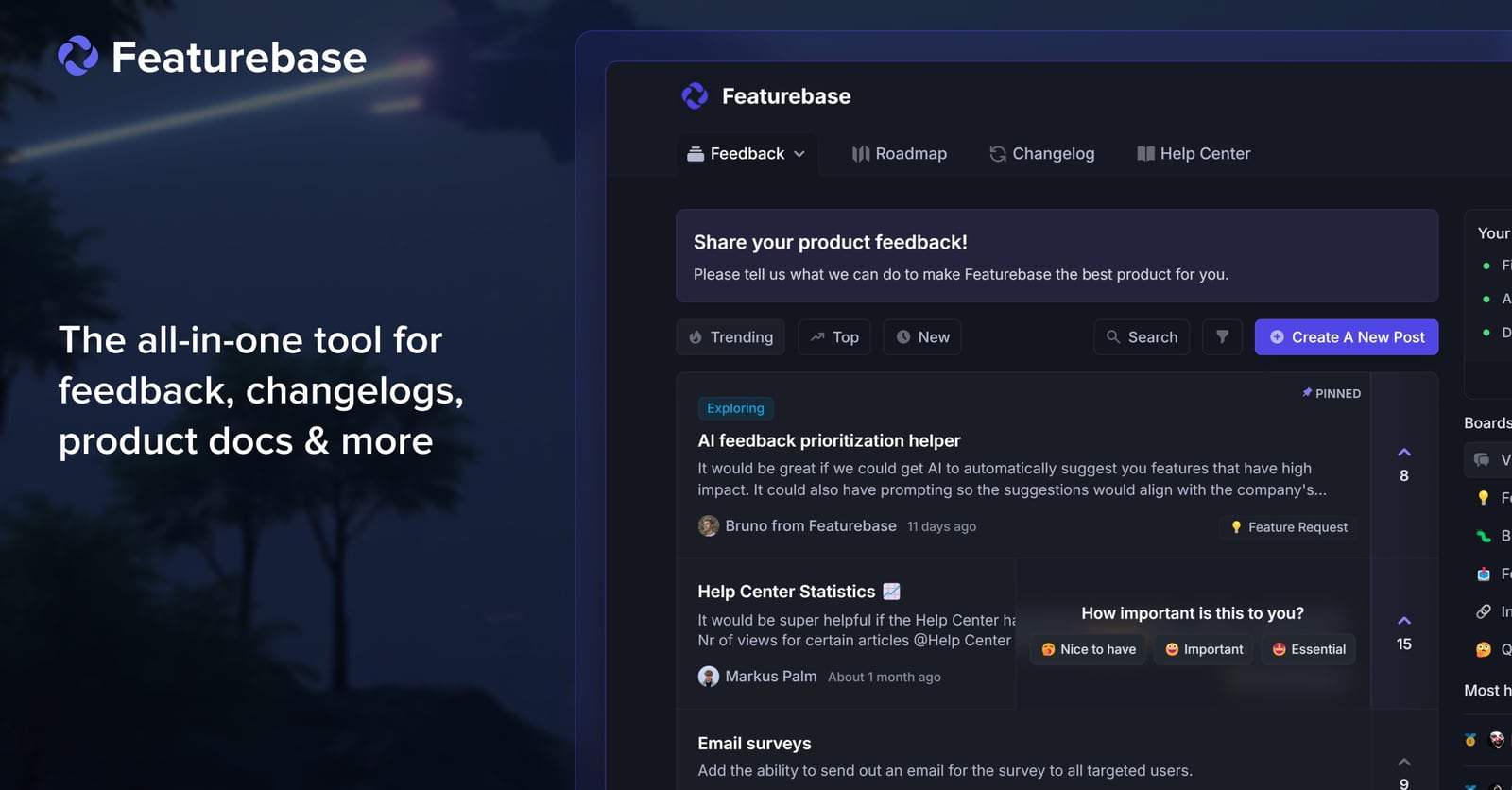
Featurebase product interface.
Featurebase consolidates customer communication, feedback collection, and product announcements into one platform. It is designed for product, support, and marketing teams that want to close the loop between what customers ask for and what gets built.
The platform includes an omnichannel inbox that connects in-app chat, Slack, Discord, and email. Its AI agent, Fibi, automates resolutions using your knowledge base. What sets Featurebase apart is the feedback layer: customers can submit ideas, vote on existing requests, and see a public roadmap that shows what the team is working on. A built-in changelog tool lets you announce updates across your product, website, and email.
Featurebase is used by thousands of companies including Lovable, Elementor, Checkly, Civitai, and Amplemarket. Users consistently praise its transparency, ease of use, and affordability compared to larger platforms like Intercom and Zendesk. For product-led teams, the feedback-to-roadmap workflow is the main reason to choose it over a pure support tool.
CXone Overview
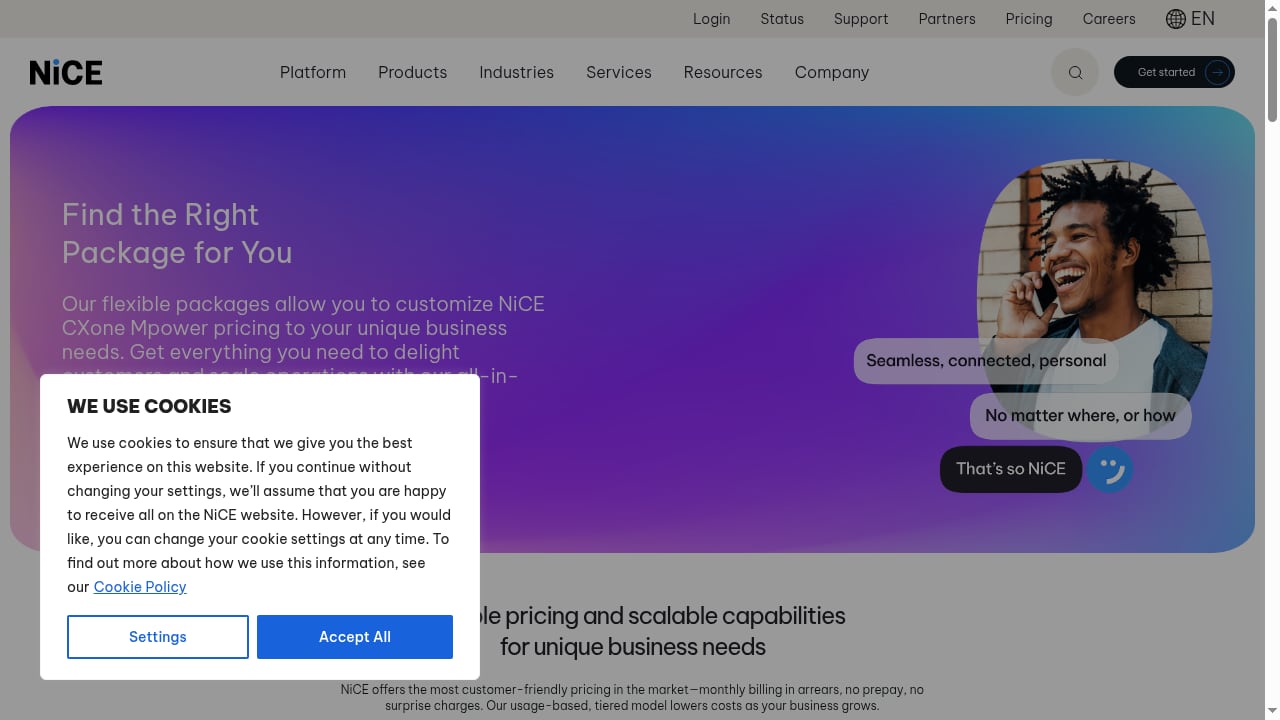
First viewport screenshot of CXone Packages and Pricing | NiCE.
CXone, from NICE, is an all-in-one AI-powered customer experience platform that combines contact center as a service (CCaaS) with advanced AI, automation, and analytics. It is built for organizations that operate large contact centers and need to orchestrate customer journeys across voice, chat, email, and social channels at scale.
CXone serves financial services, healthcare, insurance, retail, telecommunications, government, education, and business process outsourcers. Its capabilities include omnichannel routing, AI-driven self-service, agent assist, workforce engagement management, and journey orchestration. The platform emphasizes moving from AI experimentation to full-scale production by harmonizing Agentic AI, real-time data, and human expertise.
Pricing is usage-based with monthly billing in arrears, no prepay, and tiered models that lower costs as usage grows. CXone also offers industry-specific packages for higher education, healthcare, and insurance. If your support operation includes a significant voice component or requires enterprise-grade workforce management, CXone is the strongest fit of the three.
Feature-by-Feature Comparison
First viewport screenshot of Citizen Customer Experience Software for Government Organizations | NiCE CX Solutions.
AI Agents and Automation
Intercom's Fin is a mature, natively integrated AI Agent that resolves conversations using your existing knowledge base and help center content. Because Fin lives inside the same platform as the inbox and reporting, there is no integration overhead. Intercom also offers Copilot to assist human agents with suggested replies and summaries.
Featurebase's Fibi AI agent automates resolutions within the omnichannel inbox. Featurebase also applies AI to feedback prioritization, helping product teams identify which feature requests matter most based on customer signals. This is a different use of AI: less about conversation deflection, more about turning support interactions into product intelligence.
CXone takes an enterprise approach. It provides AI-driven self-service, agent assist, and Agentic AI orchestration designed to work across voice and digital channels at production scale. The emphasis is on harmonizing AI with human agents and real-time data rather than replacing agents outright.
Feedback Management and Product Roadmaps
This is where Featurebase has a clear advantage. It includes a centralized feedback hub with voting, a public roadmap, and a changelog tool. Customers can submit ideas, upvote existing requests, and see what the team is building. Support conversations and product feedback live in the same system, which reduces tool sprawl for product-led teams.
Intercom does not offer native voting, public roadmaps, or changelog publishing. You can collect feedback through conversations, but turning that into a structured product roadmap requires a separate tool or manual process.
CXone is not designed for product feedback management. Its focus is contact center operations, not product discovery. Organizations using CXone for support would typically pair it with a dedicated product feedback tool.
Omnichannel Support and Voice
CXone is the strongest option for omnichannel orchestration at scale. It routes interactions across voice, chat, email, and social channels using a unified routing engine. Workforce engagement management, agent assist, and journey orchestration are all built in. For contact centers with high voice volume, CXone is purpose-built.
Intercom supports live chat, email, in-app messaging, and phone, but its heritage is digital-first. It handles voice, but voice is not the centerpiece of the platform the way it is with CXone.
Featurebase connects in-app chat, Slack, Discord, and email. It does not position itself as a voice or telephony platform. For teams whose customers live in Slack, Discord, or in-app widgets, that is a strength. For teams that need enterprise telephony, it is a limitation.
Pricing and Total Cost
Featurebase is consistently praised for affordability compared to Intercom and Zendesk. For startups and small product teams, the lower price point combined with the feedback and changelog features makes it a high-value option.
Intercom uses outcome-based pricing across Essential, Advanced, and Expert plans. You pay based on resolutions and usage rather than purely per seat. For teams with high AI deflection, this can be efficient. For teams with low volume or unpredictable usage, costs can be harder to predict.
CXone uses usage-based pricing with monthly billing in arrears and no prepay. Tiered models lower costs as usage grows. This structure suits large organizations with predictable contact volumes, but it is less accessible for small teams that want a simple per-seat price.
When to Choose Each Platform
Choose Intercom if:
- You want a natively integrated AI Agent that resolves conversations without third-party tooling
- Your support is primarily chat, email, and in-app messaging
- You value AI Insights and agent copilot features built into the same platform
- You are a digital-first SaaS or ecommerce business measuring AI deflection rates
Choose Featurebase if:
- You need feedback collection, voting, and a public roadmap alongside support
- Your customers are active in Slack, Discord, or your in-app widget
- You are a product-led startup that wants support and product discovery in one tool
- Budget predictability and affordability are top priorities
Choose CXone if:
- You run a contact center with significant voice volume
- You need workforce engagement management and journey orchestration
- You operate in a regulated industry like healthcare, insurance, or financial services
- You are moving from AI pilots to full-scale production across many channels
Practical Example: Three Teams, Three Choices
Team A is a B2B SaaS company with 40 employees. Support comes through chat and email. The team wants to deflect repetitive questions and give agents an AI assistant. Intercom fits because Fin resolves conversations natively and the shared inbox keeps everything in one place.
Team B is a product-led startup with 15 employees. Customers submit feature requests constantly, and the team wants a public roadmap to show what is coming. Support happens mostly in Discord and in-app chat. Featurebase fits because the feedback hub, voting, and changelog are built in, and the price is manageable for a small team.
Team C is a mid-sized insurance company with a 200-seat contact center. Most interactions are voice calls, with email and chat as secondary channels. The company needs workforce management, compliance-friendly routing, and AI agent assist at scale. CXone fits because it is purpose-built for that environment.
Limitations to Consider
Intercom's feedback and roadmap features are limited compared to Featurebase. If product discovery is a core part of your workflow, you will likely need an additional tool.
Featurebase is not a contact center platform. It lacks enterprise telephony, workforce engagement management, and the scale-oriented orchestration that CXone provides.
CXone is overkill for small digital-first teams. Its usage-based pricing and enterprise feature set are designed for large operations, not startups that need a simple helpdesk with a public roadmap.
Related reading
- HubSpot Customer Platform Review 2026: Tested & Rated - Evidence-based HubSpot Customer Platform review covering Smart CRM, Breeze AI, Marketing, Sales, and Service Hubs, pricing signals, limitations, and ideal users.
- How to Use Gladly: A Practical Setup Guide for Support Teams - Learn how to use Gladly step by step: configure your AI agent, set up knowledge sources, test responses, monitor performance, and improve customer conversations.
Sources and further reading
- AI Customer Support Platforms Compared (2026) - Bookbag - Compare Bookbag with Chatbase, Intercom, Zendesk, Gorgias, Ada, and more. Side-by-side AI customer support comparisons for Shopify and ecommerce teams.
- Blog | AI Products for CX - Reviews, comparisons, and guides to help you choose the right AI product for your CX team.
- Best AI Customer Support Alternatives for Ecommerce (2026) - Looking to switch? Compare the best alternatives to Chatbase, Intercom, Zendesk, Gorgias, Ada and more — ranked for Shopify and ecommerce support teams.
FAQ
Is Featurebase a good alternative to Intercom?
Yes, especially for product-led teams. Featurebase combines support, feedback, and changelogs in one affordable platform. If you need a public roadmap and voting alongside your helpdesk, Featurebase offers that natively where Intercom does not. If your priority is a deeply integrated AI Agent for conversation resolution, Intercom remains stronger.
Can CXone replace Intercom for a SaaS company?
It depends on your channel mix and scale. CXone excels at omnichannel routing, voice, and workforce management for large contact centers. A digital-first SaaS company with chat and email support would likely find Intercom more practical and faster to adopt. CXone is the better choice when voice volume and enterprise orchestration are central requirements.
Which platform has the best AI agent?
Intercom's Fin is the most mature natively integrated AI Agent of the three for digital support conversations. Featurebase's Fibi automates resolutions within its inbox and adds AI-powered feedback prioritization. CXone provides enterprise-grade Agentic AI designed for production contact center environments, with a stronger emphasis on agent assist and orchestration than standalone conversation deflection.
How does pricing compare?
Featurebase is generally the most affordable and predictable. Intercom uses outcome-based pricing that scales with resolutions. CXone uses usage-based pricing with monthly billing and tiered discounts, which suits larger organizations with stable contact volumes.
Can I use Featurebase and Intercom together?
Some teams do. Intercom can handle support conversations while Featurebase manages feedback, voting, and changelogs. However, running both means maintaining two knowledge bases and two inboxes. For many product-led teams, Featurebase alone is sufficient. For support-heavy teams that only need basic feedback capture, Intercom plus a lightweight feedback tool may work better.
The Bottom Line
Intercom wins when AI-powered conversation resolution is the primary goal and your support is digital-first. Featurebase wins when support, feedback, and product announcements need to live in one affordable, product-led platform. CXone wins when you are orchestrating customer journeys at enterprise scale, especially with significant voice volume and workforce management requirements.
Start with your channel mix and your primary workflow. If you need a public roadmap, Featurebase is the clear choice. If you need a natively integrated AI Agent, Intercom leads. If you run a contact center, CXone is the platform built for that job. For a deeper look at how Intercom compares to other support tools, see our Intercom vs ProProfs Chat comparison or learn how to extend Intercom with agentic automation in our Intercom with Beam AI setup guide.