Intercom vs Freshdesk: Which Support Platform Wins in 2026?

Intercom vs Freshdesk: Which Support Platform Wins in 2026?
Choosing between Intercom and Freshdesk is less about picking the "better" tool and more about matching the platform to how your team actually works. Intercom is an AI-first customer service platform built around conversational messaging and autonomous resolution. Freshdesk is a ticketing-first helpdesk that has layered AI on top of a structured workflow. Both are credible options, but they optimize for different outcomes.
This comparison breaks down the real differences: AI capabilities, pricing mechanics, ticketing depth, channel coverage, and the use cases where each platform makes the most sense.
Quick Verdict
Choose Intercom if your support strategy centers on proactive, conversational engagement and you want an AI Agent that resolves a meaningful share of conversations without human intervention. Intercom's Fin AI Agent and Copilot are natively integrated into the inbox, which makes automation feel like a core capability rather than an add-on.
Choose Freshdesk if your team lives in a structured ticketing environment, needs advanced routing and SLA management, and wants predictable per-agent pricing with a lower entry point for AI features.
The distinction matters because the two platforms approach customer service from opposite directions. Intercom starts with conversation and adds structure. Freshdesk starts with structure and adds conversation.
AI Capabilities: Fin vs Freddy
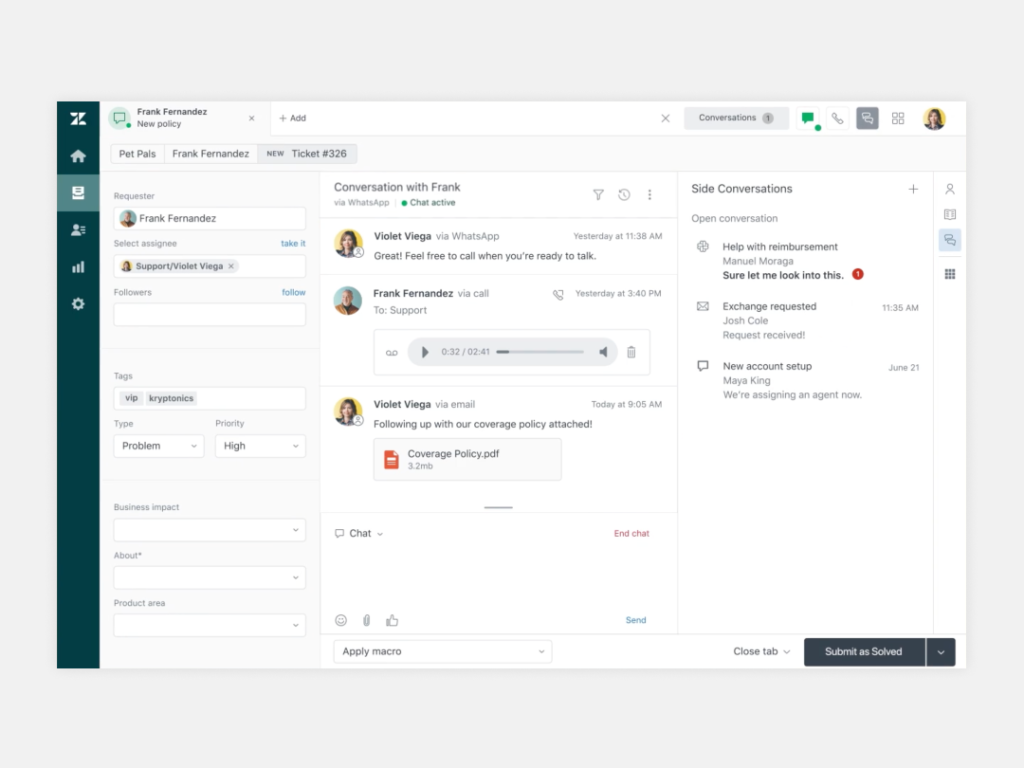
Intercom vs Freshdesk: Which Support Platform Wins in 2026? - AI Capabilities: Fin vs Freddy.
AI is where the two platforms diverge most clearly.
Intercom Fin AI Agent
Intercom positions Fin as a natively integrated AI Agent that works directly inside the helpdesk. Fin is designed to resolve customer questions instantly by drawing on your help center content, past conversations, and connected business tools. The goal is resolution, not deflection: Fin can complete tasks like checking order status, updating account details, or walking a customer through a return without handing off to a human.
Intercom also offers Copilot, an AI assistant for human agents that drafts replies, summarizes conversations, and suggests next actions. AI Insights then analyzes conversation data to surface trends, gaps in help content, and opportunities for automation.
The key architectural difference: Intercom treats AI as the primary interface. The inbox, the agent workspace, and the reporting layer are all designed around the assumption that AI will handle a significant portion of volume.
Freshdesk Freddy AI
Freshdesk's Freddy AI includes an AI Agent for autonomous resolution and an AI Copilot for agent productivity. Freshworks reports that Freddy AI Copilot can speed up resolution by 38% and improve CSAT by 6%, with features like sentiment-based ticket prioritization, automatic summarization, and real-time response quality monitoring.
Freddy AI Agent uses session-based pricing, which Freshworks positions as more predictable than per-resolution billing. The AI capabilities are solid, but they sit on top of a ticketing system rather than being the system's organizing principle.
The practical difference: Intercom's AI feels native to the conversation flow. Freshdesk's AI feels like a productivity layer on a traditional helpdesk. Both can resolve tickets, but the experience for agents and customers differs.
Pricing Models: Predictability vs Flexibility

Intercom vs Freshdesk: Which Support Platform Wins in 2026? - Pricing Models: Predictability vs Flexibility.
Pricing is one of the most frequently cited friction points in Intercom vs Freshdesk comparisons.
Intercom Pricing
Intercom uses outcome-based pricing with Essential, Advanced, and Expert plans. The base plans start at $29 per agent per month, but the total cost depends heavily on usage. Fin AI Agent is billed per resolution at $0.99 per automated resolution. This means your AI costs scale directly with how much Fin actually resolves.
For teams that want AI to handle a large share of volume, this can get expensive quickly. But the model also aligns cost with value: you pay for AI when it works, not when it sits idle.
Freshdesk Pricing
Freshdesk uses a more traditional per-agent model. The Pro plan runs $79 per agent per month and includes access to advanced features. Freddy AI Agent uses session-based pricing, where a session can include multiple resolved issues. Freshworks gives this example: 1,000 sessions with a 65% resolution rate costs $490, compared to $644 for the equivalent Intercom volume at per-resolution pricing.
Freshdesk's model is easier to forecast for budget planning. Intercom's model is more flexible but requires closer monitoring of resolution volume.
For a deeper look at how AI chatbot pricing works across platforms, see this guide to AI chatbot pricing with live chat included.
Ticketing Depth: Structured Workflows vs Conversational Inbox
Intercom vs Freshdesk: Which Support Platform Wins in 2026? - Ticketing Depth: Structured Workflows vs Conversational Inbox.
Freshdesk's strongest argument is its ticketing engine. The platform offers advanced routing based on agent skill, load, or round-robin assignment. Agents can collaborate with internal and external experts in the same conversation pane. SLA management, custom ticket statuses, scheduled tickets, and event-based automations are all part of the core workflow.
Intercom is newer to the ticketing space. Its shared inbox blends email, chat, and in-app messages into a single conversational stream. While this creates a unified view of customer interactions, it can make email threads harder to parse. Intercom's routing and automation capabilities have improved, but teams with complex, multi-step ticket workflows may find Freshdesk's structure more suitable.
When ticketing depth matters: If your support operation handles high volumes of email-based requests with defined SLAs, escalation paths, and multi-team collaboration, Freshdesk's ticketing maturity is a genuine advantage. If your support is primarily chat-driven and conversational, Intercom's inbox model may feel more natural.
Channel Coverage and Omnichannel Support
Both platforms support multi-channel customer service, but there are structural differences.
Freshdesk's omnichannel story requires understanding the Freshworks ecosystem. Full omnichannel capability typically involves Freshdesk for ticketing, Freshchat for live chat, and Freshcaller for voice. Teams that need all three may need separate subscriptions. Freshworks has been consolidating these under the Freshdesk Omni umbrella, but the product history matters.
Intercom offers live chat, email, in-app messaging, and phone support within a single platform. The in-app messaging capability is a differentiator: Intercom can trigger proactive messages based on user behavior, product usage, or lifecycle stage. This makes Intercom particularly strong for SaaS companies and product-led businesses that want support to feel like part of the product experience.
Ease of Use and Onboarding
Freshdesk is generally considered easier to set up and use for traditional support teams. The interface is clean, the ticketing workflow is familiar, and the learning curve is modest. Freshworks also emphasizes customer success with 24/7 email support and 24/5 phone and chat support on paid plans.
Intercom has a more powerful feature set, but some users find the interface overwhelming. The routing and automation configuration can be complex, and the platform's flexibility means more decisions to make during setup. Intercom's support experience has drawn criticism, with some users reporting slow response times for basic queries.
The tradeoff: Freshdesk gets you operational faster. Intercom gives you more capability but requires more configuration investment.
When to Choose Intercom
Intercom is the stronger choice when:
- AI resolution is a strategic priority. Fin's native integration and per-resolution pricing align with teams that want AI to handle a meaningful share of volume.
- Proactive engagement matters. In-app messaging, product tours, and behavior-triggered outreach are core Intercom strengths.
- Your support is conversation-first. If most interactions happen via chat or messaging rather than email tickets, Intercom's inbox model fits better.
- You serve a product-led SaaS audience. Intercom's product context, user data, and in-app experience are built for software companies.
For a broader look at how Intercom stacks up against other platforms, see this Intercom vs Dashly vs HelpCrunch comparison or the Intercom vs Gorgias analysis for ecommerce-focused teams.
When to Choose Freshdesk
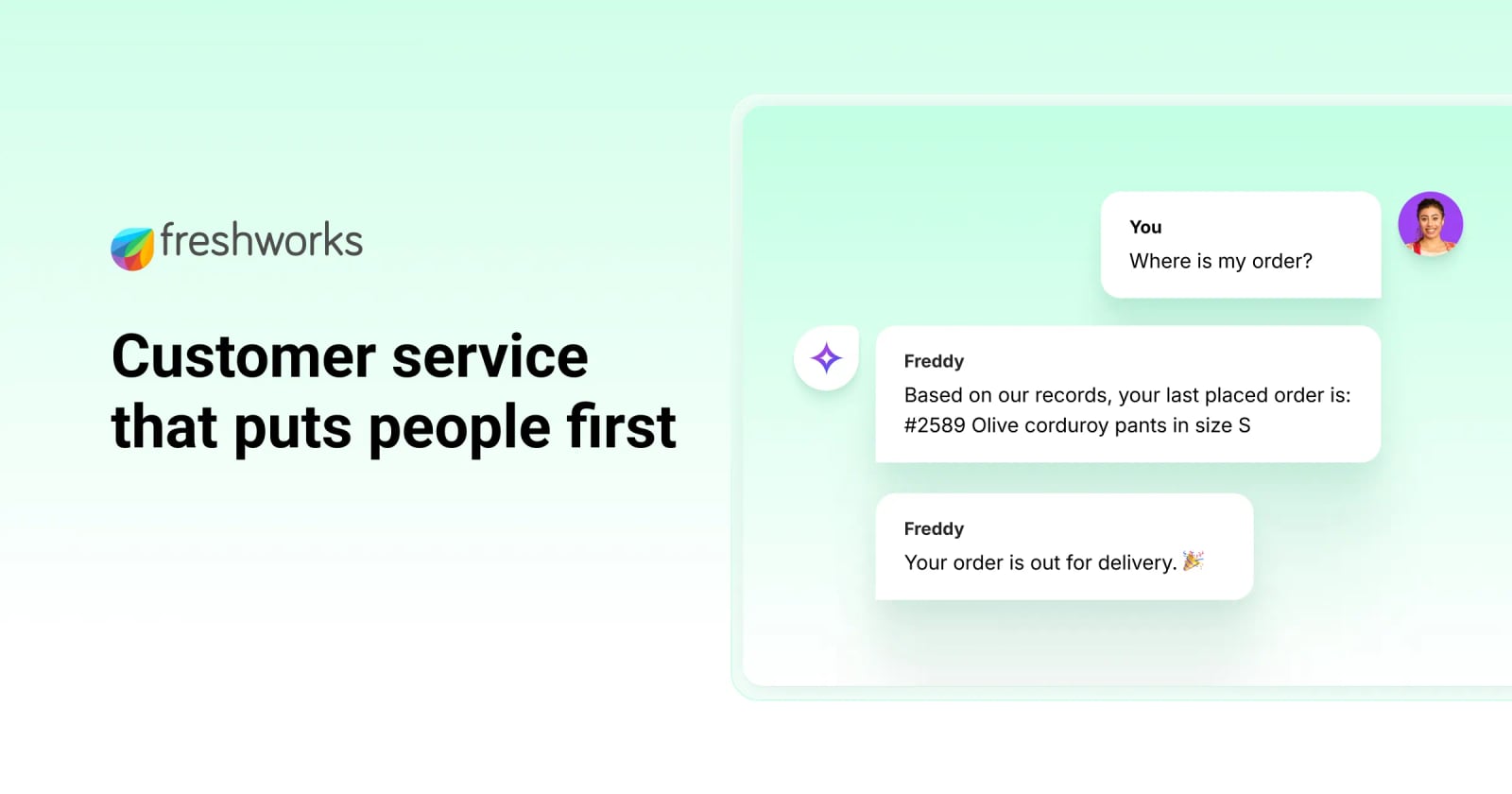
Freshdesk product interface.
Freshdesk is the stronger choice when:
- Structured ticketing is non-negotiable. Advanced routing, SLA management, and multi-team collaboration are Freshdesk's core strengths.
- Budget predictability matters. Per-agent pricing with session-based AI costs is easier to forecast.
- Your team is new to AI. Freshworks offers a guided path to AI adoption, which can reduce the risk of over-investing in automation before your workflows are ready.
- You need traditional support channels. Email-heavy operations with defined escalation paths fit Freshdesk's model well.
Feature Comparison at a Glance
| Capability | Intercom | Freshdesk |
|---|---|---|
| Core model | Conversational messaging + AI | Structured ticketing + AI |
| AI Agent | Fin (per-resolution pricing) | Freddy (session-based pricing) |
| AI Copilot | Yes, natively integrated | Yes, with sentiment prioritization |
| Ticketing depth | Moderate, conversation-first | Advanced, with SLA and routing |
| In-app messaging | Strong, proactive outreach | Limited without Freshchat |
| Omnichannel | Unified within one platform | May require Freshworks ecosystem |
| Pricing model | Outcome-based, usage-sensitive | Per-agent, more predictable |
| Ease of setup | More configuration required | Faster time to value |
The Bottom Line
Intercom and Freshdesk represent two valid philosophies for customer service in 2026. Intercom bets that AI-driven conversation will become the primary support interface, and it has built its platform accordingly. Freshdesk bets that structured workflows and predictable pricing will remain essential, with AI as a productivity multiplier rather than a replacement.
Your choice should follow your support strategy. If you want AI to resolve conversations autonomously and your team thinks in terms of customer interactions rather than tickets, Intercom is the stronger fit. If you need a mature ticketing system with predictable costs and a guided AI adoption path, Freshdesk deserves serious consideration.
Related reading
- Help Scout Review 2026: Pricing, Features, and Verdict - In-depth Help Scout review covering shared inbox, AI features, pricing signals, setup, limitations, and who should buy it in 2026.
- Talkdesk Review 2026: AI Contact Center Tested - In-depth Talkdesk review covering AI agents, omnichannel support, pricing signals, setup, limitations, and who should buy it in 2026.
Sources and further reading
- Has anyone replaced Zendesk or Freshdesk with Intercom for ... - Aug 7, 2025 ... In terms of the offer, Intercom is very strong. It's probably much stronger from a chat perspective. Zendesk is more typically stronger as a ...
- Freshdesk vs Intercom: 2026 Comparison - Freshworks - Discover the distinct features that make Freshdesk a better choice than Intercom. Compare pricing, functionality, and more.
- Freshdesk vs Intercom: Pick Based on Your Team's Workflow - Freshdesk excels at structured ticket management, while Intercom specializes in real-time conversational messaging. See which fits your workflow.
Frequently Asked Questions
Is Intercom more expensive than Freshdesk?
It depends on usage. Intercom's base plans start lower at $29 per agent per month, but Fin AI resolution costs $0.99 per resolution, which can add up quickly. Freshdesk's Pro plan is $79 per agent per month with session-based AI pricing that Freshworks claims is about 24% cheaper than Intercom's equivalent AI volume. Teams should model both scenarios based on expected ticket and resolution volume.
Does Intercom have ticketing?
Yes, Intercom has ticketing capabilities, but they are less mature than Freshdesk's. Intercom's ticketing is built around its conversational inbox, which blends email and chat. Teams with complex routing, SLA, and multi-team collaboration requirements may find Freshdesk's ticketing engine more capable.
Can Freshdesk do live chat?
Freshdesk offers live chat through Freshchat, which is part of the Freshworks ecosystem. Depending on your plan, you may need a separate Freshchat subscription to access full chat capabilities. Intercom includes live chat natively within its platform.
Which platform has better AI?
Both platforms have capable AI. Intercom's Fin is more deeply integrated into the conversational experience and is designed for autonomous resolution. Freshdesk's Freddy offers strong agent productivity features, including sentiment-based prioritization and response quality monitoring. The right choice depends on whether you prioritize autonomous resolution or agent assistance.
Is Freshdesk easier to use than Intercom?
Generally, yes. Freshdesk's ticketing interface is familiar to most support teams and requires less configuration to get started. Intercom's flexibility and feature depth can feel overwhelming, especially for teams without dedicated technical resources.
Can I try both before deciding?
Both platforms offer free trials. Intercom provides a free trial of its plans, and Freshdesk offers a 14-day free trial with access to Enterprise plan features. Testing both with real support scenarios is the most reliable way to determine fit.