Talkdesk Review 2026: AI Contact Center Tested
Talkdesk Review 2026: AI Contact Center Tested
Talkdesk has moved well beyond the cloud contact center category it helped define. Today it positions itself as a customer experience automation (CXA) platform, combining CCaaS infrastructure with autonomous AI agents that can resolve customer issues end to end. This review examines whether that promise holds up in practice, based on verified user feedback from Gartner Peer Insights, Trustpilot, and Talkdesk's own published customer evidence, plus an analysis of the platform's pricing, setup, and ideal use cases.
If you are evaluating contact center platforms in 2026, the central question is no longer "can it handle voice?" but "how much of the workload can AI actually resolve without a human?" Talkdesk answers that question aggressively with Copilot, Autopilot, and Navigator. The trade-offs involve cost transparency, implementation complexity, and whether your team is ready for a platform that assumes AI orchestration from day one.
What Is Talkdesk?
Talkdesk is a cloud-native contact center platform founded in 2011 and headquartered in Palo Alto. It serves mid-market and enterprise organizations across voice, email, chat, SMS, and social channels. The platform's differentiator is its AI layer, which includes:
- Talkdesk Copilot: an AI assistant for human agents that surfaces next best actions, knowledge base answers, and automatic call summaries.
- Talkdesk Autopilot: agentic AI virtual assistants for voice and digital channels that autonomously resolve issues without human intervention.
- Talkdesk Navigator: AI-powered routing that uses natural conversation and context to match customers to the right human or AI agent.
- Interaction & Quality Analytics: conversation intelligence for coaching, compliance, and performance monitoring.
Verified Gartner Peer Insights reviews describe the platform as enabling "true experience transformation—not just a lift and shift of legacy telephony." One banking VP reported consolidating more than 10 disconnected systems into a single pane of glass using the Financial Services Experience Cloud, with a 13-point increase in customer satisfaction scores and a 40% SMS survey response rate.
Who Should Use Talkdesk?
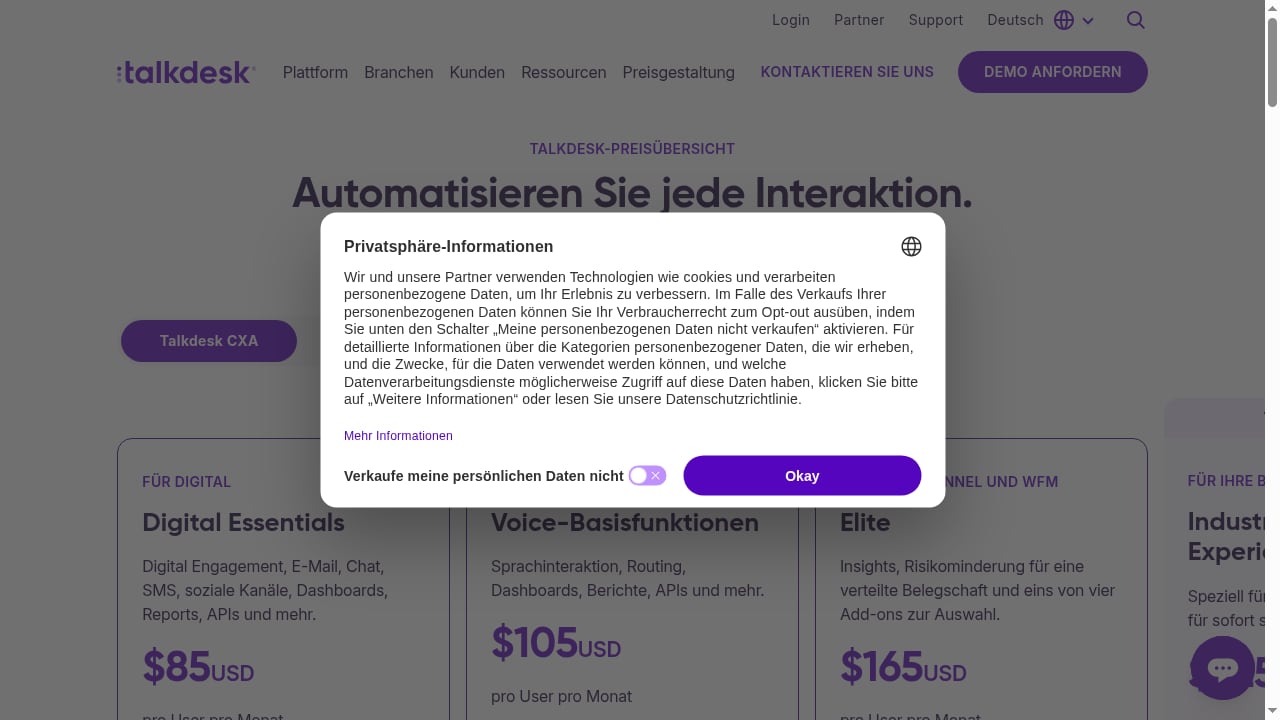
First viewport screenshot of Preise der Contact Center-Software | Talkdesk.
Talkdesk is not a one-size-fits-all tool. It skews toward organizations that meet several of the following criteria:
Ideal Users
- Mid-market and enterprise contact centers running 50+ agents who need omnichannel orchestration, not just a phone system.
- Organizations consolidating legacy tools. If you are replacing multiple point solutions—IVR, workforce management, analytics, CRM integrations—Talkdesk's unified platform can reduce vendor sprawl.
- Teams ready to automate high-volume, repetitive inquiries. Industries like financial services, healthcare, retail, and travel benefit most from Autopilot's ability to handle balance checks, order status, appointment scheduling, and similar tasks.
- Companies that value low-code journey design. Talkdesk's flow builder lets non-technical teams iterate call flows, messaging, and routing logic without heavy vendor dependency.
Less Ideal Users
- Small teams under 10 agents. Talkdesk's pricing starts at $85 per user per month for digital essentials, and voice plans typically cost more. Smaller teams may find simpler tools like Intercom or Dialpad more cost-effective.
- Organizations that only need a basic helpdesk. If your primary channel is email or Slack, a platform like ClearFeed may be a better fit than a full CCaaS suite.
- Teams that want predictable, flat pricing. Talkdesk uses custom quotes for most plans, which frustrates some buyers who prefer transparent per-seat pricing.
Key Strengths
1. AI Agents That Actually Resolve Issues
The most significant differentiator is Autopilot. Unlike basic chatbots that deflect to a human after one failed attempt, Talkdesk's agentic AI assistants are designed to complete tasks end to end—checking an account balance, processing a card activation, or updating an address—without agent involvement. This is a meaningful shift from deflection to resolution.
2. Unified Platform Architecture
Verified reviewers consistently praise the consolidation benefit. One healthcare engineering manager noted that the platform supports operations well, while a banking VP highlighted replacing 10+ disconnected systems. For organizations tired of stitching together telephony, CRM, WFM, and analytics tools, this is a compelling argument.
3. Industry Experience Clouds
Talkdesk offers tailored solutions for financial services, healthcare, retail, and other verticals. These include pre-built workflows, compliance features, and integrations specific to each industry. This reduces implementation time compared to building industry logic from scratch.
4. Strong Innovation Roadmap
Gartner Peer Insights reviewers repeatedly mention Talkdesk's forward-looking AI roadmap. The company has moved quickly from basic AI assistance to agentic automation, and its Data Cloud underpins real-time context for AI agents.
Key Limitations
Talkdesk Review 2026: AI Contact Center Tested - Key Limitations.
1. Pricing Opacity
Talkdesk publishes a starting price of $85 per user per month for digital essentials, but most buyers will need a custom quote. Voice plans, Autopilot, and Industry Experience Clouds all require sales conversations. This makes budget planning difficult and comparison shopping frustrating. For transparent pricing comparisons, see this AI chatbot pricing guide.
2. Journey Debugging Complexity
A recurring theme in verified reviews is difficulty debugging end-to-end customer journeys. One Gartner reviewer noted that "the single story of what happened with a call is only visible if you review multiple reports and piece it together." This fragmented visibility can slow down troubleshooting and optimization.
3. Implementation Effort
While Talkdesk markets low-code tools, enterprise deployments still require meaningful configuration. Integrating with banking cores, CRMs, and workforce management systems takes time. Organizations should budget for professional services or internal technical resources.
4. Mixed Support Experiences
Trustpilot reviews show a spread of experiences. Some customers praise "white glove" support, while others report slow response times and ticket escalation issues. This inconsistency is worth probing during the sales process—ask specifically about support SLAs and escalation paths.
Pricing Signals
Talkdesk does not publish full pricing. Here is what we know:
| Plan | Starting Price | What's Included |
|---|---|---|
| Digital Essentials | $85/user/month | Digital channels, basic routing, analytics |
| Voice plans | Custom quote | Voice, IVR, call recording |
| CX Cloud with Autopilot | Custom quote | AI agents, Copilot, Navigator |
| Industry Experience Clouds | Custom quote | Vertical-specific workflows and compliance |
Budget guidance: Mid-market deployments typically land between $100 and $200 per user per month when voice, AI, and analytics are included. Enterprise deployments with Autopilot and industry clouds can exceed $200 per user per month. Always ask for a total cost of ownership breakdown that includes implementation, training, and any per-minute or per-interaction fees.
Setup and Implementation
Talkdesk's setup experience varies significantly by deployment size:
Small deployments (10–50 agents): Most teams can configure basic voice and digital channels within a few weeks using the low-code flow builder. CRM integrations with Salesforce, Zendesk, and HubSpot are generally straightforward.
Mid-market deployments (50–250 agents): Expect 4–8 weeks for full omnichannel configuration, including IVR design, routing rules, and analytics dashboards.
Enterprise deployments (250+ agents): Plan for 8–16 weeks or more, especially if you are integrating with core banking systems, EHRs, or custom WFM tools. Talkdesk's professional services team is typically involved, and the quality of your implementation partner matters significantly.
AI configuration: Autopilot requires training on your knowledge base, intent design, and testing before going live. Organizations that skip this step often see disappointing AI resolution rates in the first quarter.
Talkdesk vs. Alternatives
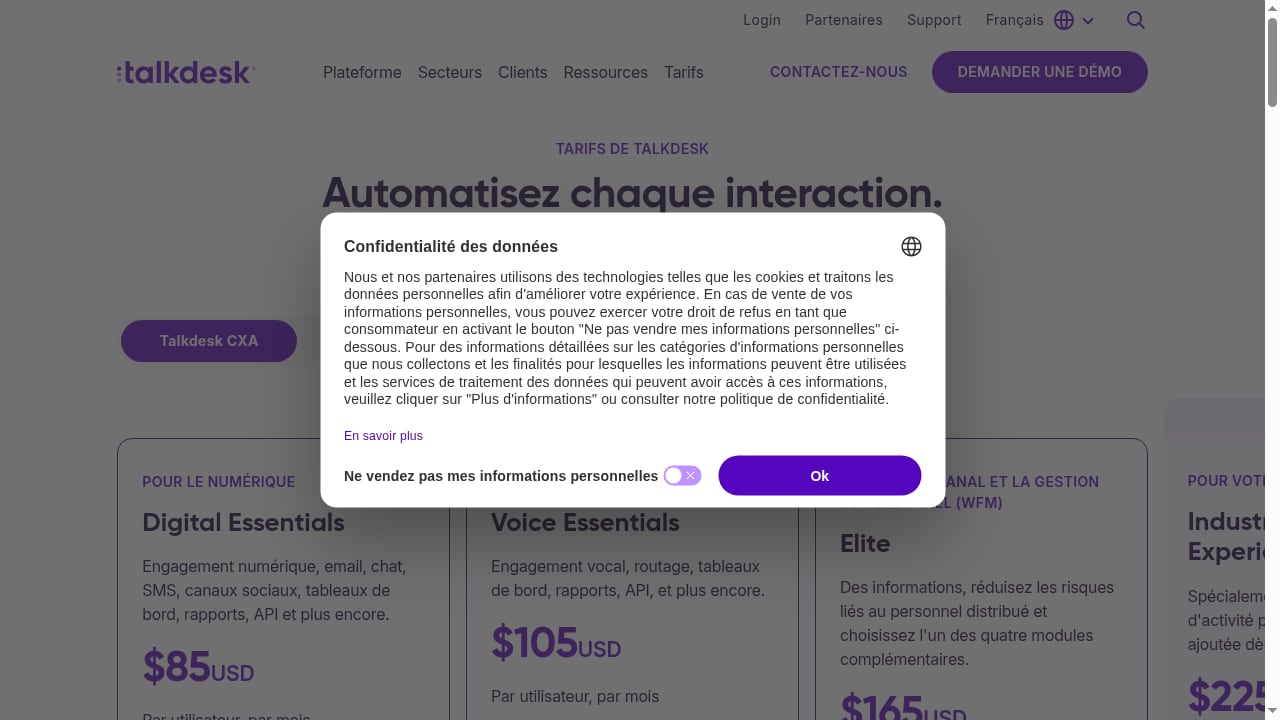
First viewport screenshot of Tarifs des solutions de centre de contact | Talkdesk.
Talkdesk vs. Intercom
Intercom is stronger for product-led SaaS companies that prioritize in-app messaging and proactive support. Talkdesk is stronger for voice-heavy contact centers that need enterprise-grade telephony and AI routing. If your support volume is primarily digital and product-related, Intercom may be simpler. If you run a traditional contact center with significant voice volume, Talkdesk wins.
Talkdesk vs. Dialpad
Dialpad offers competitive AI features at generally lower price points, making it attractive for cost-conscious teams. However, Talkdesk's Industry Experience Clouds and deeper enterprise integrations give it an edge for regulated industries like banking and healthcare. See the full Intercom vs Dialpad vs HelpCrunch comparison for more detail.
Talkdesk vs. Ada
Ada focuses on AI-powered customer service automation for digital channels, with strong ecommerce and fintech use cases. Talkdesk is broader, covering voice and digital in a unified platform. If you need a specialized AI agent for digital self-service, Ada may be simpler. If you need a full contact center with AI, Talkdesk is the more complete option.
Decision Criteria: Should You Buy Talkdesk?
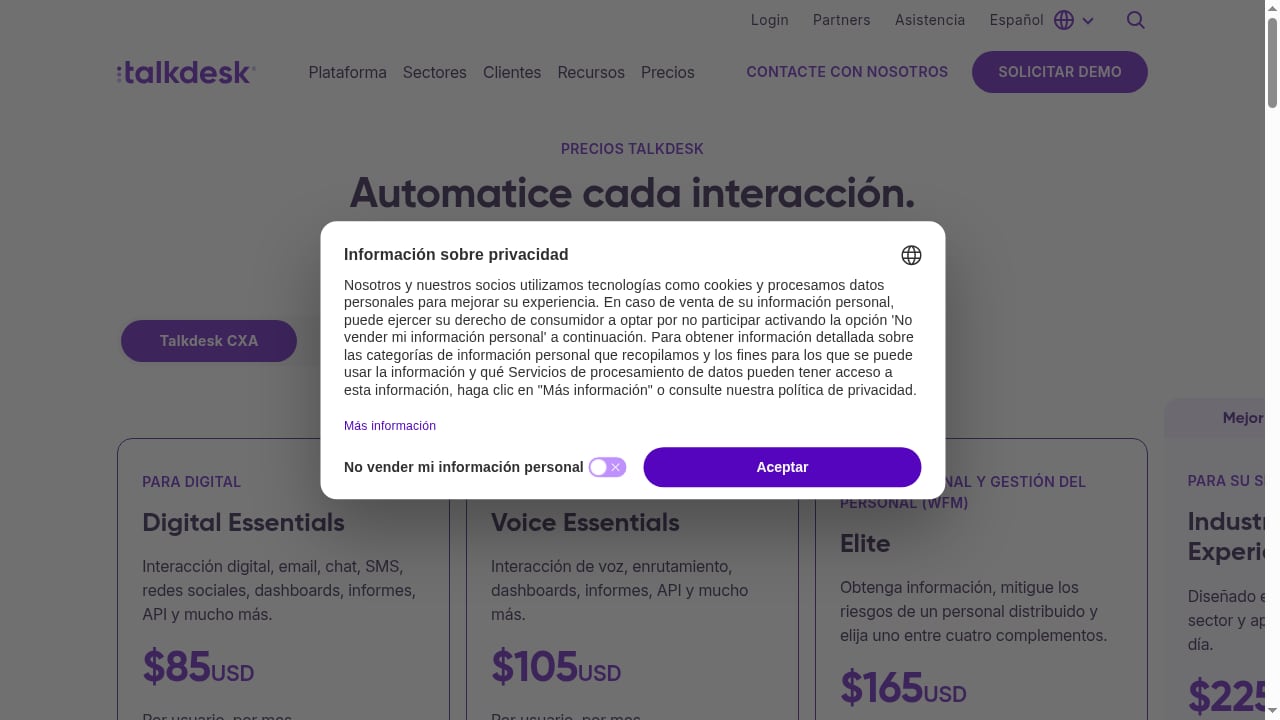
First viewport screenshot of Precios del Software para Centro de Contacto | Talkdesk.
Ask yourself these questions before committing:
What percentage of your interactions are voice? If voice is more than 40% of volume, Talkdesk's telephony depth matters. If you are digital-first, lighter tools may suffice.
How many systems are you consolidating? If you are replacing 5+ tools, Talkdesk's unified platform delivers real ROI. If you only need one or two capabilities, you may be overpaying.
Is your team ready for AI orchestration? Autopilot requires knowledge base investment and intent design. Without that groundwork, AI resolution rates will disappoint.
What is your budget transparency tolerance? If you need published pricing to get internal approval, Talkdesk's custom quote process may frustrate you.
What industry are you in? Regulated industries benefit most from Talkdesk's Industry Experience Clouds and compliance features.
Related reading
- Intercom vs WotNot vs ClearFeed: 2026 Comparison - Compare Intercom, WotNot, and ClearFeed on AI capabilities, channels, pricing, and ideal use cases. Find the right customer service platform for your team.
- Intercom vs Yuma AI: Which Support AI Wins in 2026? - Compare Intercom and Yuma AI on AI resolution, pricing models, channels, ecommerce fit, and scalability. See which customer service platform fits your team.
Sources and further reading
- Read Customer Service Reviews of talkdesk.com - Trustpilot - Join the 871 people who've already reviewed Talkdesk. Your experience can help others make better choices.
- Talkdesk Reviews - Hear from our Customers | Talkdesk - Read Talkdesk reviews on numerous review sites such as G2 & TrustRadius. Discover why we're the highest-rated cloud contact center in the industry.
- Talkdesk Reviews & Ratings 2026 | Gartner Peer Insights - Explore 934 in-depth Talkdesk reviews and insights from real users verified by Gartner, and choose your business software with confidence.
Frequently Asked Questions
Is Talkdesk worth the price?
For mid-market and enterprise contact centers consolidating multiple tools and ready to invest in AI automation, yes. The platform's ability to replace legacy telephony, IVR, WFM, and analytics tools in one system delivers measurable ROI. For small teams or digital-only support operations, the price may be hard to justify.
How much does Talkdesk actually cost?
Published pricing starts at $85 per user per month for digital essentials. Most voice and AI-enabled deployments require custom quotes, typically ranging from $100 to $200+ per user per month depending on features, volume, and industry.
Does Talkdesk's AI actually resolve issues without humans?
Yes, for well-defined, high-volume tasks. Autopilot can handle account inquiries, order status, appointment scheduling, and similar workflows end to end. Success depends on knowledge base quality, intent design, and testing. Organizations that invest in AI configuration see meaningfully higher resolution rates.
How long does Talkdesk take to implement?
Small deployments can go live in 2–4 weeks. Mid-market deployments typically take 4–8 weeks. Enterprise deployments with core system integrations can take 8–16 weeks or more.
What are the most common Talkdesk complaints?
The most frequent complaints in verified reviews are pricing opacity, difficulty debugging end-to-end customer journeys, and inconsistent support experiences. Some users also report that advanced features require significant configuration effort.
Is Talkdesk good for small businesses?
Generally no. The platform is designed for mid-market and enterprise contact centers. Small teams under 10 agents will likely find simpler, more affordable options.
Conclusion
Talkdesk has earned its position as a leader in the contact center space by pushing beyond traditional CCaaS into genuine AI automation. Its Autopilot agents, Copilot assistant, and Navigator routing represent a meaningful step toward the hybrid workforce model—where AI handles routine work and humans focus on judgment and empathy.
The platform is not without friction. Pricing opacity, journey debugging challenges, and implementation complexity are real concerns that verified users raise consistently. But for organizations that need to consolidate legacy systems, automate high-volume interactions, and operate in regulated industries, Talkdesk offers one of the most complete AI-powered contact center platforms available in 2026.
Before you commit, request a proof of concept with your actual use cases. Test Autopilot on your top five call drivers. Ask hard questions about pricing, support SLAs, and implementation timelines. The platform's potential is clear—whether it delivers for your organization depends on fit, readiness, and execution.