Intercom vs Nextiva vs Pylon: 2026 Comparison
Intercom vs Nextiva vs Pylon: Which Support Platform Fits Your Team?
Choosing between Intercom, Nextiva, and Pylon is less about finding a single "best" tool and more about matching the platform to how your team actually works. Intercom leads with an AI-first helpdesk built around its Fin AI Agent. Nextiva unifies phone, contact center, and team messaging into one communications backbone. Pylon narrows the focus to B2B support with deep account context. Each solves a different problem well.
This comparison breaks down the three platforms across AI capabilities, channels, pricing signals, and ideal use cases so you can make a decision without sitting through three separate demos first.
How the Three Platforms Position Themselves
Pylon product interface.
Before diving into features, it helps to understand the core promise each vendor makes.
Intercom positions itself as an AI-first customer service platform for the AI Agent era. The platform combines a shared inbox, Fin AI Agent, and proactive messaging tools. Intercom targets businesses that want to automate a meaningful share of support conversations while keeping human agents available for complex issues. It is built for SaaS companies, ecommerce brands, and any business that lives inside a product or app.
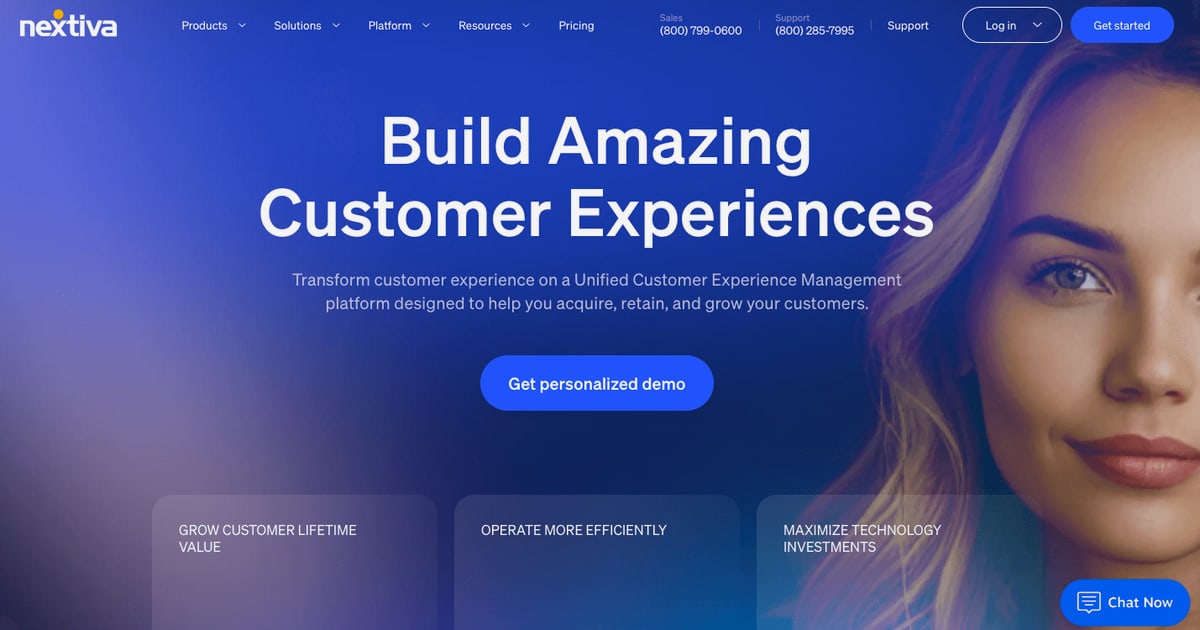
Nextiva comes from the voice and unified communications world. Its pitch is consolidation: business phone, contact center, AI receptionist, video meetings, and team messaging in one system. Nextiva suits organizations where phone support is still a primary channel and where internal communication and customer communication need to share infrastructure.
Pylon is purpose-built for B2B companies. Instead of trying to serve every industry, Pylon focuses on support and customer success teams that manage long-term, high-value accounts. Its differentiator is account intelligence: every ticket carries the full context of the customer relationship, from usage data to renewal risk.
AI Capabilities Compared

Pylon product interface.
AI is now the deciding factor for most support platform evaluations. Here is how each vendor approaches it.
Intercom: Fin AI Agent and Agent Copilot
Intercom's Fin AI Agent is designed to resolve customer questions without human involvement. Fin learns from your help center, past conversations, and internal knowledge to answer questions across chat, email, and in-app messaging. When Fin cannot resolve an issue, it escalates to a human agent with full conversation context.
Intercom also offers Fin AI Copilot, which assists agents during live conversations by suggesting responses, summarizing long threads, and pulling relevant knowledge base articles. The platform's AI Insights feature surfaces trends from resolved conversations, helping teams spot recurring issues before they become support backlogs.
For teams already committed to an AI-first workflow, Intercom's native integration between Fin and the shared inbox removes the friction of bolting a chatbot onto a separate helpdesk. The tradeoff is cost: Intercom charges per AI resolution on top of seat fees, which can add up quickly for high-volume teams.
Nextiva: XBert AI Employee and AI Receptionist
Nextiva approaches AI from a workflow automation angle. Its XBert AI employee is trained on your business's own data and can handle routine tasks across voice, chat, and email. The AI Receptionist answers calls, routes inquiries, and handles common requests without a human picking up the phone.
Nextiva's AI Agent Assist provides real-time guidance to agents during calls and chats, suggesting next steps and pulling customer history automatically. Because Nextiva owns the voice infrastructure, its AI features extend naturally to phone-based workflows, which is a meaningful advantage for businesses where calls dominate.
The platform emphasizes reliability alongside AI, with a stated 99.999% uptime commitment and 24/7 support. For organizations that cannot afford dropped calls or downtime, that infrastructure focus matters.
Pylon: AI Agents Built for B2B Workflows
Pylon ships multiple AI agents, each scoped to a specific job: Assist for agent support, Background for autonomous ticket work, Slack for internal team assistance, and a Support Agent for customer-facing resolution. This division of labor reflects Pylon's belief that B2B support requires more than a single general-purpose bot.
Pylon's self-writing knowledge base is a notable feature. Instead of requiring teams to manually maintain help articles, Pylon drafts and updates documentation based on resolved tickets and agent input. For B2B teams drowning in tribal knowledge, this reduces one of the most persistent maintenance burdens.
The platform's account intelligence layer connects every ticket to the broader customer relationship. Agents see product usage, support history, and account health signals directly in the ticket view. This context is hard to replicate in general-purpose platforms like Intercom, which treat each conversation as a discrete unit rather than part of an ongoing account journey.
Channel Coverage and Omnichannel Depth

Pylon product interface.
Channel support reveals a lot about each platform's intended audience.
Intercom excels at digital-first channels: live chat, in-app messaging, email, and a help center. Phone support exists but is not the platform's center of gravity. For SaaS products where users live inside the app, Intercom's in-app messenger and product tours are hard to match.
Nextiva is the strongest on voice. Business phone, contact center, and AI receptionist features are native, not bolted on. Team messaging and video meetings round out the internal communication side. If your support operation is phone-heavy or you want one vendor for both internal and external communication, Nextiva's breadth is compelling.
Pylon covers the channels B2B customers actually use: Slack, Microsoft Teams, Discord, Telegram, WhatsApp, phone, SMS, chat widget, and email. The Slack and Teams integrations are particularly deep, allowing support to happen where B2B customers already work. This is a meaningful differentiator for companies whose customers expect support inside their own collaboration tools rather than a separate portal.
Pricing Signals and Cost Structure

Pylon product interface.
Pricing transparency varies across the three vendors, but the structural differences are clear.
Intercom uses outcome-based pricing with Essential, Advanced, and Expert plans. Seat pricing starts around $29 per seat per month, with an additional charge per AI resolution. For teams that successfully deflect a high percentage of tickets to Fin, the per-resolution cost is offset by reduced agent workload. For teams with unpredictable volumes, the variable cost can be harder to forecast. Intercom offers a free trial, which makes evaluation straightforward.
Nextiva has historically positioned itself as a value play in unified communications, with promotional offers like up to 12 months free for switching. Pricing varies by plan and feature tier, but the bundled nature of the platform means you are paying for communications infrastructure plus contact center capabilities. For businesses replacing separate phone, video, and support tools, the consolidated cost can be lower than the sum of parts.
Pylon does not publish straightforward pricing, reflecting its enterprise B2B focus. The platform is trusted by over 1,500 B2B companies, and its pricing is typically customized based on seat count, channel mix, and AI usage. Teams evaluating Pylon should expect a sales conversation rather than a self-serve checkout.
For a deeper look at how Intercom's pricing model compares to other AI-first platforms, see our Intercom vs Dialpad comparison.
Where Each Platform Wins
Choose Intercom When
- Your support volume is heavily digital: chat, email, and in-app messaging
- You want a natively integrated AI agent rather than a third-party add-on
- Your product is a SaaS app where in-app engagement drives retention
- You are willing to pay per AI resolution in exchange for automation depth
Intercom's strength is the tight coupling between Fin, the shared inbox, and proactive messaging. If your team already manages conversations in a shared inbox and wants to layer AI on top without changing tools, Intercom is a natural fit.
Choose Nextiva When
- Phone support is a primary or growing channel
- You want to consolidate business phone, video, messaging, and contact center into one vendor
- Uptime and reliability are non-negotiable requirements
- Your team spans customer support and internal communications
Nextiva's unified communications heritage means it handles voice better than most support-first platforms. For service businesses, healthcare providers, and professional services firms where calls drive customer relationships, Nextiva's AI receptionist and call routing solve problems that chat-centric tools ignore.
Choose Pylon When
- You are a B2B company managing long-term customer accounts
- Support and customer success teams need shared account context
- Your customers expect support inside Slack or Microsoft Teams
- You want AI agents scoped to specific B2B workflows rather than one general-purpose bot
Pylon's account intelligence and B2B-native design make it the strongest choice for companies where support is part of a broader customer success motion. The platform's focus on end-to-end resolution within account context is difficult to replicate with general-purpose tools.
What the Comparison Misses
No three-way comparison can capture every nuance. Here are a few factors worth testing in your own evaluation:
Intercom's per-resolution pricing can be either a feature or a bug depending on your deflection rate. Run a pilot with real ticket volume before committing.
Nextiva's breadth means depth varies by feature. Its contact center is solid, but teams looking for deep B2B account intelligence will find Pylon more specialized.
Pylon's B2B focus is a strength for B2B companies and a limitation for everyone else. If you sell to consumers or run a high-volume ecommerce operation, Pylon's account-centric model adds complexity without proportional benefit.
For teams weighing Intercom against other support-first platforms, our Intercom vs Freshdesk comparison covers a different set of tradeoffs around ticketing depth and pricing.
Related reading
- Dashly Review 2026: AI Revenue Platform Tested - In-depth Dashly review covering AI agents, lead qualification, pricing signals, setup, limitations, and who should buy it in 2026.
- Intercom vs Talkdesk vs Freshdesk: 2026 Comparison - Compare Intercom, Talkdesk, and Freshdesk on AI resolution, pricing, channels, and ideal use cases. Find the right customer service platform for your team.
Sources and further reading
- 35 Best Customer Support Tools To Build a Scalable Support Stack - Improve your CSAT scores with the best customer support tools. Explore scalable software that automates ticket processing and delights your customers.
- 12 Best Customer Communication Tools for Teams in 2026 - The best customer communication tools improve your team's productivity and your customer satisfaction. Here are our top choices.
- Paid and Free Zendesk Alternatives - Top Picks in 2026 - Explore modern Zendesk alternatives that use native AI to deflect up to 80% of tickets and turn customer support into a growth engine.
Frequently Asked Questions
Is Intercom cheaper than Nextiva or Pylon?
It depends on volume. Intercom's base seat pricing is competitive, but the per-AI-resolution charge can make total cost unpredictable for high-volume teams. Nextiva's bundled pricing often works out lower when you are replacing multiple communication tools. Pylon's custom pricing requires a sales conversation, so direct comparison is difficult without a quote.
Can Nextiva replace Intercom for SaaS support?
Nextiva can handle chat and email support, but its strengths lie in voice and unified communications. SaaS teams that rely on in-app messaging, product tours, and deep product integrations will find Intercom more purpose-built for those workflows. Nextiva is a better fit when phone support and internal communication share the same infrastructure needs.
Does Pylon work for non-B2B companies?
Pylon is explicitly designed for B2B support and customer success teams. Its account intelligence, Slack-native workflows, and multi-agent AI architecture assume long-term customer relationships with named accounts. Consumer-facing or high-volume transactional support teams would likely find the platform's B2B focus misaligned with their needs.
Which platform has the strongest AI agent?
Intercom's Fin AI Agent is the most mature general-purpose AI agent among the three, with deep integration into the helpdesk and a track record across 30,000+ brands. Pylon's multi-agent approach is more specialized for B2B workflows. Nextiva's XBert AI employee excels at voice-based automation and workflow tasks. The "strongest" agent depends on what you need it to do.
Do all three platforms offer a free trial?
Intercom offers a free trial. Nextiva's trial availability varies by plan and promotion. Pylon typically requires a demo and sales conversation rather than a self-serve trial. Check current vendor pages for the most up-to-date trial policies.
The Bottom Line
Intercom, Nextiva, and Pylon solve three different problems. Intercom automates digital-first customer service with a tightly integrated AI agent. Nextiva consolidates voice, video, messaging, and contact center into one reliable platform. Pylon gives B2B teams the account context and workflow-specific AI agents they need to support long-term customer relationships.
The right choice depends on your channels, your customer model, and how much of your support volume you want AI to absorb. Run a pilot with real ticket data, measure deflection and resolution rates, and let the numbers guide the decision rather than the feature list.