Intercom vs OTRS vs Chatwoot: 2026 Comparison
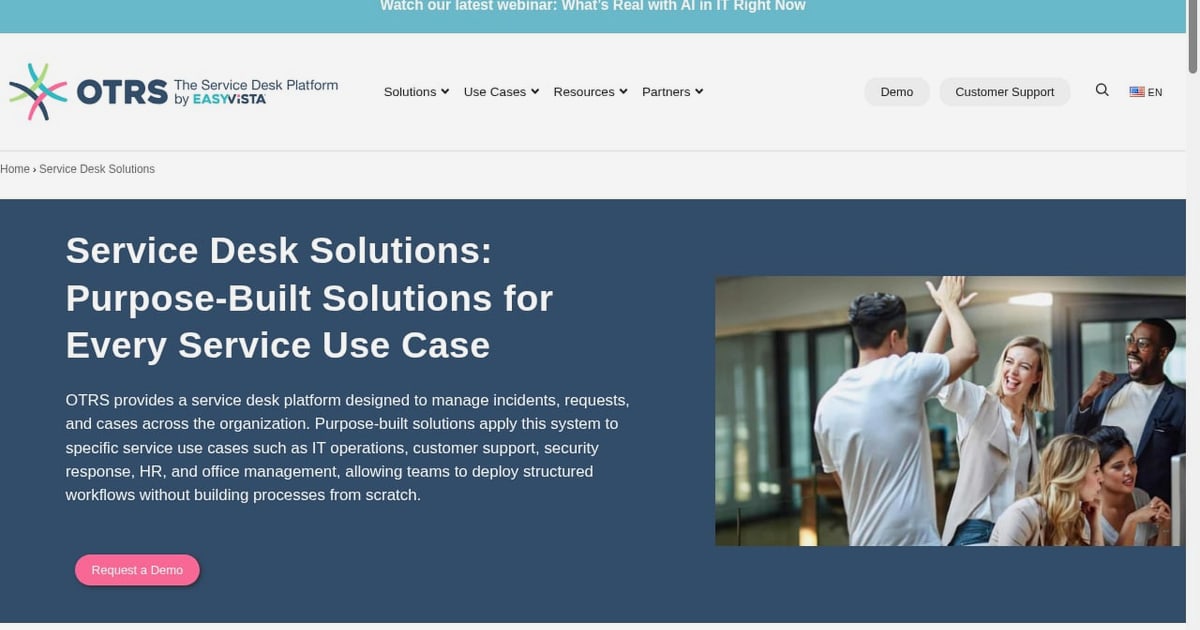
Intercom vs OTRS vs Chatwoot: Which Platform Fits Your Support Team?
Choosing between Intercom, OTRS, and Chatwoot comes down to one question: what is your support operation actually trying to solve? Intercom leads with an AI-first customer service experience built around its Fin AI Agent. OTRS brings deep IT service management (ITSM) and workflow automation to organizations that need structured, compliant processes. Chatwoot offers an open-source, privacy-focused alternative with a built-in AI assistant called Captain and full self-hosting control.
This comparison breaks down the strengths of each platform across the criteria that matter most: AI capabilities, channel coverage, customization, pricing model, and ideal use cases.
Quick Verdict
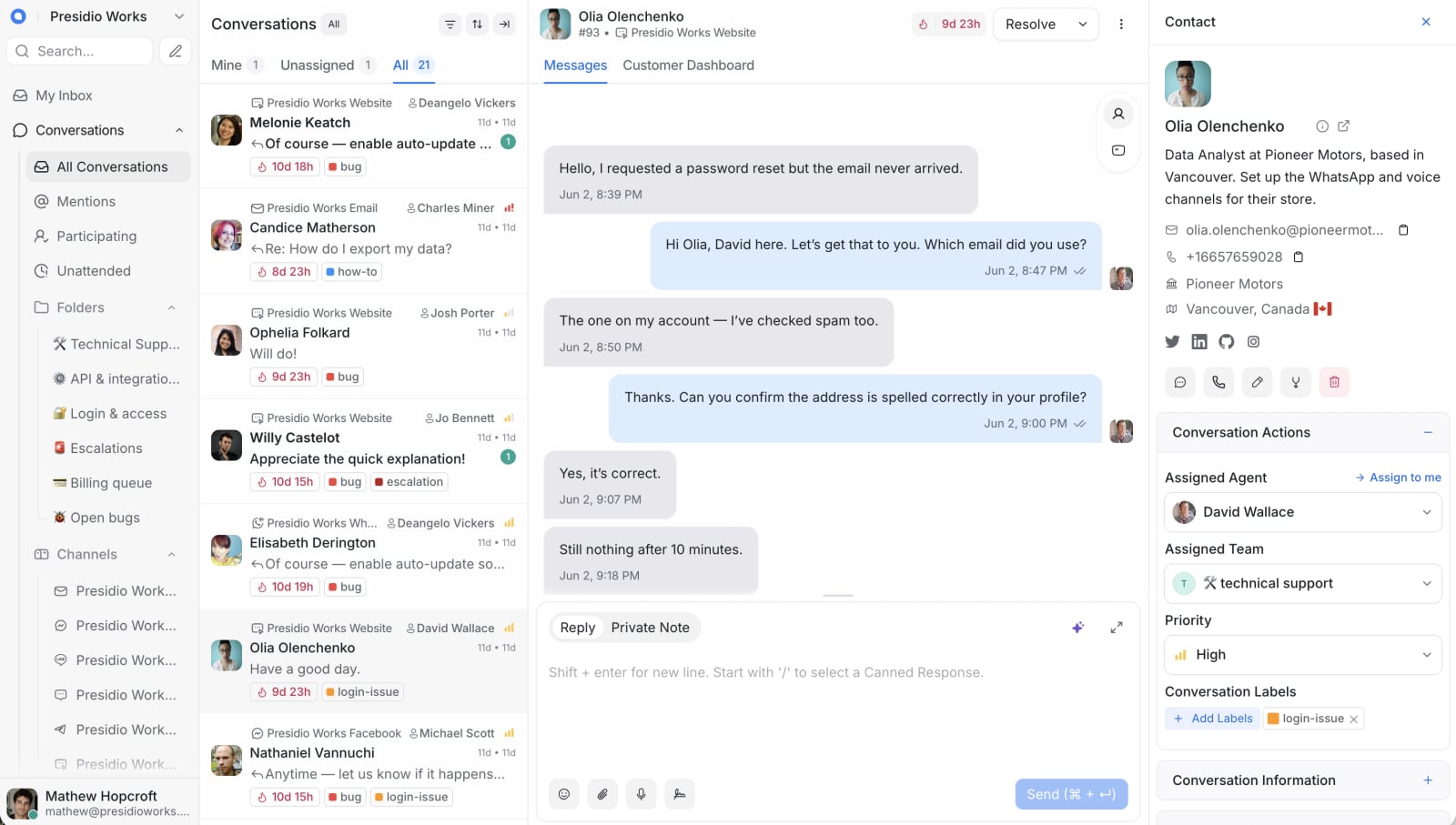
Chatwoot dashboard showing a customer conversation.
- Choose Intercom if you want a polished, AI-first helpdesk where the Fin AI Agent resolves a high percentage of conversations automatically and your team works primarily across live chat, email, and in-app messaging.
- Choose OTRS if you need a flexible service management platform spanning ITSM, HR, and customer service with strong workflow automation, asset management, and integration into enterprise tools like SAP and Salesforce.
- Choose Chatwoot if you want an open-source, self-hostable omnichannel inbox with full data ownership, a free tier, and an AI assistant that learns from your own help center and chats.
AI Capabilities Compared
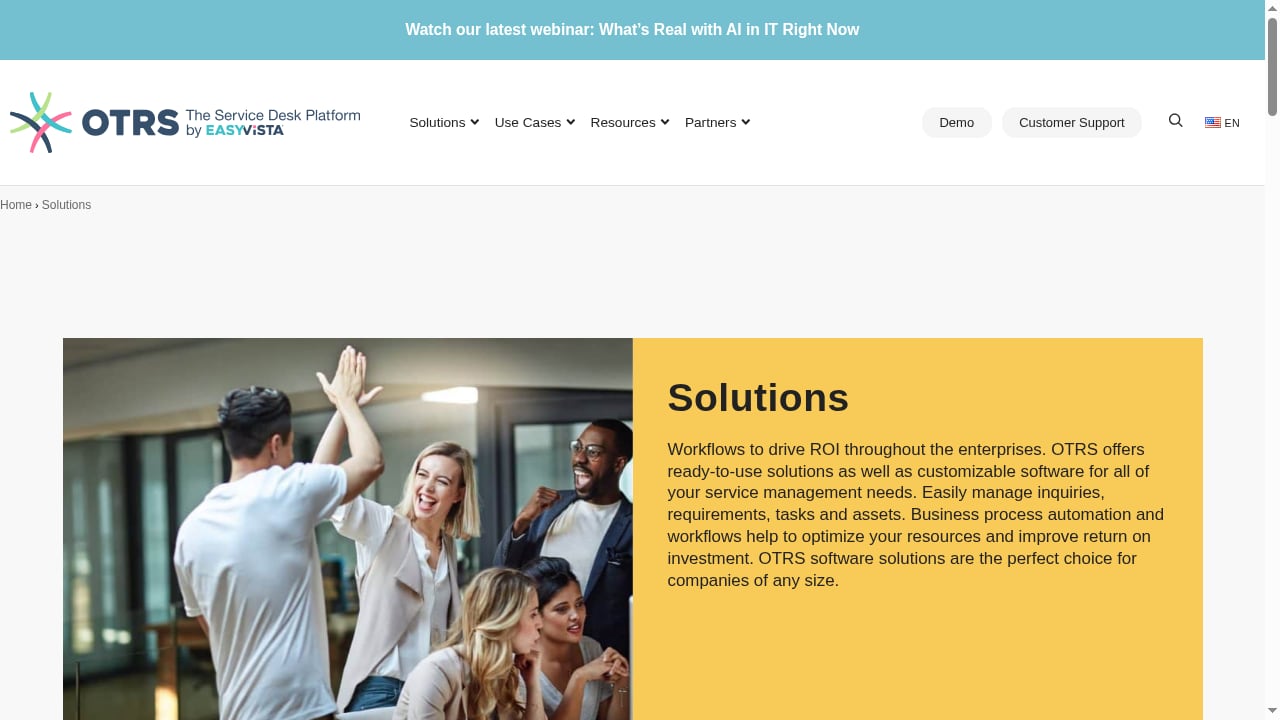
First viewport screenshot of Solutions.
Intercom: Fin AI Agent and AI-First Design
Intercom positions itself as an AI-first customer service platform, and the centerpiece is Fin, its natively integrated AI Agent. Fin is designed to resolve customer questions instantly by drawing on your existing help center content, past conversations, and internal knowledge. Rather than bolting AI onto a legacy ticketing system, Intercom built the helpdesk around the AI Agent experience.
Support teams also get Fin AI Copilot, an assistant that drafts replies, summarizes long conversations, and suggests next actions for human agents. AI Insights then surfaces trends, gaps in your knowledge base, and emerging customer issues without requiring a data analyst.
For teams that want to deflect repetitive questions before they reach a human, Intercom's AI resolution rate is the primary selling point. The platform also supports outbound messaging, so you can proactively reach customers with product updates, onboarding nudges, or re-engagement campaigns.
Chatwoot: Captain AI Assistant
Chatwoot's AI assistant, Captain, takes a more assistive approach. Captain learns from your help center articles, past chat transcripts, and FAQs to suggest answers and draft responses for agents. It can also automate replies to common questions, reducing the volume of tickets that require human attention.
Because Chatwoot is open source, you can inspect how Captain works, extend it, or integrate your own AI models. For privacy-conscious teams, this is a meaningful advantage: the AI can run entirely within your own infrastructure when self-hosted, keeping customer data under your control.
Captain is newer and less battle-tested than Fin at enterprise scale, but for small and mid-sized teams it offers a capable AI assistant without the premium pricing of an AI-first platform.
OTRS: AI-Assisted Workflow Automation
OTRS approaches AI from a process-management angle. Its AI-powered automation focuses on ticket classification, AI-assisted summaries, and routing inquiries to the right team or queue. This is less about conversational AI resolving customer chats and more about reducing manual triage work inside a structured service management workflow.
For IT teams handling incidents, change requests, and service requests, OTRS's AI features help agents work faster without replacing the structured processes that ITSM requires.
Channel and Omnichannel Coverage
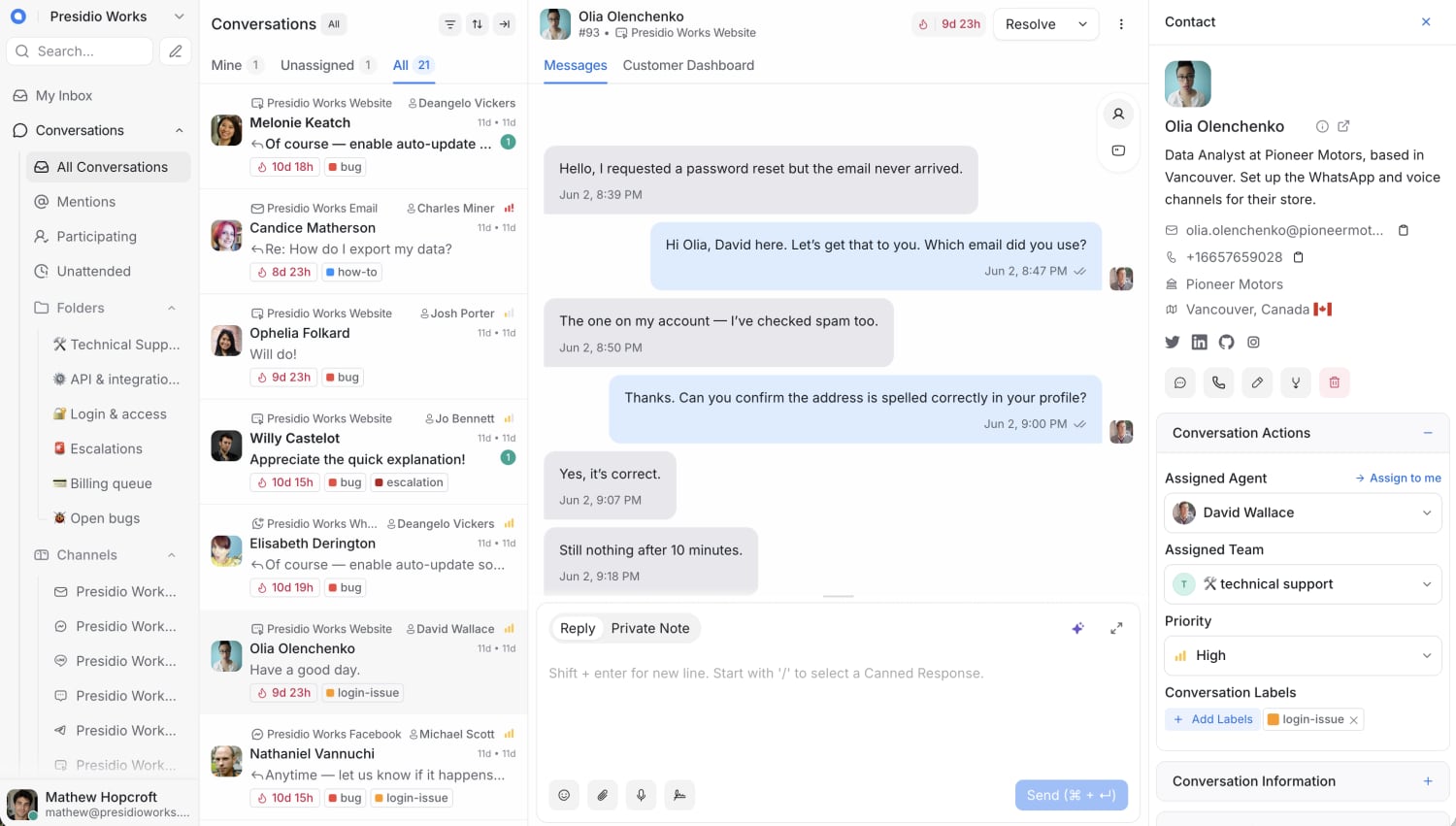
Chatwoot dashboard showing a customer conversation.
Intercom: Live Chat, Email, In-App, and Phone
Intercom excels at conversational channels. Its shared inbox unifies live chat, email, in-app messaging, and phone support. The in-app messenger is a standout feature: it lets you embed contextual support directly inside your product, which is why SaaS companies gravitate toward Intercom.
If your support strategy centers on real-time conversations with customers inside your product, Intercom's channel mix is hard to beat.
Chatwoot: Broad Messaging Coverage Including WhatsApp and Social
Chatwoot's omnichannel inbox covers live chat, email, WhatsApp, Instagram, Facebook, and voice calls from a single dashboard. This broad social and messaging coverage makes Chatwoot particularly attractive for e-commerce brands, agencies, and businesses that serve customers on the channels they already use daily.
Chatwoot's open-source nature also means the community frequently contributes new channel integrations. For teams that need WhatsApp-first support or social media inbox management, Chatwoot is a strong contender.
OTRS: Multi-Domain Service Management
OTRS is not primarily a live chat tool. Its strength lies in consolidating inquiries, incidents, requests, tasks, and assets from multiple service domains — IT, HR, customer service, and cyber defense — into one system. Email and web forms are the primary intake channels, with the option to add chat through integrations.
If your organization needs one platform to manage IT incidents, HR requests, and customer inquiries with consistent processes, OTRS provides that unified visibility.
Customization and Control
Chatwoot: Full Data Ownership and Self-Hosting
Chatwoot's biggest differentiator is self-hosting. You can deploy Chatwoot on your own servers, giving you complete control over customer data, privacy, and infrastructure. This matters for organizations in regulated industries, government agencies, or any business that cannot store customer conversations on third-party US-based servers.
Chatwoot also offers custom branding, role-based access control, SLA policies, and SSO/SAML integration. The MIT license means you can modify the code to fit your exact workflows.
OTRS: Flexible Configuration and Enterprise Integrations
OTRS is built for customization at the process level. You can configure workflows, queues, service catalogs, and automation rules to match how your organization actually operates. Out-of-the-box integrations with SAP, Salesforce, VirusTotal, VMRay, and Joe Security make it a natural fit for enterprise environments with existing tooling.
OTRS emphasizes compliance with international standards and rapid time-to-value, with ITSM deployments possible in days rather than months.
Intercom: Polished Out-of-the-Box Experience
Intercom prioritizes a refined, ready-to-use experience over deep customization. The platform is designed to be adopted quickly, with pre-built workflows, a clean agent interface, and an integrated Help Center. If you want to minimize setup time and get AI-powered support running fast, Intercom's opinionated design is an advantage.
For teams that need to heavily customize the underlying system or self-host, Intercom is less flexible than the alternatives.
Pricing and Total Cost of Ownership
Chatwoot: Free Tier and Open-Source Economics
Chatwoot offers a free tier for up to two agents, making it the lowest-barrier entry point of the three. Paid cloud plans scale with team size, and self-hosting eliminates per-agent subscription costs entirely — though you'll need to manage your own infrastructure, updates, and security.
For startups, agencies, and budget-conscious teams, Chatwoot's pricing model is compelling.
OTRS: Low Barrier with Upgrade Paths
OTRS positions itself with a low barrier to entry and clear upgrade paths to advanced solutions. The company serves over 12,000 organizations and emphasizes ROI through business process automation. Pricing is typically quote-based and scales with the modules and service domains you deploy.
Intercom: Outcome-Based Pricing
Intercom uses outcome-based pricing across Essential, Advanced, and Expert plans, with a free trial available. The pricing reflects the platform's AI-first positioning: you pay for the outcomes Fin delivers, not just seats. For high-volume support teams that can deflect a large share of conversations to AI, this can be cost-effective. For smaller teams with lower volume, the per-resolution model may feel expensive compared to Chatwoot's flat pricing.
For a deeper look at how Intercom stacks up against other AI support platforms, see our Intercom vs Ada comparison and the Intercom vs Ada vs Capacity breakdown.
Ideal Use Cases
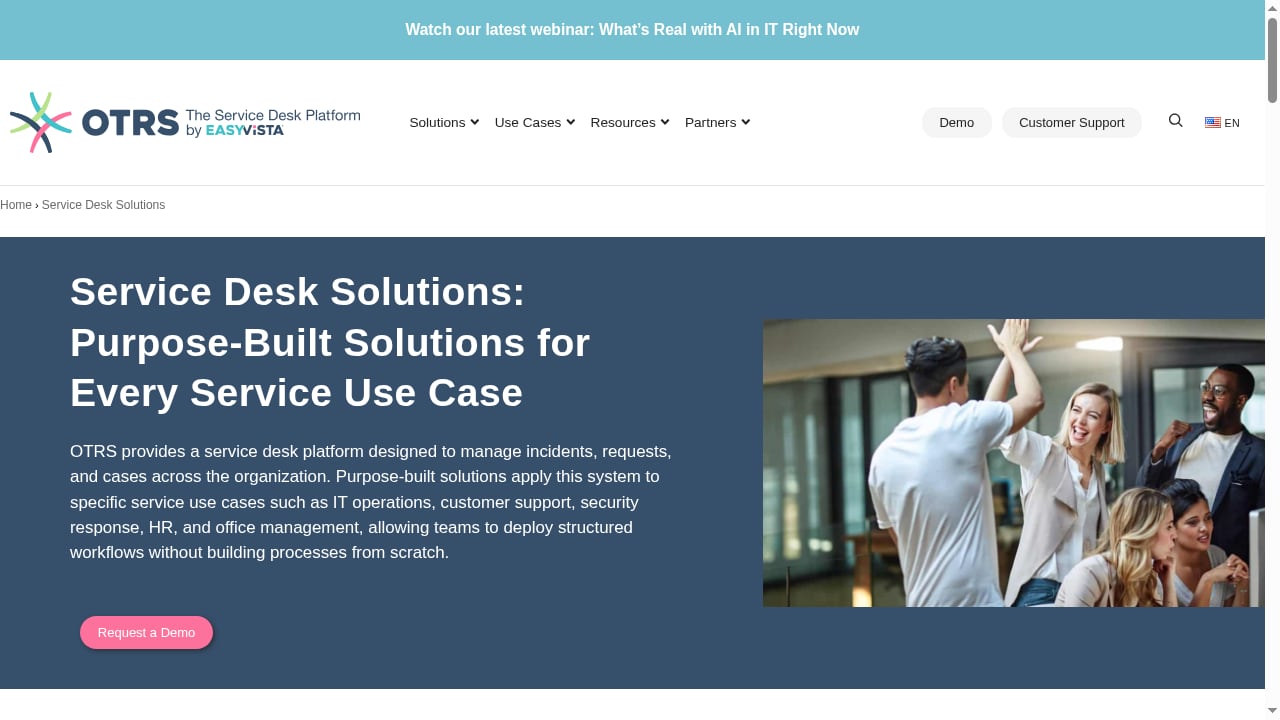
First viewport screenshot of Service Desk Solutions.
When Intercom Wins
- SaaS companies that want in-app messaging and contextual support inside their product
- Teams prioritizing AI resolution rates and automated deflection
- Businesses that want a polished helpdesk with minimal setup time
- Support operations centered on live chat and email conversations
When OTRS Wins
- IT departments that need full ITSM capabilities: incident, change, and asset management
- Enterprises that must integrate support with SAP, Salesforce, or security tools
- Organizations managing multiple service domains (IT, HR, customer service) in one system
- Teams that require compliance with international standards and structured workflows
When Chatwoot Wins
- Privacy-focused organizations that need self-hosting and full data control
- E-commerce and agency teams that support customers on WhatsApp, Instagram, and Facebook
- Startups and small teams that want a free tier or low-cost entry point
- Developers who want to customize their support stack with open-source code
For more context on how service desk platforms fit into a modern support stack, read our service desk platform buyer's guide.
Integration Ecosystems
Integration depth matters as much as built-in features. Intercom connects with a wide range of SaaS tools through its app marketplace, with strong CRM and data platform integrations. Chatwoot's open API and community-driven integrations cover popular messaging apps, CRMs, and e-commerce platforms. OTRS stands out for its enterprise-grade integrations with SAP, Salesforce, and security tools like VirusTotal — connections that matter in large IT environments.
Related reading
- ClickDesk Review 2026: AI Support Platform Tested - Evidence-based ClickDesk review covering AI agents, live chat, pricing signals, setup, limitations, and ideal users. See if ClickDesk fits your team in 2026.
- No-Code AI Agents: 12 Builders Tested for 2026 - Compare the best no-code AI agent builders for 2026, from Pickaxe and n8n to Voiceflow and Botpress. Find the right platform for your use case and budget.
Sources and further reading
- Show HN: Libredesk – Open-source customer support desk. Single binary app - Kudos! We've encountered several customers that hated their help desk but couldn't move away. We've even considered building our own since we were in the business. But here comes the hard and most important part that Zendesk and the like do that makes all the difference: Integration.
- Integrations | Minimal AI - Connect your tools and give your AI customer support agent superpowers. 60+ integrations for helpdesks, e-commerce, shipping, and more.
- Is there an open source live chat/support? - Quora - Sep 12, 2017 ... It is a free and open source software that you can effortlessly integrate into your website or ... Intercom and Zendesk, I think Chatwoot is the ...
Frequently Asked Questions
Is Chatwoot a good alternative to Intercom?
Yes, for many teams. Chatwoot offers omnichannel support, an AI assistant, and a free tier, with the added benefit of self-hosting for full data control. It lacks Intercom's polished in-app messenger and Fin's enterprise-scale AI resolution, but it covers the core support workflow at a fraction of the cost.
Can OTRS replace Intercom for customer support?
It depends on your needs. OTRS is stronger for structured, process-driven service management across IT and HR domains. If your customer support is primarily conversational — live chat, in-app messaging, email — Intercom's interface and AI capabilities are better suited. If you need workflow automation, asset management, and enterprise integrations, OTRS is the stronger choice.
Which platform is best for a small team on a budget?
Chatwoot. The free tier for two agents and affordable paid plans make it the most accessible option. Self-hosting can further reduce costs if you have the technical resources to manage it.
Does OTRS have AI features?
Yes. OTRS includes AI-powered ticket classification, AI-assisted summaries, and workflow automation. These features focus on reducing manual triage and speeding up agent workflows rather than conversational AI resolution.
Can I self-host Intercom?
No. Intercom is a cloud-hosted SaaS platform. If self-hosting is a requirement, Chatwoot is the clear choice among these three.
Conclusion
Intercom, OTRS, and Chatwoot serve different needs, and the right choice depends on your priorities. Intercom delivers the most advanced AI-first customer service experience for conversational support teams. OTRS provides the deepest service management and workflow automation for IT and enterprise environments. Chatwoot offers the most control and cost flexibility for privacy-conscious, budget-aware, and developer-driven teams.
Evaluate your channels, data requirements, and AI ambitions before deciding. If you are still weighing AI support platforms, our Intercom vs Genesys Cloud CX vs Yuma AI comparison explores another set of alternatives.