Intercom vs Replicant: AI Customer Service Platform Comparison
Intercom vs Replicant: Which AI Platform Actually Solves Customer Service?
Choosing between Intercom and Replicant means deciding between two fundamentally different approaches to AI-powered customer service. Intercom is an AI-first customer service platform built for the modern support team. Replicant is a contact center automation tool focused on voice calls. This comparison breaks down their capabilities, strengths, and limitations so you can pick the right tool for your business.
Intercom vs Replicant: Quick Comparison
| Feature | Intercom | Replicant |
|---|---|---|
| Core Focus | AI-first customer service platform | AI contact center voice automation |
| Primary AI | Fin AI Agent, Copilot for agents | Conversational AI for phone calls |
| Channels | Live chat, email, in-app, phone, SMS, social | Phone, with limited chat/messaging |
| Helpdesk | Full shared inbox, ticketing, Help Center | No native helpdesk; integrates with existing CCaaS |
| Self-Service | Integrated Help Center, AI Agent resolution | Voice-based self-service automation |
| Agent Tools | AI Copilot, macros, collision detection | Agent assist features via integration |
| Analytics | AI Insights, CSAT, resolution rate reporting | Real-time call analytics, intent capture |
| Best For | Businesses of all sizes needing a complete AI-first platform | Enterprise contact centers with high voice call volume |
| Pricing Model | Outcome-based (Essential, Advanced, Expert) | Transparent, usage-based pricing |
What Is Intercom?
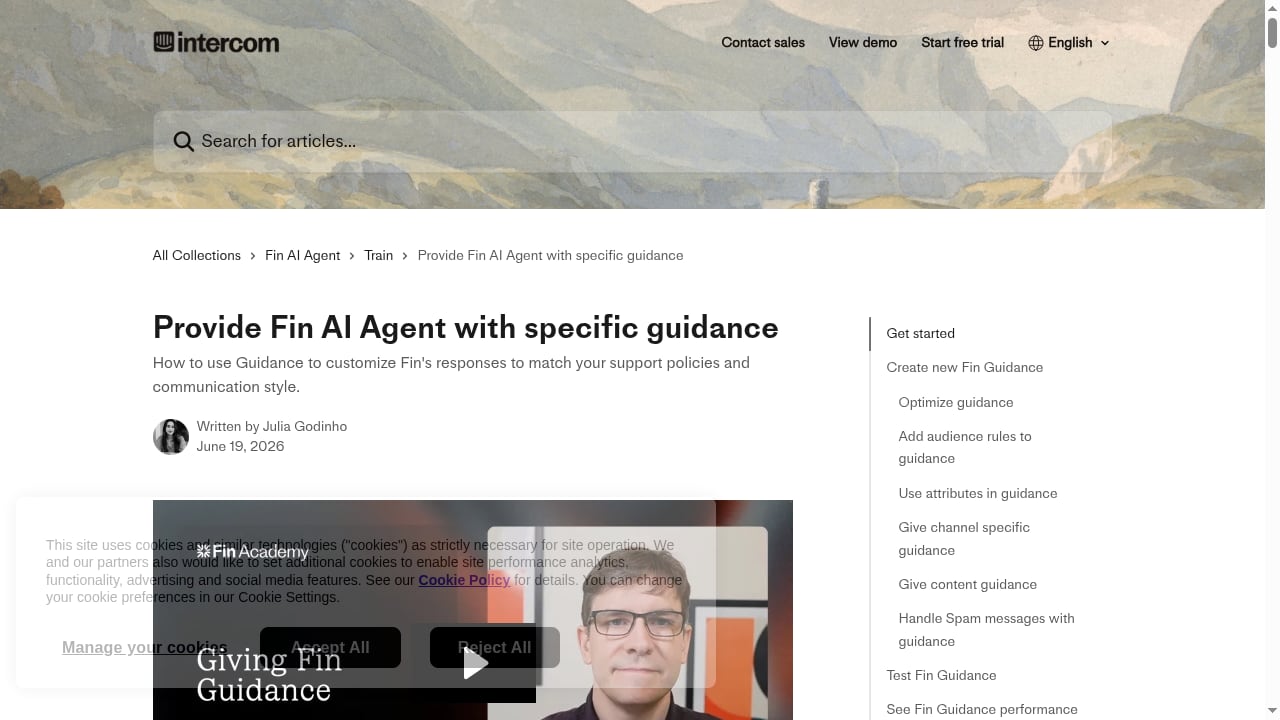
First viewport screenshot of Provide Fin AI Agent with specific guidance | Intercom Help.
Intercom is an AI-first customer service platform designed for the AI Agent era. It combines a powerful helpdesk with a natively integrated AI Agent, Fin, to resolve customer inquiries instantly. Over 30,000 brands trust Intercom to deliver perfect customer experiences across live chat, email, in-app messaging, and phone.
The platform’s standout feature is Fin, an AI Agent that handles routine questions without human intervention. When agents do step in, the AI Copilot assists with suggested replies, summaries, and tone adjustments. Intercom also includes AI Insights for analytics, a shared inbox for team collaboration, and outbound messaging capabilities. It’s a complete system, not just a bot bolted onto existing tools.
For a deeper look at how Intercom leads the market, see our ranking of the Top 10 AI-First Customer Service Platforms in 2026.
What Is Replicant?
Replicant is an AI contact center automation platform that replicates an organization’s best human agents on their best day. It focuses on automating routine customer service calls end-to-end. The platform handles tasks like authentication, intent capture, scheduling, and order verification through conversational AI that understands natural language.
Replicant targets high-volume contact centers in industries like insurance, roadside assistance, financial services, and on-demand delivery. Case studies with AAA, DoorDash, and CorVel demonstrate outcomes such as a 50% reduction in handle time and automation of over 350,000 calls per day. The platform integrates with existing contact center infrastructure rather than replacing it.
Key Differences Between Intercom and Replicant
Replicant pricing | Flexible AI for scalable customer support.
Platform Scope: Complete Platform vs Point Solution
Intercom provides a full customer service platform. You get a shared inbox, ticketing, a Help Center, AI Agent, AI Copilot, and multi-channel support in one system. This unification means one platform, one inbox, one bill—a strategy we explore in our guide on One Platform. One Inbox. One Bill.
Replicant is a point solution for voice automation. It excels at automating phone calls but doesn’t offer a native helpdesk, ticketing system, or self-service knowledge base. You must integrate it with your existing contact center platform. This adds complexity and cost if you need a full-service solution.
AI Capabilities: Fin AI Agent vs Voice-First Automation
Intercom’s Fin AI Agent works across chat, email, and messaging channels. It resolves up to 50% of common questions instantly, using your existing Help Center content. Fin 2 introduces customizable answers, tone matching, and multi-step workflows. The AI Copilot supports human agents with real-time suggestions.
Replicant’s AI focuses on voice. It understands natural language, captures intent, and resolves issues over the phone without human intervention. This is powerful for call-heavy operations but leaves text-based channels underserved. Replicant’s AI doesn’t offer the same depth of agent-assist features or multi-channel flexibility as Intercom.
Channel Support: Omnichannel vs Voice-Centric
Intercom supports live chat, email, in-app messaging, phone, SMS, and social media. Customers reach you on their preferred channel, and the AI Agent works across all of them. This omnichannel approach ensures consistent experiences everywhere.
Replicant centers on voice automation. While it offers some chat and messaging capabilities, its core strength remains phone calls. If your customers primarily use digital channels, Replicant’s voice-first design may leave gaps in your support strategy.
Deployment and Ease of Use
Intercom offers a free trial and rapid onboarding. Teams can set up the platform, configure the AI Agent, and start resolving conversations within days. The interface is intuitive, and the AI trains on your existing Help Center articles.
Replicant promises deployment in weeks, not months, using pre-built conversational components. However, this still requires integration with your contact center infrastructure and training the AI on your specific call flows. The setup process is more involved than Intercom’s self-serve approach.
Pricing and Value
Intercom uses outcome-based pricing with Essential, Advanced, and Expert plans. You pay based on the value you receive—resolutions delivered by Fin, seats for agents, and advanced features. This model scales with your business.
Replicant offers transparent, usage-based pricing tied to call volume. While this can work for predictable call centers, costs may escalate with seasonal spikes. Intercom’s AI resolves issues before they become calls, potentially reducing your total support volume and cost.
Why Intercom Is the Stronger Choice for Most Teams
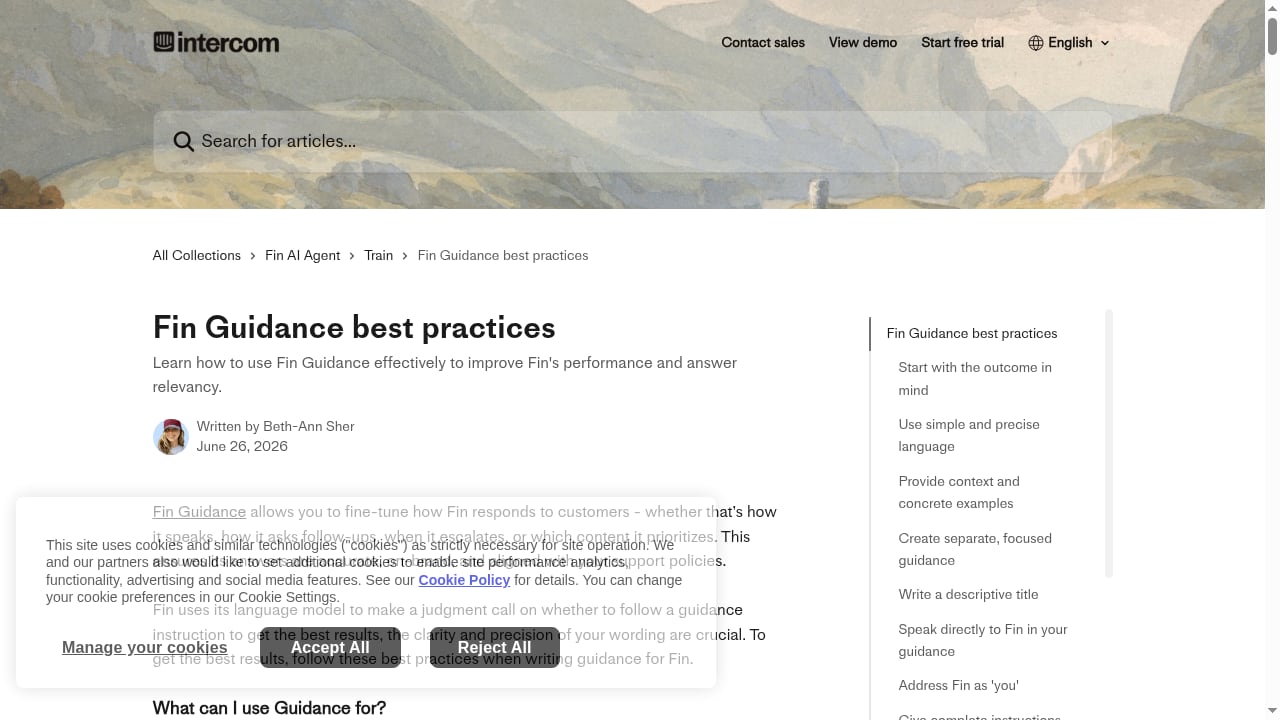
First viewport screenshot of Fin Guidance best practices | Intercom Help.
Intercom’s advantages stem from its AI-first, platform-wide approach:
- Complete platform: Helpdesk, AI Agent, self-service, and analytics in one system. No need to stitch together multiple tools.
- Multi-channel AI: Fin works on chat, email, and messaging, not just voice. Customers get instant help wherever they are.
- Agent empowerment: AI Copilot reduces handle time and improves response quality for human agents.
- Proven scale: Trusted by over 30,000 brands, from startups to enterprises.
- Faster time to value: Free trial, intuitive setup, and AI that trains on your existing content.
For teams comparing AI-native platforms, our Intercom vs Botpress comparison shows why Intercom’s integrated approach wins for customer service.
Where Replicant Fits
Replicant shines in specific scenarios:
- High-volume voice call centers: If phone support dominates your operations, Replicant’s voice automation can reduce handle times and costs.
- Enterprise contact centers: Large organizations with existing CCaaS infrastructure may benefit from Replicant’s integration-first approach.
- Seasonal scaling: Automating routine calls helps absorb spikes without hiring temporary agents.
However, Replicant’s narrow focus becomes a liability if you need a complete customer service platform. It lacks a native helpdesk, multi-channel AI Agent, and self-service knowledge base. You’ll need additional tools to fill these gaps.
When to Choose Intercom Over Replicant
Choose Intercom if:
- You want an AI-first platform that covers all support channels.
- Your customers use chat, email, and in-app messaging more than phone.
- You need a helpdesk with built-in AI Agent and agent tools.
- You value fast setup and a free trial to test before buying.
- You want outcome-based pricing tied to resolutions, not just call volume.
Choose Replicant if:
- Your support is overwhelmingly phone-based with high call volumes.
- You already have a contact center platform and only need voice automation.
- You operate in an industry with complex phone authentication and scheduling needs.
Related reading
- Tidio Review 2025: AI Chat, Lyro Agent & Real-World Results - In-depth Tidio review: We test Lyro AI, live chat, and help desk tools. See real pricing, strengths, limitations, and who should use Tidio in 2025.
Sources and further reading
- NieR Replicant or NieR:Automata ? not asking which is ... - Replicants is more personal and character-driven whereas Automatas is more existential and theme-heavy. Personally, I've always preferred ...
- Compare Contact Center Automation Platforms | Replicant - Picking a Contact Center Automation platform is a complicated process. Use our quick guides to see how Replicant compares against the competition.
- NieR Autómata or Replicant? :: NieR:Automata™ General Discussions - Hi!! I’d really appreciate some guidance from people who have played both NieR games. I’m trying to choose whether to start with NieR Replicant or NieR: Automata, and here are my thoughts so far: - I love games with strong philosophical themes that make me reflect on things like existence, identity, and morality. - I’m not very fond of sci-fi settings or robots.
FAQ: Intercom vs Replicant
Can Intercom handle phone support?
Yes. Intercom supports phone as one of its channels, alongside chat, email, and messaging. The AI Agent and shared inbox work across all channels.
Does Replicant offer a helpdesk?
No. Replicant is a voice automation layer that integrates with existing contact center platforms. It does not provide a native helpdesk, ticketing system, or knowledge base.
Which platform is better for small businesses?
Intercom. Its Essential plan, free trial, and self-serve setup make it accessible for small teams. Replicant targets enterprise contact centers with complex voice needs.
How does Intercom’s Fin AI Agent compare to Replicant’s AI?
Fin resolves questions across chat, email, and messaging using your Help Center content. Replicant’s AI automates phone calls. Fin offers broader channel support and deeper agent-assist features.
Can I use both Intercom and Replicant together?
Technically yes, but it creates tool sprawl. Intercom already supports phone, so adding Replicant for voice-only automation adds unnecessary complexity and cost.
Final Verdict
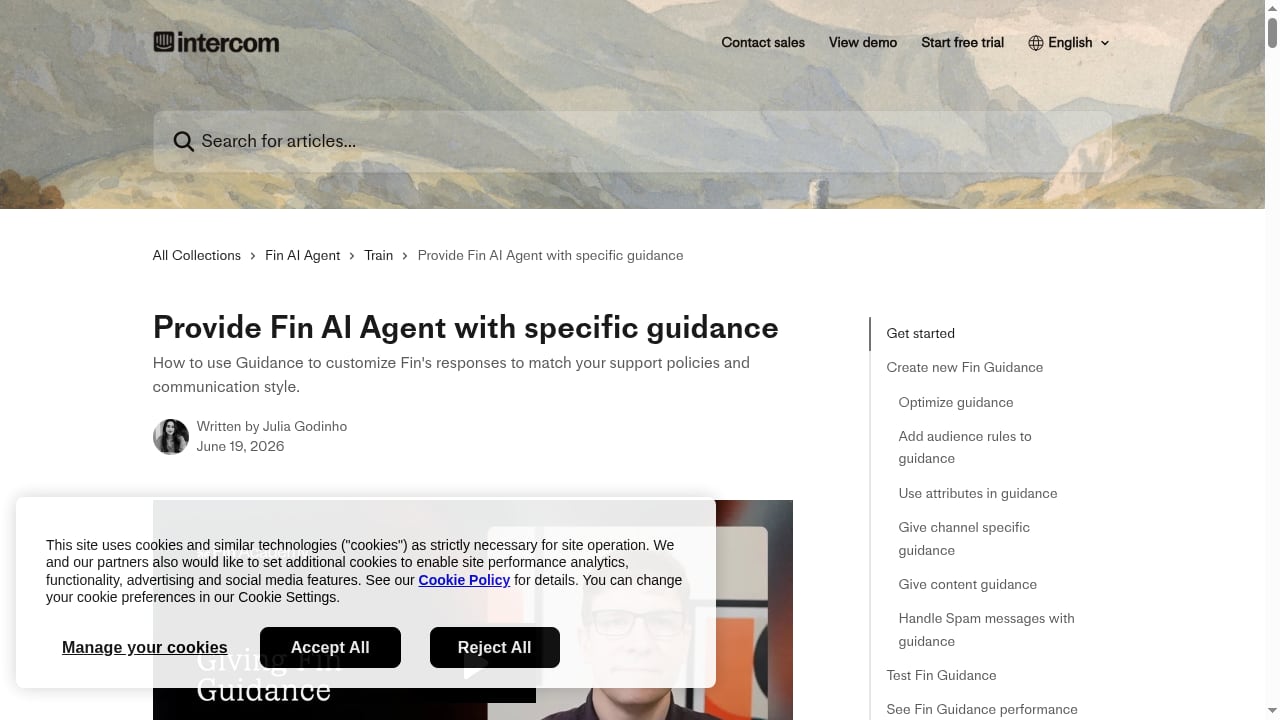
First viewport screenshot of Provide Fin AI Agent with specific guidance | Intercom Help.
Intercom is the more complete, flexible, and future-proof choice for customer service. Its AI-first platform unifies helpdesk, AI Agent, and multi-channel support in a way Replicant’s voice-centric automation cannot match. Unless your needs are strictly limited to high-volume phone call automation within an existing contact center, Intercom delivers more value across the entire customer journey.
For a broader view of how Intercom stacks up against other solutions, explore our Intercom vs Dialpad vs OTRS comparison or see the Top 10 Customer Engagement Platforms in 2026.