Intercom vs Richpanel: AI Customer Service Compared (2026)
Intercom vs Richpanel: AI Customer Service Compared (2026)
Intercom and Richpanel both promise AI that answers customers before a human has to. They get there from opposite directions. Intercom is a general AI-first customer service platform with a natively integrated AI Agent, Fin, built to work across chat, email, in-app messaging, and phone. Richpanel is a helpdesk purpose-built for ecommerce brands, with AI employees layered on top of order and returns workflows.
That difference decides most evaluations. If your tickets are mostly "where is my order" and "can I exchange this," a commerce-native tool looks attractive. If your support spans products, regions, and channels, a platform built around an AI Agent and a shared inbox tends to hold up better as you scale. This comparison walks through where each platform is strong, where the substitute has documented friction, and how to run a fair test on your own tickets.
Quick comparison: Intercom vs Richpanel

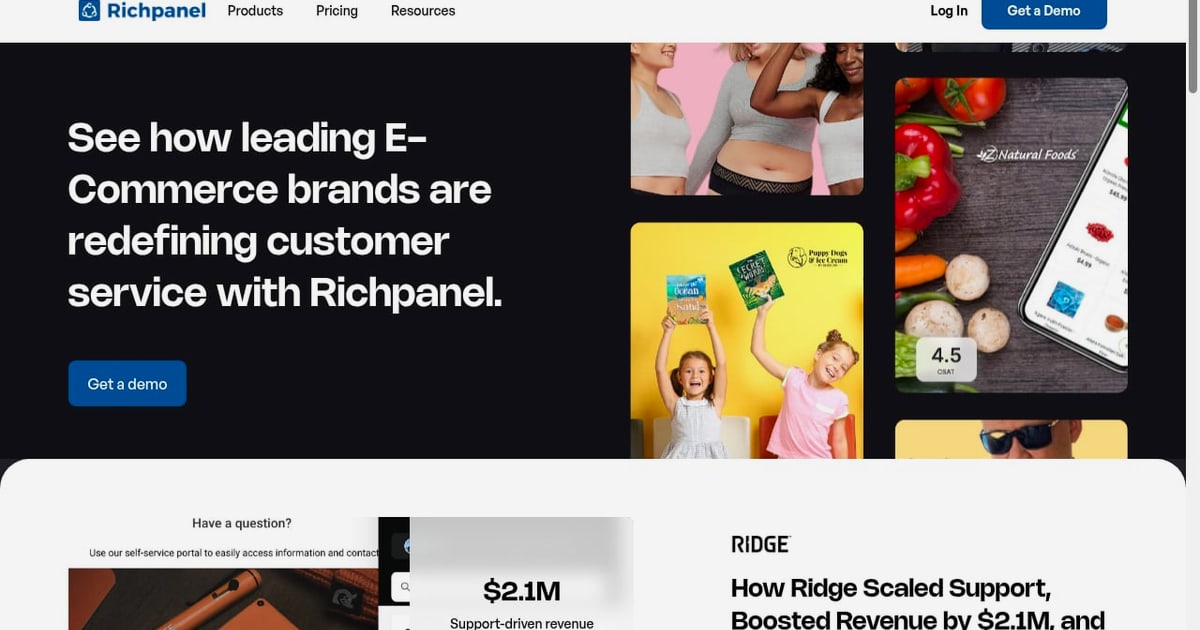
First viewport screenshot of Richpanel: AI-Powered Customer Service Platform for Ecommerce.
| Dimension | Intercom | Richpanel |
|---|---|---|
| Core positioning | AI-first customer service platform for the AI Agent era | AI-powered customer service platform for ecommerce |
| AI agent | Fin, natively integrated into the helpdesk | AI employees that automate repetitive inquiries |
| Channels | Live chat, email, in-app messaging, phone | Email, chat, and social media unified in one dashboard |
| Self-service | Integrated Help Center | Self-service portal with order management and returns |
| Pricing model | Outcome-based: Essential, Advanced, Expert plans, plus per-outcome AI pricing | Subscription per seat, plus per-AI-conversation charges and an AI minimum |
| Best fit | Teams of any size needing multichannel AI support | Ecommerce brands with high order-related ticket volume |
A note on pricing evidence: Richpanel's own comparison page lists Richpanel at $99 per seat per month annually plus roughly $0.20 per AI conversation with a $200 monthly AI minimum, and Intercom Fin at $0.99 per outcome with helpdesk seats starting at $29 per month. Treat those figures as directional and confirm current terms with each vendor before you build a business case.
Where Intercom is strong

First viewport screenshot of Ecommerce Customer Service Case Study | Richpanel.
Fin is part of the platform, not bolted on
Intercom's central claim is that Fin is natively integrated rather than a separate bot you configure and maintain elsewhere. In practice that means the AI Agent shares the same knowledge, workflows, and conversation history as your human team. When Fin hands off, the agent who picks up already has the context.
Richpanel's own evaluation guide acknowledges this architectural point from the other side: Fin can run with Intercom or with another supported helpdesk, so leaving Intercom is not always required to use it. That flexibility cuts both ways, but it does show the AI layer is designed to travel with the platform rather than depend on a single helpdesk.
Breadth beyond ecommerce
Intercom supports live chat, email, in-app messaging, and phone, and pairs that with a shared inbox, Copilot for agents, AI Insights for analytics, and outbound messaging. Richpanel unifies email, chat, and social media, which covers the channels most ecommerce conversations happen in, but the surrounding platform is narrower by design.
If your support organization handles onboarding questions, billing disputes, and product education alongside order status, the broader surface area matters more than a deep Shopify integration.
Outcome-based pricing aligns cost with results
Intercom prices AI on outcomes rather than seats alone, which means the AI cost scales with work actually completed. That model has a real caveat: you need to know exactly what counts as a billable outcome. Richpanel's comparison page makes this point well, noting that a billable outcome can include a completed procedure that hands off to a person, and recommending buyers ask how each vendor counts silence, reopened requests, and handoffs.
That is a fair question for both platforms. The advantage for Intercom is that the pricing model is published and testable at volume, so you can model normal and peak months before committing.
Trusted at scale
Intercom reports more than 30,000 brands using the platform, from small teams to large enterprises, and runs a solution partner program for agencies and consultants. That ecosystem matters when you need implementation help or a reference customer in your industry.
Where Richpanel falls short
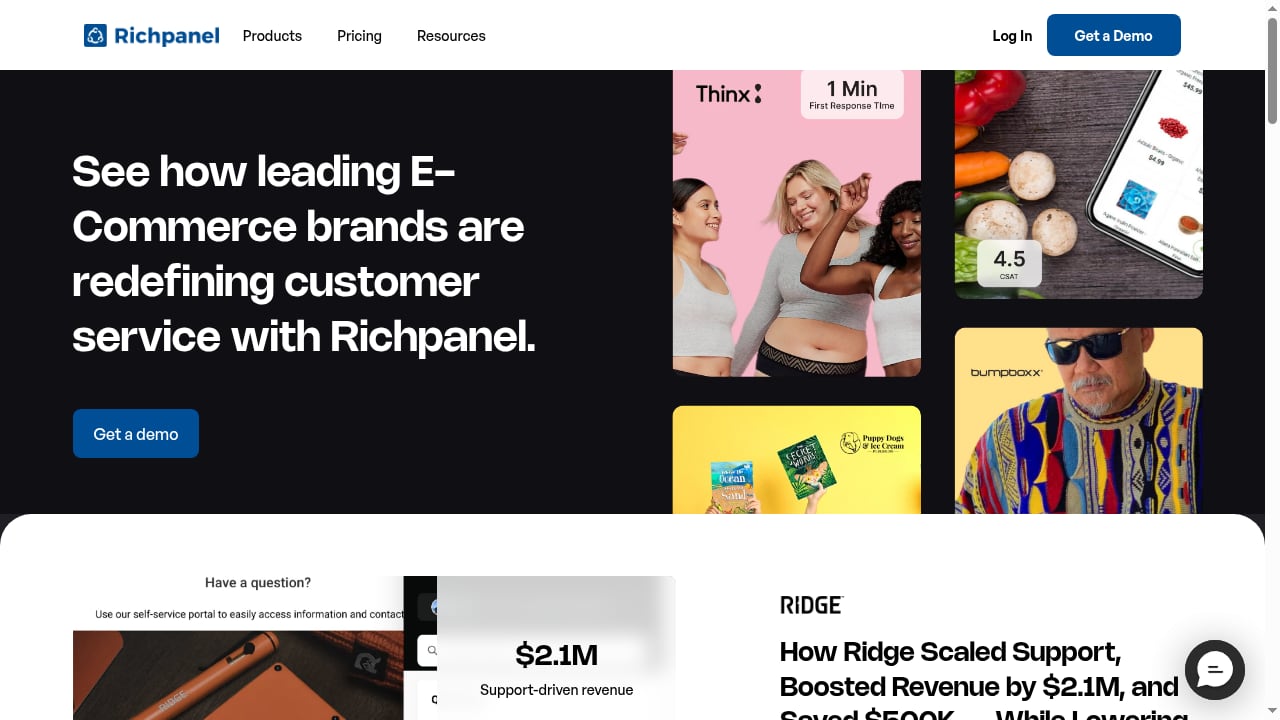
First viewport screenshot of Ecommerce Customer Service Case Study | Richpanel.
Seat pricing compounds as you grow
Richpanel's model charges per seat and per AI conversation, with a monthly AI minimum on top. Independent analysis of Richpanel alternatives flags cost as the most common reason teams look elsewhere, citing $99 per seat monthly plus $0.20 per AI-handled conversation and an additional $99 for the Returns and Exchanges module. Seat-based pricing means every new hire costs the same fixed amount regardless of ticket load, which is awkward when volume is seasonal.
Intercom also charges for seats, so this is a difference of degree rather than kind. The relevant question is which model tracks your actual cost drivers. If AI is doing more of the work over time, paying per seat for humans plus per conversation for AI can double-count the same resolution.
Ecommerce workflows are thinner than the positioning suggests
Richpanel markets itself on order management and returns, and for straightforward cases that holds. But third-party review analysis describes a support layer thinner than commerce-native competitors past refunds and address edits, with reports of missing internal notes or collision detection, meaning two agents can sometimes reply to the same conversation.
That is a meaningful gap for a helpdesk. Collision detection and internal notes are basic coordination features, not nice-to-haves, and their absence shows up fastest during peak season when several agents touch the same customer.
Interface complexity and personalization limits
Reviewers cited in the same analysis flag a cluttered sidebar and limited per-agent personalization, while praising setup and technical support. Read that as a trade-off: Richpanel is approachable to deploy, but the day-to-day workspace may feel rigid for agents who live in it for eight hours.
Automation guarantees cover only half the story
Richpanel backs its AI with a guarantee of 50 percent of conversations automated within 30 days or a refund. That is a confident claim, and it is also a useful benchmark. The guarantee says nothing about the other half of conversations, which a person still answers. When you evaluate any AI agent, ask what happens to the tickets it cannot resolve, because that is where your team's workload actually lives.
How to test both platforms on your own tickets
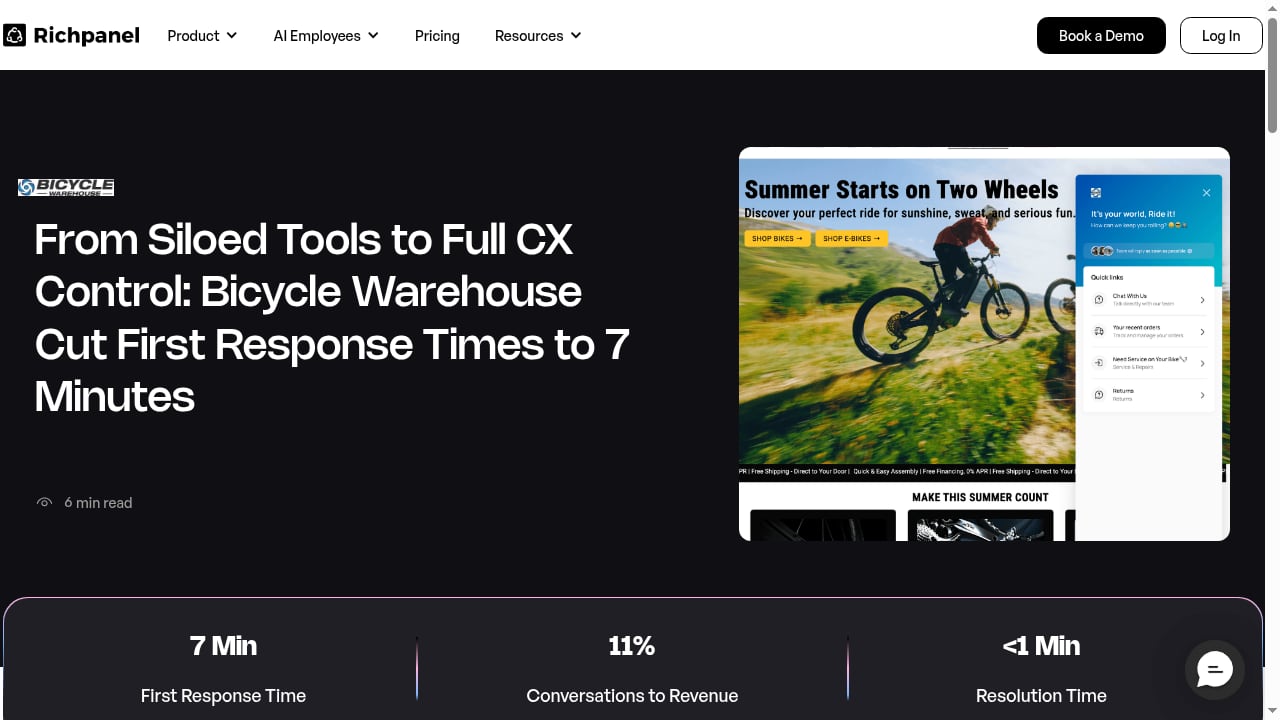
First viewport screenshot of From Siloed Tools to Full CX Control: Bicycle Warehouse Cut First Response Times to 7 Minutes.
Feature tables rarely predict outcomes. A structured test does. Richpanel's evaluation guide suggests a 100-ticket sample, and that is a reasonable starting point for either platform.
- Measure resolution, not deflection. Separate tickets the AI genuinely completed from conversations where the customer simply stopped replying. Both vendors should report these separately.
- Model total cost at your volume. Include seats, AI usage, and required add-ons. Run the numbers for a normal month and a peak month using each vendor's billing definition.
- Test actions, not just answers. For ecommerce, verify that address changes, exchanges, and subscription pauses actually complete in your order system and stay within your rules.
- Inspect the handoff. The moment Fin or a Richpanel AI employee transfers to a human is where quality is won or lost. Check whether history, order details, and prior attempts travel with the customer.
- List what you would lose. If you leave Intercom, catalog the proactive messaging, reports, and workflows that depend on it, then confirm replacements and test a data export before signing.
For a broader view of how Intercom stacks up against other AI support platforms, see our Intercom vs Dixa vs eesel AI comparison and the Intercom vs Nextiva breakdown.
Which platform should you choose?
Choose Intercom if: your support spans multiple channels and product lines, you want an AI Agent that shares context with your human team, and you prefer pricing that scales with completed outcomes rather than headcount alone. It is also the safer pick if you already rely on Intercom's messaging and outbound tools, since Richpanel does not replace that full suite.
Choose Richpanel if: you are an ecommerce brand whose ticket mix is dominated by order status, returns, and exchanges, your team is small and stable, and a commerce-specific self-service portal is worth more to you than platform breadth. Read independent analyses of Richpanel alternatives before deciding, because the cost and workflow trade-offs are well documented.
Consider a third option if: you need deep marketplace coverage beyond Shopify, or you want AI that executes refunds and cancellations across many systems. Comparisons of Siena AI alternatives cover that segment in detail.
One more consideration: Richpanel's own page notes that Salesforce announced an agreement to acquire Fin, with the deal pending close as of its publication. If contract continuity or roadmap stability matters to your decision, ask both vendors directly about current status before you commit.
Related reading
- Zoom Review 2026: AI Companion, Pricing, Pros and Cons - Evidence-based Zoom review for 2026: AI Companion, ZoomMate, My Notes, pricing signals, setup, limitations, and who should buy it.
- Automate Accounts Receivable: 2026 Guide to Faster Cash Flow - Learn how to automate accounts receivable: invoicing, reminders, reconciliation, and collections. Includes DSO benchmarks, tool selection, and customer service tips.
Sources and further reading
- Best Intercom Fin alternatives for your support team - Compare Fin alternatives by completed requests, required integrations and total cost. First decide whether you want to keep Intercom’s messaging tools or replace the helpdesk too.
FAQ
Is Intercom or Richpanel better for ecommerce?
Richpanel is purpose-built for ecommerce, with order management and returns in its self-service portal. Intercom is broader and handles ecommerce alongside other use cases, with Fin resolving conversations across chat, email, in-app messaging, and phone. If nearly all your tickets are order-related, Richpanel's focus is an advantage. If your support mix is wider, Intercom's breadth usually wins.
How does Intercom Fin pricing compare with Richpanel?
Richpanel's published comparison lists Fin at $0.99 per outcome with Intercom seats from $29 per month, and Richpanel at $99 per seat per month annually plus about $0.20 per AI conversation with a $200 monthly AI minimum. The models are not directly comparable, so model both against your real monthly volume and confirm what each vendor counts as a billable outcome.
Can I use Intercom Fin with a different helpdesk?
Yes. Richpanel's evaluation guide states that Fin can run with Intercom or another supported helpdesk, which means you do not necessarily have to leave Intercom to change your AI layer. Richpanel, by contrast, replaces the helpdesk itself, so the migration scope is larger.
What is the main weakness of Richpanel?
Based on third-party review analysis, the recurring concerns are cost at scale, a thinner ecommerce workflow layer than commerce-native competitors past refunds and address edits, missing internal notes and collision detection, and a cluttered interface with limited per-agent personalization. Setup and technical support, by contrast, receive consistent praise.
Does Richpanel replace Intercom's messaging features?
No. Richpanel's own comparison states that it does not replace Intercom's full product-messaging suite. If proactive messaging and outbound engagement are core to your strategy, factor that into any switch.
Conclusion
Intercom and Richpanel are not interchangeable, and treating them as such is the fastest way to a bad decision. Intercom is an AI-first customer service platform where Fin, a shared inbox, and multichannel support work as one system, priced around outcomes. Richpanel is a focused ecommerce helpdesk with AI employees, priced around seats and conversations, and it does not replace Intercom's messaging suite.
Run the same 100 tickets through both. Measure completed resolutions separately from silence, test the handoff, and model peak-season cost. Whichever platform survives that test is the one worth buying.