Intercom vs RingCentral vs BlackBeltHelp: 2026 Comparison
Intercom vs RingCentral vs BlackBeltHelp: Which Customer Service Platform Fits?
Choosing a customer service platform in 2026 is less about picking a helpdesk and more about deciding how AI and humans should share the work. Intercom, RingCentral, and BlackBeltHelp all promise faster answers and lower support costs, but they start from very different places: an AI-first helpdesk, a unified communications and voice AI suite, and a helpdesk built specifically for higher education.
This comparison breaks down where each platform is strongest, where the trade-offs sit, and how to match the choice to your team's actual workload.
The short answer
- Intercom is the strongest fit when your priority is AI-resolved customer conversations inside a single helpdesk, with Fin AI Agent and your human team working from the same inbox, knowledge, and customer record.
- RingCentral is the strongest fit when voice is the core of your business and you want AI layered onto an existing phone, messaging, meetings, and contact center stack.
- BlackBeltHelp is the strongest fit for colleges and universities that need 24/7 student, IT, and admissions support with deep student information system integrations and trained human agents behind the AI.
How the three platforms differ at a glance
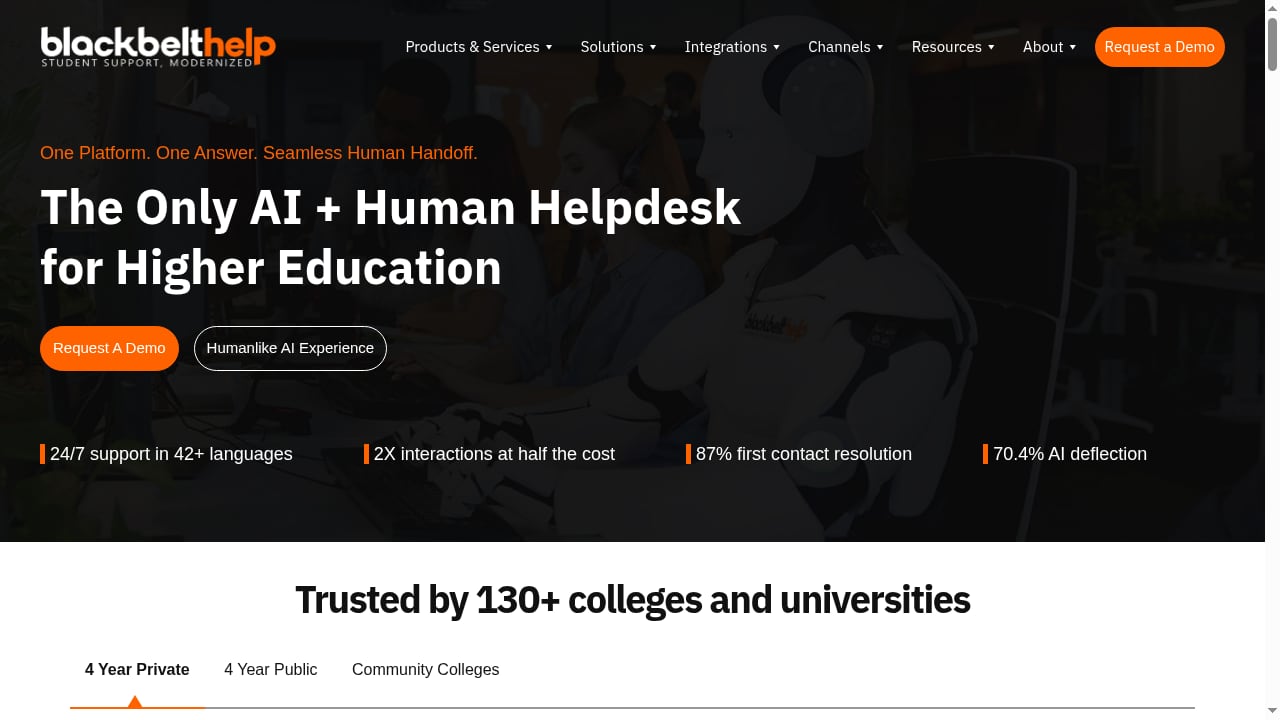
First viewport screenshot of www.blackbelthelp.ai.
| Criterion | Intercom | RingCentral | BlackBeltHelp |
|---|---|---|---|
| Core identity | AI-first customer service platform with a natively integrated AI Agent (Fin) | Agentic Voice AI and unified communications platform | AI-powered helpdesk and contact center for higher education |
| AI model | Fin AI Agent built into the same system as the helpdesk | Out-of-the-box AI agents: AI Receptionist (AIR), AI Virtual Assistant (AVA), AI Conversation Expert (ACE) | Generative AI plus trained human agents, with human handoff |
| Strongest channel | Omnichannel inbox (chat, email, messaging, and more) | Voice, telephony, meetings, and contact center | Voice, chat, email, and other channels for student inquiries |
| Best-fit buyer | Support and CX teams scaling AI resolution | Organizations modernizing business communications and contact center | Colleges and universities |
| Notable proof point | Fin averages 76% resolution across 12,000+ customers, with many above 85% | Serves more than 600,000 businesses | 87% first contact resolution, 70.4% AI deflection, 42+ languages, 130+ institutions |
Where Intercom stands out
First viewport screenshot of www.ringcentral.com.
Intercom's central claim is architectural: Fin is not bolted onto a helpdesk, it is built into the same system. Fin and human agents share one inbox, one knowledge base, and one customer record. When Fin needs approval or a missing detail, it can ask a teammate and then finish the conversation itself. That loop is what makes the platform self-improving in practice — every human conversation becomes training material for the next AI answer.
Key strengths supported by the product:
- AI resolution at scale. Fin averages 76% resolution across 12,000+ customers, and many businesses see above 85%. That is a meaningful benchmark when you are modeling deflection and headcount.
- One system for AI and humans. Handoffs carry full context because both sides work from the same record, so customers do not repeat themselves.
- Centralized knowledge management. A single hub powers Fin, human agents, self-serve support, and the help center, with reporting on how content performs at each touchpoint.
- Broad integrations. 450+ apps including Jira, Slack, Salesforce, Shopify, and Stripe, with Fin able to pull data and take action through APIs or MCP.
- Transparent, outcome-based pricing. Seats start at $19 per seat per month plus $0.99 per resolution, with spending limits you control.
For teams planning how far to push automation, our guide to autonomous AI agents in customer service covers where agents fit and how to deploy them responsibly. If you are also weighing other helpdesks, the Intercom vs Talkdesk comparison looks at resolution rates and fit side by side.
Where RingCentral stands out
First viewport screenshot of www.ringcentral.com.
RingCentral approaches the same problem from the communications side. It is an Agentic Voice AI platform that combines AI-powered business phone, messaging, meetings, and contact center capabilities with out-of-the-box AI agents — AI Receptionist (AIR), AI Virtual Assistant (AVA), and AI Conversation Expert (ACE) — to automate, assist, and analyze interactions end to end.
Its credible strengths:
- Voice depth. RingCentral positions itself as "The Voice of Your Business," and its telephony heritage shows in reliability and scale across devices.
- A complete communications stack. RingEX covers team calls, messages, and meetings; RingCX covers customer engagement; AI agents understand intent and automate outcomes.
- Custom agent building. AIR Pro lets organizations build custom AI agents rather than relying only on packaged ones.
- Proven scale. More than 600,000 businesses use the platform, which matters if procurement wants a large, established vendor.
RingCentral is a strong choice when your customer interactions are phone-heavy, your organization already runs on RingCentral for internal communications, or you want one vendor for telephony and contact center with AI layered across both.
Where BlackBeltHelp stands out
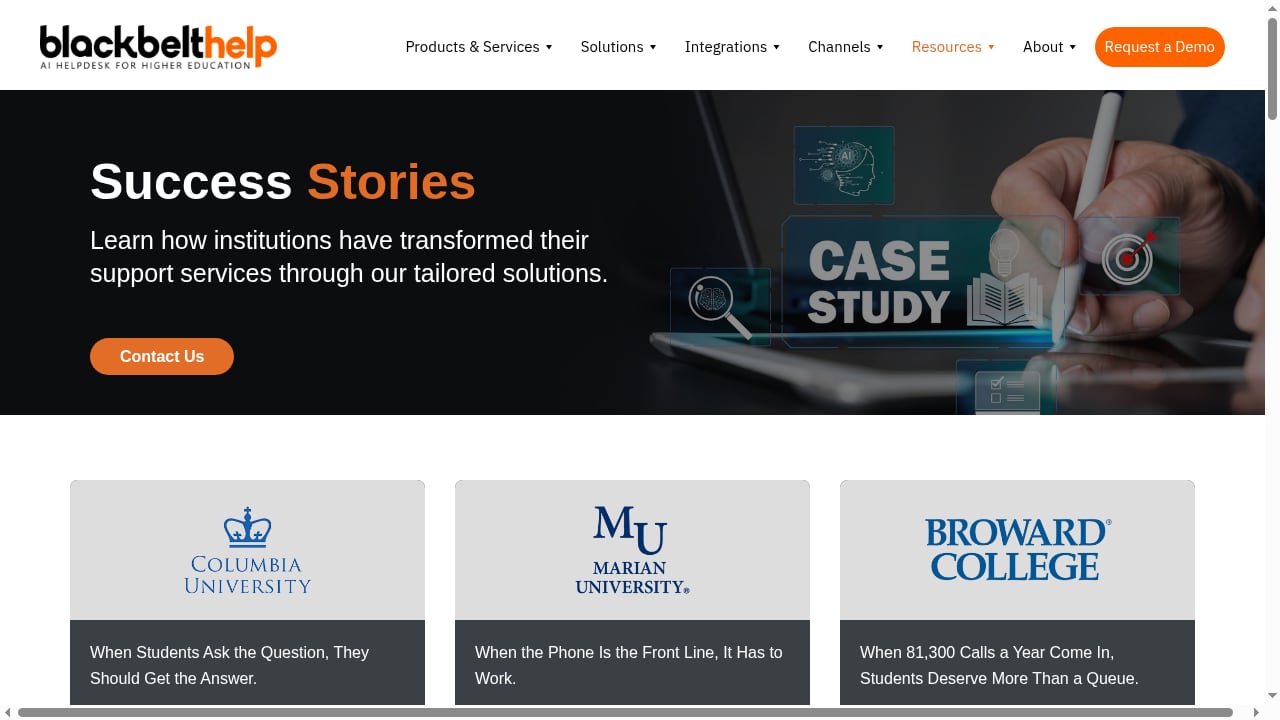
First viewport screenshot of www.blackbelthelp.ai.
BlackBeltHelp is deliberately narrower, and that focus is its advantage. It is built for higher education, combining generative AI, trained human agents, and integrations with systems like Ellucian Banner, Canvas, Slate, and Microsoft Entra to support IT, student services, and admissions questions around the clock.
Its credible strengths:
- Higher-ed domain fit. Integrations with the student information system, LMS, CRM, and identity provider are the integrations universities actually need.
- 24/7 coverage with human backup. AI handles volume; trained agents step in when a conversation needs a person.
- Strong published metrics. 87% first contact resolution, 70.4% AI deflection, 2X interactions at half the cost, and support in 42+ languages.
- Institutional trust. More than 130 colleges and universities, including Columbia University, Cornell University, and the California Community Colleges System, with over 8 million helpdesk interactions managed annually.
For a registrar's office fielding thousands of repetitive questions each semester, or an IT helpdesk that empties out at 5 p.m., that combination is hard to match with a general-purpose platform.
How to choose
Choose Intercom if...
- Most of your support volume arrives through chat, email, and messaging rather than phone.
- You want AI resolution and human support governed by one knowledge base and one customer record.
- You need Fin to take real actions — look up orders, adjust accounts, trigger workflows — through integrations.
- You want to pay partly on outcomes and cap AI spend.
Choose RingCentral if...
- Voice is your primary customer channel and call quality and telephony reliability are non-negotiable.
- You want one vendor for business phone, meetings, contact center, and AI agents.
- You need custom AI agents built for specific voice workflows.
- Your IT and procurement teams prefer a large unified communications provider.
Choose BlackBeltHelp if...
- You are a college or university, not a commercial brand.
- Your inquiries span IT, student services, and admissions and peak around enrollment and semester start.
- You need out-of-the-box connectors to Banner, Canvas, Slate, and Entra.
- You want AI deflection with trained human agents available after hours and in 42+ languages.
Practical examples
A subscription ecommerce brand with 60% chat volume and a small support team would likely get the most from Intercom: Fin resolves routine order and billing questions, Copilot assists agents on complex cases, and the shared inbox keeps context intact when a handoff happens.
A professional services firm that lives on inbound calls and already runs its desk phones on RingCentral would gain more by extending RingCX and its AI agents than by migrating its voice stack to a chat-first helpdesk.
A community college handling financial aid, registration, and LMS password resets would see faster time-to-value with BlackBeltHelp's pre-built higher-ed integrations than with a general platform requiring custom connector work.
Related reading
- Intercom vs Talkdesk: AI Customer Service Showdown 2026 - Compare Intercom's natively integrated Fin AI Agent with Talkdesk's CX automation. See resolution rates, pricing, and fit for support teams in 2026.
- HelpCrunch Review 2026: Live Chat, Automation & Value - Evidence-based HelpCrunch review covering live chat, chatbots, knowledge base, email marketing, pricing signals, setup, and ideal users for 2026.
- Autonomous AI Agents in Customer Service: A Practical Guide - Learn how autonomous AI agents work in customer service, where they fit, and how to deploy them responsibly with a platform like Intercom.
Sources and further reading
- Intercom | A complete system for human and AI customer service - Intercom is the only helpdesk with a natively integrated AI Agent, Fin, meaning every customer conversation improves the next one, enabling perfect experiences that were never possible before.
- The helpdesk built for AI and humans | Intercom - Intercom is a fully-featured, AI-powered helpdesk with Fin natively integrated. It gives agents the tools, workflows and insights they need to work faster and deliver the highest quality customer service.
- Intercom Systems: Definitions, FAQs, and How Aiphone Helps - Learn how intercom systems work, from video and audio to IP and analog intercoms, including core technologies like SIP and ONVIF.
FAQ
Is Intercom a replacement for RingCentral?
Not in the telephony sense. Intercom is an AI-first customer service platform built around an omnichannel inbox and Fin AI Agent. RingCentral is a unified communications and voice AI platform. Organizations with heavy phone operations often keep a telephony provider and use a helpdesk for written and AI-resolved conversations.
Can BlackBeltHelp work for a non-education company?
It is purpose-built for higher education, with integrations and workflows designed around student information systems, LMS platforms, and admissions CRMs. A commercial business would typically be better served by a general-purpose platform.
How does Intercom's Fin pricing work?
Intercom lists helpdesk seats at $19 per seat per month plus $0.99 per resolution for Fin, with spending limits so costs stay within budget. That outcome-based model lets teams scale AI resolution without open-ended cost.
Which platform has the best AI resolution rate?
Intercom reports Fin averaging 76% resolution across 12,000+ customers, with many above 85%. BlackBeltHelp reports 70.4% AI deflection in higher education. RingCentral emphasizes voice automation and agentic workflows rather than publishing a single comparable resolution figure, so evaluate it on call automation outcomes instead.
Do these platforms integrate with the tools we already use?
Intercom connects 450+ apps including Slack, Salesforce, Jira, Shopify, and Stripe. BlackBeltHelp integrates with Ellucian Banner, Canvas, Slate, and Microsoft Entra. RingCentral integrates with common business and CRM tools as part of its communications stack. Confirm the specific connectors your workflow depends on during evaluation.
Conclusion
There is no universal winner here — only a best fit. Intercom wins on natively integrated AI resolution and a unified system for AI and human support. RingCentral wins on voice depth and a complete communications stack. BlackBeltHelp wins on higher-education specificity and around-the-clock student support. Start with your dominant channel, your industry constraints, and how much of your volume you want AI to resolve, and the decision usually becomes clear.
For a broader market view, see our roundup of the top AI customer service automation software for 2026.