NiCE CXone Review 2026: AI Contact Center Pros & Cons
NiCE CXone Review 2026: AI Contact Center Pros & Cons
NiCE CXone is a cloud contact center platform that combines omnichannel routing, workforce optimization, analytics, and AI-powered automation in one suite. It is built for organizations that handle large volumes of customer interactions and want to move beyond AI experiments into production-scale automation. This review pulls together verified user feedback, product capabilities, and practical decision criteria so you can judge whether CXone fits your operation.
What NiCE CXone actually is
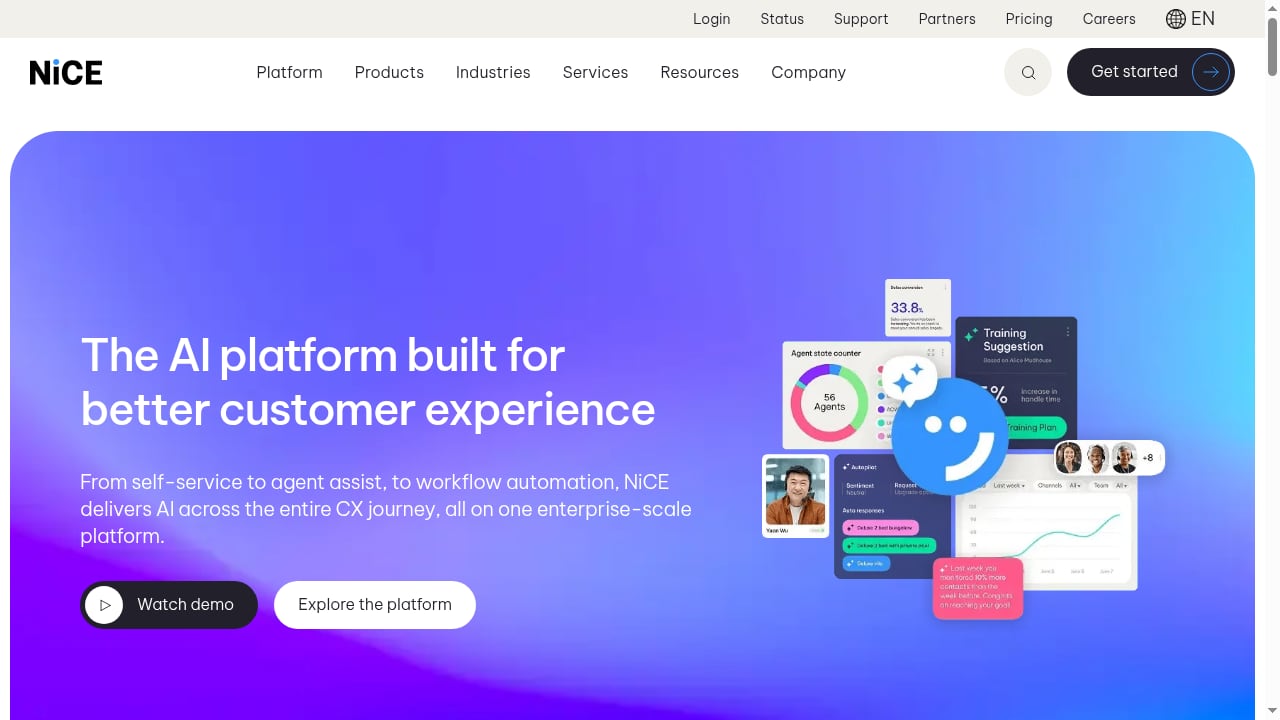
First viewport screenshot of NiCE: Customer Experience (CX) AI Platform for Transformation at Scale.
CXone is a contact-center-as-a-service (CCaaS) platform from NiCE Ltd., a public company founded in 1999 and headquartered in Hoboken, New Jersey. The platform covers:
- Omnichannel engagement — voice, chat, email, and social media handled from a single agent dashboard.
- AI customer service automation — agentic AI and self-service tools intended to resolve routine requests before they reach a human.
- Workforce optimization — forecasting, scheduling, quality management, and performance analytics.
- Conversational commerce — tools that help retail and ecommerce teams turn service conversations into sales.
- Real-time reporting — dashboards for service metrics, agent performance, and operational efficiency.
NiCE positions CXone as an all-in-one platform with flexible bundles that can be customized by industry and scale. It serves financial services, healthcare, insurance, retail, telecommunications, government, education, and business process outsourcers.
Who NiCE CXone is best for
First viewport screenshot of Customer experience software for BPO | Call center software | NiCE CX Solutions.
CXone is not a one-size-fits-all tool. Based on user reviews and product positioning, it fits best when:
- You run a large or complex contact center — often hundreds to tens of thousands of concurrent agents.
- You need deep workforce management with forecasting, scheduling, and quality scoring built in.
- You want omnichannel routing and analytics in a single vendor rather than stitching together point solutions.
- You are in a regulated industry (healthcare, insurance, financial services) where compliance and audit trails matter.
- You have dedicated admin and engineering resources to configure and maintain the platform.
A recurring theme in community discussions is that CXone rewards scale. One long-time user noted that the platform is capable of extremely large contact centers and has powerful scripting tools, but suggested that operations under roughly 1,000 concurrent agents may find better fit and support elsewhere. That is a useful signal: CXone is strongest when your volume justifies the operational overhead.
Core strengths
1. Broad, integrated product suite
CXone bundles contact center routing, workforce optimization, quality management, analytics, and AI into one platform. Reviewers on Software Advice highlight flexibility across contact center workflows, including Studio scripting, CXone WFM, Quality Management, and Analytics. A single dashboard for voice, chat, and email reduces the tool sprawl that plagues many CX teams.
2. Powerful scripting and automation
Studio, CXone's scripting environment, is frequently praised for call flow design. Administrators report that it can automate maintenance and complex routing logic. For teams with technical resources, this is a major advantage over simpler CCaaS tools.
3. Analytics that change operations
Verified reviewers on Gartner Peer Insights describe sentiment analysis and intent analysis as genuinely useful. One telephony engineer reported using conversation analytics to track negative sentiment, identify common words, and strengthen quality assurance. Another said intent analysis helped adjust staffing and skills in areas like customer service, sales, and billing. These are operational improvements, not just dashboards.
4. Enterprise-grade scale
CXone is built for very large contact centers. If you need to manage tens of thousands of agents across sites and channels, the platform has the architecture and product depth to support it.
Limitations and risks
1. Support quality is inconsistent
This is the most common complaint. Reviewers on Gartner Peer Insights describe troubleshooting delays, limited visibility in the NOC, and difficulty engaging level 3 engineering without executive escalation. A Reddit user in r/workforcemanagement said support can be frustrating for smaller organizations without a dedicated support engineer. Software Advice reviewers also mention repeating themselves across multiple points of contact.
2. Workforce management has gaps
Some workforce managers report that forecasting for digital channels (email and chat) is limited in the Digital First Omnichannel (DFO) model. One reviewer said they could not pull interval-level historical data without aggregating it, which made custom forecasting difficult. If WFM is your primary buying reason, test this carefully in a proof of concept.
3. Reporting can be confusing
Software Advice reviewers note that reporting parameters sometimes seem "off" or require interpretation. Supervisors may need to validate definitions before trusting the numbers. This is manageable with training, but it adds friction.
4. Operational overhead is real
CXone is not a plug-and-play tool. Community feedback suggests that demos can look more polished than the actual configuration process, and that running the platform well requires a team. If you lack admin resources, implementation and ongoing management can strain your team.
5. Digital channel maturity varies
While voice telephony is widely praised, some users report that newer digital channels have documentation and scripting challenges. If digital-first service is central to your strategy, validate the specific channels you need during evaluation.
Pricing signals
NiCE does not publish standard list pricing for CXone. The platform is sold through customized bundles, and pricing depends on:
- Number of agents and concurrent seats
- Channels and modules selected (voice, digital, WFM, QM, analytics, AI)
- Contract length and volume commitments
- Industry-specific compliance requirements
Public review data and community discussions suggest CXone is priced for mid-market and enterprise buyers, not small teams. If you are comparing options, it helps to understand how AI-first helpdesk pricing works in adjacent categories. Our breakdown of Intercom pricing for AI-first helpdesks explains seat-based versus resolution-based models, which is useful context when evaluating CCaaS proposals.
For a broader market view, see our comparison of Intercom, Ada, and Talkdesk for enterprise CX. It covers where AI agents and contact center platforms fit best, which can help you frame CXone against alternatives.
Setup and implementation
CXone implementations typically involve:
- Discovery and design — mapping channels, routing rules, and workflows.
- Configuration — building scripts in Studio, setting up queues, and connecting channels.
- WFM and QM setup — configuring forecasts, schedules, and quality forms.
- AI and automation — deploying self-service and agent-assist tools.
- Testing and training — validating reporting, call quality, and agent workflows.
- Go-live and optimization — monitoring performance and iterating.
Expect a multi-week to multi-month timeline depending on complexity. Organizations with dedicated implementation resources and vendor support tend to have smoother rollouts. If you are evaluating AI support agents alongside CXone, our Enjo review covers end-to-end AI resolution and setup considerations that may inform your build-versus-buy decision.
How NiCE CXone compares to alternatives
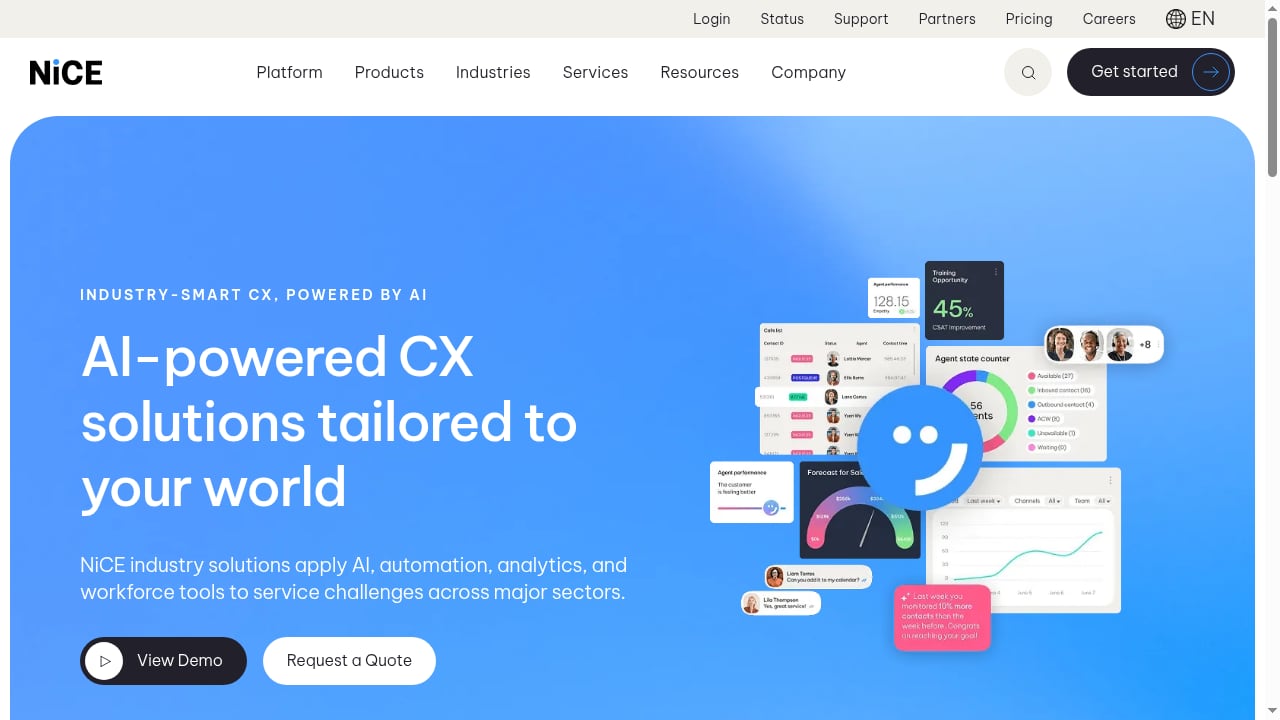
First viewport screenshot of Cloud Customer Experience (CX) Platform | NiCE.
| Factor | NiCE CXone | Typical CCaaS alternatives |
|---|---|---|
| Best fit | Large, complex contact centers | Mid-market or simpler operations |
| WFM depth | Strong, with some digital gaps | Varies; often lighter |
| AI automation | Agentic AI and self-service | Increasingly common |
| Setup complexity | High; needs admin resources | Often lower |
| Support experience | Mixed, especially for smaller orgs | Varies by vendor |
| Pricing | Custom enterprise bundles | More published pricing |
If your contact center is under 1,000 concurrent agents and you do not need deep WFM, simpler platforms may deliver faster time-to-value. If you are a large enterprise with complex routing, compliance, and workforce needs, CXone's depth is a real advantage.
Decision criteria: is NiCE CXone right for you?
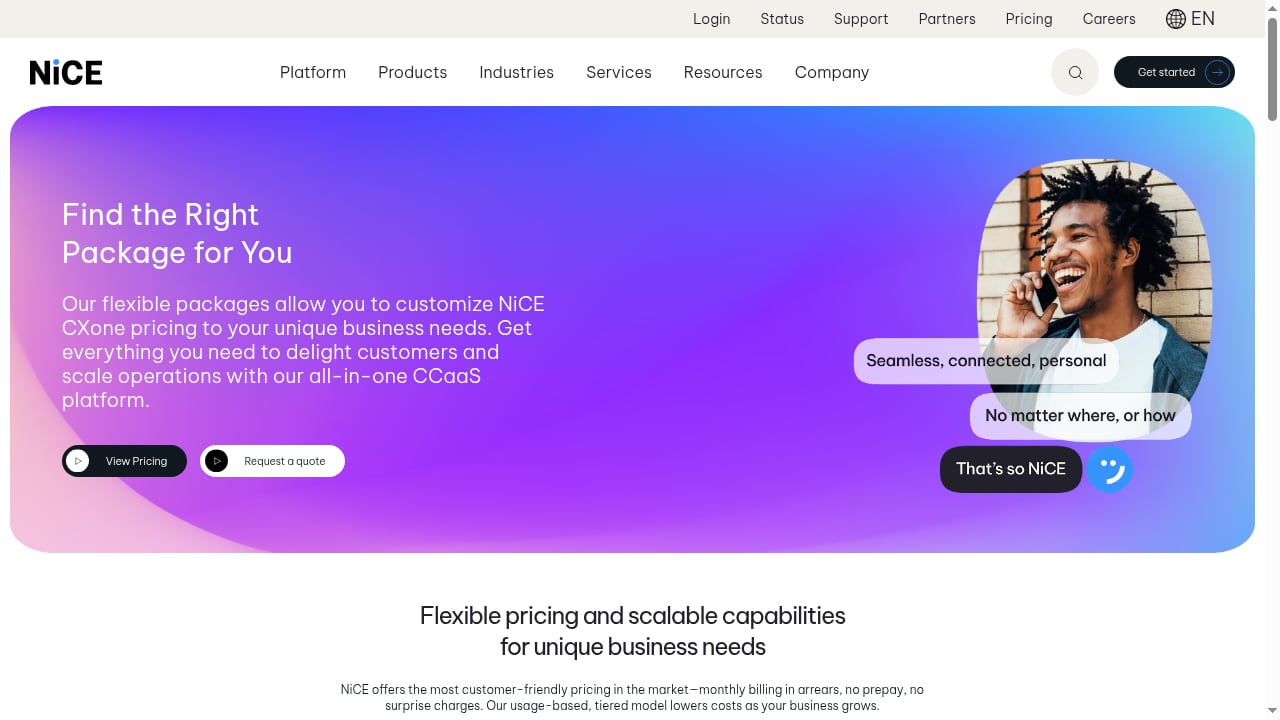
First viewport screenshot of CXone Packages and Pricing | NiCE.
Ask these questions before committing:
- Scale: Do you have enough volume to justify the platform's depth and cost?
- WFM needs: Do you need digital channel forecasting? If so, validate it in a proof of concept.
- Admin capacity: Do you have dedicated resources to configure and maintain CXone?
- Support expectations: What SLA and escalation paths are included in your contract?
- AI roadmap: Are you ready to move from AI pilots to production? CXone is designed for that transition, but it requires governance and data readiness.
- Reporting trust: Can your team validate metric definitions and reporting outputs?
- Total cost: Have you modeled seats, modules, implementation, and ongoing admin costs?
Related reading
- Intercom Pricing: AI-First Helpdesk Costs Explained - Understand Intercom pricing for AI-first customer service: Fin AI Agent resolution costs, seat-based plans, and how to estimate your total spend.
- Top 10 Ecommerce Customer Experience Platforms 2026 - Independent ranking of the 10 best ecommerce customer experience platforms in 2026, with verified evidence, pricing signals, and fit guidance for CX teams.
- How to Use Intercom with Fin: Setup, Workflows & Examples - Learn how to use Intercom with Fin AI Agent: setup steps, knowledge sources, Procedures, simulations, handoff, and metrics that prove ROI.
FAQ
Is NiCE CXone good for small contact centers?
Generally, no. Community feedback suggests that smaller operations may find the platform complex and support harder to access. It is better suited to mid-market and enterprise contact centers with dedicated admin resources.
What are the most common complaints about NiCE CXone?
Support responsiveness, workforce management gaps for digital channels, reporting clarity, and operational overhead. Voice quality and telephony are usually praised.
Does NiCE CXone include AI?
Yes. CXone includes AI customer service automation, agentic AI, and analytics. The depth of AI features depends on the bundle and modules you select.
How long does implementation take?
It varies by complexity, but expect several weeks to several months. Large, multi-channel deployments with WFM and AI take longer.
Is NiCE CXone pricing public?
No. Pricing is customized through bundles based on seats, modules, and contract terms. You will need to request a quote.
Conclusion
NiCE CXone is a powerful, enterprise-grade CCaaS platform with deep workforce optimization, strong telephony, and increasingly capable AI. It is a strong fit for large contact centers that need integrated routing, analytics, and WFM, and that have the resources to manage a complex platform. It is less suitable for smaller teams that want fast setup and predictable support.
The deciding factors are scale, admin capacity, and how much you rely on digital channel forecasting. Validate those in a proof of concept, model the total cost, and confirm support terms before signing. If CXone's depth matches your operation, it can be a durable foundation for AI-driven customer experience. If not, simpler alternatives may get you to value faster.