Top 10 Agentic B2B Support Platforms 2026: Ranked & Tested
Top 10 Agentic B2B Support Platforms 2026: Ranked & Tested
Agentic B2B support platforms stopped being a novelty in 2026. Buyers now ask a harder question than "does it use AI?" — they ask what the agent can actually change in production systems, how you prove it works before customers see it, and what happens on the 900th ticket when an action fails.
This ranking covers ten platforms that genuinely belong to the agentic B2B support category. It excludes general-purpose sales agents, pure enterprise search tools, and AI-first helpdesks that are adjacent rather than native to agentic support work. Intercom, for example, is a strong AI-first customer service platform with its Fin AI Agent, but it is a helpdesk-plus-agent product rather than a dedicated agentic B2B support platform, so it appears here only as context where a workflow comparison is useful.
How We Evaluated These Platforms
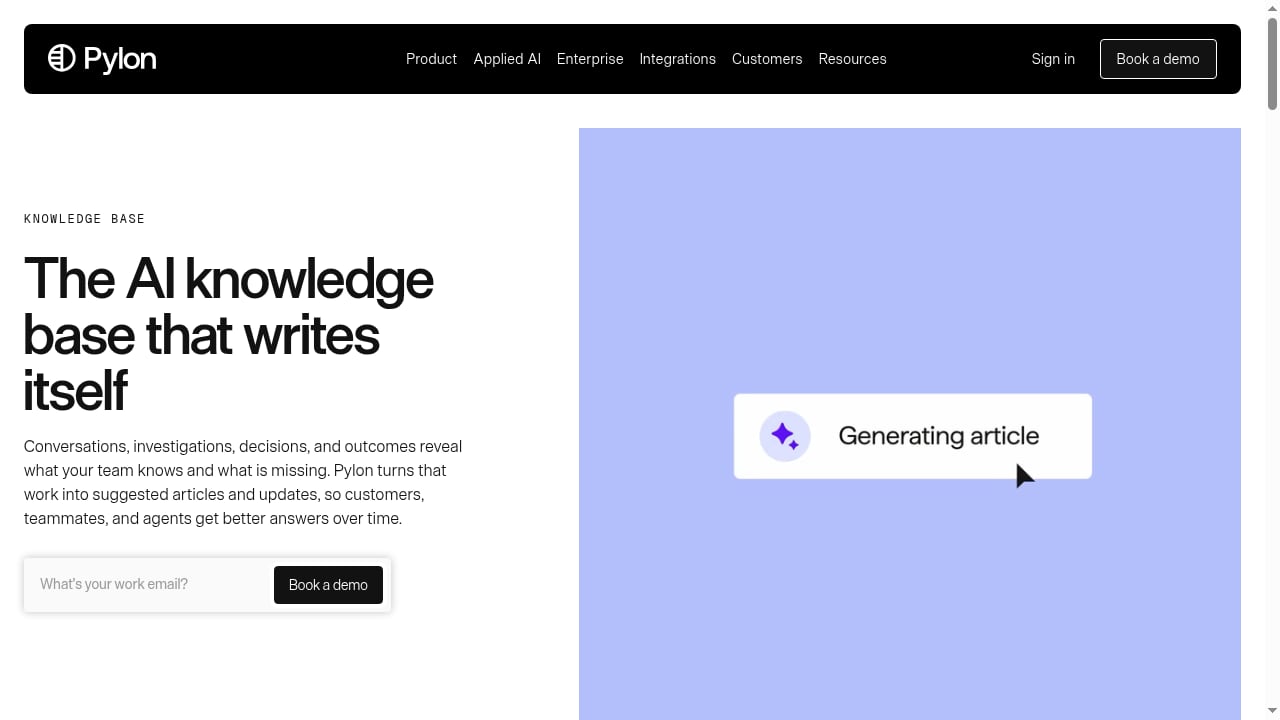
First viewport screenshot of AI Knowledge Base | Pylon.
Every product below was scored against six criteria that matter once you are paying the bill:
- Write actions, not just reads. Can the agent look up an order, change a subscription, issue a credit, or update a CRM record — or does it only answer questions?
- Pre-launch testing. Does the vendor let you replay historical tickets and measure accuracy before the agent touches a live inbox?
- Governance and auditability. Are permissions, caps, audit logs, and escalation rules built in, or bolted on later?
- Channel and system coverage. Which helpdesks, CRMs, billing tools, and messaging channels does it integrate with natively?
- Pricing transparency. Is the billable unit public, or do you need a sales call to learn what a resolution costs?
- Smallest realistic contract. What does a mid-market B2B team actually pay to start?
A chatbot that links a help article is not agentic. A tool earns the label when it plans multi-step work, calls real APIs, and hands off to a human with context attached when it is out of its depth.
The Top 10 Agentic B2B Support Platforms for 2026
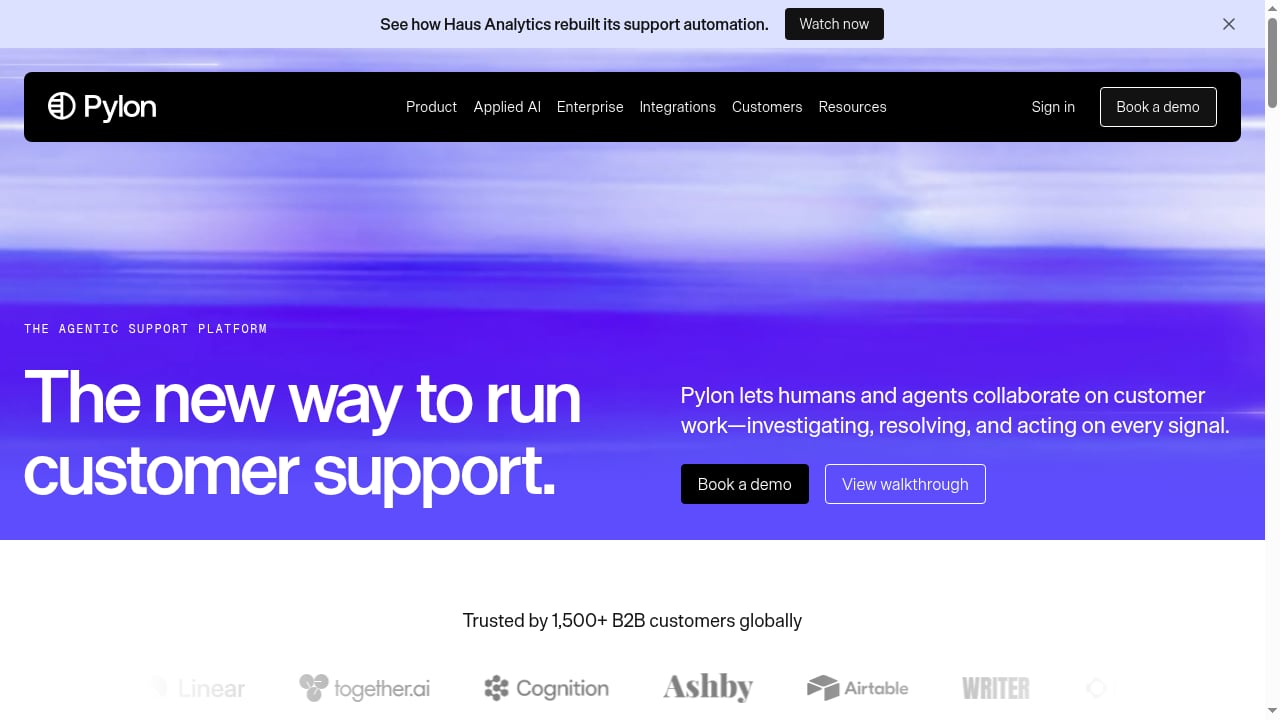
First viewport screenshot of Pylon: Agentic B2B Support.
1. Pylon — Best Overall for Human-AI Collaboration on B2B Customer Work
Pylon is built around a simple premise: humans and AI agents should work the same queue, on the same signals, with the same context. It lets teams investigate, resolve, and act on every customer signal — from support tickets to Slack messages to account activity — rather than treating AI as a separate deflection layer.
Why it ranks first: Pylon is trusted by 1,500+ B2B companies, which is a meaningful sample size for a category this young. Its collaboration model means AI agents and human agents share ownership of customer work instead of competing for tickets, and its action layer is designed for B2B account complexity rather than single-transaction ecommerce refunds.
Best for: B2B SaaS and services teams where customer context spans multiple systems, stakeholders, and long-lived accounts.
Watch for: Teams that only need simple FAQ deflection may find the collaboration model more than they need.
2. Sierra — Best for Outcome-Based Pricing on Consumer-Facing Support
Sierra prices per outcome rather than per seat or per conversation, which shifts risk onto the vendor: if the agent does not resolve something, you generally do not pay for a resolution. Its Agent SDK and tool integrations let agents take real actions, and its monitoring and experimentation tooling supports pre-launch evaluation.
Best for: Brands that want a predictable cost per resolved issue and are willing to trade some configuration control for it.
Watch for: Outcome definitions matter enormously. Negotiate exactly what counts as a resolution before signing.
3. Decagon — Best for High-Volume Enterprise CX Teams
Decagon targets teams handling 10,000+ tickets per month. It supports write actions through its agent operations layer, and it ships evals and observability so you can measure agent quality against historical data before rollout. Pricing is volume-tiered and not public.
Best for: Large enterprise support organizations with enough ticket volume to justify a custom contract.
Watch for: The lack of public pricing makes early budgeting harder; expect a quote-based process.
4. Salesforce Agentforce — Best for Teams Already Deep in Salesforce
Agentforce deploys autonomous agents across sales, service, and marketing workflows natively inside Salesforce. Because it lives where your CRM data already lives, write actions against customer records are native rather than integration-dependent. Its Testing Center supports pre-launch validation, and billing runs on Flex Credits or conversations.
Best for: Enterprises whose entire customer record already sits in Salesforce and who want agents to act on it directly.
Watch for: Costs scale quickly, and the platform is effectively Salesforce-only. If your support stack is not Salesforce-native, the value proposition weakens considerably.
5. Kore.ai — Best for Multi-Agent Orchestration Across CX and EX
Kore.ai provides a platform for designing, deploying, and governing AI agents at enterprise scale, with multi-agent orchestration, no-code and pro-code development paths, a marketplace of 300+ pre-built agents, and 250+ integrations. It is model-, cloud-, and data-agnostic, and it emphasizes AI governance and security.
Best for: Large organizations that need to run many governed agents across customer support, employee service, and process automation from one control plane.
Watch for: The breadth of the suite can overwhelm teams without a structured rollout plan, and it is not aimed at small or mid-sized businesses.
6. Ada — Best for Enterprises Automating at Scale
Ada focuses on high-volume automation with Actions that let agents perform real tasks, and it integrates with existing helpdesks rather than replacing them. Reported contracts start around $30,000 per year, and pricing is per resolution.
Best for: Enterprises handling 300,000+ conversations annually that want an automation layer on top of their current helpdesk.
Watch for: Pricing is not public, and smaller teams will find the entry point steep.
7. Maven AGI — Best for a Single Agent Spanning Support and Sales
Maven AGI positions one agent across both support and sales motions, which matters for B2B companies where a prospect question and a customer issue can arrive in the same conversation. It integrates with existing helpdesks rather than replacing them.
Best for: Teams that want one agent handling pre-sale and post-sale conversations without a hard handoff between systems.
Watch for: Public documentation on testing and governance is thinner than competitors, so ask hard questions during evaluation.
8. Cognigy — Best for Enterprise Conversational Automation
Cognigy is an enterprise conversational AI platform that has extended into agentic workflows, with strong voice and chat capabilities and deep integration options. It suits organizations that need to orchestrate conversations across many channels and languages.
Best for: Enterprises with complex, multilingual contact center requirements that need conversational automation with agentic extensions.
Watch for: Its heritage is conversational automation, so verify that write-action depth matches dedicated agentic support platforms.
9. Lorikeet — Best for Regulated Fintech and Healthtech Support
Lorikeet targets fintech and healthtech teams that need guarded, deterministic workflows rather than open-ended agent behavior. It supports pre-launch testing, prices per credit per resolution, and publishes a rate starting around $1,500 per month, with annual contracts around $18,000.
Best for: Compliance-sensitive B2B support organizations that need scoped, auditable agent actions.
Watch for: The deterministic approach trades some flexibility for safety, which is the right call in regulated industries but limiting elsewhere.
10. Gorgias AI Agent — Best for B2B Teams Selling Through Ecommerce Channels
Gorgias combines an ecommerce helpdesk with an AI agent that can take order actions through Flows. Pricing is public at around $1.50 per interaction plus the underlying ticket cost, with plans starting near $40 per month.
Best for: B2B brands with a direct-to-customer ecommerce motion where order-level actions matter.
Watch for: Testing and governance capabilities are more limited than enterprise-focused competitors, so scope autonomy carefully.
Quick Comparison: Which Agentic Support Platform Fits Your Team?
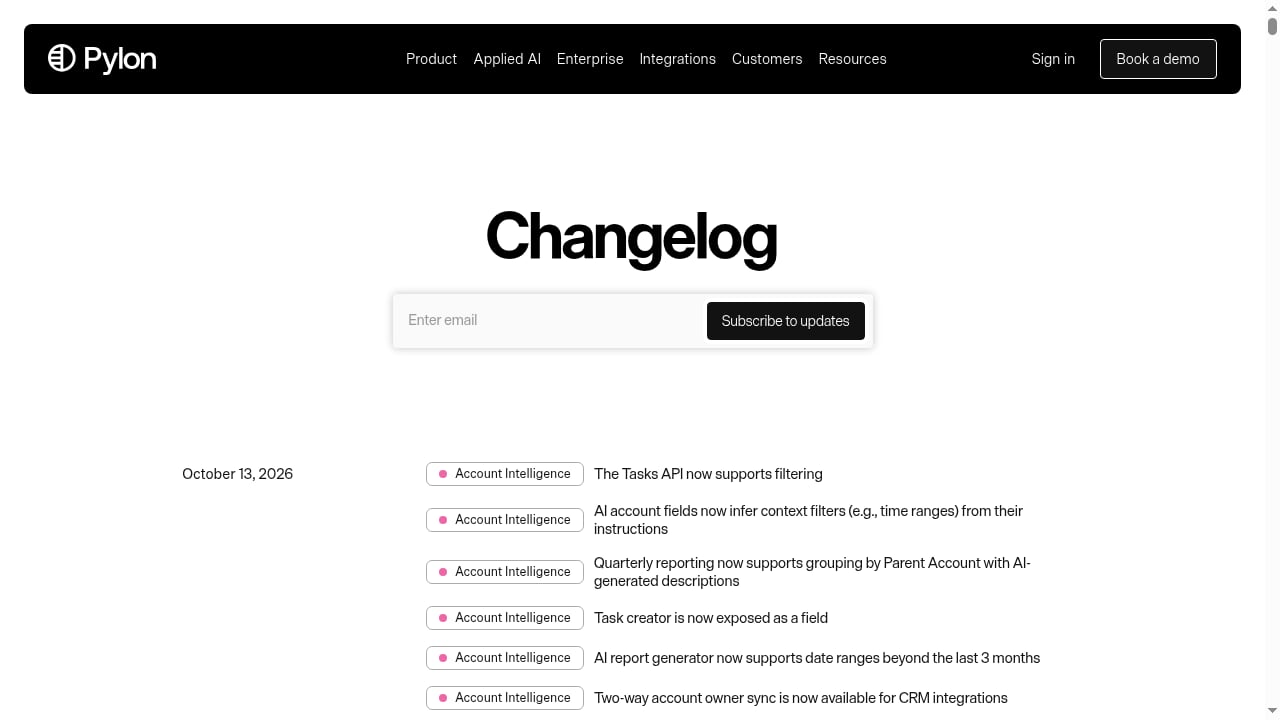
First viewport screenshot of Pylon Changelog: Latest Features & Updates.
| Platform | Best fit | Write actions | Public pricing |
|---|---|---|---|
| Pylon | B2B SaaS collaboration | Yes, across customer signals | Contact sales |
| Sierra | Outcome-based consumer CX | Yes, via Agent SDK | No |
| Decagon | 10k+ tickets/month | Yes, via agent operations | No |
| Salesforce Agentforce | Salesforce-native enterprises | Yes, native to CRM | Flex Credits |
| Kore.ai | Multi-agent enterprise governance | Yes, via integrations | Flexible models |
| Ada | 300k+ conversations/year | Yes, via Actions | No |
| Maven AGI | Unified support and sales | Yes | No |
| Cognigy | Multilingual contact centers | Yes, via integrations | No |
| Lorikeet | Fintech and healthtech | Yes, guarded workflows | From $1,500/mo |
| Gorgias | Ecommerce-led B2B | Yes, order actions | ~$1.50/interaction |
If your evaluation includes adjacent AI-first helpdesks, it is worth understanding how those products differ. Our comparison of Intercom vs Zendesk vs ClickDesk AI agents shows where native AI agents sit relative to traditional helpdesk automation, and our Intercom vs Ada vs Talkdesk enterprise CX comparison covers the enterprise end of that spectrum.
How to Prove an Agentic Support Platform Works Before You Go Live
First viewport screenshot of Pylon: The Only Support Platform Built for B2B.
The most useful discipline in this category is replaying your own history. Before any agent touches a live inbox, run it against a few hundred past tickets and measure three things: how often it triaged correctly, how often its drafted resolution was sent unchanged, and how often it contained a factual error. Those three numbers rarely move together, and the gap between them is where rollout risk lives.
Ask every vendor two questions early. First, show me the list of write actions this agent can perform out of the box on my helpdesk — not the read actions. Second, what happens on the 900th ticket when that action fails? A vendor that only answers the first question is selling you a search bar with better marketing.
For teams that need to connect an existing AI-first helpdesk into broader automation, our walkthrough on using Intercom with conversational AI and APIs for SMS, email, and voice covers the integration path when your stack mixes helpdesk and agentic layers.
Related reading
- Intercom vs OTRS: AI Helpdesk or ITSM Suite Compared - Intercom vs OTRS compared for customer service, ITSM, ISMS, and SOAR needs. See where Intercom's native Fin AI Agent wins and where OTRS fits better.
- NiCE CXone Review 2026: AI Contact Center Pros & Cons - Evidence-based NiCE CXone review: AI features, omnichannel routing, WFM, pricing signals, setup, limitations, and who should buy it in 2026.
Sources and further reading
- 10 Best Agentic Sales Tools in 2026 (Ranked) - Compare 10 agentic AI sales tools for 2026: Fin, Qualified, Chili Piper, 11x, and more. Pricing, CRM integrations, and real results.
- 7 best agentic AI platforms in 2026 | Enterprise market guide - Best 7 agentic AI platforms and tools for 2026: 1. Kore.ai · 2. Glean · 3. Moveworks · 4. Aisera · 5. Sierra · 6. Decagon · 7. Cognigy. Compare features, use cases, pros & cons
- The 10 best agentic customer service software tools in 2026 - I compared the 10 best agentic customer service software platforms on real write actions, pre-launch testing, 2026 billing units and what each one costs.
FAQ
What makes a support platform "agentic" in 2026?
A platform is agentic when its AI can plan and execute multi-step tasks using real APIs — looking up records, changing subscriptions, issuing credits, updating CRMs — and can escalate to a human with the work so far attached. Answering questions from documentation is table stakes, not agentic behavior.
Is Intercom an agentic B2B support platform?
Intercom is an AI-first customer service platform that combines a helpdesk with a natively integrated AI Agent called Fin. It is a strong product for AI-assisted customer service, but it is a helpdesk-plus-agent platform rather than a dedicated agentic B2B support platform, so it is not ranked in this list.
How much do agentic B2B support platforms cost in 2026?
Pricing models vary widely. Some vendors charge per resolution or per outcome, others per conversation, credit, or seat. Public entry points range from roughly $40 per month for ecommerce-focused tools to $1,500 per month for compliance-oriented platforms, while enterprise contracts commonly run into six figures annually.
What should I test before signing a contract?
Replay at least 200–300 historical tickets through the agent, measure triage accuracy, draft acceptance rate, and factual error rate separately, and require a documented list of write actions with caps and audit logging. If the vendor cannot show you exactly which write scopes the agent holds, treat that as a red flag.
Which platform is best for a mid-market B2B SaaS team?
Mid-market B2B SaaS teams generally benefit most from platforms designed around shared human-AI queues and multi-system customer context, like Pylon, rather than consumer-focused outcome pricing or Salesforce-only deployments. The deciding factor is usually how many systems an agent must act on to resolve a typical ticket.
Conclusion
The agentic B2B support category in 2026 rewards buyers who look past demo polish. The platforms worth your shortlist are the ones that can take real write actions, prove quality against your own ticket history before launch, and govern autonomy with scoped permissions and audit trails. Pylon leads this ranking because it treats AI agents and human agents as collaborators on the same customer work rather than as separate tiers of service, and the 1,500+ B2B companies using it suggest that model holds up in production. Whichever platform you choose, start with the two questions: what can it change, and what happens when that change fails.