Top 10 AI Help Desk & Ticketing Software for 2026
Top 10 AI Help Desk & Ticketing Software for 2026
AI help desk and ticketing software has moved from novelty to necessity. In 2026, the question is no longer whether a platform has AI, but whether that AI actually resolves tickets or merely routes them to a human. This guide ranks ten products that genuinely belong to the AI help desk and ticketing category, using transparent criteria and evidence from vendor documentation and published comparisons.
We evaluated each platform on AI resolution capability, ticketing depth, automation and self-service, integrations, pricing transparency, and fit for specific environments such as IT service desks, e-commerce, or MSP operations. We excluded platforms that are primarily messaging or CRM suites with AI added on, and we did not rank Intercom in this category because it is an AI-first customer service platform rather than a dedicated help desk and ticketing system.
How We Evaluated These Platforms
Every product on this list was assessed against the same six criteria:
- AI resolution vs. deflection: Does the AI fully resolve tickets, or does it only suggest responses and route work? We prioritized platforms with documented automation or resolution rates.
- Ticketing depth: Request capture, routing, SLA tracking, conversation threads, and reporting.
- Automation and self-service: Workflow rules, knowledge bases, self-service portals, and AI agents that take actions.
- Integrations: Connections to chat, email, voice, CRM, RMM, documentation, and e-commerce platforms.
- Pricing transparency: Published pricing or clear per-resolution or per-agent models.
- Environment fit: Whether the platform suits internal IT, customer support, MSPs, e-commerce, or enterprise ITSM.
Where vendors publish automation rates, we cite them as vendor-reported figures. Where independent comparisons exist, we note the range.
The Top 10 AI Help Desk and Ticketing Software for 2026
First viewport screenshot of www.helpdesk.com.
1. HelpDesk
Best for: Support teams that want a straightforward, AI-assisted ticketing system with a free starting point.
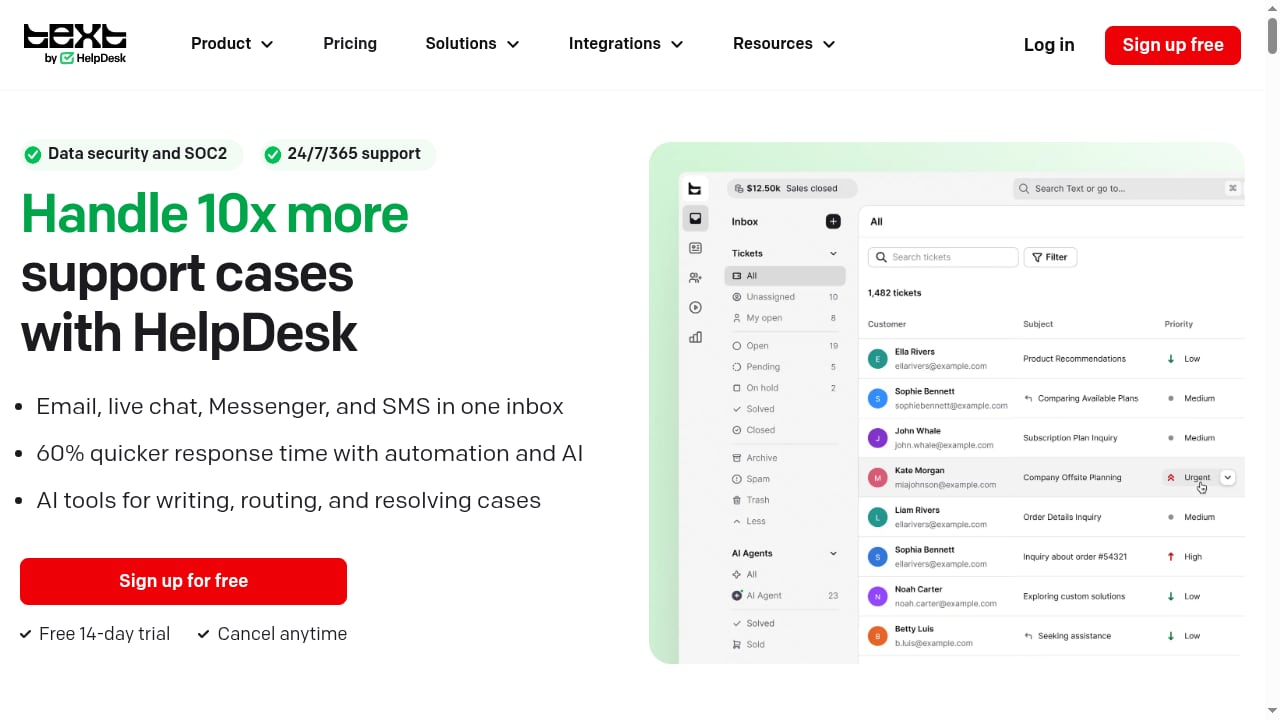
HelpDesk.com is a ticketing system for managing customer communication in one place. It combines a shared inbox, ticket management, and AI assistance so teams can start for free without a credit card. For small and mid-sized support teams, that low barrier to entry is a genuine differentiator: you can test AI-assisted ticketing before committing to a per-seat contract.
Evidence and strengths: The product is positioned as an AI help desk and ticketing system for support teams, with a free tier and no credit card requirement. Its core workflow covers ticket creation, assignment, and response management in a single interface.
Trade-offs: As a newer entrant, it has a smaller integration marketplace than legacy vendors, and teams with complex ITIL or MSP requirements may need a more specialized platform.
2. Open
Best for: Teams that want maximum AI automation and are willing to adopt a newer, AI-native platform.
Open is an AI-native ticketing platform that reports a 77% automation rate, meaning tickets fully resolved by AI rather than deflected. Its agentic workflows can take actions such as refunds, account updates, and order tracking, and it supports chat, email, voice, SMS, and WhatsApp. Pricing is per resolution at $0.99, which aligns cost with outcomes rather than seats.
Evidence and strengths: Open reports the highest automation rate among the platforms compared in published 2026 rankings, and its per-resolution pricing is transparent. Setup is reported to take under an hour.
Trade-offs: Founded in 2024, Open has a smaller integration marketplace and is still building some enterprise features. Teams with deep legacy integrations should validate fit carefully.
3. Zendesk AI
Best for: Enterprises already invested in the Zendesk ecosystem.
Zendesk is a mature help desk platform with AI features layered onto its ticketing architecture. Published comparisons place its automation rate at 15–25%, reflecting an AI-assisted rather than AI-native model. Pricing runs roughly $55–169 per agent plus AI add-ons.
Evidence and strengths: Zendesk has extensive integrations, a large partner ecosystem, and proven scalability. Its AI can suggest responses, route tickets, and answer simple FAQs.
Trade-offs: The architecture was built around human-processed ticket queues, so AI resolution rates lag AI-native platforms. Total cost rises quickly with AI add-ons.
4. Freshdesk
Best for: Budget-conscious teams that want solid ticketing with basic AI.
Freshdesk offers a free tier and paid plans from roughly $15–79 per agent, with AI features concentrated in higher tiers. Its Freddy AI provides response suggestions and automation, with reported automation rates of 20–30%.
Evidence and strengths: Strong value, multi-channel support including phone, and a mature knowledge base. It is a reliable choice for teams prioritizing cost over maximum automation.
Trade-offs: AI is “good enough” rather than exceptional, and advanced AI requires higher-tier plans.
5. Salesforce Service Cloud
Best for: Large enterprises already standardized on Salesforce CRM.
Salesforce Service Cloud combines case management with Einstein AI. Published comparisons report automation rates of 15–30%, and pricing ranges from $25–300 per user plus implementation services.
Evidence and strengths: Deep CRM integration, enterprise-grade compliance, and a massive marketplace. It is proven at Fortune 100 scale.
Trade-offs: Implementation is complex and often requires consultants, and total cost of ownership is high. Einstein underperforms dedicated AI help desk solutions on pure resolution.
6. HubSpot Service Hub
Best for: SMBs already using HubSpot CRM.
HubSpot Service Hub bundles ticketing, knowledge base, and AI features into its CRM suite. Pricing ranges from $45 to $1,200 per month depending on tier and contacts, with reported automation rates of 15–25%.
Evidence and strengths: Tight CRM integration, ease of use, and a unified view of customer data. It is a natural fit for teams already running HubSpot marketing and sales.
Trade-offs: AI resolution is modest, and costs scale with contact volume. It is less suited to pure IT service desk workflows.
7. Help Scout
Best for: Small teams that want simple, email-first support with a human touch.
Help Scout offers a shared inbox, knowledge base, and AI drafts. Pricing runs from $20–65 per user, with a free plan available. Reported automation rates are 15–25%.
Evidence and strengths: Clean interface, strong email workflow, and a focus on personalized support. AI drafts save time without pretending to fully resolve complex tickets.
Trade-offs: Limited automation depth and fewer advanced AI features than AI-native platforms. Not ideal for high-volume technical support.
8. Gorgias
Best for: Shopify and e-commerce brands.
Gorgias is an e-commerce help desk with deep Shopify integration, social media support, and AI automation rules. Pricing is volume-based from $10–900 per month, with reported automation rates of 25–35%.
Evidence and strengths: Purpose-built for e-commerce, including order data in tickets and pre-sales support tools. It handles high-volume social and email inquiries well.
Trade-offs: The e-commerce focus limits versatility outside Shopify, and AI is more rule-based than generative. Volume-based pricing can spike during busy periods.
9. Freshservice
Best for: IT teams that collaborate on tickets in Microsoft Teams.
Freshservice is a cloud-based IT service management platform with ticket, incident, problem, and change management. It includes SLA management, a ticket summary generator, and field prediction. Pricing starts around $19 per user per month billed annually.
Evidence and strengths: Strong ITIL alignment, Microsoft Teams collaboration, and automation for routing and escalation. It is a solid fit for internal IT service desks.
Trade-offs: AI is focused on IT workflows rather than customer-facing resolution, and advanced features require higher tiers.
10. Zoho Desk
Best for: Teams already using Zoho apps such as Zoho CRM.
Zoho Desk offers context-aware help desk software with multi-channel support, automation, and AI assistance. Pricing is available on request, with a 15-day free trial.
Evidence and strengths: Strong value within the Zoho ecosystem, multi-channel intake, and workflow automation. It integrates well with Zoho CRM for context.
Trade-offs: AI resolution is less mature than AI-native platforms, and pricing transparency is lower than some competitors.
Comparison Table: AI Help Desk Software at a Glance
First viewport screenshot of www.helpdesk.com.
| Platform | Best for | AI resolution/automation (reported) | Pricing model |
|---|---|---|---|
| HelpDesk | SMB support teams | AI-assisted ticketing | Free tier; paid plans |
| Open | Maximum AI automation | 77% automation | $0.99 per resolution |
| Zendesk AI | Zendesk enterprises | 15–25% | $55–169/agent + AI add-ons |
| Freshdesk | Budget teams | 20–30% | $15–79/agent |
| Salesforce Service Cloud | Salesforce enterprises | 15–30% | $25–300/user + implementation |
| HubSpot Service Hub | HubSpot SMBs | 15–25% | $45–1,200/month |
| Help Scout | Small email-first teams | 15–25% | $20–65/user |
| Gorgias | Shopify brands | 25–35% | $10–900/month volume-based |
| Freshservice | IT service desks | IT workflow automation | From $19/user/month |
| Zoho Desk | Zoho ecosystem | AI-assisted | On request |
How to Choose the Right AI Help Desk Software
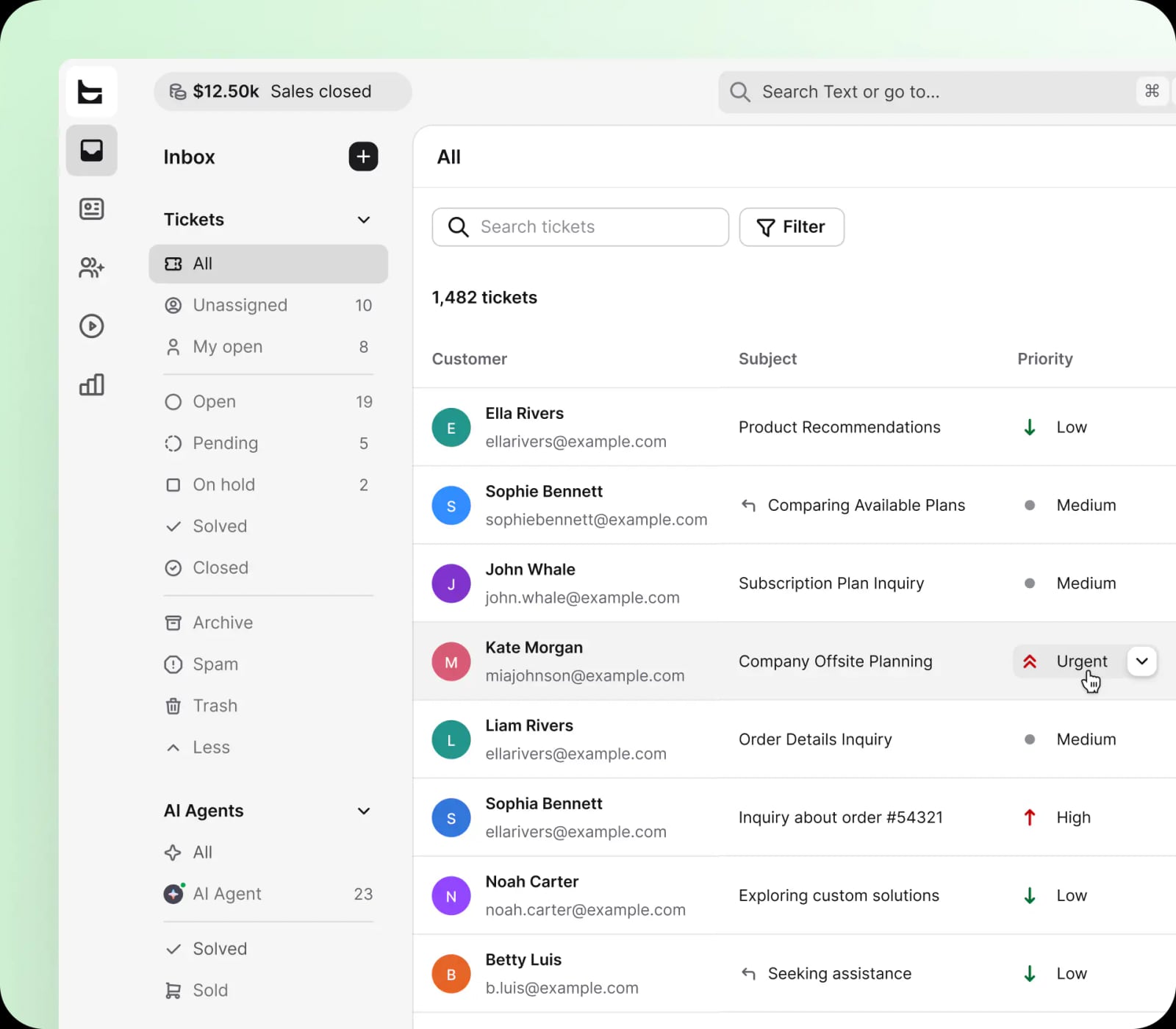
HelpDesk ticket inbox showing AI-assisted support with 1,482 tickets, priority filtering, and multichannel views.
Start with the work around the ticket, not the ticket itself. If your team supports customers, prioritize AI resolution rate and channel coverage. If you support employees, prioritize SLA tracking, asset context, and ITIL workflows. If you run an MSP, look for PSA integration with RMM and documentation tools.
Ask vendors for resolution rate, not deflection rate. Deflection counts tickets that did not reach a human, but it does not confirm the customer’s problem was solved. Resolution rate measures tickets fully resolved by AI with confirmed satisfaction.
Consider pricing architecture. Per-resolution pricing aligns cost with outcomes but can spike with volume. Per-seat pricing is predictable but may discourage AI adoption if every resolution adds cost. Hybrid models can compound costs.
For teams exploring adjacent AI customer service workflows, our guide to autonomous AI agents in customer service explains where AI agents fit and how to deploy them responsibly. If you are comparing broader automation platforms, see our top 10 AI customer service automation software ranking.
Where Intercom Fits
First viewport screenshot of www.helpdesk.com.
Intercom is an AI-first customer service platform with a natively integrated Fin AI Agent, and it is often evaluated alongside help desk software. It is not a dedicated AI help desk and ticketing product in the same sense as the platforms above, so we did not rank it here. However, teams that need in-app messaging, product tours, and AI-assisted chat may find Intercom complementary to a ticketing system. Published comparisons place Intercom’s automation rate at 30–40% with pricing of $39–139 per seat plus $0.99 per resolution. For a deeper comparison of Intercom against other platforms, see our Intercom vs Talkdesk AI customer service showdown.
Related reading
- How to Use Intercom with Zoom: AI + Human Support - Learn how to connect Intercom's AI-first helpdesk with Zoom to unify customer conversations, automate resolutions, and escalate to live video support.
- Intercom vs RingCentral vs BlackBeltHelp: 2026 Comparison - Compare Intercom, RingCentral, and BlackBeltHelp on AI customer service, voice, higher-ed helpdesk fit, integrations, and pricing to pick the right platform.
- HelpCrunch Review 2026: Live Chat, Automation & Value - Evidence-based HelpCrunch review covering live chat, chatbots, knowledge base, email marketing, pricing signals, setup, and ideal users for 2026.
Frequently Asked Questions
What is the difference between AI help desk software and AI ticketing software?
AI help desk software typically includes a broader set of support tools such as knowledge bases, self-service portals, and reporting, while AI ticketing software focuses on capturing, routing, and resolving tickets. In practice, the categories overlap heavily, and most platforms on this list offer both.
Do AI help desk platforms actually resolve tickets?
Some do, some do not. AI-native platforms report automation rates of 70–80%, while legacy help desks with AI add-ons report 15–30%. Always ask for resolution rate rather than deflection rate.
How much does AI help desk software cost in 2026?
Pricing ranges from free tiers for small teams to $300 per user per month for enterprise CRM-integrated platforms. Per-resolution models typically charge around $0.99 per resolved ticket.
Can I use Intercom as an AI help desk?
Intercom is an AI-first customer service platform with a strong AI agent, but it is not a dedicated help desk and ticketing system. It can complement a ticketing platform for teams that need messaging and in-app support.
What should IT teams look for in AI ticketing software?
IT teams should prioritize SLA tracking, asset and documentation context, Microsoft Teams or Slack intake, and ITIL-aligned workflows. Freshservice, ManageEngine ServiceDesk Plus, and SysAid are common choices.
Conclusion
The best AI help desk and ticketing software for 2026 depends on whether you need maximum AI resolution, deep IT workflows, e-commerce integration, or a low-cost starting point. AI-native platforms like Open lead on automation, while established platforms like Zendesk, Freshdesk, and Salesforce offer maturity and ecosystem depth. HelpDesk stands out for teams that want a free, straightforward entry into AI-assisted ticketing. Evaluate resolution rates, pricing architecture, and environment fit before committing.