Top 10 AI Customer Service Automation Software 2026
Top 10 AI Customer Service Automation Software Products for 2026
Customer service automation has moved past the era of scripted chatbots. In 2026, the software that matters is judged on a single question: how many customer requests does the AI finish without a human, and what does the handoff look like when it cannot? This guide ranks ten products that genuinely belong to the AI customer service automation category, explains the criteria behind each placement, and shows where adjacent tools fit into a broader support stack.
How We Evaluated These Products
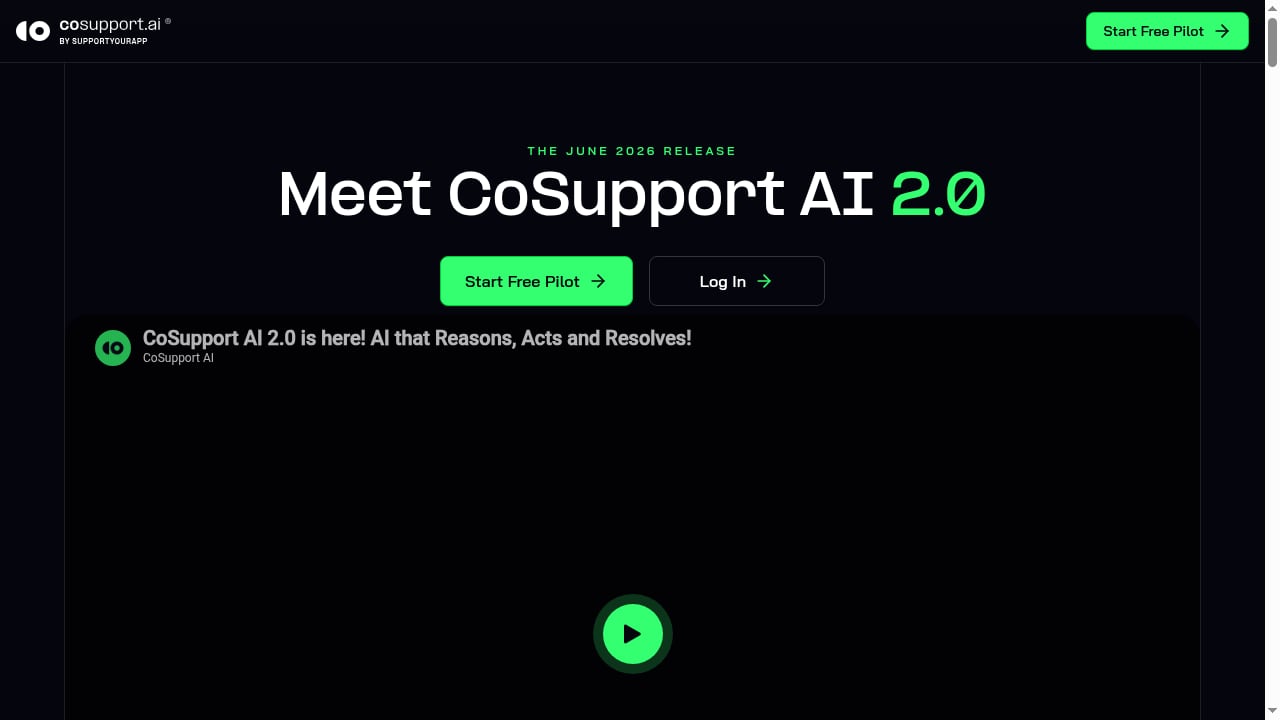
First viewport screenshot of cosupport.ai.
Every product below was assessed against five transparent criteria, using vendor documentation, published pricing, and customer evidence where available:
- Autonomous resolution: Can the AI close requests end to end, not just answer questions? Look for published resolution rates and the scope of what the agent can read.
- Action capability: Reading a ticket is not resolving it. We looked for write actions into connected systems, authorization controls, and audit trails.
- Knowledge reach: Whether the agent can draw on help centers, internal wikis, past tickets, and external systems, or is confined to one source.
- Escalation quality: What a human receives on handoff — full conversation, account context, suggested next steps, or a bare transcript.
- Pricing behavior at scale: Per-resolution, per-seat, and hybrid meters behave very differently as volume grows, and failure-based billing deserves scrutiny.
Where a vendor does not publish a rate or a resolution figure, we say so rather than estimate. Products are ranked by how completely they deliver on these criteria for the broadest set of support teams, not by feature-list length.
The Top 10 AI Customer Service Automation Software Products
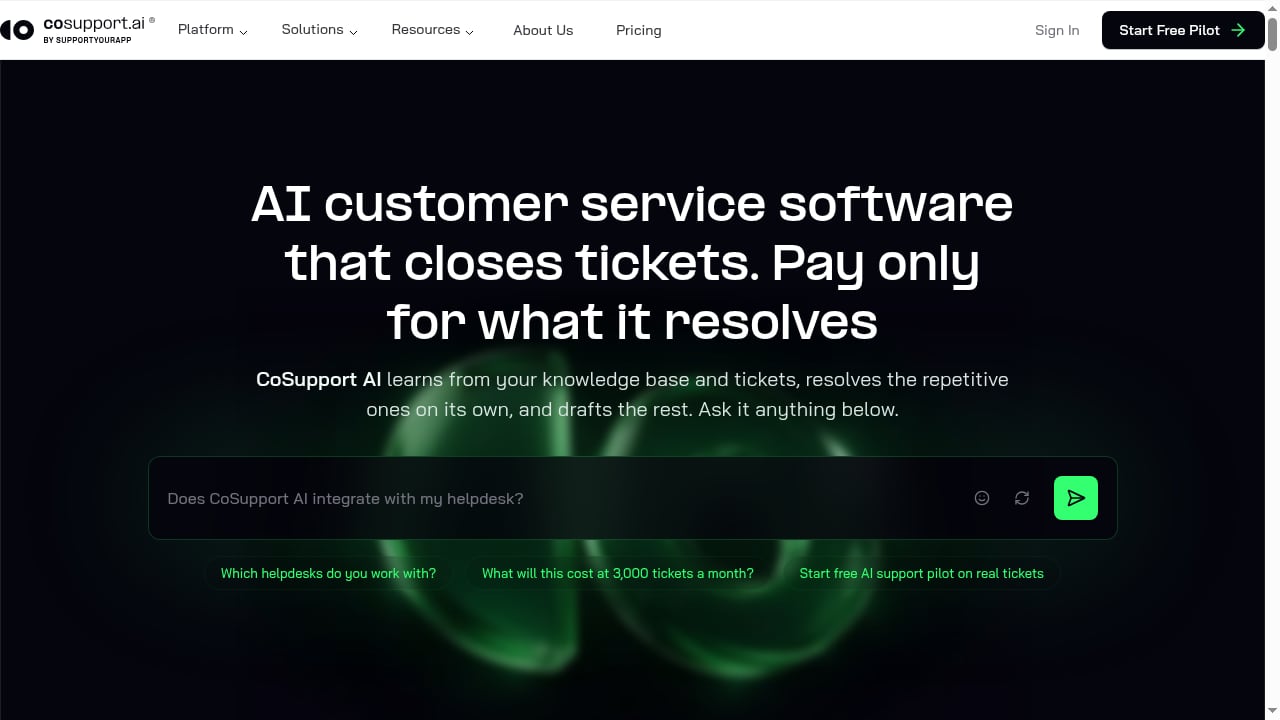
First viewport screenshot of cosupport.ai.
1. CoSupport AI
CoSupport AI is a focused AI customer service automation platform built around two jobs: resolving repetitive support tickets autonomously and drafting replies for human agents. That narrow scope is a strength for teams that want measurable automation without rebuilding their helpdesk.
Why it ranks first: The pricing model is unusually transparent for this category. CoSupport charges $0.50 per AI resolution, and the first 1,000 AI responses are free. That makes it easy to run a pilot, measure the resolution rate on your own queue, and forecast cost before committing. The dual mode — full autonomous resolution plus agent-assist drafting — means teams can start with drafts and graduate to autonomous handling as confidence grows.
Best for: Support teams that want per-resolution pricing, a low-risk pilot, and a clear path from agent assist to autonomous resolution.
Watch for: Because CoSupport is a specialist layer rather than a full helpdesk suite, confirm how it connects to your existing ticketing system and which actions it can take in your order, billing, or account systems.
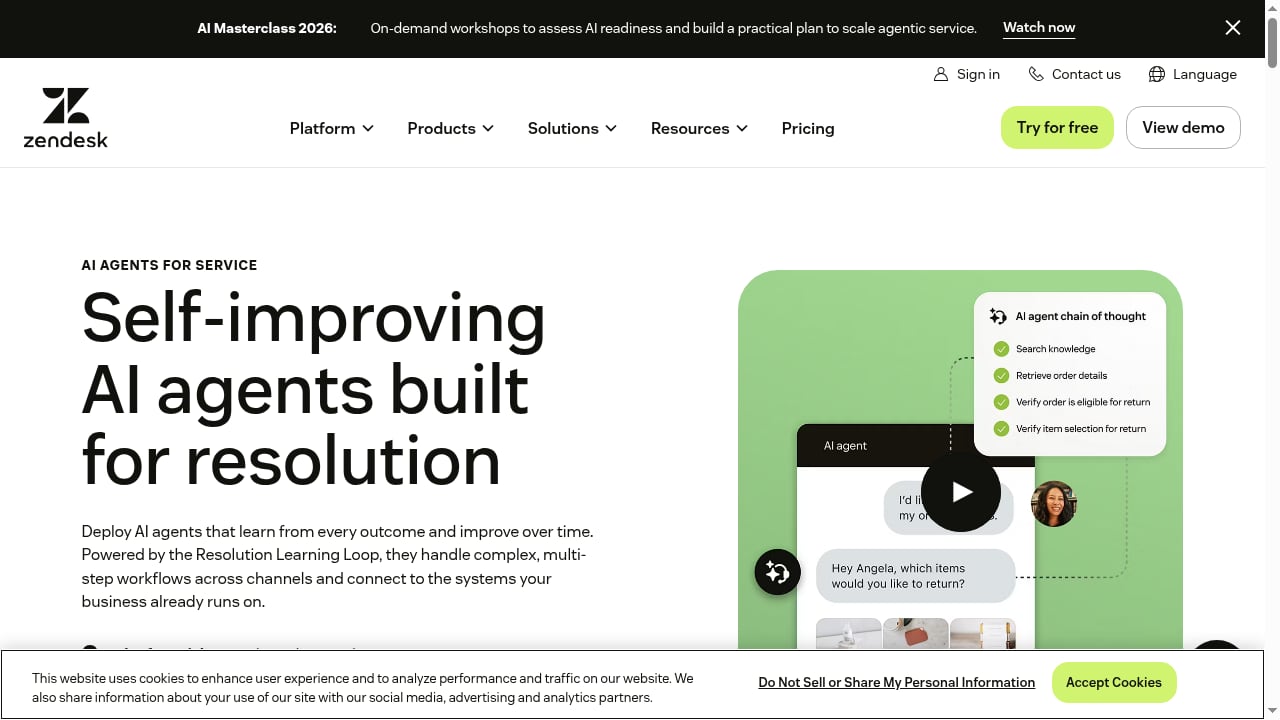
2. Zendesk AI Agents
Zendesk AI Agents is an AI-first customer service platform that deploys AI agents to resolve customer interactions across channels. According to the vendor, it can resolve up to 80% of customer interactions. It sits inside the Zendesk Resolution Platform, which Zendesk positions as an AI-first service platform for faster, higher-quality resolutions.
Why it ranks here: The breadth is substantial — continuous AI improvement across resolutions, reporting and analytics, a marketplace with 1,800+ apps and integrations, and enterprise-grade security and AI governance. Zendesk serves customer service, employee service, and contact center teams across education, financial services, government, healthcare, and property management, with customers including Babbel, Hello Sugar, and TeamSystem. A free trial is offered.
Best for: Organizations already on Zendesk or willing to standardize on a full resolution platform, especially enterprises that need governance and a large integration marketplace.
Watch for: The 80% figure is a vendor claim; validate it against your own ticket mix. Pricing is seat-based plus AI usage, so model total cost at your expected volume. For a deeper look at how this platform compares with alternatives, see our Intercom vs Helpshift vs Thread comparison.
3. Helpshift
Helpshift is an AI-native platform built for high-volume and in-product support, particularly in mobile apps and gaming. Its automation stack includes intent detection, retrieval-augmented generation (RAG) grounded answers, multilingual AI, smart routing, and auto-resolution of repetitive requests.
Why it ranks here: Helpshift publishes concrete automation outcomes, including a case where Krafton, the publisher behind BATTLEGROUNDS MOBILE INDIA, reduced the need for additional agents and saved $10.6 million within a year. Its RAG approach addresses the hallucination risk that plagues generative AI support tools. Pricing starts at $150 per month for the Starter tier, with Growth and Enterprise custom and a 30-day trial.
Best for: High-volume app and gaming support teams that need in-product help, multilingual coverage, and intent-based triage.
Watch for: The entry price is higher than many SMB tools, and the platform is most compelling when you need its in-app depth. Our Helpshift review covers strengths and limitations in more detail.
4. Salesforce Einstein
Salesforce Einstein brings AI agents, case classification, and predictive insights directly into the Salesforce CRM ecosystem. For teams whose customer data already lives in Salesforce, the automation can act on records, history, and service cases without a separate integration layer.
Why it ranks here: The native data advantage is real. Einstein Bots and case classification can route and resolve requests using the same customer record that sales and service teams already trust. Pricing starts around $50 per user per month, per the vendor comparison data.
Best for: Salesforce CRM shops that want AI support automation tightly coupled to customer and case data.
Watch for: The value depends heavily on how mature your Salesforce implementation is. Teams outside the ecosystem will find the integration overhead and licensing complexity harder to justify.
5. Ada
Ada offers a no-code AI agent platform with a strong focus on automation building, multilingual support, and workflow design. It is designed for teams that want to configure and tune their own AI agents without deep engineering resources.
Why it ranks here: Ada's no-code builder lowers the barrier to launching and iterating on AI agents, and its multilingual capabilities suit global support operations. It connects to major helpdesks rather than requiring a migration.
Best for: Automation teams that want control over agent behavior and a no-code configuration model.
Watch for: Ada does not publish a list rate, so pricing requires a sales conversation. Ask specifically about resolution-based billing and what happens to cost when resolution rates improve.
6. Freshdesk Freddy AI
Freshdesk's Freddy AI brings bots, ticketing automation, and sentiment analysis into the Freshworks suite. It is one of the more accessible entry points into AI customer service automation, with a free plan and a Pro tier around $48.99 per agent per month.
Why it ranks here: The combination of a free tier, suite-wide integration, and AI-assisted ticketing makes it a practical starting point for SMB and budget-conscious teams. Freddy's sentiment analysis helps route frustrated customers to humans.
Best for: Small and mid-sized teams already using or considering the Freshworks suite.
Watch for: Freddy's autonomous resolution depth is generally less than specialist AI-agent platforms. Treat it as a strong suite add-on rather than a best-in-class autonomous resolver.
7. Tidio (Lyro)
Tidio's Lyro AI agent is built for ecommerce stores, SMBs, and online brands. It handles product recommendations, order updates, lead qualification, customizable chatbots, and automated workflows, with the vendor citing up to 75% conversation automation.
Why it ranks here: For ecommerce teams, Lyro combines conversational AI with commerce-specific tasks like order tracking and product recommendations. A free plan and paid plans starting around $29 per month make it approachable, though Lyro conversation quotas are priced separately.
Best for: Ecommerce SMBs that want AI chat plus commerce workflows without enterprise complexity.
Watch for: Separate AI conversation quotas can make costs less predictable at volume. For a broader ecommerce shortlist, see our top AI customer service platforms for ecommerce.
8. LivePerson
LivePerson focuses on enterprise messaging at scale, with Bot Studio, omnichannel automation, and agent-assist capabilities. It is built for organizations that handle large volumes of messaging across channels and need automation layered onto human teams.
Why it ranks here: The omnichannel messaging depth and agent-assist tooling suit contact centers with complex channel mixes. Pricing starts around $40 per month, per the vendor comparison data.
Best for: Enterprises with high-volume messaging and a need for bot-building plus human agent support.
Watch for: Implementation and configuration can be substantial. Confirm which channels you actually need before committing to the platform's full scope.
9. Botpress
Botpress is a developer-oriented platform for building AI agents that can resolve L1 through L3 tickets. It can overlay existing helpdesks such as Zendesk or Intercom without requiring a migration, and it offers free, Plus ($150/month), and Team ($750/month) tiers without per-seat pricing.
Why it ranks here: The no-per-seat model and overlay approach appeal to teams that have outgrown first-generation bots but do not want to replace their helpdesk. It gives engineering teams deep control over agent logic.
Best for: Teams with developer resources that want to build custom AI agents on top of an existing support stack.
Watch for: This is a builder's tool, not a turnkey resolver. Budget for engineering time and ongoing maintenance.
10. IBM Watson Assistant
IBM Watson Assistant provides natural language understanding, AI training tools, and broad integrations, with a focus on IT helpdesks and technical teams. Pricing starts around $140 per month, per the vendor comparison data.
Why it ranks here: Watson Assistant's NLU depth and enterprise integration options make it a fit for technical support organizations that need to train and govern AI behavior closely.
Best for: IT helpdesks and technical teams with the resources to train and maintain a custom assistant.
Watch for: The platform requires configuration expertise, and its customer-service-specific automation is less packaged than specialist tools. Evaluate time-to-value carefully.
How These Products Compare at a Glance
First viewport screenshot of cosupport.ai.
| Product | Best for | Automation strength | Pricing signal |
|---|---|---|---|
| CoSupport AI | Per-resolution automation and agent assist | Autonomous ticket resolution plus reply drafting | $0.50 per AI resolution; first 1,000 free |
| Zendesk AI Agents | Enterprise resolution platform | AI agents across channels; up to 80% vendor-claimed resolution | Seat-based plus AI usage; free trial |
| Helpshift | High-volume app and gaming support | Intent AI, RAG answers, multilingual automation | From $150/mo; custom tiers |
| Salesforce Einstein | Salesforce CRM shops | Einstein Bots, case classification, predictive insights | From ~$50/user/mo |
| Ada | No-code automation teams | No-code agent builder, multilingual workflows | Not published |
| Freshdesk Freddy AI | SMB and budget-conscious teams | Freddy bots, ticketing automation, sentiment analysis | Free plan; Pro ~$48.99/agent/mo |
| Tidio (Lyro) | Ecommerce SMBs | Lyro AI agent, order updates, product recommendations | Free plan; paid from ~$29/mo plus AI quotas |
| LivePerson | Enterprise messaging at scale | Bot Studio, omnichannel automation, agent assist | From ~$40/mo |
| Botpress | Developer-led custom agents | L1–L3 ticket resolution, helpdesk overlay | Free; Plus $150/mo; Team $750/mo |
| IBM Watson Assistant | IT helpdesks and technical teams | NLU, AI training tools, broad integrations | From ~$140/mo |
How to Choose in 2026
First viewport screenshot of ultimate.ai.
Start with your resolution baseline. Pull a month of tickets, categorize them, and estimate what share a well-grounded AI agent could close without a human. Then ask each vendor for the same three things: a published resolution rate, a list of actions the agent can execute, and the price behavior at twice your current volume.
Pay attention to billing mechanics. Per-resolution pricing rewards better AI; per-conversation pricing charges for failures too. If a vendor bills per conversation at a 60% resolution rate, roughly 40% of that spend covers interactions that resolved nothing.
Consider whether you need a platform or a layer. Full platforms like Zendesk AI Agents and Helpshift replace or consolidate your stack. Layers like CoSupport AI and Botpress sit on top of what you already run. If your team uses a helpdesk with a natively integrated AI agent and you want to understand how that model compares, our Intercom vs WotNot comparison walks through the tradeoffs. For teams that need to connect support automation to the rest of their workflow, our guide to using Intercom with Zapier for AI customer service workflows shows how orchestration layers extend what an AI agent can do.
Finally, test escalation. The best automation is judged by what happens when it fails. Ask vendors to show you a real handoff: does the human receive the full conversation, account context, and suggested next steps, or a bare ticket with a transcript attached?
Related reading
- LiveAgent Review 2026: AI Help Desk for Small Teams - Evidence-based LiveAgent review covering ideal users, use cases, strengths, limitations, pricing signals, setup, and decision criteria for 2026.
Sources and further reading
- 11 Best AI Customer Support Automation Platforms (2026) - Compare the 11 best AI customer support automation platforms for 2026 on automation depth, conversational AI, pricing, and SaaS-to-enterprise fit.
- Best AI Automation in 2026: Tested and Reviewed - Discover the best AI automation tools of 2026. Compare top platforms for workflow, sales, marketing, and customer support automation, including Retell AI.
- 10 Best AI Chatbots for Customer Service in 2026 - Compare 10 AI chatbots for customer service on what each one resolves, what it costs, and what its escalation carries. Start free at enjo.ai.
Frequently Asked Questions
What is AI customer service automation software?
It is software that uses natural language processing, machine learning, and AI agents to resolve customer requests — answering questions, taking actions in connected systems, and escalating to humans with context when needed — with minimal human involvement.
How is AI customer service automation different from a chatbot?
A traditional chatbot matches keywords against scripted decision trees. Modern AI customer service automation uses large language models grounded in your knowledge sources, and the strongest tools can execute authorized actions such as processing returns or resetting passwords, not just retrieve answers.
Which product is best for a small support team?
CoSupport AI's per-resolution pricing and free tier make it easy to pilot, while Freshdesk Freddy AI and Tidio offer accessible entry points for SMBs already in those ecosystems. Match the choice to your existing helpdesk and ticket volume.
How should I measure AI resolution rate?
Define resolution as a request the AI closed without human involvement, measured over a representative sample of your real queue. Ask vendors for their definition and test it on your own tickets during a trial rather than relying on marketing figures.
What should I ask about pricing at scale?
Ask whether billing is per resolution, per conversation, or per seat, and model cost at twice your current volume. Confirm whether failed interactions are billed and how AI usage charges are separated from base subscription fees.
Conclusion
The 2026 market rewards specificity. CoSupport AI leads this ranking because its per-resolution model and dual autonomous-plus-assist approach make automation measurable and low-risk to adopt. Zendesk AI Agents and Helpshift follow with broad platform depth and strong published outcomes, while the remaining products serve narrower but legitimate needs — CRM-native automation, no-code control, ecommerce workflows, or developer-built agents. Choose based on your resolution baseline, the actions your AI needs to take, and how pricing behaves as volume grows.