AI Customer Service Solutions: A Practical Buyer's Guide for 2026

AI Customer Service Solutions: A Practical Buyer's Guide for 2026
Customers now expect fast, accurate answers at any hour, and support teams are under pressure to deliver them without ballooning headcount. AI customer service solutions promise to close that gap, but the market is crowded and the claims are hard to compare. This guide explains what these platforms actually do, how to evaluate them, and where a natively integrated AI agent such as Intercom's Fin fits into a modern support stack.
What AI customer service solutions actually do
First viewport screenshot of www.intercom.com.
At a practical level, AI customer service solutions fall into three layers. Most vendors blend them, but the balance matters when you compare products.
- Self-service AI agents answer customer questions directly in chat, email, messaging, and increasingly voice. They draw on your help center, past conversations, and connected systems to resolve issues without a human.
- Agent assist tools sit beside human reps, drafting replies, summarizing long threads, and surfacing relevant knowledge so people handle complex cases faster.
- Workflow automation routes, tags, and escalates conversations, triggers follow-ups, and keeps context intact as a case moves between AI and people.
The strongest platforms connect these layers so that every conversation, whether resolved by AI or a human, improves the next one. That feedback loop is the real differentiator, not the length of a feature list.
Why the market is shifting from handoffs to resolution
Older support models were built around handoffs: a chatbot deflects, a ticket is created, a human takes over. The result was often a worse experience than no automation at all. The current generation of AI customer service solutions aims at resolution instead, handling multi-step requests such as verifying a customer, updating an order, or triggering a follow-up.
Industry vendors frame this shift in similar terms. IBM's AI for customer service describes AI agents that break complex requests into coordinated, secure actions across channels. Sierra emphasizes building agents from existing documentation and optimizing them over time. The common thread is that AI is expected to complete work, not just talk.
That raises the bar for evaluation. A tool that only answers FAQs is table stakes in 2026; the question is how much of your actual ticket volume it can resolve end to end.
How to evaluate an AI customer service platform
First viewport screenshot of www.intercom.com.
Use the criteria below as a scorecard. They reflect what buyers actually weigh when comparing tools, as seen in roundups such as Freshworks' review of AI customer support tools.
1. Resolution rate, not deflection rate
Deflection counts conversations the AI avoided; resolution counts problems actually solved. Ask vendors for resolution data on use cases like yours, and check whether the AI can take actions in your backend systems or only answer questions.
2. Native integration between AI and helpdesk
Many platforms bolt an AI layer onto a legacy helpdesk. That creates sync gaps, duplicated knowledge, and awkward escalation. A natively integrated AI agent, like Fin inside Intercom, shares the same conversation history and knowledge base as your human team, so context carries over when a case escalates.
3. Channels and voice
Chat and email are baseline. Messaging apps, in-product support, and voice are increasingly expected. If phone support matters to your business, confirm whether voice is native or requires a third-party add-on.
4. Knowledge management and learning
Check how the AI is trained: from your help center, past conversations, uploaded documents, or all three. Then ask how it improves. The best systems learn from every interaction and flag gaps for your team to fix.
5. Integrations and actions
Your AI is only as useful as the systems it can reach. Look for CRM, order management, and workflow connectors, plus automation platforms such as Zapier for the long tail. For a deeper look at connecting Intercom to other tools, see our guide on using Intercom with Zapier for AI customer service workflows.
6. Pricing model
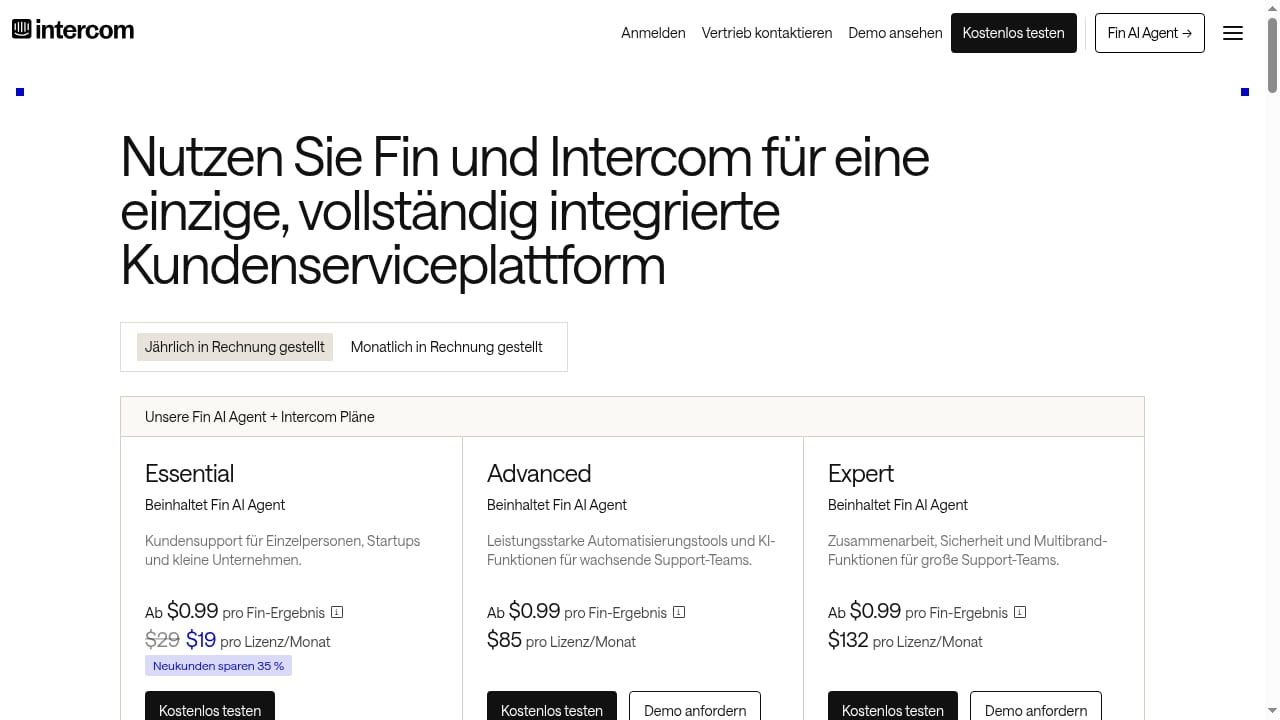
AI pricing varies widely: per seat, per resolution, per conversation, or custom. Model your expected volume at realistic resolution rates before committing. A low headline price can hide high per-resolution costs at scale.
7. Security and governance
Confirm data handling, access controls, and audit trails. AI that touches customer records needs the same governance as any other system.
Where Intercom fits in an AI-first stack
First viewport screenshot of www.intercom.com.
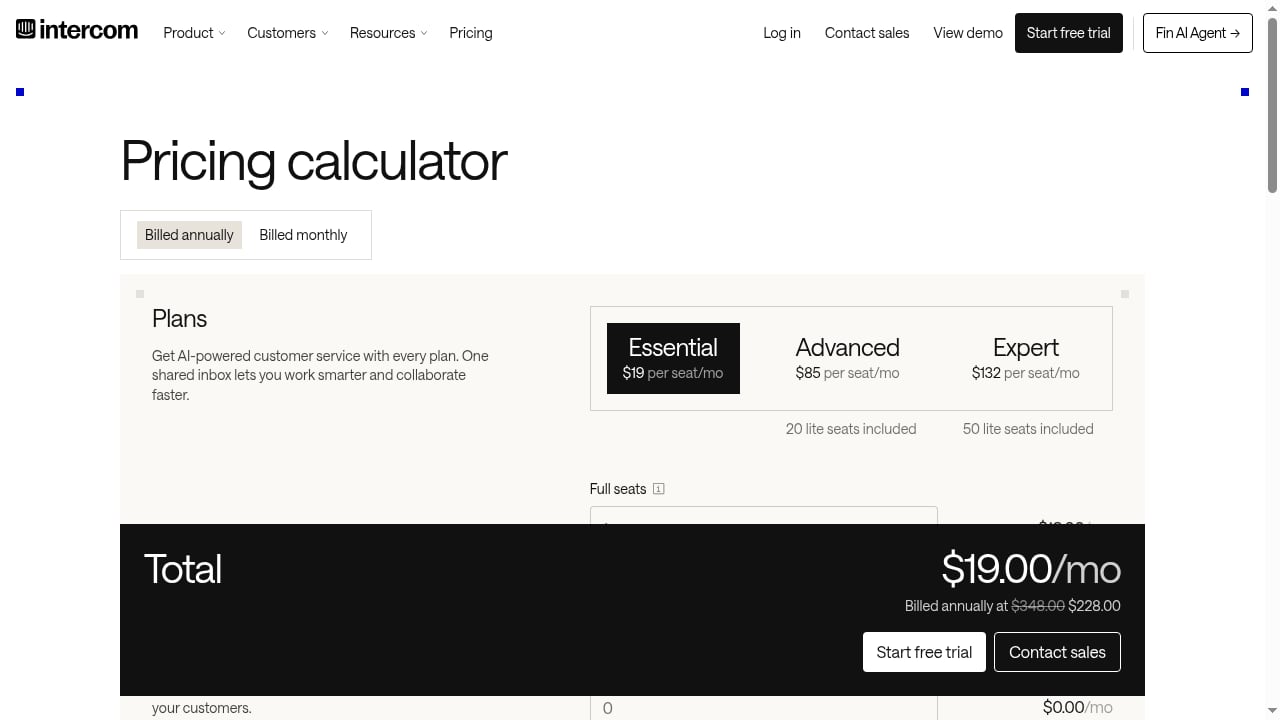
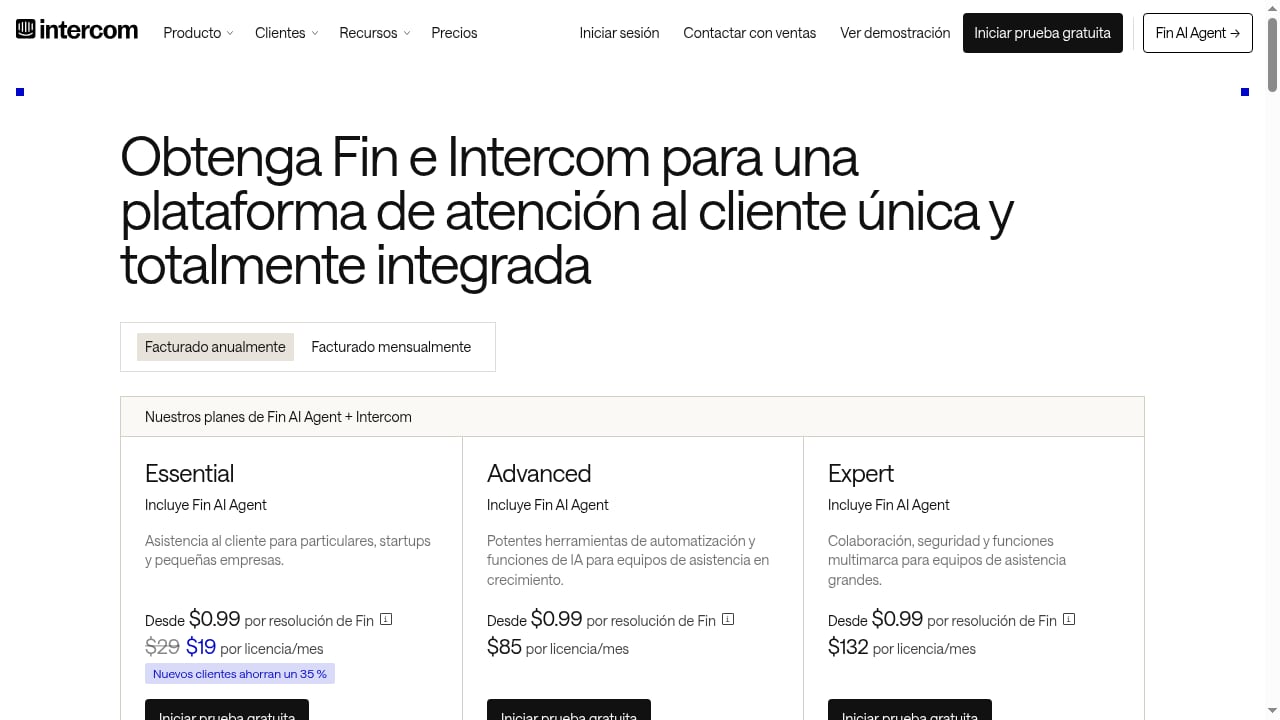
Intercom is an AI-first customer service platform built around a single idea: the AI agent and the human helpdesk should be one system. Fin, Intercom's AI Agent, is natively integrated rather than layered on top, which means every customer conversation feeds the same knowledge and context that human agents use. That design supports the resolution-first model described above: Fin can answer, act, and escalate with full context.
This matters most for teams that want to start with AI on the front line and keep humans for complex or sensitive cases. If that is your model, compare Intercom against alternatives on AI resolution, voice, and pricing in our Intercom vs Talkdesk comparison, or browse the broader top 10 AI help desk and ticketing software for 2026.
Common pitfalls when adopting AI customer service
First viewport screenshot of www.intercom.com.
- Automating before you have content. AI agents are only as good as the knowledge they draw on. Fix documentation gaps first.
- Measuring deflection only. Deflection can look great while customers reopen tickets elsewhere. Track resolution and CSAT together.
- Ignoring escalation design. The handoff from AI to human is where experiences break. Test it explicitly.
- Underestimating change management. Agents need new workflows, not just new tools.
Related reading
- How to Use Intercom with Zoom: AI + Human Support - Learn how to connect Intercom's AI-first helpdesk with Zoom to unify customer conversations, automate resolutions, and escalate to live video support.
- Intercom vs RingCentral vs BlackBeltHelp: 2026 Comparison - Compare Intercom, RingCentral, and BlackBeltHelp on AI customer service, voice, higher-ed helpdesk fit, integrations, and pricing to pick the right platform.
FAQ
What is the difference between an AI chatbot and an AI customer service solution?
A chatbot typically answers scripted or FAQ-style questions. A full AI customer service solution combines an AI agent, agent assist, workflow automation, and analytics in one platform, and can take actions in connected systems.
How do I measure whether AI customer service is working?
Track resolution rate, containment, first-contact resolution, CSAT, and escalation quality. Compare AI-handled and human-handled conversations on the same metrics rather than looking at deflection alone.
Can AI customer service solutions handle voice?
Some can. Voice support is increasingly available, but depth varies. If phone is a major channel for you, test voice quality and escalation paths during evaluation.
Is a natively integrated AI agent better than a bolt-on?
Generally yes, because native integration keeps knowledge, context, and reporting in one place. Bolt-on tools can work, but expect more sync work and more places for context to get lost.
Conclusion
AI customer service solutions have moved from novelty to core infrastructure. The right choice depends less on feature count and more on how well the AI resolves real issues, how cleanly it hands off to humans, and how quickly it improves with every conversation. Build a scorecard around resolution, native integration, channels, knowledge, and pricing, then test with your own traffic before you commit. Platforms like Intercom, which treat AI and human support as one system, are a useful benchmark for what an AI-first stack should look like in 2026.