Intercom Pricing: AI-First Helpdesk Costs Explained
Intercom Pricing: What AI-First Customer Service Really Costs
Pricing an AI-first customer service platform is not the same as pricing a traditional helpdesk. When an AI Agent resolves conversations on its own, your bill depends on outcomes as much as on seats. Intercom, the AI-first customer service platform built around the Fin AI Agent, reflects this shift. This article explains how Intercom pricing works, what drives cost, and how to estimate your total spend before you commit.
How Intercom Pricing Is Structured
First viewport screenshot of Intercom Customers | See who trusts Intercom.
Intercom combines two cost components:
- Seat-based plans for the human support team using the helpdesk.
- Fin AI Agent pricing based on the volume of conversations the AI resolves.
This dual model means you pay for the people who handle complex or escalated issues and for the AI that handles the rest. The balance between the two determines your effective cost per resolution.
Seat-Based Plans
Intercom offers tiered plans that scale with team size and feature needs. Each tier unlocks more advanced helpdesk capabilities, automation, reporting, and integrations. You pay per seat, so the number of human agents directly affects the base cost. For a detailed walkthrough of setting up seats, channels, and the AI Agent, see How to Use Intercom: Setup, Fin AI Agent & Best Practices.
Fin AI Agent Pricing
Fin is priced per AI resolution rather than per seat. An AI resolution is a conversation Fin handles end to end without a human agent. This model aligns cost with value: you pay when the AI successfully resolves a customer issue, not merely when it attempts one. Businesses that automate a high percentage of conversations often see their cost per resolution drop significantly compared to seat-only pricing.
What Drives Your Intercom Bill
First viewport screenshot of Sign Up | Intercom.
Several factors determine what you actually pay each month.
1. Number of Human Seats
Every support agent who logs into the helpdesk needs a seat. If your team grows, seat costs grow. However, a well-configured AI Agent can reduce the number of seats you need over time by deflecting routine tickets.
2. AI Resolution Volume
Fin's cost scales with the number of conversations it resolves. High-volume periods, seasonal spikes, or product launches can increase AI resolution counts. The upside is that AI resolutions are typically far cheaper than human-handled tickets, so volume growth does not translate into proportional cost growth.
3. Resolution Rate
The percentage of conversations Fin resolves without human help is the single biggest lever on total cost. A higher resolution rate means fewer escalations, fewer human hours, and lower cost per customer interaction. Improving your knowledge base and using Fin Procedures directly improves this metric. For a practical guide, see How to Use Intercom with Fin: Setup, Workflows & Examples.
4. Channels and Integrations
Intercom supports email, chat, messenger, SMS, and other channels. Connecting more channels can increase conversation volume, but it also centralizes support and reduces tool sprawl. Evaluate whether each channel justifies its cost.
5. Add-Ons and Advanced Features
Advanced reporting, custom roles, compliance features, and premium support may carry additional costs depending on your plan. Always confirm what is included at your tier before signing.
Estimating Your Intercom Cost: A Practical Example
First viewport screenshot of Pricing Calculator | Intercom.
Suppose a company handles 10,000 support conversations per month.
- Without AI: If each conversation takes a human agent 10 minutes and agents cost $30/hour fully loaded, that is roughly $50,000 per month in labor.
- With Fin resolving 60% of conversations: 6,000 conversations are handled by AI. The remaining 4,000 human-handled conversations cost about $20,000 in labor, plus the AI resolution fees for 6,000 conversations.
Even after adding AI resolution costs, the total is often substantially lower than the all-human scenario. The exact savings depend on your resolution rate and the complexity of your remaining tickets.
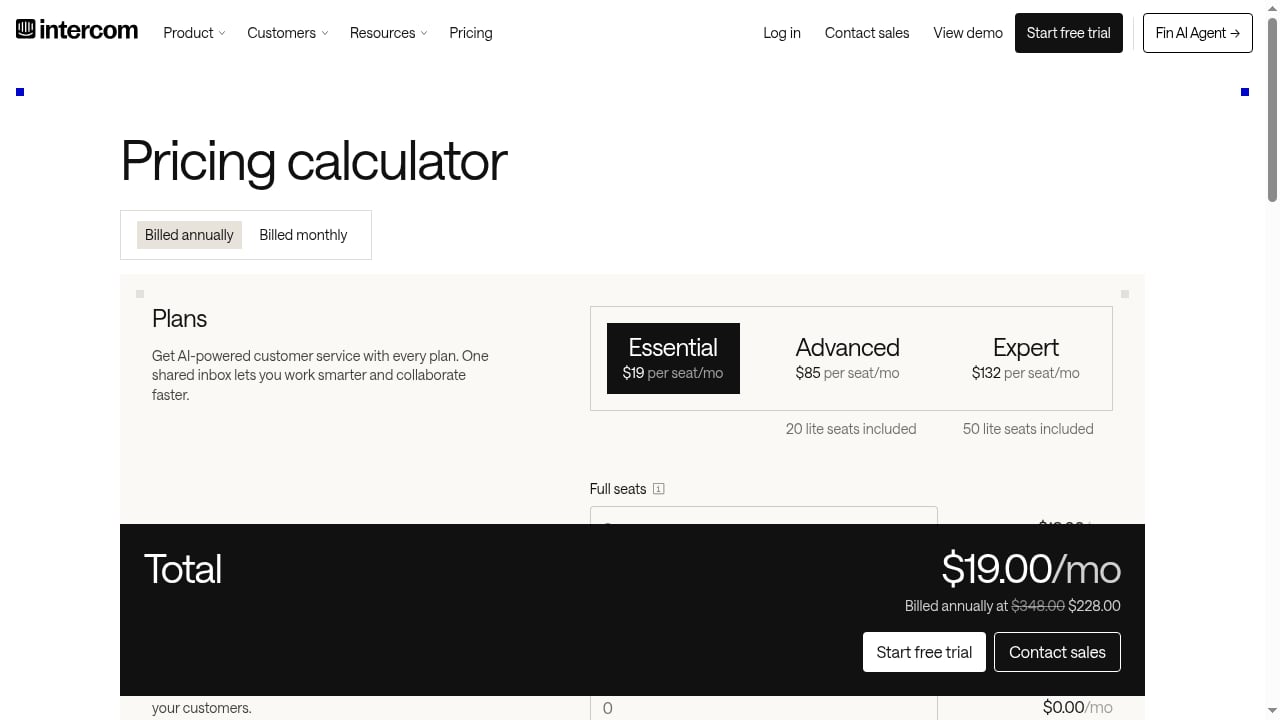
Intercom provides a pricing calculator that lets you input team size and expected outcomes to estimate costs. Use it to model different resolution rates and see how they affect your bill.
Intercom vs. Traditional Helpdesk Pricing
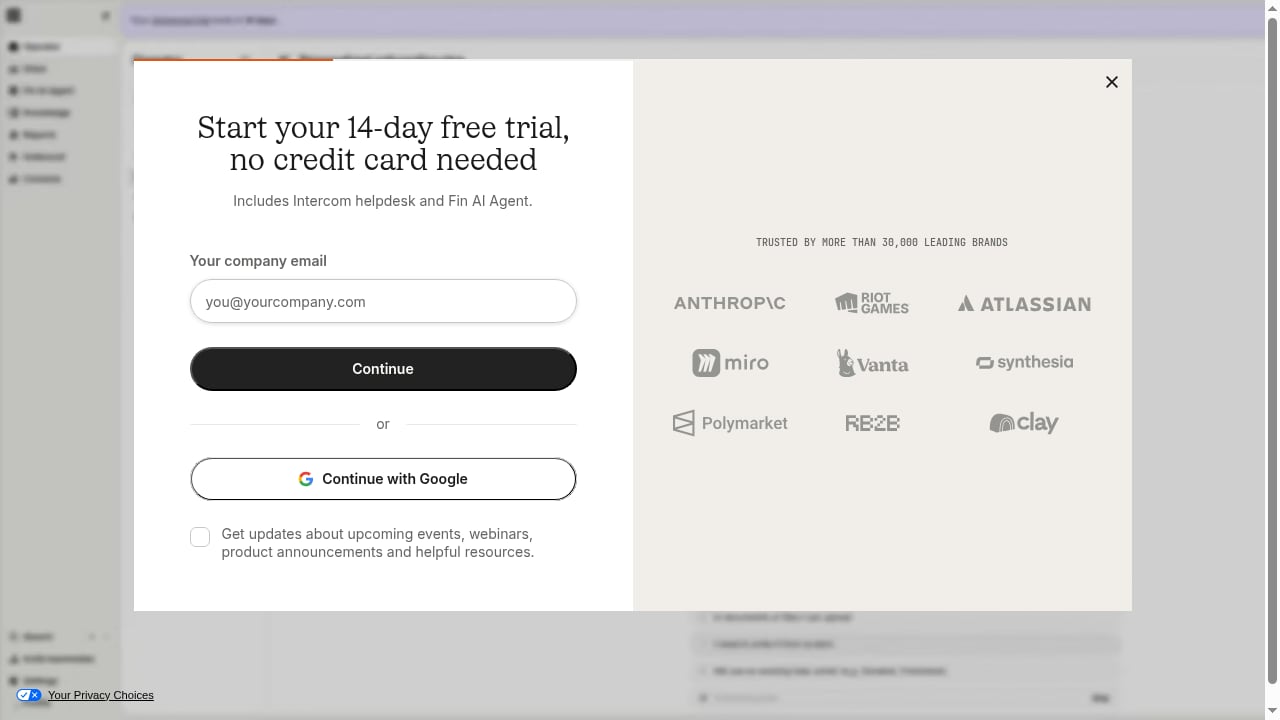
First viewport screenshot of Sign Up | Intercom.
Traditional helpdesks charge per agent, per month, with limited or no AI resolution capability. You pay for seats whether or not those seats are busy. AI-first platforms like Intercom shift part of the cost to outcomes.
| Model | Primary Cost Driver | AI Included? |
|---|---|---|
| Traditional helpdesk | Seats | Limited or add-on |
| Intercom | Seats + AI resolutions | Native Fin AI Agent |
The key difference is that Intercom's AI is not a bolt-on. Fin is built into the helpdesk, so there is no separate AI vendor to manage or integrate. This can simplify both your tech stack and your billing.
When Intercom Pricing Makes Sense
Intercom tends to be a strong fit when:
- You handle a high volume of repetitive or routine inquiries.
- You want to reduce cost per resolution without cutting service quality.
- You need multilingual support without hiring multilingual staff.
- You want AI and human agents working from the same system.
It may be less ideal if your support volume is very low or if most conversations require deep, specialized human expertise that AI cannot yet handle.
For a broader comparison of enterprise options, see Intercom vs Ada vs Talkdesk: Enterprise CX AI Comparison.
How to Control Intercom Costs
- Improve your knowledge base. Better content means higher Fin resolution rates and fewer escalations.
- Use Fin Procedures. Structured workflows guide the AI through complex but repeatable tasks.
- Monitor resolution metrics. Track which conversations Fin resolves and which it escalates. Fix the gaps.
- Right-size your seats. As AI resolution rates rise, you may need fewer human seats.
- Review channels. Disconnect channels that add volume without adding value.
Related reading
- Intercom vs Gladly: AI Helpdesk or Agentic Commerce? - Intercom vs Gladly compared: native Fin AI agent and helpdesk versus Gladly's agentic commerce platform for premium retail brands. Pricing, fit, and limits.
Sources and further reading
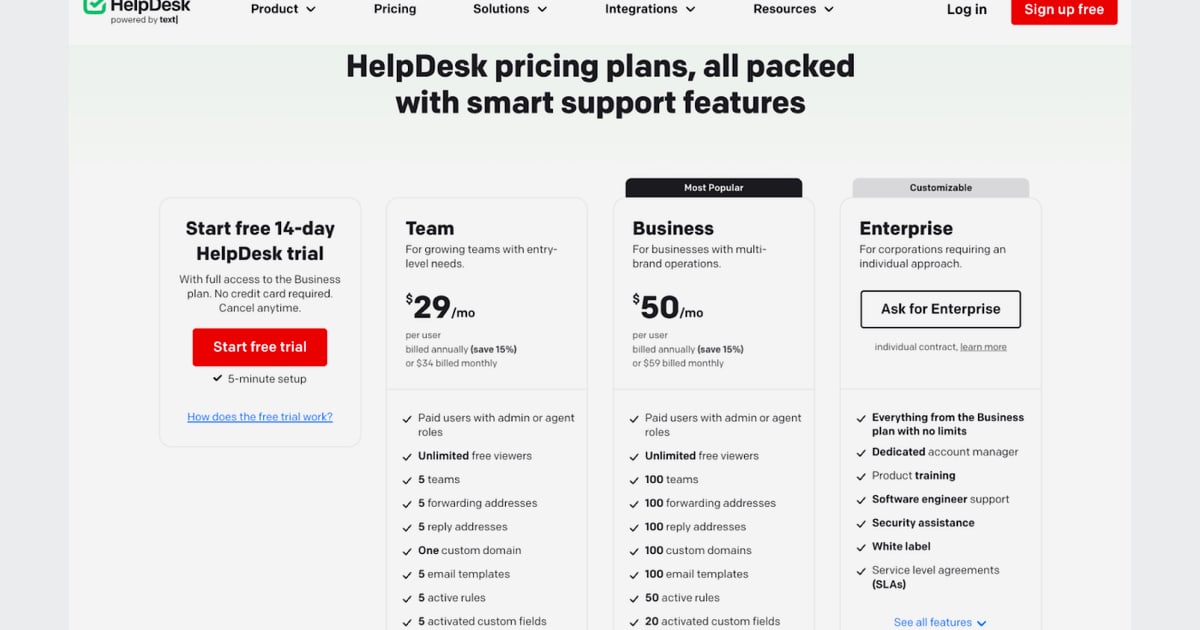
- Help Desk Pricing: From $19/User/Mo, Free 14-Day Trial, AI Included - Three plans, one AI-powered support platform. HelpDesk starts at $19/mo and includes AI Agents, ticketing, and multichannel inbox. No hidden fees. Free 14-day trial.
- Help Desk Pricing: Plans From $14/Agent/Month - Mojo Helpdesk - Help desk pricing from $14 per agent each month. Ticketing, knowledge base, SLAs, automation, and Felix AI are included. Free 21-day trial.
- IT Help Desk Service Pricing: What You Need to Know Before You Buy | E-Pulse Blog - Get insights into IT Help Desk pricing, compare features, and find the best service option before making your purchase.
FAQ
How much does Intercom cost per month?
Intercom pricing depends on your number of seats and AI resolution volume. There is no single flat rate. Use the pricing calculator or contact sales for a quote based on your specific usage.
Is Fin AI Agent included in Intercom plans?
Fin is natively integrated into Intercom. AI resolution pricing is separate from seat pricing, so you pay for the resolutions Fin completes.
What is an AI resolution?
An AI resolution is a customer conversation that Fin handles from start to finish without a human agent. You are charged per resolution, not per attempt.
Can I try Intercom before paying?
Yes. Intercom offers a 14-day free trial with no credit card required.
How does Intercom pricing compare to hiring more agents?
In most high-volume scenarios, AI resolutions cost significantly less per conversation than human-handled tickets. The savings grow as your AI resolution rate improves.
Does Intercom offer discounts for annual billing?
Billing terms and discounts vary. Confirm current options with Intercom sales or your account manager.
Conclusion
Intercom pricing reflects the reality of AI-first customer service: you pay for seats and for AI resolutions. The more conversations Fin resolves on its own, the lower your cost per resolution becomes. To get the most value, focus on knowledge base quality, Fin Procedures, and resolution metrics. Start with the free trial, model your costs with the pricing calculator, and scale from there.
For teams evaluating the full landscape, Top 10 Ecommerce Customer Experience Platforms 2026 offers a broader view of how Intercom fits alongside other platforms.